
Getting rid of old company cell phones isn't as simple as hitting "factory reset" and tossing them in a box. The right way involves secure data erasure, a fully documented chain-of-custody, and environmentally compliant recycling. For any organization, this process is now a critical function that protects sensitive data, keeps you on the right side of the law, and prevents old assets from turning into major liabilities.
Why Smart Phone Disposal Is a Critical Business Strategy
That box of old company smartphones stashed in a storage closet might seem harmless, but it's a ticking time bomb. Each of those devices is a treasure trove of sensitive corporate information—from employee emails and client contacts to financial data and internal documents. Improperly disposing of old cell phones has graduated from a simple IT cleanup task to a core business function with serious financial, legal, and reputational fallout.
Without a formal disposal process, you're leaving the door wide open for a costly data breach. It only takes one device falling into the wrong hands to compromise your entire network. And it's not just about the immediate security threat; regulatory bodies are cracking down with strict rules around data privacy and e-waste.
The Scale of the E-Waste Problem
The sheer volume of discarded electronics has hit a tipping point. Globally, a staggering 5.3 billion mobile phones are expected to become e-waste every single year. This mountain of obsolete tech creates massive environmental headaches because of the hazardous materials inside. If you want to visualize the scale, just imagine stacking them—they'd reach 120 times higher than the International Space Station.
This is exactly why a documented, professional strategy isn't just a nice-to-have; it's non-negotiable for modern businesses. A proactive approach doesn't just sidestep risks, it can actually unlock hidden value.
A well-managed IT asset disposition (ITAD) program transforms a potential liability into a secure, compliant, and sometimes profitable process. It’s about protecting your data first, then responsibly recovering value from the hardware itself.
From Liability to Asset
Thinking of old phones as worthless junk is a big mistake. Many devices, even a few generations old, hold significant resale value. Even the non-working ones are packed with precious metals like gold, silver, and copper that recyclers can recover. A smart disposal plan allows your organization to:
- Protect Sensitive Corporate Data: Guarantee total data sanitization to stop breaches before they happen.
- Maintain Regulatory Compliance: Stay compliant with standards like GDPR and HIPAA and dodge those hefty fines.
- Uphold Your Reputation: Show your customers and partners you're serious about environmental responsibility and data security.
- Recover Financial Value: Turn those depreciated assets into a new revenue stream through resale or materials recycling.
Bottom line: mastering the process of disposing of old cell phones is an essential piece of modern risk management and corporate responsibility.
Securing Your Data Before Any Device Leaves
Before a single phone is recycled, resold, or even moved to a storage closet, its data must be gone for good. A simple factory reset might feel like enough for personal use, but it's dangerously inadequate for a business handling sensitive corporate, employee, and customer information.
The process of disposing of old cell phones starts long before the physical device leaves your office—it begins with rock-solid data security.
First things first: you need a complete and verified backup of any essential information. This is non-negotiable for business continuity and prevents the accidental loss of critical files. Once you've safely secured the data you need to keep, the focus must shift entirely to the permanent, irreversible erasure of everything left on the device.
The consequences of dropping the ball here can be catastrophic.
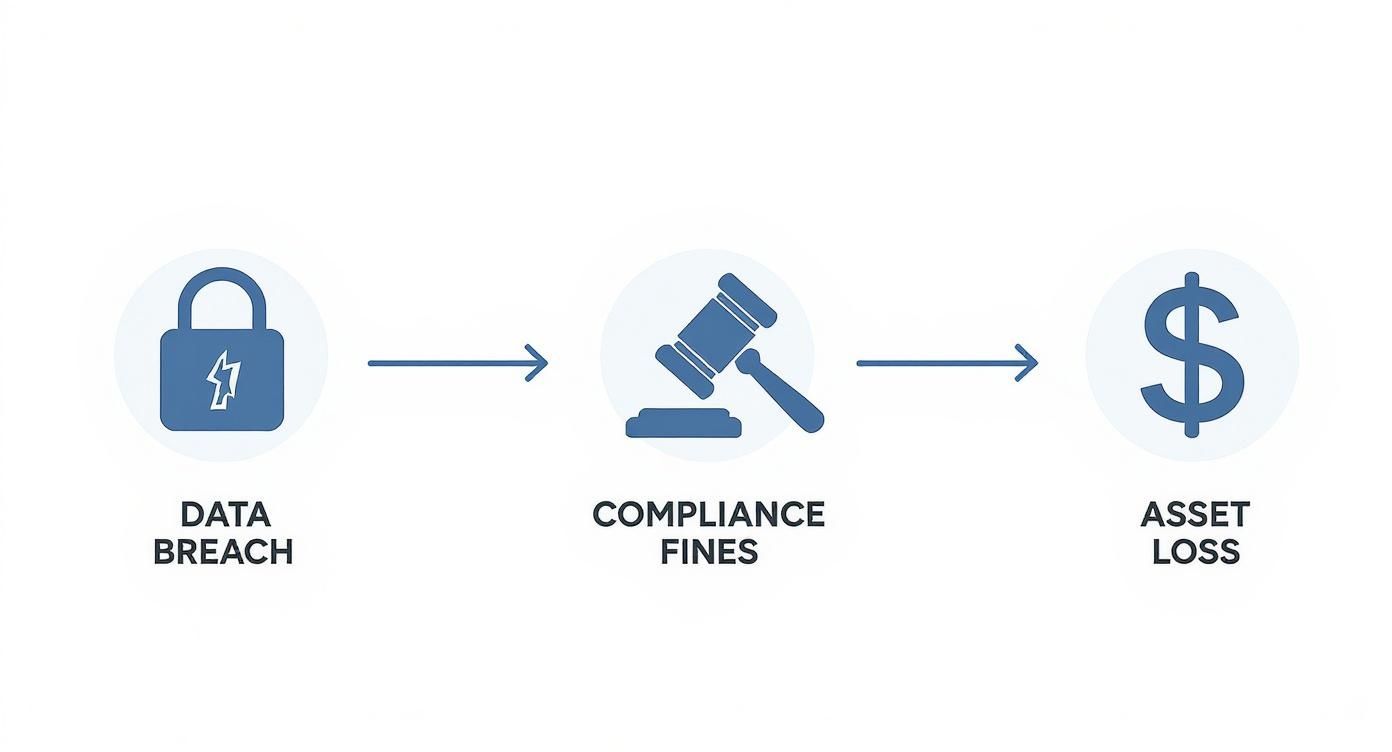
A single data breach can easily spiral into crippling compliance fines, leading directly to financial and asset loss. It’s a chain reaction you want no part of.
Moving Beyond the Factory Reset
That standard "Erase All Content and Settings" option? It's built for consumer convenience, not corporate security. The scary truth is that data recovery software can often pull information right off a device that's only been factory reset.
This happens because the reset typically just removes the pointers to the data, not the data itself. The information is left vulnerable, waiting to be overwritten—or recovered by someone with bad intentions.
For real security, businesses must use certified data erasure methods. This means using specialized software to overwrite the device's storage multiple times with random data, making the original information completely and utterly unrecoverable. This is the only way to be sure.
Documenting Every Single Erasure
A paper trail isn't just good practice; it's your defense. For every single device, you have to document the entire data destruction process. This record is your proof of due diligence and becomes invaluable if you're ever staring down a security audit.
Your documentation needs to be thorough. Make sure it includes:
- Device Identifiers: The serial number, asset tag, and model of the phone.
- Erasure Method: The specific software and standard used (e.g., NIST 800-88).
- Verification: The exact date and time the erasure was completed and verified.
- Personnel: The name of the technician who performed the erasure.
This level of detail is the cornerstone of any sound IT asset disposition program. If you want to dive deeper into the technical side, you can learn more about what data sanitization is and why it's so vital.
Ultimately, a huge part of preventing data breaches from old phones comes down to strong employee information security awareness. When your team understands the risks involved with data handling and device disposal, they become your most effective first line of defense.
Tracking Every Device from Desk to Disposition
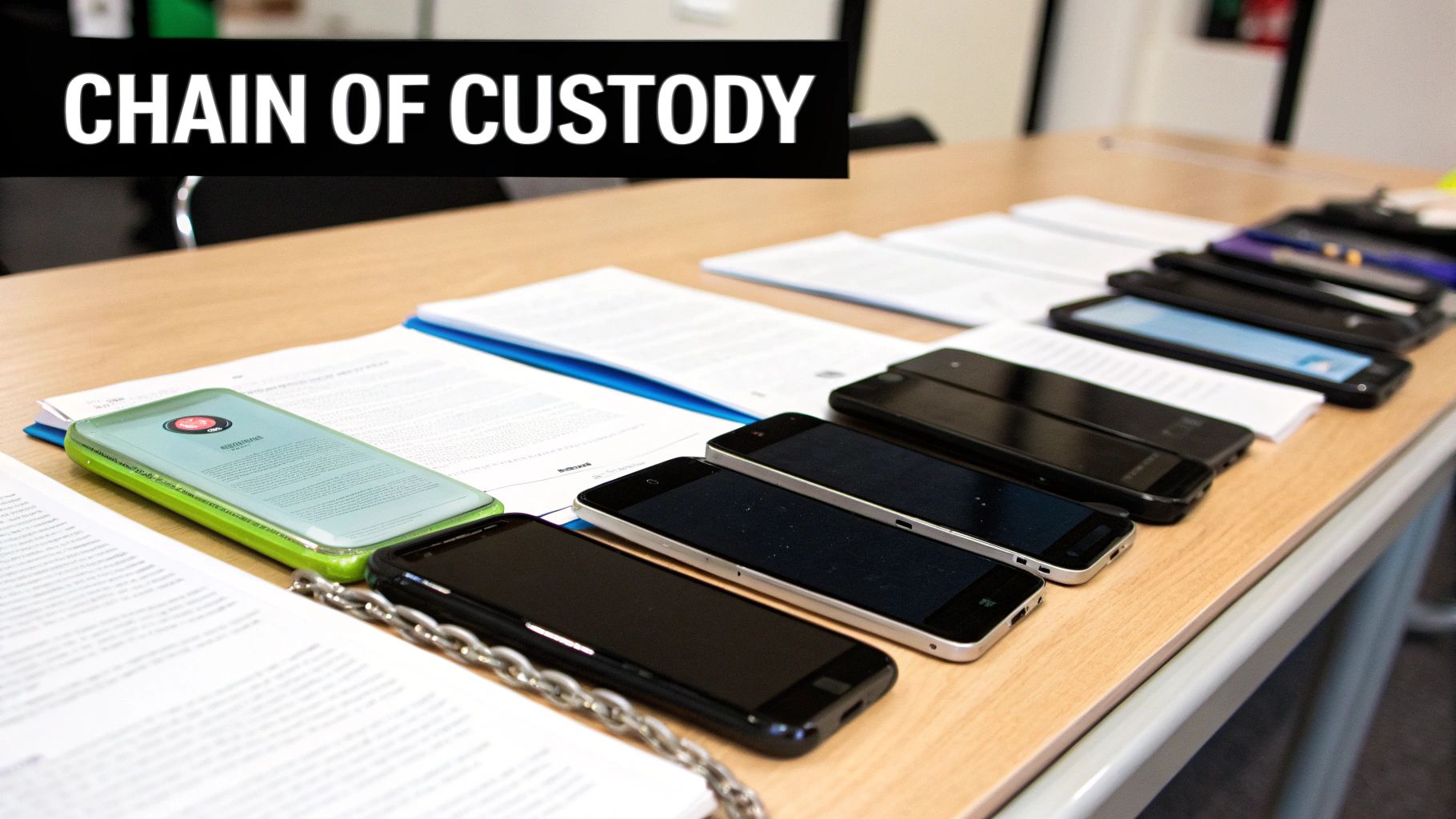
Once your phones have been scrubbed clean of all sensitive data, the next critical step is all about physical control. You can’t just toss them in a box and hope for the best. A single misplaced phone, even a wiped one, can cause major headaches during an audit and raise all sorts of uncomfortable questions. This is where a rock-solid inventory and chain of custody process becomes your best friend.
The whole point is to create a clear, unbroken paper trail for every single device, starting from the moment it's taken out of service until it's officially gone for good. Think of it as the final chapter in the device's life story with your company. This detailed record is your proof against loss or theft, and it shows you handled every asset responsibly. For a bigger-picture view, this all fits into the broader discipline of IT asset management.
Building Your Chain of Custody Log
Look, creating this log doesn't need to be complicated. You don't need fancy software. A simple spreadsheet usually does the trick perfectly. What matters to auditors and stakeholders isn't the complexity of your tool—it's the consistency of your tracking. This documentation is your ultimate proof of due diligence.
A well-organized log tells a clear, transparent story for every phone you’re getting rid of. Here's a sample you can adapt for your own process.
Sample Device Chain of Custody Log
This table is a straightforward template for tracking your corporate mobile devices as they move through the disposal process. Using a log like this helps ensure complete accountability and keeps your organization compliant.
| Asset Tag ID | Device Model | Serial Number | Data Wipe Confirmation (Date/Method) | Collected By (Employee) | Final Disposition (Recycled/Resold/Destroyed) | Certificate of Destruction ID |
|---|---|---|---|---|---|---|
| CORP-4512 | iPhone 12 Pro | F17F9XYZ1234 | 2024-10-26 / NIST 800-88 | Jane Doe | Recycled by Montclair Crew | MC-DESTRUCT-5678 |
| CORP-4513 | Galaxy S21 | R5CN4ABC5678 | 2024-10-26 / NIST 800-88 | Jane Doe | Resold by Montclair Crew | MC-RESALE-9101 |
| CORP-4514 | Pixel 6 | 1A987ZYX6543 | 2024-10-27 / DoD 5220.22-M | John Smith | Recycled by Montclair Crew | MC-DESTRUCT-5679 |
This level of detail makes sure that no device can just vanish into thin air. It becomes your single source of truth for your entire mobile asset disposal project.
This meticulous record-keeping is a key pillar in the wider strategy of managing your company's technology assets. If you're looking to build out a more comprehensive program, digging into https://www.montclaircrew.com/it-asset-management-best-practices/ can give you a complete framework for handling the entire lifecycle of your devices, connecting the dots from purchase all the way to secure, final disposal.
Choosing the Right Disposal Path for Your Business
Okay, your devices are wiped clean and you have a detailed inventory list. Now comes the big decision: what's the final destination for all this old hardware? This isn't just about clearing out a storage closet. It’s a strategic choice that juggles security, your company's environmental commitments, and potential financial returns.
For any business, just dropping old phones off at the local electronics bin is a non-starter. You absolutely need a partner who can give you official certifications for both data destruction and responsible handling. Anything less is a risk.
Evaluating Your Primary Options
When it comes to corporate e-waste, you generally have three main avenues. You can partner with a certified e-waste recycler, see what manufacturer take-back programs offer, or bring in a full-service IT Asset Disposition (ITAD) partner.
- Certified E-Waste Recyclers: These are the specialists in breaking down electronics in an environmentally sound way. You'll want to look for partners holding either R2 (Responsible Recycling) or e-Stewards certifications. These aren't just fancy badges; they guarantee the recycler meets the highest standards for data security, environmental safety, and worker health.
- Manufacturer Buyback Programs: Big names like Apple and Samsung have their own trade-in or recycling programs. They can be convenient if you only have a few newer devices, but they often pay less and might not provide the detailed, audit-ready documentation your business needs to prove compliance.
- IT Asset Disposition (ITAD) Partners: This is your all-in-one solution. An ITAD provider handles everything—secure pickup, data erasure, testing, refurbishing, and reselling the devices. For maximizing your financial return while ensuring you've checked every compliance box, this is usually the best way to go.
The right partner won’t just take your old phones; they will provide a certificate of destruction for every single device. This document is your official proof that you have met your legal and ethical obligations for data privacy.
Uncovering the Hidden Value in Old Phones
Too many businesses see old phones as a disposal expense. That's a mistake. They're actually a potential revenue stream hiding in plain sight.
The components inside are packed with valuable precious metals. The economic potential here is massive—recycling just 1 million phones can recover thousands of pounds of copper and hundreds of pounds of silver and gold. It's an opportunity many organizations miss, but the global mobile phone recycling market is projected to hit $9.8 billion by 2032. You can find more fascinating stats on the value of e-waste recycling on bankmycell.com.
Beyond just the raw materials, a good portion of your retired phones probably still have significant resale value. An ITAD partner is an expert at finding that value. They test, grade, and refurbish devices to get the highest price on the secondary market, often sharing a piece of the profit back with you.
This completely changes the game. Instead of paying to get rid of old assets, you're opening up a new income stream that can help pay for your next tech upgrade. To see how this plays out in the real world, check out our business guide on how mobile phone recycling works. Shifting your perspective from "cost center" to "revenue opportunity" is the key to a smart, modern ITAD strategy.
Partnering with a Local Atlanta Disposal Expert

Sure, national mail-in programs are an option, but for businesses here in the Metro Atlanta area, there are huge upsides to working with a local expert. For any organization from Alpharetta to Marietta, a local partner brings a level of convenience, speed, and accountability that's tough to get from a company halfway across the country.
When you work with a local team, you get real, personalized service from people who actually know the regional business landscape. If you have a question or need to schedule a last-minute pickup, you’re not navigating a massive call center; you're talking directly to the crew that will be handling your equipment. That local connection makes all the difference in logistics and building genuine trust.
The Montclair Crew Advantage for Atlanta Businesses
For local organizations that need to get rid of old cell phones the right way, Montclair Crew offers a complete, specialized solution right in your backyard. We handle the entire process, making sure your old tech is disposed of securely, compliantly, and responsibly. Our services are specifically built around the needs of Atlanta-area businesses.
We've zeroed in on a few key areas to give you total peace of mind:
- Secure On-Site Pickup: Our team comes straight to your office, whether you're in Sandy Springs or Kennesaw. This approach immediately eliminates the risk of devices getting lost or stolen in transit and keeps your chain of custody solid from the second the phones leave your building.
- Certified Data Destruction: We perform certified data erasure that meets the strict DoD 5220.22-M standard. For every single device, you get a certificate of destruction—the hard proof you need for compliance checks and internal audits.
- Responsible Recycling: We're serious about our environmental commitment. Every component of the phones we handle is recycled the right way. We make sure hazardous materials are properly managed and valuable resources are recovered, keeping toxic e-waste out of our landfills.
Partnering with a local, certified expert like Montclair Crew isn't just about convenience. It’s about adding a critical layer of physical security and direct accountability to your IT asset disposition process. You know exactly who has your sensitive equipment and precisely where it’s headed.
More Than Just Disposal
Choosing a local expert is also a direct investment in our local economy. It keeps business right here in our community and gives you a partner who is always accessible and ready to respond. A local team can build custom solutions that a one-size-fits-all national program just can't offer.
From secure logistics and certified data wiping to recovering value from reusable devices, a local ITAD partner combines all the best practices into one smooth service. To see exactly how we manage this for Atlanta businesses, take a look at our professional IT asset removal services.
Answering Your Top Phone Disposal Questions
Even with a solid plan in place, questions always pop up when it's time to retire old company phones. Getting straight answers is the only way to handle the tangled mess of data security, environmental rules, and asset recovery with confidence. Let's dig into some of the most common things we hear from businesses just like yours.
Is a Factory Reset Enough to Wipe Our Company Phones?
Let me be blunt: absolutely not. A factory reset is for consumer convenience, not corporate data security. It's like tearing the table of contents out of a book—the pages are still there for anyone determined enough to find them.
Modern phones use strong encryption, but a simple reset can still leave data fragments behind. For business devices packed with customer lists, financial data, or internal communications, that's a risk you just can't take.
You need to use a certified data erasure solution. This isn't just an app; it's specialized software that overwrites every bit of the phone's storage according to government and industry standards, like NIST 800-88. This process makes the original data completely unrecoverable and, just as importantly, gives you a certificate of destruction. That certificate is your proof of compliance.
What Do R2 and e-Stewards Certifications Mean?
Think of R2 (Responsible Recycling) and e-Stewards as the gold standard for anyone handling e-waste. When a disposal partner has these certifications, it’s your guarantee that they're following incredibly strict rules for every step of the process.
These standards are comprehensive, covering things like:
- Data Security: A promise that all data is completely and verifiably destroyed.
- Environmental Safety: Preventing toxic materials from poisoning landfills and groundwater.
- Worker Health: Making sure employees are protected from exposure to hazardous components.
Choosing a certified vendor means your old phones won't be illegally shipped overseas or dumped in a landfill, protecting your company's reputation and our shared environment.
Can We Actually Make Money from Our Old Phones?
Yes, and you'd be surprised how much value is often sitting in that storage closet. Corporate smartphones, even models that are a few years old, frequently hold significant resale value.
A full-service IT Asset Disposition (ITAD) partner like Montclair Crew takes care of everything. We securely wipe the data, test the hardware, refurbish the devices, and resell them on the secondary market for you.
This process often covers the cost of disposal entirely and can even generate a nice return back to your company. It turns a potential liability into a revenue stream.
What about devices with no resale value? That's when the conversation can shift to doing some good. Donating old phones to reputable charities provides a critical lifeline to people in need. You can learn more about where to donate an old cell phone and make a real impact in the community.
What Should We Do with Broken or Non-Working Phones?
Even a phone with a shattered screen or one that won't turn on is still a security risk. The internal storage chip might hold recoverable data, and the device itself is packed with valuable materials that need to be recycled properly.
Never, ever just toss them in the trash. A certified e-waste recycler will physically destroy the storage media to guarantee data is gone for good. Then, they'll responsibly recover the precious metals and other materials inside. It's the only way to ensure total security and environmental compliance, no matter what condition the phone is in.
