
When you retire your company's IT equipment—think old servers, laptops, and hard drives—you're sitting on a potential goldmine of sensitive data. For any business in Tucker, just hitting "delete" on old files is a huge gamble. It's shockingly easy to recover information from discarded devices, leaving a digital breadcrumb trail right back to your company.
This is why professional data destruction in Tucker isn't just a final step in an asset's life; it's a critical security measure. Getting this right protects you from serious financial and reputational damage.
Why Data Destruction Is a Non-Negotiable Business Priority
Picture your company's old hard drives as unlocked vaults. Even after you've moved on to newer, faster technology, these devices are still packed with valuable assets: client lists, proprietary trade secrets, and employee financial records. Failing to properly secure this information before disposal opens up a massive vulnerability.
A single discarded drive can be the gateway for a devastating data breach. The cost isn't just about fines or legal fees; it's about the erosion of customer trust that you've spent years building. In today's climate, proving you're serious about data privacy is a must to keep your clients loyal and stay ahead of the competition.
Beyond the Delete Key
A lot of people think that reformatting a drive or dragging files to the trash bin is enough. That's a dangerous misconception.
Think of it like trying to erase a book by ripping out the table of contents. All the pages are still there, they're just a little harder to find. Standard deletion simply removes the pointers that tell the computer where the data is. The actual information remains intact, easily accessible with basic, often free, recovery software.
Certified data destruction is the only way to guarantee that information is gone for good, permanently and irretrievably. The process uses methods that render the data completely unreadable, closing the security gap left by your retired IT assets.
The Real-World Consequences
For any Tucker business, the risks of cutting corners on data disposal are real and severe. A breach that traces back to a carelessly discarded device can set off a chain reaction of negative consequences that disrupt your entire operation and threaten your bottom line.
Here are the key risks you face:
- Financial Penalties: If you're in a regulated industry, non-compliance with laws like HIPAA or FACTA can lead to eye-watering fines.
- Legal Action: Customers or employees whose data gets compromised have every right to take legal action against your company.
- Loss of Reputation: News of a data breach can permanently tarnish your brand and send customers running straight to your competitors.
- Competitive Disadvantage: Imagine your strategic plans or client data falling into a rival's hands. It could give them an unfair—and crippling—advantage.
The reality is that your legal and ethical duty to protect data doesn't stop when you unplug a device. That responsibility continues until the data is verifiably destroyed. This makes professional disposal a fundamental part of any sound risk management strategy.
Ultimately, secure disposal is a proactive investment in your company's security and future. You can learn more about what happens to recycled electronics and how responsible partners manage the entire process to give you total peace of mind.
Understanding Your Data Destruction Methods
Once you see the risks of letting old IT gear pile up, the next step is getting a handle on how professional data destruction actually works. For any business here in Tucker, picking the right method comes down to a simple balance of your security needs, budget, and any compliance rules you have to follow. There are really three main ways the pros make data completely unrecoverable for good.
Think of them like different tools in a toolbox. You wouldn't use a hammer to drive a screw, right? Same idea here. Data wiping is perfect for one job, but if your company policy demands total physical destruction, you need a different tool. Knowing what each one does helps you pick the perfect one for your situation.
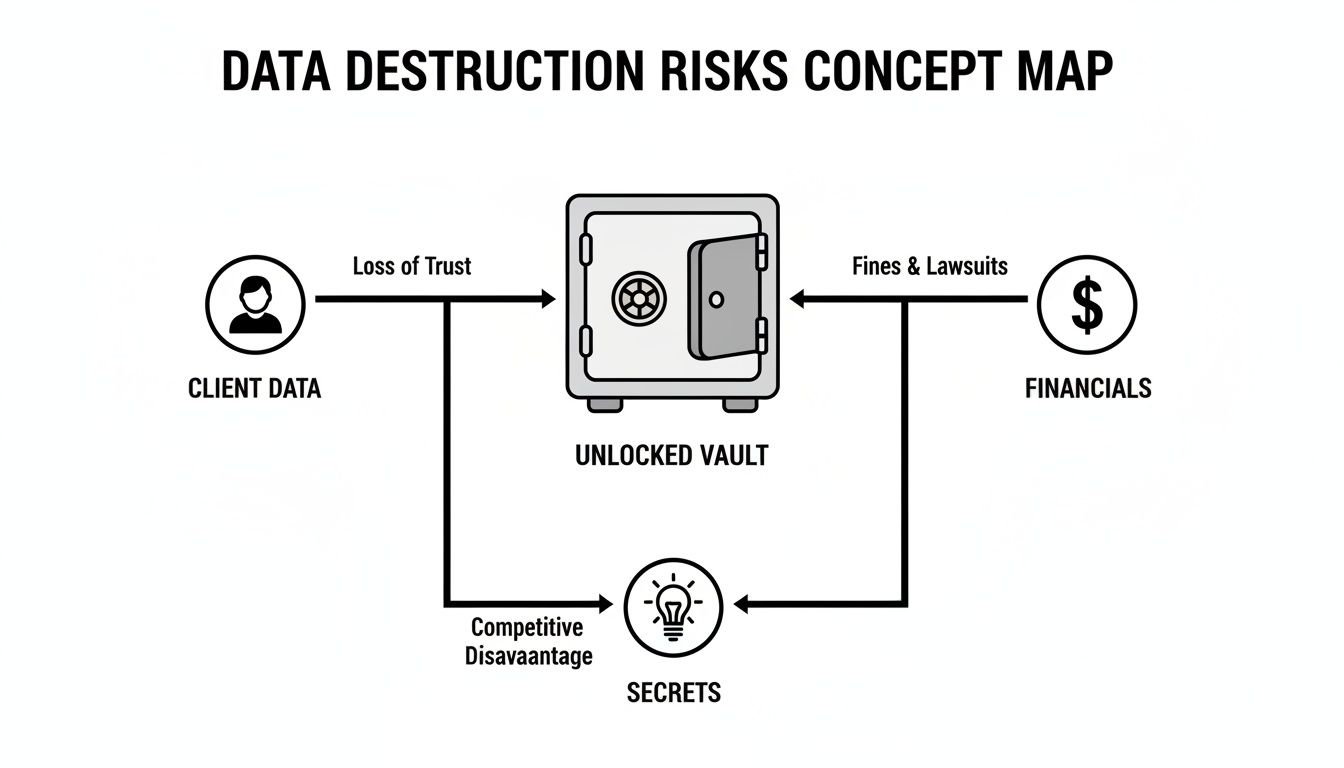
This image really drives the point home: an old hard drive is like an unlocked safe. It's full of your client data, financial records, and company secrets—all things that need serious protection.
Data Wiping: Erasing The Digital Slate Clean
Data wiping, sometimes called data erasure, is the high-tech approach. It uses special software to write over every single part of a hard drive with random junk data—think endless streams of zeros and ones—again and again. This isn't like hitting "delete," which just hides the file. Wiping methodically buries the original data until there’s absolutely no way to bring it back.
Picture a whiteboard covered in sensitive notes. Instead of just wiping it clean, imagine scribbling random letters over every single inch, then doing it two more times. Those original notes are gone for good, and the board is perfectly clean and ready to be used again.
This method is the go-to for businesses that want to resell, donate, or reuse their IT assets. Because the hardware isn't damaged, you can get some value back from your old equipment without ever risking a data breach. Any certified data destruction Tucker provider will use software that meets tough standards like DoD 5220.22-M.
Degaussing: Scrambling Data With Magnetic Force
Degaussing is a powerful and very specific technique that works on magnetic storage, like your classic spinning hard disk drives (HDDs) and old backup tapes. A degausser machine creates an incredibly strong magnetic field that instantly scrambles the magnetic coating on the drive's platters where all your data lives.
It's like taking a giant magnet to a cassette tape. The magnetic force would instantly turn the music into a garbled mess. Degaussing does the same thing to the organized data on a hard drive, turning it into useless noise and destroying the information forever. A degaussed hard drive is completely fried and has to be recycled.
Physical Shredding: The Most Direct Approach
Physical destruction is exactly what you're imagining. We're talking industrial-grade machines that literally grind hard drives, solid-state drives (SSDs), and other media into a pile of tiny, mangled pieces. Professional shredders make sure nothing is left but fragments.
This is the ultimate proof that your data is gone—you can see it with your own eyes. It's a simple and brutally effective process, especially for drives that are already broken or for companies with zero-tolerance security policies. If you want to see the nitty-gritty, you can learn more about the best ways to destroy a hard drive in our detailed guide.
Comparing Data Destruction Methods
To make it easier for Tucker businesses to choose, here's a quick rundown of the methods side-by-side.
| Method | How It Works | Best For | Key Benefit |
|---|---|---|---|
| Data Wiping | Software overwrites the drive with random data multiple times. | Reusing, reselling, or donating functional hardware. | Preserves the hardware's value and usability. |
| Degaussing | A powerful magnetic field scrambles data on magnetic media (HDDs, tapes). | Old or failing magnetic hard drives that need fast, secure disposal. | Extremely fast and effective for destroying data on magnetic media. |
| Shredding | An industrial machine physically grinds the device into small pieces. | Damaged drives, SSDs, or when absolute physical proof of destruction is required. | Provides undeniable, visible confirmation that the data is destroyed. |
Each method has its place. Your choice really depends on what you plan to do with the old equipment and what level of security your company requires.
Staying Compliant with Data Privacy Laws
For businesses here in Tucker, especially if you're in healthcare, finance, or law, getting rid of old data isn't just a good idea—it's the law. The maze of data privacy regulations can feel like a headache, but the basic idea is simple. These rules are all about protecting people, and slipping up can cost you big time.
The whole point is to make sure sensitive personal information is handled with care from the moment it's created to the day it's permanently destroyed. A stack of old hard drives full of client records or patient charts tossed in a dumpster? That’s a serious breach of trust and a direct violation of the law. This is exactly why bringing in a professional data destruction Tucker service is such a critical step for staying compliant.
Key Regulations Tucker Businesses Must Know
Several major federal laws require secure data disposal. The ones that apply to you really just depend on your industry. This isn't every single rule on the books, but these are the big ones that demand certified data destruction.
- HIPAA (Health Insurance Portability and Accountability Act): If you handle patient health information, this is the big one. HIPAA is non-negotiable. It mandates that any protected health information (PHI) must be made completely unreadable, indecipherable, and impossible to piece back together before you get rid of old IT gear.
- FACTA (Fair and Accurate Credit Transactions Act): Does your business use consumer reports for things like credit checks, insurance, or hiring? Then FACTA’s Disposal Rule is for you. It requires you to take "reasonable measures" to destroy consumer info so no one can get their hands on it.
- GLBA (Gramm-Leach-Bliley Act): This one’s for the financial world—banks, investment advisors, you name it. GLBA requires you to safeguard the security and privacy of nonpublic personal information (NPI) and make sure it’s securely disposed of when the time comes.
Getting a handle on these rules is crucial, and it's worth exploring the benefits of meeting security compliance for your company's health.
The Gold Standard for Data Destruction
So, how do you actually prove you're doing everything by the book? You look for vendors who live and breathe industry standards and hold the right certifications. Think of these as a seal of approval that confirms a provider follows strict, audited security processes.
One of the most important benchmarks is NIST 800-88, a set of detailed guidelines from the National Institute of Standards and Technology for media sanitization. On top of that, a NAID AAA Certification is the top credential in the data destruction world. It means a company is subject to tough, unannounced audits covering everything from their security and hiring practices to the destruction process itself. Working with a NAID AAA certified partner shows you’ve done your homework.
In the shadowy world of cybercrime, data destruction failures have fueled an unprecedented economic catastrophe, with global cybercrime costs exploding from $3 trillion in 2015 to a staggering $10.5 trillion annually by 2025. This massive figure marks the greatest wealth transfer in history, and a single breach from unsecurely disposed gear can lead to reputational ruin.
At the end of the day, compliance is about more than just avoiding fines. It's about building a secure foundation that protects your clients, your reputation, and your business. Proper data destruction is a cornerstone of that foundation. For more on managing data over time, check out our guide on record retention guidelines for businesses.
On-Site vs Off-Site Destruction: What to Choose
One of the biggest calls you'll have to make is where the destruction happens. This decision—choosing between on-site and off-site service—directly shapes your security, convenience, and cost. Each route has its perks, and what's right for your Tucker business really boils down to your specific needs and how much risk you're willing to take.
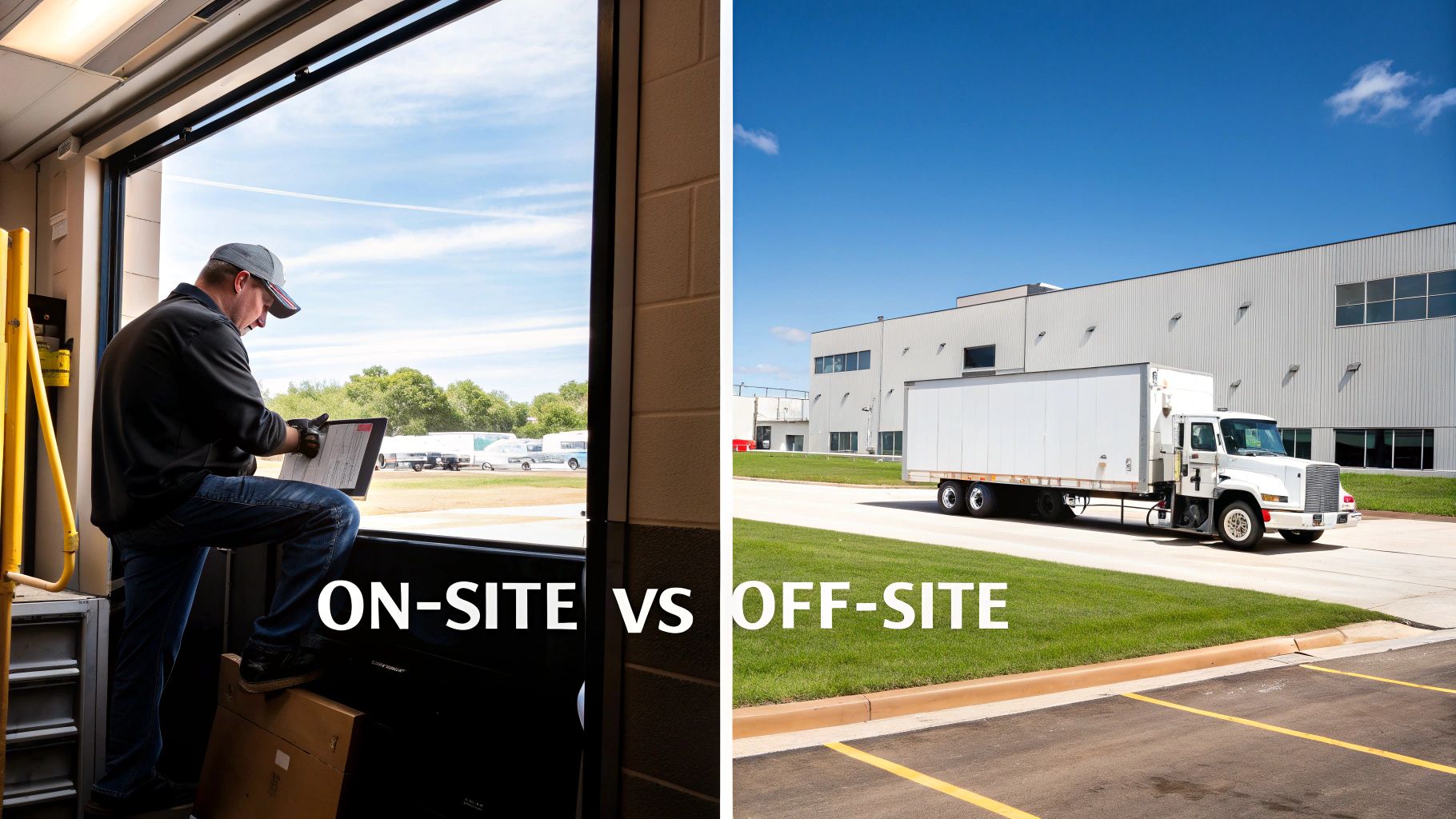
Let's break it down with a simple analogy. Think of on-site destruction like having a notary public come directly to your office. You watch them witness the signature, stamp the document, and hand it back. It’s all done right there, giving you complete peace of mind.
On the other hand, off-site destruction is more like using a secure, armored truck to move valuables to a bank vault. It’s incredibly secure and efficient, especially when you’re dealing with a large volume of assets.
The Case for On-Site Destruction
This is exactly what it sounds like. On-site, or mobile, destruction means we bring the shredding gear right to your doorstep in Tucker. A specialized truck pulls up, and we destroy your hard drives, SSDs, or tapes right there in your parking lot.
The biggest draw here is maximum transparency and security. You get to physically watch the entire process, which completely erases any worries about the chain-of-custody once things get rolling. This is hands-down the preferred method for organizations that can't afford any guesswork:
- Healthcare clinics managing sensitive patient records
- Law firms handling confidential client files
- Government contractors with strict security protocols
With on-site service, you get your Certificate of Destruction on the spot. The job is confirmed done before our truck even pulls away.
The Efficiency of Off-Site Destruction
Off-site destruction is all about secure logistics. A certified technician comes to your location, puts your assets into locked containers, and transports them in a GPS-tracked vehicle to a secure facility for destruction. You don't see the shredding happen, but the whole process is governed by a strict, documented chain of custody from start to finish.
This approach is often far more cost-effective and practical for big jobs. A professional team can process huge quantities of IT assets much faster at their dedicated plant. If your business is going through a massive office cleanout or decommissioning a data center, off-site services will save you serious time and money.
When you partner with a reputable, NAID AAA Certified provider, the process is just as secure as doing it on-site. Every single step is audited and verified. This model works great for businesses across the metro area; you can check out how we manage data destruction in Dunwoody to get a feel for our regional service.
The Importance of a Verifiable Chain of Custody
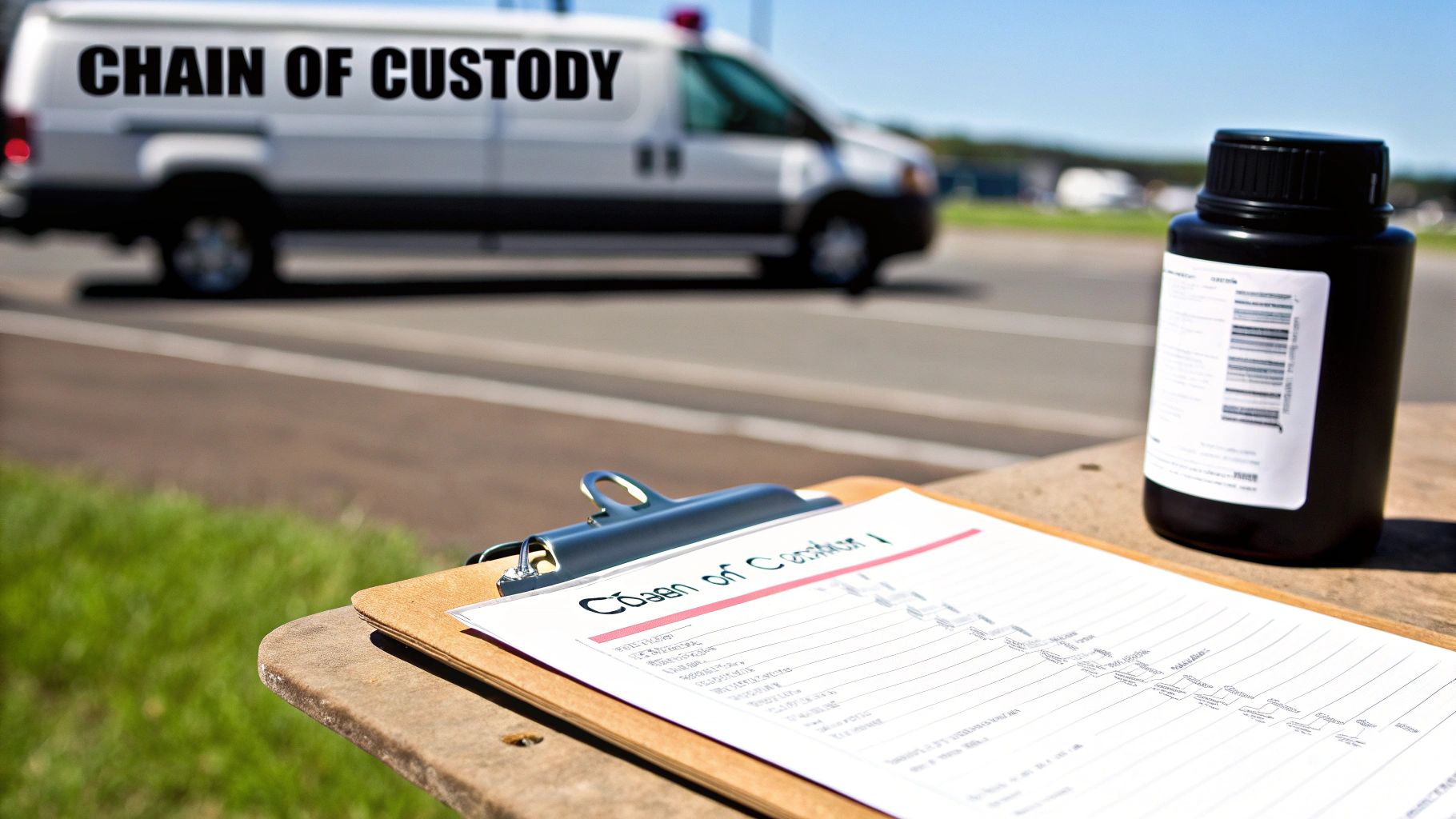
So, what actually happens to your sensitive hard drives the moment they leave your office? It’s a critical question, and the answer lies in a process called the chain of custody. Think of it as the documented, unbroken trail your IT assets follow from the second we pick them up to their final destruction.
This isn’t just a handshake agreement; it’s a rigorous, verifiable process. A strong chain of custody means every single step is logged and secured, leaving zero room for error or uncertainty. It gives you a complete history of who handled your assets, where they went, and exactly when they were destroyed.
For any business looking for data destruction in Tucker, this process is your ultimate proof of due diligence. It turns a potential liability into a documented, ironclad security procedure.
Key Elements of a Secure Process
A trustworthy chain of custody isn't just a single document. It’s a whole series of interlocking security measures, where each piece builds on the last to create an auditable and defensible record of what happened.
Here’s what that looks like in practice:
- Secure Collection: Our technicians arrive at your site, inventory every single asset, and immediately place them in locked, tamper-evident containers before they even leave your building.
- Serialized Asset Tracking: Each hard drive or device is given its own unique serial number. This barcode gets scanned and tracked at every touchpoint, from your office all the way to the destruction facility.
- GPS-Tracked Transport: The assets are then transported in a secure, GPS-tracked vehicle. We know where your equipment is in real-time until the moment it reaches its destination.
This level of security is becoming the standard. The global hard drive destruction market hit $1.65 billion and is projected to skyrocket to $5.05 billion by 2035. Why the massive jump? Rising security fears and strict new privacy regulations are pushing organizations to ditch risky self-handling for certified providers. This trend just goes to show how critical these verifiable processes have become.
The Final Proof: Your Certificate of Destruction
The entire chain of custody process culminates in one final, crucial document: the Certificate of Destruction. This is much more than a receipt. It's your official, legally recognized proof that you fulfilled your duty to protect sensitive data.
This certificate is your legal shield if you ever face an audit or a breach investigation. It confirms the specific assets destroyed, the exact method used, and the date the job was completed. You can learn more about the critical role of a Certificate of Destruction and why it provides such invaluable peace of mind.
How to Choose the Right Data Destruction Partner
Picking the right partner is the last, and most important, step in making sure your business's data stays secure. It's easy to just compare prices, but you have to look deeper. The goal is to find a provider for data destruction in Tucker who acts like a true security partner, not just a company that hauls away old gear.
The secure data destruction market is growing fast as businesses scramble to keep up with privacy laws. It’s currently valued at $3.72 billion and is expected to climb to $5.64 billion by 2029. For any business in Metro Atlanta, that growth is a huge sign that outsourcing certified destruction is no longer a "nice to have"—it's a must to avoid a costly breach. You can get a better sense of this trend from this market report.
With a bigger market comes more choices, which means you need to be careful about who you hire. A great partner does more than show up with a shredding truck; they give you solid proof, understand compliance inside and out, and let you sleep at night.
Key Questions to Ask Potential Vendors
You need to have the right questions ready to go. This helps you quickly tell the real experts from the rest. A professional, transparent company will have no problem giving you clear, direct answers to these.
Are You NAID AAA Certified? Honestly, this is the big one. It's the highest security certification in the industry and means the vendor has to pass tough, surprise audits. If they have this, it’s the best sign of their commitment to security.
Can You Walk Me Through Your Chain of Custody Process? They need to be able to explain every single step, from how they secure devices in locked bins and track every asset to how they monitor their trucks with GPS. If their answer is fuzzy, that's a huge red flag.
What Kind of Insurance Do You Have? They should have general liability, of course, but the critical one is downstream data liability insurance. This is what protects you if something goes wrong after the equipment leaves your hands.
How Do You Handle E-Waste and Recycling? A responsible partner won't just destroy the data; they'll also handle the leftover electronics properly. Look for certifications like R2 or e-Stewards. This ensures everything is recycled in an environmentally friendly way, which also helps your company meet its own green initiatives.
Picking a partner for data destruction in Tucker isn't just a vendor choice; it's a risk management decision. The right company gives you a secure, unbroken, and auditable process that protects your data, your reputation, and your customers from the second your old equipment is out the door.
Data Destruction Questions We Hear All The Time
Even after sorting out the logistics, you might have a few questions lingering. That’s perfectly normal. We’ve put together some straightforward answers to the questions we get most often from businesses right here in Tucker.
Can’t I Just Delete The Files From My Old Computers?
That’s a hard no. Simply hitting "delete" or even reformatting a hard drive leaves your business wide open. It’s surprisingly easy to recover files with free, publicly available software. We’re talking about sensitive stuff like payroll records, customer lists, and private employee information—all still sitting there for the taking.
Professional methods, whether it's physical shredding or specialized data wiping, are the only ways to guarantee your data is 100% gone for good. Think of it as non-negotiable insurance against data breaches, identity theft, and the legal headaches that come with them.
What Exactly Is a Certificate of Destruction?
A Certificate of Destruction is the official paper trail that proves you did everything right. Your data destruction partner provides this formal document, which serves as a legal, auditable record confirming your devices were destroyed securely and in line with all data privacy laws.
This certificate is your proof of due diligence. It will list the date, the methods used (like shredding or wiping), and an inventory of every single asset that was destroyed. It’s the key piece of evidence you’d need if you were ever audited.
What Happens to the Shredded Metal and Plastic Afterward?
A good IT disposal partner doesn't just destroy the data; they handle the leftover electronic waste responsibly. This is a critical part of modern data destruction in Tucker.
Once your hard drives and devices are shredded into a mix of metal, plastic, and circuit board fragments, they are securely transported to certified recycling facilities. There, the materials are carefully sorted and processed. This keeps hazardous materials out of landfills and puts valuable resources back into the supply chain, ticking both the security and sustainability boxes for your company.
Ready to make sure your retired IT assets are truly secure? The team at Montclair Crew Recycling provides certified, reliable data destruction services for businesses all over the Tucker area. Give us a call today to put together a disposal plan that protects your data and your reputation. Find out more at https://www.montclaircrew.com.
