
Got a storage closet packed with old company laptops? You’re not just looking at a pile of outdated hardware. You’re looking at a major business risk. For companies all over Georgia, from the tech hubs in Atlanta to office parks in the suburbs, figuring out what to do with retired IT assets is a huge headache. That's why professional corporate laptop recycling services in Georgia have become so important for staying secure and compliant.
Why Laptop Recycling Is a Critical Task for Georgia Businesses
That room full of old laptops isn't just clutter—it's a vault filled with ticking time bombs. Every single device could be a backdoor to your company's most private information.
Think of it like leaving an unlocked filing cabinet in the middle of a public park. Inside, you've got everything from financial records and customer lists to employee PII and your company’s next big strategy.
In today's world, data is money. Disposing of old tech the wrong way is no longer just a mistake; it's a direct threat to your reputation and your bottom line. Simply "wiping" a drive or, even worse, tossing a laptop in a dumpster is an open invitation for a data breach. Just one incident can bring on crippling fines, lawsuits, and a loss of customer trust that you might never get back.
It's About More Than Just Data Security
Your responsibility doesn't stop with just protecting digital files. Laptops and other electronics are considered e-waste for a reason. They're full of hazardous materials like lead, mercury, and cadmium.
When this stuff ends up in a landfill, those toxins can leak into Georgia’s soil and water, causing environmental damage for years to come. You have to be proactive about retiring old laptops—it's non-negotiable for any modern business.
This is where specialized corporate laptop recycling services in Georgia become a key partner. A real professional handles the entire process, turning a massive security and environmental problem into a simple, secure part of your operations.
A good partner handles every step with precision, including:
- Secure Logistics: Professional pickup and transport from your office to a secure facility.
- Certified Data Destruction: A guarantee that every bit of sensitive information is gone for good, with proof.
- Environmental Compliance: Making sure all parts are recycled correctly according to federal, state, and local rules.
- Detailed Reporting: Giving you Certificates of Destruction and Recycling for your own records and audits.
Handling e-waste correctly isn’t just some task to check off a list; it’s a fundamental part of running a responsible business. When you partner with experts, you turn a potential liability into a clear sign that you’re serious about security and sustainability. To dig deeper, check out our guide on how businesses can recycle IT equipment in Georgia and learn more about the wider impact. It’s a smart move that protects your company from harm and does right by the environment.
The Hidden Dangers in Your Retired Business Laptops
When a business laptop gets old, it’s tempting to just see it as outdated hardware. But the real problem isn't a slow processor or a cracked screen. The real danger is all the sensitive data still sitting on its hard drive.
Every one of those retired laptops is a potential goldmine for data thieves. Don't think for a second that dragging files to the trash or reformatting the drive is enough. It’s not. Doing that is like tearing the table of contents out of a book; all the pages are still there for anyone determined enough to find them.
This old data is a direct threat to your entire company. One breach from a laptop you thought was "handled" can spiral into massive fines, messy legal fights, and a permanent black eye on your brand's reputation.
The Data You Are Exposing
Just stop and think about the sheer amount of confidential information that passes through a single company laptop. These aren't just random files. They are the core of your business and the private details of your employees and customers.
Data we see on business laptops all the time includes:
- Personally Identifiable Information (PII): Names, addresses, Social Security numbers, and birth dates for both your staff and your clients.
- Financial Records: Your company's banking info, customer credit card numbers, payroll records, and sensitive tax documents.
- Intellectual Property (IP): Your trade secrets, product designs, proprietary code, and strategic plans for the future.
- Protected Health Information (PHI): For any company in healthcare, this includes patient medical records and histories—a top target for criminals.
Getting rid of old equipment the wrong way isn't just a simple mistake; it's a direct line to data breaches, crippling fines under laws like HIPAA and FACTA, and brand damage you can't undo. Professional data destruction is the only way to be sure these threats are neutralized.
If your business is in a regulated industry like healthcare or finance, the penalties are even worse. A data breach with PHI can lead to millions in fines under HIPAA. And if you handle consumer credit data, ignoring FACTA's disposal rule can land you in serious legal trouble. The risk is just too big to ignore. You should check out our detailed guide on secure data destruction to see the methods that keep you fully compliant.
The Environmental Toll of Improper Disposal
Beyond the huge data security risk, there's a serious environmental price to pay for mishandling old electronics. Laptops are packed with toxic materials that can do lasting damage if they just get dumped in a landfill.
Common hazardous materials inside include:
- Lead in the circuit boards
- Mercury in the LCD screens
- Cadmium in the batteries
- Brominated Flame Retardants in the plastic casing
When these electronics are thrown in the trash, these poisons can seep into Georgia's soil and contaminate our local groundwater. It's an environmental problem that not only breaks regulations but also makes your company look irresponsible.
The global e-waste problem is getting worse every year. A shocking 62 million tonnes were generated in 2022 alone, and that number is expected to hit 82 million tonnes by 2030. Laptops and other small IT devices make up 4.6 million tonnes of that, but only 22% are properly recycled.
This is exactly why professional corporate laptop recycling services in Georgia are not a luxury—they're a necessity. A certified partner like Montclair Crew Recycling doesn't just guarantee your data is destroyed. We also make sure every single component is recycled the right way, protecting your business and our environment.
Understanding Data Destruction for Total Compliance
When you retire a corporate laptop, just hitting the "delete" key is like tossing a sensitive file into an open office trash can. It might seem like it's gone, but it’s nowhere near secure. Anyone with basic data recovery software can easily get those "deleted" files back, putting your company at massive risk.
Simply reformatting a hard drive isn't a real solution, either. Think of it like ripping the table of contents out of a book—all the chapters are still there for anyone who knows how to find them. Real data security means using professional-grade destruction methods that make information completely unrecoverable. This is a critical part of any compliant corporate laptop recycling service in Georgia.
Software Wiping: The DoD and NIST Standards
For most businesses, software-based data destruction is the perfect balance of security and cost-effectiveness. This process uses specialized software to overwrite the entire drive with random data, not just once, but multiple times. It’s a bulletproof way to sanitize hard drives.
The gold standard for years has been the DoD 5220.22-M three-pass wipe. Imagine shredding a top-secret document, burning the shreds, and then scattering the ashes in the wind. That’s the level of security we're talking about.
It works in three distinct passes:
- Pass One: Overwrites the entire hard drive with a string of zeros.
- Pass Two: Follows that up by overwriting everything with a string of ones.
- Pass Three: Finishes with a final overwrite using random characters and then verifies the wipe was 100% successful.
This layered approach guarantees the original data is totally destroyed. Another key standard is NIST 800-88, which gives a full framework for media sanitization. It defines different levels—Clear, Purge, and Destroy—so you can match the method to your data's sensitivity. The "Purge" method is a lot like the DoD wipe and is designed to stop data recovery even with advanced lab equipment.
For Georgia companies in finance, law, or other fields handling sensitive client data, a certified DoD or NIST-compliant wipe offers powerful security. It ensures you meet regulatory demands and proves your data is gone for good, all while allowing the drive to be reused—a great choice for the environment.
Physical Destruction: When Wiping Is Not Enough
For some organizations, there's no room for error. When a hard drive has held incredibly sensitive information like Protected Health Information (PHI) or classified government data, even the smallest chance of recovery is too much.
This is where physical destruction becomes the only answer. Instead of just wiping the data, the entire hard drive is physically demolished.
Hard drive shredding is exactly what it sounds like. We use a powerful industrial shredder to grind the hard drive and its internal platters into tiny, mangled metal fragments. There is zero chance of reassembling these pieces or getting any data back. This method gives you absolute peace of mind and is often the required standard for HIPAA compliance.
To help you decide, here’s a quick look at how these methods stack up.
Comparing Data Destruction Methods
Choosing the right technique all comes down to the type of data you're handling and your industry's compliance rules. This table breaks down the most common methods we use for Georgia businesses.
| Method | Security Level | Best For | Compliance Note |
|---|---|---|---|
| DoD 5220.22-M Wipe | High | Standard corporate data, financial records, employee PII. | Meets most data security regulations and allows for hardware reuse. |
| NIST 800-88 Purge | High to Very High | Sensitive data in various industries, aligns with federal guidelines. | Provides a flexible framework based on data sensitivity. |
| Physical Shredding | Absolute | PHI in healthcare, classified data, intellectual property. | The gold standard for HIPAA, FACTA, and top-secret data disposal. |
Ultimately, whether you choose a software wipe or physical shredding depends on your risk profile. No matter the method, you should always get documentation proving the destruction was completed. To understand why this paperwork is so vital, you can learn more about the role of a Certificate of Destruction for hard drives in protecting your business.
Your Step-by-Step Guide to Laptop Recycling in Georgia
Turning a closet full of old laptops from a security risk into a documented success isn't as complicated as you might think. It's not one single action but a clear, structured process. Think of it like a planned project where a professional service guides you from start to finish, handling all the details.
This step-by-step approach takes all the guesswork and logistical headaches off your plate. For businesses, schools, and hospitals across Georgia, this system turns a potential compliance nightmare into a simple and secure operation. Let's walk through the six main stages.
Stage 1: Initial Consultation and Logistics Planning
It all starts with a simple conversation. You'll talk with a recycling partner about your project—what kind of gear you have, how much there is, and where it's all located. This isn't just about counting laptops; it’s about understanding your specific security requirements and any logistical challenges.
From that talk, a detailed plan is put together. This plan covers everything from scheduling the pickup to deciding on the right data destruction methods for your devices. It’s the blueprint for a smooth and efficient job.
Stage 2: Secure On-Site Pickup
Once the plan is locked in, the physical work begins. A professional crew arrives at your Georgia office, data center, or facility at the scheduled time to do all the heavy lifting. This isn't a simple moving service; it's a secure chain of custody in action from the moment we arrive.
Every asset is carefully packed and loaded into a secure truck. For companies all over the Metro Atlanta area, this on-site service means your daily operations aren't disrupted. Your team doesn’t have to worry about packing, hauling, or managing the equipment—it's all handled by trained pros.
Stage 3: Detailed Asset Tagging and Inventory
When your laptops get to the secure recycling facility, they aren't just dumped in a pile. Every single asset is meticulously logged. This means assigning a unique serial number or asset tag to each laptop, hard drive, and server.
This detailed inventory creates a clear, auditable paper trail. You get a comprehensive report listing every single device we processed. This is vital for your own internal asset management and serves as the first layer of documentation for your compliance records.
The flowchart below shows the different levels of data sanitization that happen in the next, most critical stage.
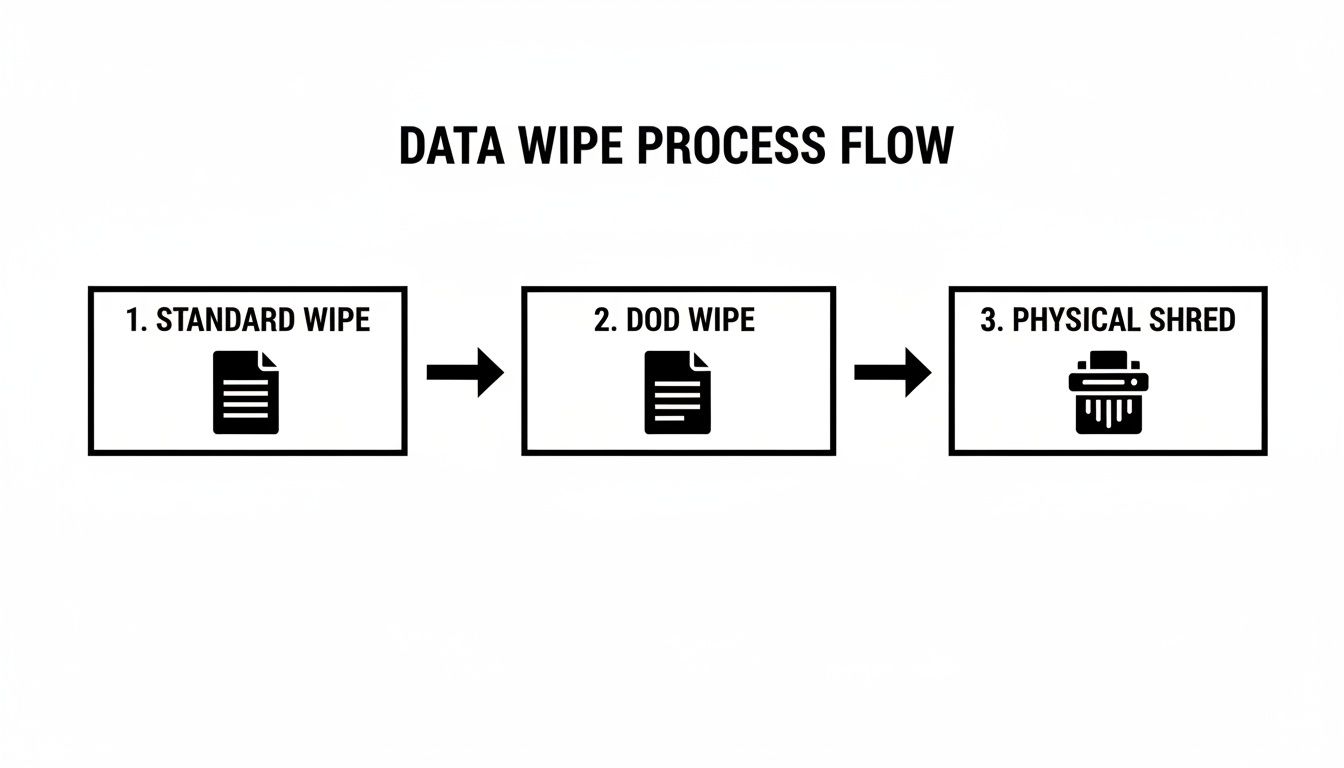
This visual breaks down the progression from standard software wipes to the total security of physical shredding.
Stage 4: Certified Data Destruction
This is the most important step for protecting your business. Based on the plan from our initial chat, every hard drive undergoes certified data destruction. This might be a DoD 5220.22-M wipe, a NIST 800-88 purge, or complete physical shredding.
The core promise of a professional corporate laptop recycling service in Georgia is the absolute and verifiable destruction of your data. This step single-handedly neutralizes the risk of a data breach from your retired assets.
Stage 5: Compliant Recycling and Value Recovery
With all data completely destroyed, the focus shifts to being environmentally responsible. Laptops are carefully taken apart into their core components—plastic, glass, metals, and circuit boards. Any toxic materials are safely removed and handled according to all state and federal regulations, which guarantees a zero-landfill policy.
At the same time, any components or whole devices that still have market value are evaluated. This IT Asset Disposition (ITAD) process can often bring back a financial return, which can help offset or even completely cover the cost of the recycling service.
Stage 6: Final Compliance Documentation
The process wraps up when we deliver your final paperwork. This is your proof that the job was done correctly and completely.
You will get:
- A Certificate of Data Destruction, which lists the serial numbers of the drives that were sanitized.
- A Certificate of Recycling, confirming your assets were processed in an environmentally compliant way.
This paperwork closes the loop on the entire project, giving you an essential audit trail for any compliance questions that might come up. Our guide on where businesses can recycle IT equipment in Georgia offers more context on finding partners who meet these standards.
The electronic goods recycling industry in the United States keeps on growing, with 863 businesses operating in 2025—that's a 1.3% compound annual growth rate over five years. This growth shows the rising need for professional services as Georgia companies retire their aging IT assets. Globally, the electronics recycling market is valued at USD 43.2 billion in 2025 and is expected to reach USD 147.9 billion by 2035, highlighting just how critical responsible e-waste management has become. You can learn more about these market trends from IBISWorld.
How to Choose the Right E-Waste Recycling Partner
Picking a partner for your corporate laptop recycling services in Georgia is a huge deal. It’s a decision that directly affects your company's security, compliance, and even your reputation. Not all recyclers are created equal, and choosing the wrong one is like hiring a security guard who leaves the front door unlocked—it creates more problems than it solves.
This isn't just about hauling away old equipment. It’s about finding a certified expert who understands the risks and protects your business from data breaches and legal trouble. Here’s what you need to look for to spot the professionals from the pretenders.
Check for Industry Certifications
Certifications are your first and most important checkpoint. They are the only way to know for sure that a recycler is following strict, independently audited standards for environmental safety and data security. A vendor without proper certification is a serious red flag.
You need to look for these two specific certifications:
- R2 (Responsible Recycling): This tells you the company follows best practices for protecting the environment, keeping their workers safe, and handling your data securely from start to finish.
- e-Stewards: Many consider this the gold standard. An e-Stewards certification guarantees that no hazardous e-waste gets shipped to developing countries and that your data is wiped according to the highest security protocols.
When a partner is certified, they're accountable to a third-party auditor. That gives you peace of mind that they won't cut corners with your assets.
Demand a Data Destruction Guarantee
A simple promise to "wipe your data" is worthless. You need a rock-solid, verifiable guarantee backed by a formal process. Any potential partner must be able to explain exactly how they destroy your data and provide the paperwork to prove it.
The most critical part of this whole process is the data destruction protocol. You absolutely must ask if they provide a Certificate of Data Destruction. This document lists the serial numbers of every single drive that was wiped or shredded, and it’s your legal proof that you complied with data privacy laws.
Ask them straight up: Do you perform DoD 5220.22-M wipes? Do you follow NIST 800-88 guidelines? Can you do on-site physical shredding for our most sensitive hard drives? A real pro will have confident, clear answers for all three.
Confirm a Zero-Landfill Policy
Responsible e-waste recycling is all about protecting the environment. Your partner must have a strict zero-landfill policy. This means every single part of your old laptops—from the plastic casing to the circuit board—is either reused, refurbished, or recycled. Absolutely nothing should end up in a Georgia landfill.
This is what keeps toxic materials like lead and mercury out of our local soil and water. Ask any vendor for their environmental policy statement and make sure they issue a Certificate of Recycling. This confirms their commitment to doing things the right way.
Evaluate Their Logistics and Asset Tracking
A secure chain of custody is non-negotiable. From the second your laptops leave your office, you need to know exactly where they are and that they're secure. A professional recycling service provides a documented, transparent process from your door to their facility.
This should always include:
- Secure On-Site Pickup: Using their own company-owned vehicles and vetted, background-checked employees, not random third-party movers.
- Asset Tagging and Auditing: Creating a detailed inventory list of every single device as soon as it arrives at their facility.
- GPS-Tracked Transport: For high-value or highly sensitive equipment, you should be able to track the truck your assets are in.
This level of control prevents laptops from "falling off the truck" on the way to the recycling facility, which is where data breaches often happen with cut-rate services. A partner with a solid tracking system gives you end-to-end accountability for every asset.
Unlocking Value from Your Old IT Assets
What if that closet full of old laptops wasn't a headache, but a hidden asset? It's time to stop thinking of old tech as a disposal cost. By adopting a circular economy mindset, you can turn that equipment into a new revenue source and a major boost for your company's green image.
A surprising amount of enterprise-grade laptops and servers hold significant value long after you've moved on. A professional IT Asset Disposition (ITAD) partner doesn't just see a pile of e-waste. They see an opportunity to refurbish and remarket that gear, giving it a second life.
From Cost Center to Revenue Stream
It all starts with a careful evaluation. An ITAD expert will look at each device to figure out its resale potential, factoring in its age, condition, and current market demand. Any equipment with gas left in the tank gets professionally refurbished, securely wiped, and prepped for the secondary market.
This is where the money comes back to you. Many corporate laptop recycling services in Georgia use a profit-sharing model.
Once the refurbished equipment is sold, you get a cut of the revenue. This approach can seriously reduce or even completely cover your logistics and data destruction costs, turning old hardware into found money for your budget.
For Georgia businesses trying to get the most back, understanding the local ITAD scene is a must. Our specialized ITAD services in Macon, GA, for instance, are built specifically to find the highest possible value for retired corporate assets in the area.
Bolstering Your Green Credentials
On top of the financial win, giving your old laptops a second chance is a huge plus for the environment. Think about the energy and resources needed to make a single new laptop—from mining rare metals to the massive carbon footprint of shipping it across the globe.
Reusing that laptop saves all of those resources. It’s a direct move into the circular economy, where we keep materials in use for as long as possible instead of just dumping them. That's a powerful story to tell your customers, employees, and stakeholders, showing you're truly committed to sustainability.
This isn't just a niche idea; it's becoming the standard. Laptops and PCs are the biggest part of the electronics recycling puzzle, making up 45.0% of the global market in 2025. New circular economy models are aiming to reuse 99% of laptop materials, which could slash carbon emissions by as much as 316kg for every device reused. As you can discover more insights from e-waste monitoring reports, a solid 30% of retired corporate tech is often in good enough shape to be refurbished.
When you work with a smart ITAD partner, you’re doing more than just cleaning out a storage room. You’re helping your bottom line, shrinking your environmental footprint, and building a stronger, more responsible brand.
Your Laptop Recycling Questions Answered
When it's time to get rid of old IT gear, you're bound to have questions. Getting straight answers is the first step to handling it right. Here are the most common questions Georgia businesses ask us about corporate laptop recycling.
What Equipment Do You Take Besides Laptops?
We handle just about any B2B IT asset you can think of. It's not just about corporate laptops. We also recycle desktops, servers, and all the networking hardware that makes an office run—switches, routers, you name it. We also take telecom equipment, monitors, and all sorts of IT peripherals.
Our specialty is decommissioning entire IT setups for offices, data centers, and schools. If you happen to have some specialized medical or lab equipment that's outside our wheelhouse, don't worry. We have trusted partners we can connect you with to make sure every piece of your e-waste is managed properly.
Are There Costs for Corporate Recycling Services?
The cost really depends on what you have and how much of it there is. For a lot of our corporate clients with a good amount of newer laptops, computers, or servers, the service is often free. We can do this because the value we get from reselling the working parts covers all the logistics and labor costs.
If you have a smaller batch or much older equipment with no resale value, there might be a straightforward fee for our time and transport. We are always upfront about this and give you a clear quote before we start any work. No surprises.
How Do I Schedule a Pickup for My Atlanta Office?
Scheduling a pickup is easy. Just give us a call or fill out the contact form on our website. Let us know what kind of equipment you have and where you are, and we'll get back to you with a quick quote. From there, we’ll find a time that works for you for our team to come on-site and handle the removal.
We're all about flexible scheduling. The last thing we want to do is get in the way of your business. Whether you're in Alpharetta, Marietta, or right in downtown Atlanta, we work around your schedule to make it a painless process.
What Kind of Compliance Paperwork Do I Get?
After we’ve processed your equipment, we provide you with all the necessary documentation for your records. This paperwork is your proof that you did everything by the book and it’s critical for any corporate audit. You'll receive two main documents:
- Certificate of Data Destruction: This is your guarantee that every bit of data was wiped clean according to strict standards like DoD 5220.22-M or NIST 800-88.
- Certificate of Recycling: This document confirms your assets were recycled in an environmentally sound manner, following all federal, state, and local rules.
This is the auditable trail you need to prove your company met its security and environmental obligations.
Ready to securely and responsibly handle your old IT assets? Montclair Crew Recycling offers certified, end-to-end corporate laptop recycling services for businesses across Georgia. Contact us today for a free quote at https://www.montclaircrew.com.
