
That old server whirring away in the back closet? What about that stack of obsolete laptops and the rat's nest of cables you keep meaning to deal with? This isn't just clutter—it's a major liability waiting to happen. For any business in Georgia, smart e-waste management is a necessity, not a "nice-to-have." It’s all about protecting your data and staying on the right side of the law.
Why E-Waste Management Is a Smart Move for Georgia Businesses
Getting a formal electronics recycling plan in place does more than just free up some much-needed space. It's a core business process that protects your company’s reputation and bottom line. Those outdated devices aren't just collecting dust; they're packed with sensitive data and are a potential environmental hazard. Proper disposal isn't just a chore—it's how you control risk.
Whether your office is in a downtown Atlanta high-rise or a business park out in Smyrna, every company faces this exact same challenge. And ignoring it can have serious consequences.
The Hidden Risks in Your Storage Closet
Every single piece of retired IT gear you have is a potential problem. For a business, those problems come in two main flavors: data security and legal compliance.
Think about it. A single discarded hard drive could hold years of client lists, private financial records, or your company's trade secrets. If that drive ends up in the wrong hands, the damage can be devastating, leading to expensive data breaches and destroying the trust you've built with your customers.
On top of that, businesses in Georgia have to follow environmental rules. You can't just toss old electronics in the dumpster. Not only is it irresponsible, but it can also get you hit with some hefty fines.
A solid IT asset disposition (ITAD) strategy is what turns this mess into a secure, documented, and compliant process. It gives you an audit trail that proves you did everything right to protect your data and the environment.
It's About More Than Just Recycling
If you're only thinking about electronics recycling in Georgia for businesses and offices as "getting rid of junk," you're missing the bigger picture. When you partner with the right professionals, the process delivers real benefits that strengthen your entire operation.
A modern e-waste program gives you:
- Airtight Data Security: Using certified data destruction methods like physical shredding or multi-pass wiping ensures your sensitive information is 100% gone for good.
- Regulatory Peace of Mind: When you work with a certified vendor, you know you're meeting all state and federal disposal laws. You'll get Certificates of Destruction for your records to prove it.
- Potential Value Recovery: Some of your newer or more specialized equipment might still have resale value. A good ITAD partner can test, refurbish, and sell these assets, often sharing the profits back with you.
- A Greener Reputation: Responsible recycling keeps hazardous materials like lead and mercury out of Georgia's landfills. It’s a powerful and visible way to show your company is committed to sustainability.
This guide is your roadmap. Let's turn this complicated task into a simple, secure, and beneficial process for your business.
Conducting Your IT Asset Audit and Inventory
Before you even think about calling for an electronics recycling pickup in Georgia, you need to know exactly what you’ve got. This means doing a full-blown IT asset audit. It's more than just a list—it's your roadmap for security, compliance, and getting an accurate quote.
This isn't just paperwork for the sake of it. A detailed inventory is what separates a smooth, secure disposal project from a chaotic one filled with hidden risks. It’s how you take control of the process from the very start.
Starting Your Equipment Inventory
Your first goal is simple: create a master list of every single electronic device you plan to dispose of. You can't protect what you don't track. This inventory becomes the foundation for your chain of custody, ensuring nothing gets lost in the shuffle.
Fire up a spreadsheet or your asset management software. For every item, you'll need to capture some key details. This is about building a unique "passport" for each asset, documenting its journey from your office to its final disposition.
An asset audit isn't just about what you're getting rid of. It's about knowing what sensitive information is walking out the door and having a documented plan to protect it. A single un-tracked hard drive can create a massive liability.
Many businesses find it helpful to involve external partners in this stage. When conducting a thorough IT asset audit and inventory, businesses often leverage the expertise of external IT service providers to ensure comprehensive tracking and management of equipment.
Ignoring that pile of old equipment in the storage closet creates problems that only get worse over time. What starts as a simple clutter issue can quickly become a serious data breach or compliance failure waiting to happen.
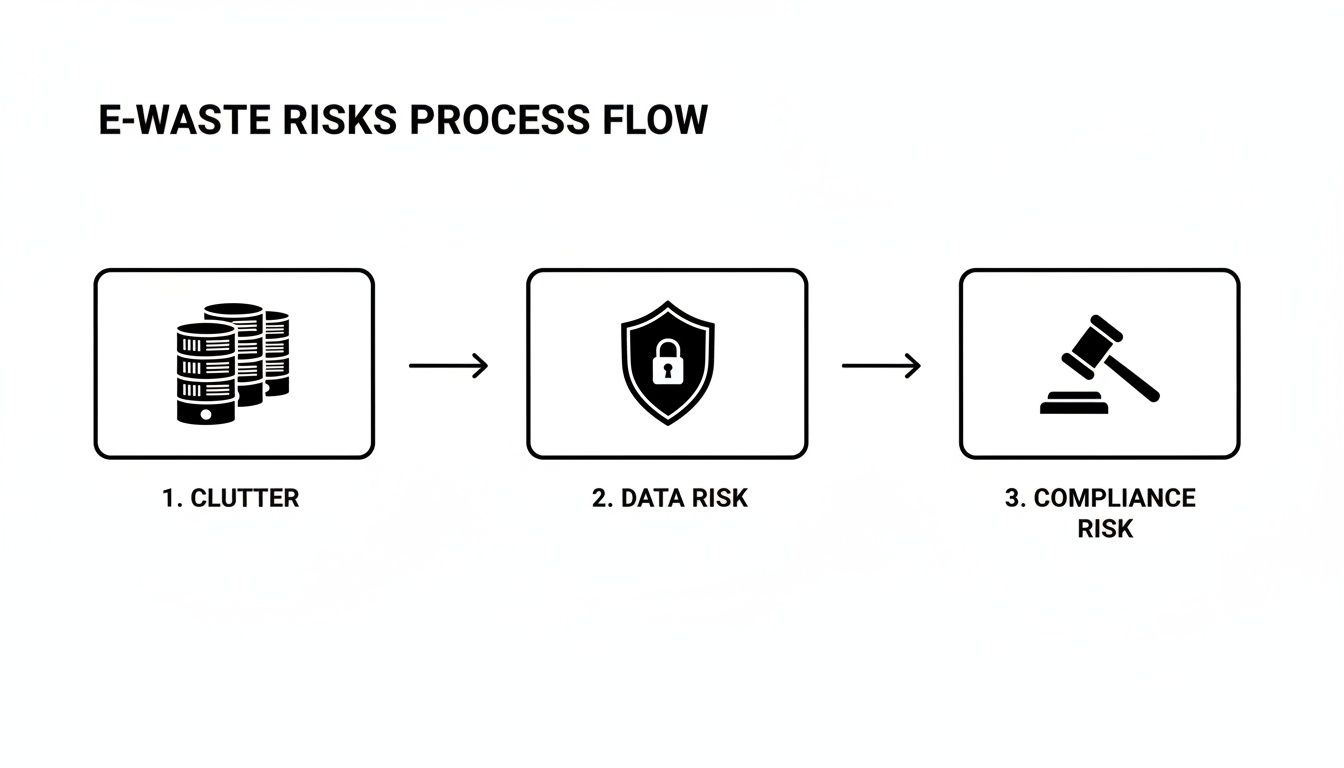
As you can see, letting e-waste sit around isn't a passive problem. It actively introduces risk into your business.
Categorizing Your Assets for Action
Once you have your master list, it's time to sort it. This simple step helps both you and your recycling partner immediately grasp the project's scope, especially when it comes to data destruction and potential value recovery.
Group your items into a few main categories. From our experience with businesses across Metro Atlanta, these are the most common buckets:
- Workstations and Laptops: Your standard employee machines, which often hold a mix of sensitive company and personal data.
- Servers and Data Center Gear: These are your high-stakes items. Servers, SANs, and NAS devices are almost guaranteed to hold critical, confidential, or proprietary business information.
- Networking Equipment: Routers, switches, and firewalls can store network configurations, passwords, and access logs—data you don’t want getting out.
- Peripherals and Mobile Devices: This is your catch-all for monitors, office phones, company tablets, and even printers, many of which have internal hard drives or memory.
Sorting your assets this way brings instant clarity. A financial firm in Sandy Springs retiring a full server rack has completely different security needs than a retail store in Marietta recycling a few old POS monitors. For a deeper dive into managing these assets, check out our complete guide on enterprise IT asset management.
The Essential IT Asset Audit Checklist
To make this process as smooth as possible, we've put together a checklist. Using a structured template like this ensures you don't miss any critical details and gives you a clean document to share with your team and your vendor.
IT Asset Audit Checklist for Georgia Businesses
Use this checklist to categorize and track your electronic assets before scheduling a pickup.
| Asset Type (e.g., Laptop, Server, Monitor) | Brand/Model | Serial Number | Contains Sensitive Data? (Y/N) | Condition (Working, Damaged, For Parts) | Current Location (Office/Room #) |
|---|---|---|---|---|---|
| Laptop | Dell Latitude 5420 | JXF5G82 | Y | Working | Office 204 |
| Server | HPE ProLiant DL380 | CZ3901A4BC | Y | Damaged | Server Closet |
| Monitor | HP EliteDisplay | CN40250KHV | N | Working | Cubicle 15B |
| Office Phone | Cisco 8841 | FCH2134E9A7 | N | For Parts | Storage Room |
This level of detail is your best friend during a business electronics recycling project. It establishes an unbroken chain of custody, gives your vendor the information they need for an accurate quote, and—most importantly—flags every single device that needs certified data destruction.
Ensuring Total Data Destruction Before Recycling
Once you've got your IT asset inventory sorted, we get to what is, frankly, the most critical step: making absolutely certain every last byte of sensitive data is gone for good. For most Atlanta businesses we work with, the fear of a data breach is the single biggest hurdle in getting rid of old electronics. It only takes one hard drive slipping through the cracks to expose client lists, financials, or company secrets. The fallout can be devastating.
This is exactly why professional data destruction isn't just a good idea—it's non-negotiable for any business serious about electronics recycling in Georgia for businesses and offices. Just dragging files to the trash or running a simple format won't cut it. Recovery software is cheap and easy to find, and it can pull that "deleted" data right back, leaving your company completely exposed. True security means using certified methods that guarantee that information is permanently unrecoverable.
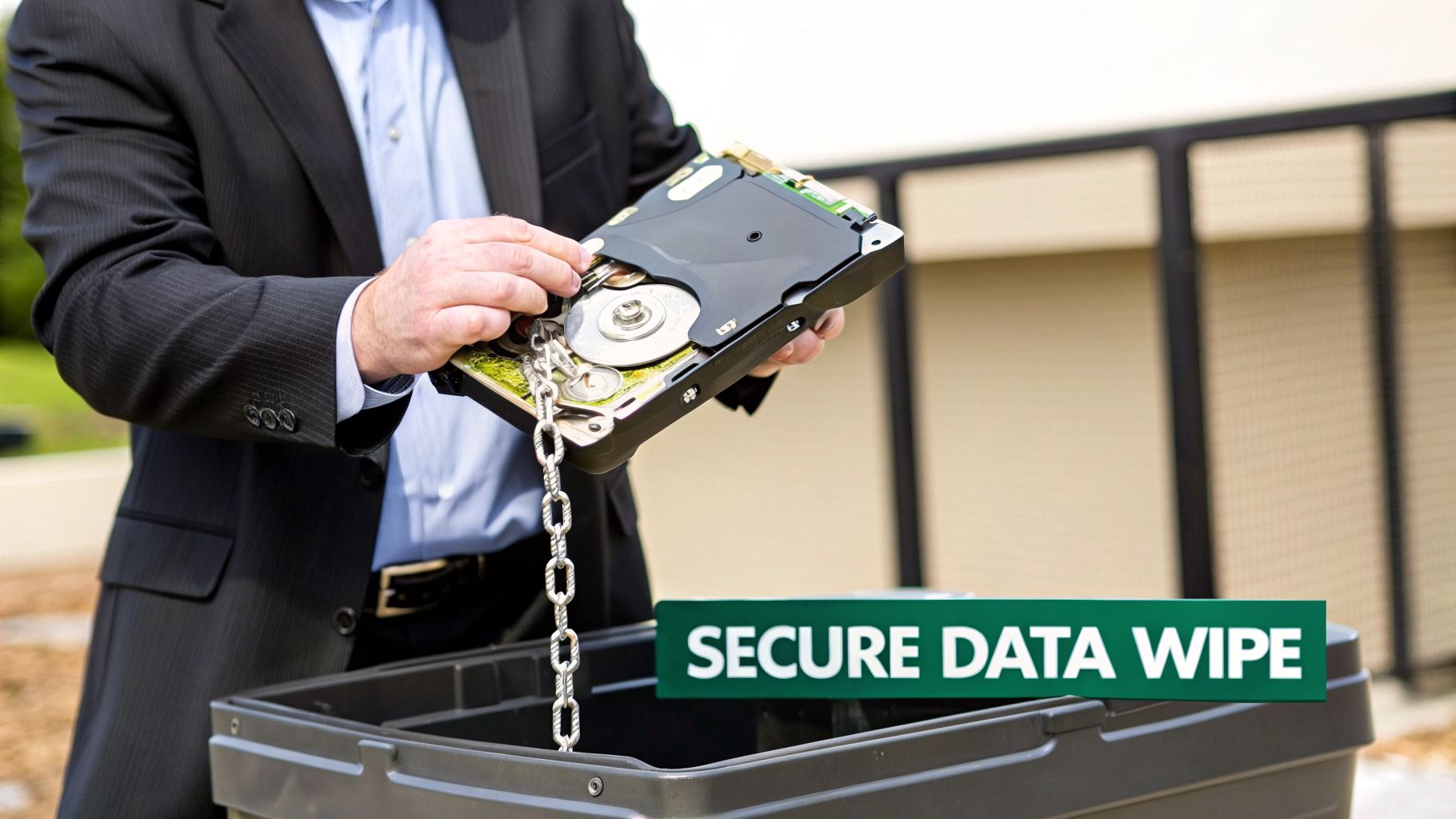
Software-Based Data Wiping
One of the most common and effective approaches is software-based wiping. This isn't just deleting files. We use specialized programs to systematically overwrite every single sector of a hard drive with random data, essentially burying the original information until it’s impossible to recover.
The gold standard here is the DoD 5220.22-M specification, a process that overwrites the drive multiple times. At Montclair Crew, we provide this service completely free of charge for any viable hard drives that come through our facility.
- Best For: Newer laptops, desktops, and servers that still have some life and value in them.
- Advantage: This method completely sanitizes the drive while leaving it physically intact. That means the equipment can be refurbished and sold, which is great for the environment and can even put some money back in your pocket.
A perfect example is a small marketing firm we recently helped in Roswell. They were retiring a fleet of three-year-old MacBooks. DoD-standard wiping was the ideal solution. Their data was completely eliminated, and the high-value laptops were remarketed, generating a nice return for the firm.
Physical Hard Drive Destruction
Sometimes, wiping just isn't the right tool for the job. For devices with extremely sensitive information, or for drives that are too old, broken, or simply not working, physical destruction is the only way to go. This process uses an industrial shredder to tear the hard drive into tiny, confetti-like pieces of metal.
When you need absolute, verifiable proof that your data is gone forever, nothing beats physical shredding. It makes data recovery physically impossible and offers the ultimate peace of mind.
For many organizations, this is a requirement, not a choice. Think about healthcare providers in Sandy Springs bound by HIPAA regulations, or law firms and financial institutions. They can't afford even the slightest risk of a data leak, making physical destruction the mandatory path.
On-Site vs. Off-Site Shredding
- On-Site Shredding: This is as secure as it gets. We bring a mobile shredding truck right to your Atlanta-area office. You can watch with your own eyes as your hard drives are turned into scrap metal, giving you an unbreakable chain of custody and instant verification.
- Off-Site Shredding: We transport your devices in locked, secure containers to our certified facility for destruction. The entire process is documented, with serial numbers tracked from pickup to destruction, and you receive a formal Certificate of Destruction afterward.
For any business handling highly classified or sensitive data, we always recommend on-site shredding. The ability to witness the destruction firsthand provides a level of security and assurance that's hard to beat. If you want to dig deeper into what’s right for you, learn more about our secure data destruction services and how we can tailor a plan to your needs.
Making the Right Choice for Your Georgia Business
So, how do you choose? It really boils down to a simple analysis of your industry, the kind of data you handle, and the age and condition of your equipment.
Here are a couple of real-world scenarios to think about:
- A Tech Startup in Alpharetta: They're upgrading their server rack and have several high-performance enterprise servers. Certified data wiping is the perfect fit. It secures their data while keeping the valuable servers intact, allowing them to recover a good chunk of their initial investment through resale.
- A School District in Kennesaw: They're retiring hundreds of old student Chromebooks. Most are damaged, obsolete, and have little to no resale value. Given the sheer volume and low value, secure off-site shredding is the most efficient and cost-effective way to ensure all student data is properly destroyed.
By understanding these two core methods, you can build a data destruction plan that fits your security requirements, compliance mandates, and your bottom line.
The Logistics of E-Waste Pickup in Metro Atlanta
You’ve done the hard work of auditing your assets and figuring out your data destruction plan. So, what’s next? The big question is how all this equipment physically gets from your office to our recycling facility.
The whole point of a professional pickup is to be completely seamless and stay out of your way. We handle everything so it feels effortless on your end.
Whether you're in a downtown Atlanta high-rise with a tricky loading dock or a sprawling suburban office park in Alpharetta, a certified partner does all the heavy lifting. This isn’t just about sending a truck. It’s a full-service operation. We bring everything needed—pallets, shrink wrap, dollies, and bins—to safely pack up and move your gear.
Scheduling Your E-Waste Pickup
Getting your pickup on the calendar is simple. Once you approve our service quote, we'll work with you to lock in a date and time that doesn't disrupt your business.
Flexibility is everything here. We can schedule pickups after hours or on a weekend. Whatever it takes to avoid interrupting your team or bothering your customers.
To make sure everything goes smoothly, we'll just need a few logistical details from you:
- Building Access: Are there any specific security check-in rules? Do we need to reserve a freight elevator for a certain time?
- Loading Dock Info: Just let us know where your loading dock is. If you don't have one, that's no problem at all. Our crew comes prepared for ground-level pickups too.
- Point of Contact: Who on your team will be there to meet our crew? This person will show them where the equipment is and handle the initial sign-off.
Giving us this info upfront means our removal team shows up ready to go, making the whole process quick and efficient.
Preparing Your Office for Pickup Day
While our team handles the real work, a little prep on your side can make the day fly by. The single best thing you can do is gather all the equipment in one or two easy-to-reach spots.
For example, if you've got old PCs scattered across different offices and some servers in a back closet, pull them all into an empty conference room or a storage area. This keeps our crew from having to hunt for assets and disrupt multiple departments. Just clear a path, and we'll take it from there.
Pro Tip: Before the crew gets there, do one last walkthrough. Make sure every single item on your inventory list is staged and ready to go. It’s a simple check that prevents anything from getting left behind.
What to Expect When the Crew Arrives
A professional pickup is about secure, organized removal, not just brute force. When the Montclair Crew team arrives at your office, we come ready to manage the entire job, from start to finish.
First, our insured, uniformed crew leader will check in with your designated contact. We'll quickly review the scope of work and confirm where all the assets are located.
Next, our team will carefully stack your equipment onto pallets and secure it all with shrink wrap. This keeps everything stable and protected during transport. You don't have to lift a finger—we handle all the loading, whether it's one pallet of laptops or several tons of data center equipment.
Before we leave, you'll get a Bill of Lading. This document is your initial receipt and officially records the transfer of custody.
For businesses with massive clear-outs or complex projects, you can see exactly how we handle the biggest jobs by checking out our specialized electronics recycling pickup services in Atlanta. Our professional approach to electronics recycling in Georgia for businesses and offices guarantees your assets are secure from the second they leave your property.
Understanding Your Certificate of Destruction and Recycling
So, the truck has pulled away with your old servers, computers, and IT gear. Out of sight, out of mind, right? Not quite. The job isn’t truly finished until you have the final paperwork in hand.
This documentation is more than just a receipt. It’s your concrete proof that you followed a secure, compliant process for electronics recycling in Georgia for businesses and offices. Without it, if a data breach were ever traced back to one of your old hard drives, you'd have no official record to show you did your due diligence.
These certificates are your official audit trail, giving you verifiable peace of mind.
The Two Documents That Matter Most
After your assets are processed by a reputable recycling partner, you should expect two key documents. Each one serves a specific, vital purpose in closing the loop on your IT asset disposal project.
First up is the Certificate of Destruction (CoD). This is all about data security. It’s your formal guarantee that every single hard drive, server, and data-bearing device was professionally sanitized or physically destroyed. This document confirms the data is gone for good and is permanently unrecoverable.
Next is the Certificate of Recycling (CoR). This one covers the environmental side of things. It confirms that all your electronic assets—from computers and monitors to keyboards and cables—were processed in an environmentally responsible way, keeping hazardous materials out of landfills.
Think of it this way: The CoD protects your data and your reputation, while the CoR protects you from environmental liability. You absolutely need both to be fully covered.
These certificates are the final, critical link in your chain of custody. You can get a deeper look into this process by reading our breakdown of what a Certificate of Destruction really means for your business.
Decoding Your Certificates: What to Look For
A legitimate certificate from a certified vendor isn't just a generic piece of paper; it’s a detailed, auditable record. When you get your paperwork, do a quick check to make sure it contains these specific details:
- Your Company's Name: It must clearly state who the service was performed for.
- The Vendor’s Information: The name, address, and contact details of the recycling company.
- A Unique Serial or Reference Number: This lets you track the specific job in the vendor's system.
- Date of Service: A clear record of when the destruction or recycling took place.
- A List of Serialized Assets: For maximum security, the CoD should list the individual serial numbers of the hard drives destroyed.
- Method of Destruction: It should specify exactly how the data was destroyed (e.g., "DoD 5220.22-M wipe," "physical shredding").
- An Authorized Signature: A representative from the recycling company must sign and validate the document.
If the certificate you receive is vague or missing this key info, it's a huge red flag. That kind of flimsy paperwork won't hold up in an audit and could leave your business exposed.
Why Vendor Certifications Are Your Guarantee
How can you trust that the certificates you get are legitimate and that the work was actually done right? The answer is third-party industry certifications. They are your best insurance policy.
These credentials prove that a vendor has been independently audited and verified to operate at the highest standards for security and environmental compliance. When you're choosing a partner for electronics recycling for businesses and offices, their certifications are non-negotiable.
Here’s a quick look at the most important certifications for e-waste recyclers in Georgia and what they really mean for your company's protection.
Comparing E-Waste Vendor Certifications in Georgia
| Certification | What It Guarantees | Why It Matters for Your Business |
|---|---|---|
| R2v3 | A comprehensive standard covering data security, environmental practices, worker safety, and the entire lifecycle of the electronics. It ensures a documented and audited chain of custody. | This is your baseline for trust. An R2v3 certified vendor has proven they have a secure and responsible process from start to finish, minimizing your risk. |
| e-Stewards | Considered the most stringent standard, with a zero-tolerance policy for illegally exporting hazardous e-waste to developing countries. It has an intense focus on data security and environmental accountability. | For businesses with the highest security needs or a strong corporate social responsibility mandate, e-Stewards provides the ultimate assurance that your e-waste and data are handled with maximum integrity. |
| NAID AAA | Specifically focuses on data destruction. Vendors must pass rigorous, unannounced audits of their data destruction processes, including hiring practices, facility security, and destruction methods. | If data security is your top concern, a NAID AAA certified vendor offers undeniable proof that they meet the gold standard for information sanitization and destruction. |
When you partner with a recycler that holds these top-tier certifications, you aren't just hiring a pickup service. You are bringing in an expert who has already done the hard work of building a secure, compliant, and responsible system. Your compliance is built on the foundation of their certifications.
Finding Value in Your Outdated IT Assets
Think that pile of old office tech is just an expense waiting to happen? For many Georgia businesses, it can actually put money back in your pocket. You just need to shift your mindset from "disposal" to IT Asset Disposition (ITAD). It’s the difference between a cleanup chore and a smart financial move.
It's a common myth that old electronics are worthless. The reality is, a lot of equipment keeps its resale value long after your company is done with it. A smart approach to electronics recycling in Georgia for businesses and offices means finding these hidden gems before they're scrapped.
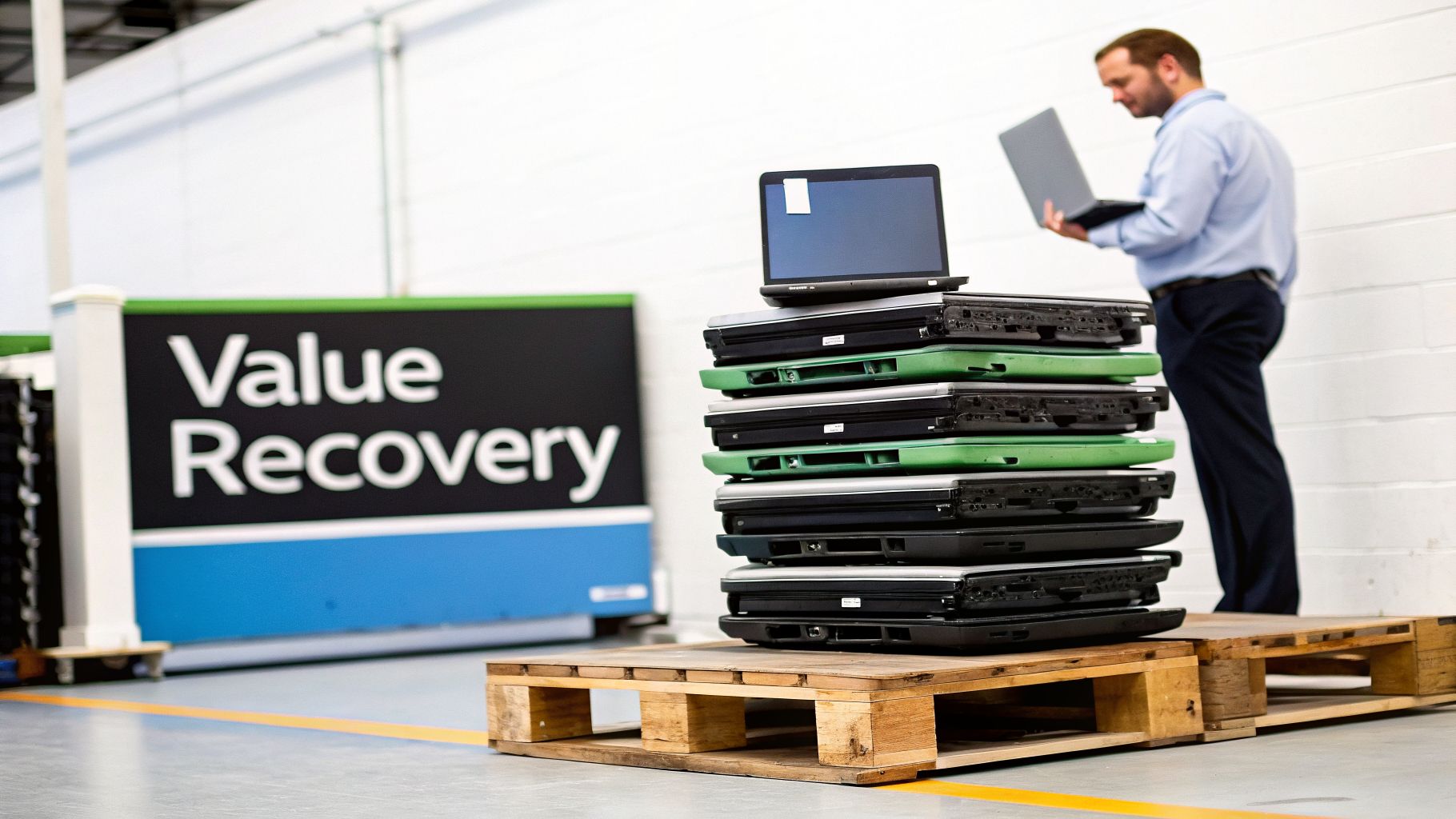
What Equipment Holds Resale Value
Not everything is destined for the shredder. The asset audit is your roadmap to finding the valuable stuff. From our experience with companies all over Marietta and Roswell, enterprise-grade gear and newer equipment are what usually bring in a return.
Here's what often has strong remarketing potential:
- Bulk Laptops: Stacks of laptops, especially if they're less than 4-5 years old, are always in high demand.
- Enterprise Servers: Powerful servers from brands like Dell and HPE can have a very long second life.
- High-End Networking Gear: Cisco switches, routers, and firewalls can hold their value surprisingly well.
- Specialized Workstations: Those beefy machines for graphic design, CAD, or video editing can definitely be remarketed.
Even broken equipment might be worth something. We've seen a single high-end server with one bad part still contain thousands of dollars worth of processors, RAM, and power supplies that can be harvested and sold.
How Profit-Sharing Works
The best way to handle value recovery is through a profit-sharing model. This isn't about you just paying a vendor; it's about forming a partnership to make money from your old assets.
With a profit-sharing agreement, your ITAD partner does all the heavy lifting—testing, certified data wiping, repairs, and finding buyers. Then, you get a cut of the net profits. This model works because our goals are perfectly aligned: we both want to get the highest return possible.
The whole process is transparent. After we pick up your equipment, every item is tested and graded. Anything viable is securely wiped, cleaned up, and sold through our established reseller channels. You get a detailed report showing exactly what sold and for how much, along with your check. This approach to IT asset disposition in the Atlanta, GA, area can often cover the entire cost of the project and then some.
Of course, not everything will make you money. Old CRT monitors or busted office printers have no resale value and will have a recycling fee. By working with a vendor who gives you a straight assessment, you can set realistic expectations, balancing the cost to recycle the junk against the revenue you can get back from the good stuff.
Your Top E-Recycling Questions Answered for Georgia Businesses
When it's time to retire old IT equipment, a lot of questions pop up. We get calls all the time from business owners and IT managers across Georgia wanting to know the nuts and bolts of security, cost, and logistics. We've pulled together the most common questions we hear to give you straight answers.
What’s the Safest Way to Get Rid of Old IT Gear?
For any business device with sensitive data on it, the only real answer is to work with a certified IT Asset Disposition (ITAD) vendor. Just deleting files or doing a quick reformat on a hard drive isn't enough. Data recovery software is easy to get, and it can pull that "deleted" information right back.
Real data security boils down to two professional methods:
- Certified Data Wiping: We use specialized software that meets the DoD 5220.22-M standard. This isn't just deleting—it's a process of overwriting every single sector of a hard drive multiple times. It makes the original data completely unrecoverable but keeps the drive itself usable, which is great for resale.
- Physical Shredding: This is the ultimate solution for drives at the end of their life or for any company that needs absolute, physical proof of destruction. We run the hard drives through an industrial shredder that turns them into tiny, unrecognizable pieces of metal. Data recovery from that is physically impossible.
No matter which method you choose, always get a Certificate of Destruction. This is your official paperwork, your auditable proof that you complied with privacy laws and handled everything correctly. It's what protects your company from liability down the road.
What Kind of Business Equipment Can We Actually Recycle?
Professional electronics recycling in Georgia for businesses and offices is about way more than just old desktop computers and laptops. A certified recycler can handle the whole spectrum of assets that keep a modern business running.
Here's a look at what we handle every day:
- Standard Office Tech: Desktops, laptops, servers, monitors, keyboards, and mice.
- Data Center & Networking Gear: Rack and blade servers, switches, routers, and firewalls.
- Business Systems: Office phones, telecom equipment, and point-of-sale (POS) systems.
- All the Extras: Printers, copiers, and every last cable or power supply that goes with them.
A good recycler knows how to manage the specific materials and data security needs for each of these items. You can be confident it's all being handled the right way.
How Much Will It Cost to Recycle Our Office Electronics?
The cost can really vary. In many cases, a recycling project can actually make your company money through a profit-sharing model. It all comes down to the age and type of your equipment.
For example, newer gear like recent-model laptops or enterprise-grade servers still has solid resale value. An ITAD partner can test, refurbish, and sell these items, and you get a cut of the profits. On the flip side, older or broken items like bulky CRT monitors or busted printers have no value and will have a small recycling fee. This just covers the cost of getting rid of them responsibly.
A trustworthy vendor will always give you a clear, upfront quote that breaks down both the potential returns and any costs involved. No surprises.
Ready to put together a secure and compliant electronics recycling plan for your Georgia business? The team at Montclair Crew Recycling makes it easy. We handle everything from on-site pickup and asset tracking to certified data destruction and getting you the best value back for your equipment.
Learn more at https://www.montclaircrew.com or give us a call today for a quote.
