
Tackling a computer recycling Savannah GA project can seem like a huge task, but it all boils down to one simple starting point: an internal audit. For any Savannah business, creating a solid inventory of every single piece of equipment you're getting rid of is the most important first step. It sets the stage for a secure, compliant, and headache-free process.
Your Pre-Recycling Game Plan
A successful IT disposal project doesn't kick off when our truck pulls up. It starts with you, getting your ducks in a row internally. This isn't just about making a quick list; it's a strategic move to account for, gather, and secure all your old tech.
Skipping this prep work? That's how assets go missing, data breaches happen, and logistics turn into a nightmare. Think of this as your first line of defense for protecting sensitive company and customer information.
Conduct a Thorough Asset Audit
Before you can recycle a single thing, you have to know exactly what you’re dealing with. This means rolling up your sleeves and doing a full internal audit. Don't just count the obvious stuff like laptops and desktops. Your inventory needs to cover every piece of electronic gear that’s been taken out of service.
- Servers and Networking Gear: Make a list of all those rack-mounted servers, switches, routers, and firewalls.
- End-User Devices: Catalog every desktop, laptop, tablet, and company-issued mobile phone.
- Peripherals and Telecom: Don’t let monitors, printers, VoIP phones, keyboards, or mice slip through the cracks.
We've seen it time and again: the most successful projects start with a detailed spreadsheet. Smart IT managers in Savannah list the item type, brand, model, and, most importantly, the serial number. This master list is your golden ticket for tracking every asset from your office to its final disposition.
Here’s a quick overview of our recommended process. Following these fundamental steps—Audit, Consolidate, and Secure—is the best way to make sure no device gets left behind.
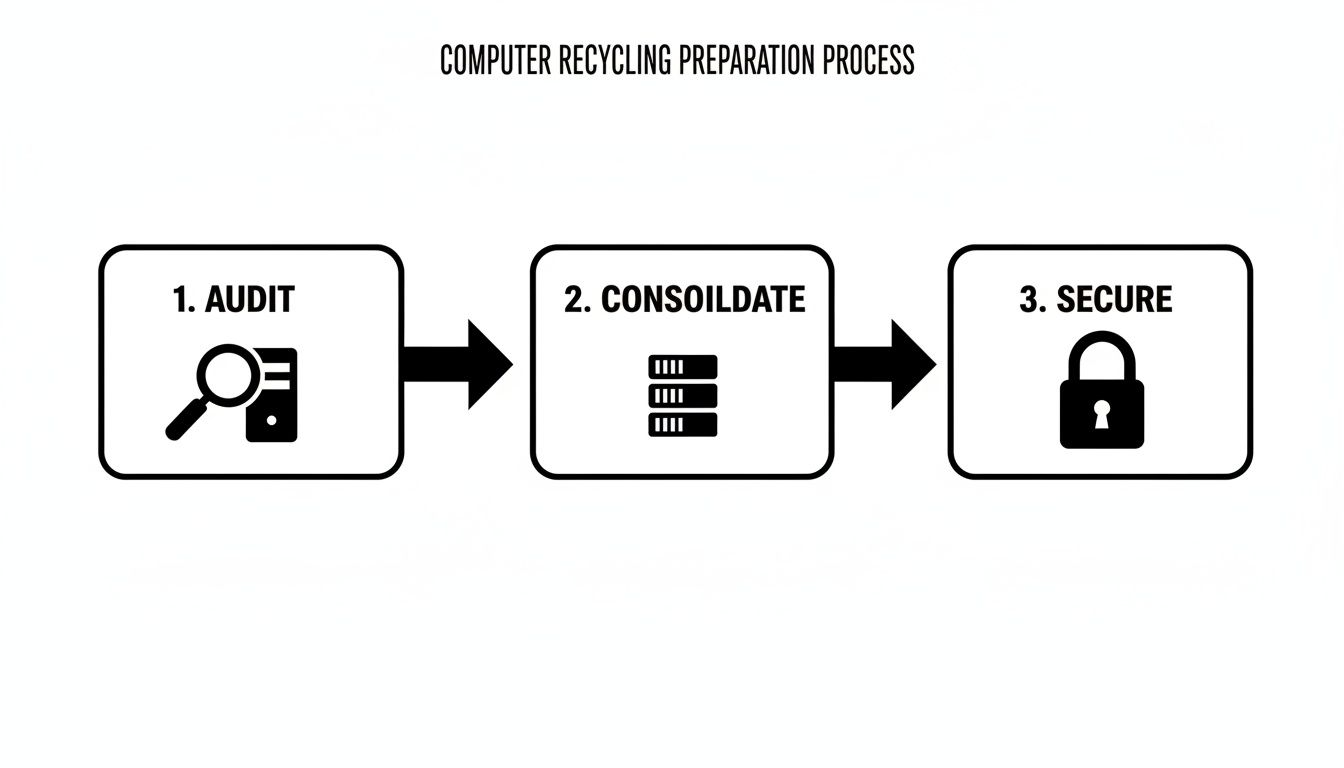
This straightforward approach ensures every piece of equipment is accounted for from start to finish.
To help you get started, we've put together a simple checklist that breaks down the process.
Pre-Recycle Checklist for Savannah Businesses
Use this streamlined checklist to prepare your IT equipment for secure and efficient recycling.
| Phase | Action Item | Key Objective |
|---|---|---|
| Audit | Create a master inventory list (type, brand, model, serial number). | Full accountability and asset tracking. |
| Audit | Identify all data-bearing devices (HDDs, SSDs, phones, etc.). | Flagging items that require certified data destruction. |
| Consolidate | Gather all decommissioned assets into one central location. | Prevent asset loss and streamline the pickup process. |
| Secure | Store equipment in a locked room, closet, or caged area. | Maintain a clear chain of custody and prevent unauthorized access. |
| Secure | Restrict access to the storage area to authorized personnel only. | Enhance physical security before the recycling partner arrives. |
Following this simple table will make the entire engagement smoother for your team and for us.
Consolidate and Secure Everything
Got your inventory list? Great. The next move is to round up all that decommissioned gear and get it into one secure spot. Leaving old computers stuffed in closets, under empty desks, or scattered across the office is just asking for trouble. It's how equipment gets "lost" or grabbed by someone who shouldn't have it.
We always recommend a designated, locked storage room or a caged-off section in a warehouse. This centralizes everything, which not only stops assets from walking away but also makes the final pickup incredibly fast and efficient for your recycling partner.
This controlled space is non-negotiable. It establishes a clear chain of custody from the second a device is unplugged.
If you're trying to get a better handle on the entire process, you might find our guide on what to do with outdated computers helpful. This simple prep work paves the way for a smooth, fully documented, and secure recycling project.
Ensuring Data Is Destroyed Before It Leaves Your Office
Once you’ve got your inventory list, the most important part of the job begins: making sure the sensitive data on those devices is gone for good. Let's be clear—just powering down a machine or even formatting a hard drive isn't nearly enough. The real danger in retiring old IT gear is the data left behind. To a cybercriminal, it's a goldmine.
This is why certified data destruction isn't just a "nice-to-have"—it's a non-negotiable part of any legitimate computer recycling Savannah GA service. It's the only way you can be absolutely certain that your company’s private files, customer information, and internal secrets are permanently destroyed and can never be recovered. There are two gold-standard methods to get this done.
Software Wiping for Asset Reuse
The first option is to use specialized software to completely wipe the data from a hard drive. We use a process that meets the DoD 5220.22-M three-pass wipe standard, which was originally developed by the Department of Defense. It works by overwriting every single sector of the drive with a pattern of ones and zeros, then doing it again with a different pattern, and then a third time with random characters.
After three complete passes, the original data is practically impossible to get back. The main benefit here is that the hard drive itself remains perfectly functional, so the computer or server can be refurbished and find a new home. This is the ideal route for newer equipment where you want to recoup some of your initial investment.
Imagine a Savannah marketing agency retiring a dozen two-year-old MacBooks. Software wiping is perfect. It secures their data completely while preserving the high-value laptops for resale. What would have been a disposal expense now puts money back into their budget.
It’s the best of both worlds, balancing total security with financial and environmental common sense.
Physical Shredding for Ultimate Security
Your other option is on-site physical hard drive shredding. It’s as straightforward and final as it sounds. We bring a mobile, industrial-grade shredder right to your office or facility and physically demolish your hard drives while you watch. The drives are literally pulverized into tiny, mangled pieces of metal.
There is no more certain way to destroy data. Period. This method gives you the ultimate peace of mind and is often the only acceptable choice for organizations operating under strict compliance rules.
We see this all the time with specific industries:
- Healthcare Providers: A clinic in Savannah must comply with HIPAA to protect patient health information (PHI). On-site shredding gives them visual proof of destruction, which is priceless for an audit trail.
- Legal and Financial Firms: Law offices and banks can't take any chances with sensitive client data. They choose shredding to eliminate any possibility of a breach and to demonstrate their due diligence.
- Government Contractors: Any business handling government contracts or CUI (Controlled Unclassified Information) will almost always be required to physically destroy data-bearing devices.
Once a drive goes through that shredder, its data is gone forever. This is the way to go when absolute risk elimination is your top priority and you don't need to resell the drive. Before deciding, it's a good idea to know the basics, and you can learn more about how to wipe a computer before recycling in our detailed guide. The choice between wiping and shredding really comes down to your company's unique risk tolerance and regulatory needs.
Solving Your Recycling Logistics in the Savannah Area
Okay, you've got your equipment inventoried and a solid plan for data destruction. Now for the final piece of the puzzle: logistics. How are you going to get all that old gear from your office to the recycling facility? For businesses in Savannah, it really boils down to two options—you can haul it yourself, or you can have us come get it.
The best choice really depends on how much gear you have, what resources are available, and frankly, how much heavy lifting you want your team to do. Getting this wrong can turn a simple task into a major headache.
Option 1: The Drop-Off Approach
For a small business with just a handful of items, a scheduled drop-off can be a simple, cost-effective way to go. If you're a small startup in Midtown retiring a couple of old laptops and a monitor, it probably makes sense to just load them up and bring them to a recycling center yourself.
This approach gives you total control over the schedule. Just don't forget that "a few items" can get heavy, fast. A single server or an old CRT monitor can be a real pain to move, so make sure you have the people and the vehicle for the job. You’re also on the hook for keeping those assets secure during transport.
Option 2: Scheduled On-Site Pickup
For most businesses, especially those with a lot of equipment, a scheduled on-site pickup is the only way to go. When you’re dealing with a computer recycling Savannah GA project that involves dozens of workstations, servers, and networking gear, a professional pickup service is a lifesaver.
Imagine a large law firm in the Historic District clearing out an entire floor's worth of IT equipment. Asking your paralegals to haul hundreds of pounds of electronics is not just inefficient, it's a liability. A professional crew shows up with the right tools—dollies, pallet jacks, and secure trucks—to get the job done safely and quickly.
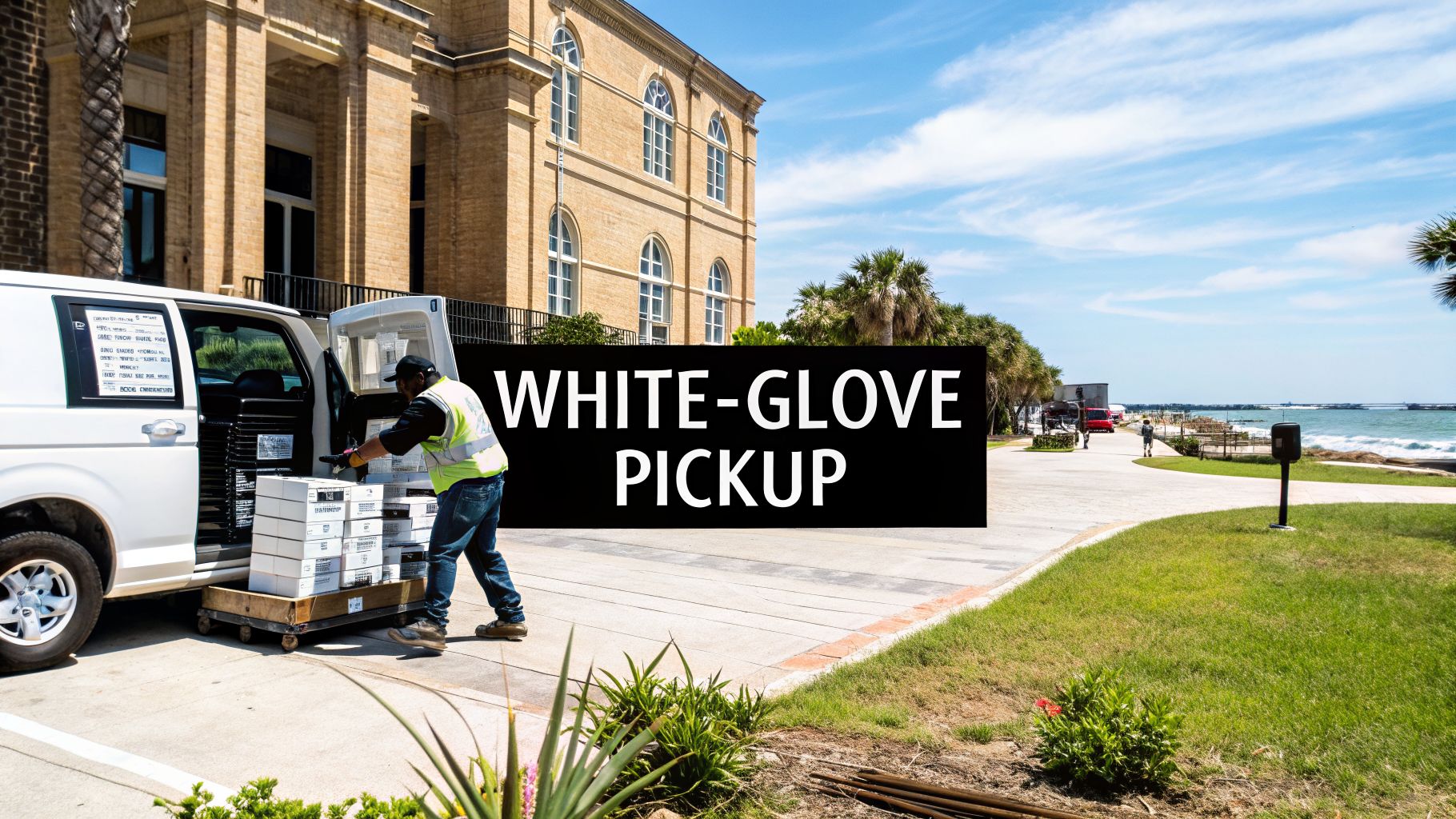
With a scheduled pickup, the recycling partner takes on the entire logistical burden. Our team arrives at your location, loads up all the palletized equipment, and hands you a chain of custody receipt before we even pull out of your parking lot. This "white-glove" service means minimal disruption for your business, freeing up your team to do their actual jobs.
This is pretty much essential for any large-scale cleanout. When you have an entire office or data center to empty, you just can't beat the efficiency of a dedicated logistics team. We handle the packing, the loading, and the transport, ensuring every single asset on your inventory sheet is accounted for.
For a deeper dive into how this process works, take a look at our complete guide on electronics recycling in Savannah GA. This service doesn't just make logistics easy; it formalizes the chain of custody from your door to our facility, giving you the documentation and peace of mind you need for full compliance.
Why Environmental and Regulatory Compliance Is Non-Negotiable
Properly recycling old computers isn't just about being green—it's a serious business requirement. Getting this wrong can open your company up to some major headaches, from steep fines to a tarnished brand reputation that’s hard to fix.
When you get rid of old IT assets, you are legally on the hook for what happens to them next. Simply calling a junk hauler to take them away won't cut it. If that equipment gets dumped illegally, the liability can trace right back to you. This is exactly why you need to partner with a certified expert in computer recycling Savannah GA.
The Big Regulations You Can't Ignore
Even though Georgia doesn’t have a specific state-level e-waste landfill ban for businesses, powerful federal laws are very much in play. The main one you need to worry about is the Resource Conservation and Recovery Act (RCRA).
This law dictates how solid and hazardous waste must be handled, and a lot of old electronics—think old CRT monitors and certain types of batteries—are classified as hazardous. The penalties for messing up RCRA compliance are no joke, and the bad press from an environmental misstep can be even more damaging than the fine. A certified recycler knows these rules inside and out, ensuring every single component is managed correctly and keeping you out of trouble.
Choosing a certified recycler is your best defense. It means you are working with a partner who guarantees a zero-landfill policy for all electronics and adheres strictly to both federal and state guidelines. This isn't just a promise; it's a documented, auditable process.
This professional oversight is the only way to be absolutely certain you've done your part, both legally and ethically.
Your Local Decision Has a Global Impact
The choice you make here in Savannah contributes to solving a massive global problem. We are drowning in electronic waste. In 2022 alone, the world generated a staggering 62 million tonnes of e-waste.
What’s worse? Only 22.3% of that was properly collected and recycled. And the problem is growing—projections show that recycling rate could slip to just 20% by 2030.
By working with a certified recycler, your business actively pushes back against this trend. You prevent hazardous materials from seeping into our soil and water while ensuring valuable commodities are recovered for reuse. It’s a powerful statement about your company’s values that customers, employees, and the community will notice. You can also get a better sense of the challenges and opportunities by reading about Georgia's broader electronics recycling landscape.
Documentation: Your Proof of a Job Done Right
So, how do you prove you followed the rules? With paperwork. Any legitimate IT recycler will provide official documentation that closes the loop on your disposal project. This isn't an "add-on" service; it’s a core part of the process.
You need to walk away with two critical documents:
- A Certificate of Recycling: This is your official confirmation that all your equipment was processed in an environmentally responsible way, fully compliant with all regulations.
- A Certificate of Data Destruction: This document lists the serial numbers of every single hard drive that was securely wiped or physically shredded. It’s your concrete proof that you protected your sensitive information.
These certificates are your compliance record. File them away and keep them safe. If you ever face an internal or external audit, this is the final, tangible evidence showing your company handled its computer recycling Savannah GA responsibilities the right way.
Finding Hidden Value in Your Old IT Equipment
Getting rid of old tech shouldn't just be an expense on your balance sheet. What many businesses don't realize is that their retired IT equipment can actually put money back into their budget. This process, often called IT Asset Value Recovery (ITAVR), turns a potential liability into a smart, sustainable business practice.
It all boils down to knowing which of your old assets are still worth something on the secondary market. Not everything will make the cut, but you’d be surprised how well enterprise-grade equipment holds its value.
What Equipment Holds Resale Value
The trick is to spot the gear that’s recent enough to be a perfect fit for another organization. That ten-year-old desktop is probably just scrap metal, but a three-year-old server? That could be exactly what a smaller company or startup is looking for. A professional recycling partner can quickly assess your inventory based on its age, condition, and current market demand.
Here are some of the items that almost always have great resale potential:
- Modern Servers: Enterprise servers from brands like Dell, HPE, and Lenovo are built like tanks and are always in high demand.
- Networking Gear: High-end switches, routers, and firewalls from companies like Cisco and Juniper are prime candidates for refurbishment and resale.
- Recent-Model Computers: Laptops and desktops that are only a few generations old, especially from brands like Apple, Dell, and Lenovo, move quickly on the secondary market.
- Bulk Components: Even individual parts can be valuable. Large quantities of working RAM, CPUs, and enterprise-grade hard drives can be sold off.
That initial asset audit you conduct is the key to this whole process. When you have a detailed inventory list, a recycler can immediately pinpoint the valuable items and give you a solid estimate.
How Revenue Sharing Works
Once the valuable assets are identified, your recycling partner will lay out a revenue-sharing agreement. The process is straightforward: they handle the refurbishment, securely wipe all data to DoD standards, and sell the equipment through their established sales channels.
After a sale is made, the recycler simply deducts their costs for labor, data destruction, and logistics. The profit that's left over is then split between your company and the recycler based on a percentage you both agreed on upfront. This turns your computer recycling Savannah GA project from a cost into a revenue generator.
This model creates a genuine partnership. We're both motivated to get the highest possible return on your equipment. But choosing the right partner is also about global responsibility. The recycling gap is real; Europe recycles about 42.8% of its e-waste, while the Americas only manage around 30%. Even more alarming, a staggering 65% of e-waste shipped across borders goes from wealthy nations to developing countries, often through sketchy, uncontrolled channels that create huge security and environmental risks. You can see the full scope of the problem in the latest UN research on global e-waste trends.
Working with a domestic partner ensures your data is destroyed accountably and that you're supporting a secure, local recycling infrastructure.
Ultimately, this approach completely changes how you look at IT asset disposal. Instead of being one final expense, it becomes a financially savvy and sustainable part of managing your equipment's lifecycle. To get a more complete picture of this process, check out our in-depth article on professional IT asset disposal.
Common Questions We Hear About Computer Recycling in Savannah
Even when you have a solid plan for your old IT gear, a few questions always pop up. We get it. Savannah businesses want to know the specifics before they schedule a pickup, and we're here to give you straight answers. Let's clear up the common sticking points so you can move forward with confidence.
What Kind of Equipment Can We Actually Recycle?
Good news—if it plugs in and was used in an office, we can probably take it. Professional IT recyclers are equipped to handle a massive range of business electronics, which makes cleaning out your office or data center much simpler. You don't have to worry about leaving things behind.
We regularly see and accept all sorts of equipment:
- The Basics: Desktops, laptops, all-in-one PCs, and servers.
- Displays: Modern flat-panel monitors and even those heavy, old-school CRT monitors.
- Network Hardware: We'll take your switches, routers, modems, and firewalls.
- Telecom Systems: That includes office phone systems, VoIP phones, and all the related hardware.
- All the Extras: Keyboards, mice, printers, scanners, and every last cable.
Now, some really specialized gear, like certain medical or lab instruments, might need a different disposal path. The best way to be sure is to just send over your inventory list before scheduling a pickup. That way, you know for a fact that your provider can handle everything you need to get rid of in one go.
Is This Going to Cost Us Anything?
This is the big question, and the answer is: it depends, but it's often free for businesses. The final cost for a computer recycling Savannah GA project really comes down to what you have and what services you need.
For example, most businesses with decent equipment qualify for free pickup, data wiping, and recycling. Why? Because the equipment still has some resale value that covers the service cost. You might see a charge for specific, intensive services like on-site hard drive shredding, which requires bringing a massive shredding truck to your location. Likewise, recycling items with no value and high disposal costs, like CRT monitors, can sometimes have a small fee.
Always ask for a detailed, itemized quote before you agree to anything. A transparent partner will break down every potential cost, so there are absolutely no surprises on the invoice.
That kind of upfront honesty is how you spot a recycler you can trust.
How Do We Get the Right Paperwork for Our Records?
Proper documentation isn't just a nice-to-have, it's a critical part of the process. Any reputable recycling partner will provide this automatically once the job is complete. This paperwork is your official proof that you followed all security and legal requirements.
You should always receive two essential documents:
- Certificate of Recycling: This is your proof that all the hardware was processed in an environmentally sound way, following regulations like the Resource Conservation and Recovery Act (RCRA).
- Certificate of Data Destruction: This document is your audit trail for data security. It confirms every hard drive was wiped or physically shredded and should list the serial numbers for your records.
This documentation is non-negotiable. You need it for your internal files and to prove compliance if you're ever audited. Make sure your provider guarantees these certificates in writing before you book the service. It’s what closes the loop and gives you permanent proof the job was done right.
Ready to clear out your old IT assets the right way? The team at Montclair Crew Recycling provides secure, compliant, and efficient computer recycling for businesses across the Savannah area and beyond. Get in touch with us today to schedule your service.
