
That pile of old office computers in the back closet? It's not just junk. For businesses in Georgia, from Alpharetta startups to established Smyrna corporations, that's a pile of financial risk, data liability, and maybe even some untapped cash.
Having a real strategy for your old tech isn't just a "nice-to-have" anymore. It's a critical part of running a smart, secure, and compliant business in the Metro Atlanta area.
Why Smart Georgia Businesses Recycle Electronics
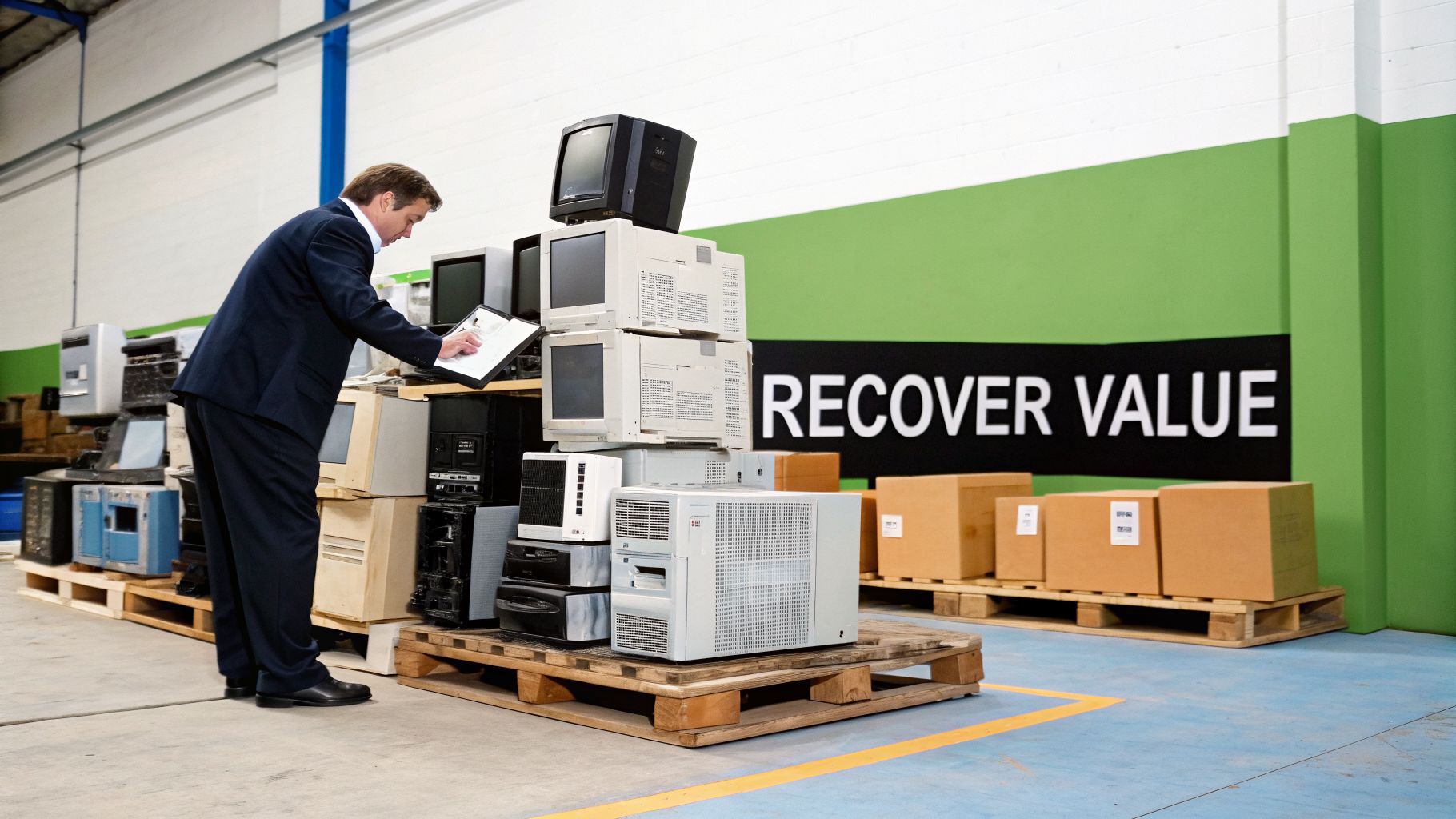
The storage room filled with retired laptops, servers, and monitors isn’t just dead space. It’s a huge blind spot for many organizations. Too many businesses see electronics disposal as just another expense, but that’s an outdated way of thinking. A modern approach reveals the truth: it's about managing risk, staying on the right side of the law, and even getting money back.
Let's be clear: just throwing old equipment in the dumpster is not an option. While Georgia is one of the 25 states that doesn't have its own e-waste recycling law, federal regulations are very much in play. The EPA's Resource Conservation and Recovery Act (RCRA) is the big one, and it strictly prohibits landfilling the hazardous materials found in most electronics.
Navigating Federal Rules and Environmental Responsibility
So what does that actually mean for your business? It means those old-school CRT monitors, heavy uninterruptible power supplies (UPS), and even laptop batteries are considered hazardous waste. Get caught disposing of them improperly, and you’re looking at serious fines and legal headaches.
A professional partner that handles business electronics recycling services in Georgia lives and breathes these regulations. They make sure every single component is processed in an environmentally sound way, keeping your company compliant and protecting our local environment. This is a powerful way to support your corporate sustainability goals.
Key Takeaway: Federal RCRA regulations make it illegal to send common electronic components to a landfill. Working with a certified recycler isn't just a good idea—it's the only way to guarantee you're compliant and avoid penalties.
This shift toward responsible disposal is a huge economic driver. The global market for e-waste recycling and reuse is expected to explode, growing from $2.3 billion in 2025 to a massive $5.6 billion by 2034. Why? Because companies are scrambling to recover valuable materials like gold and silver from all that discarded tech. It’s a big reason why having a local recycling provider here in the Atlanta area is so vital.
Turning Risk into Reward
Compliance is one thing, but the two biggest reasons businesses call us are data security and value recovery. Every hard drive, smartphone, and server sitting in that pile has information on it. That could be sensitive data about your company, your employees, or worse, your customers.
Data Security: Hitting "delete" or doing a factory reset does almost nothing. Professional recyclers provide certified data destruction. This can be done through sophisticated software that overwrites the data multiple times or by physically shredding the drive into tiny pieces. You should always get a Certificate of Destruction to prove it was handled correctly.
Value Recovery: Not all of your old tech is worthless. Newer servers, networking gear, or a large batch of identical laptops might still have resale value. A true IT Asset Disposition (ITAD) partner will audit your equipment and can often offer a profit-sharing arrangement, turning that pile of "e-waste" into actual revenue.
Ultimately, calling in a professional recycling service isn't about getting rid of stuff. It's a strategic move that protects your brand, locks down your data, keeps you legal, and unlocks cash from assets you thought were worth nothing.
Building Your IT Asset Inventory
Before you can even think about scheduling a pickup or getting a quote for business electronics recycling here in Georgia, you've got to answer one simple question: what exactly do you have? This is about way more than just counting old PCs. Putting together a detailed IT asset inventory is your first, most critical step to a smooth and secure recycling project.
Think of it less like a chore and more like a treasure hunt through your own server closets and storage rooms. A proper audit is the only way you'll uncover hidden value in your old tech, spot potential data security risks, and make sure every single device is accounted for. The effort you put in now pays off big time later, making the whole process faster and more transparent.
The level of detail you need will vary. A law firm in Marietta might just be looking at a few hundred desktops and laptops. On the other hand, a manufacturer out in Norcross could be decommissioning specialized industrial controls right alongside their standard office equipment. Each situation needs a slightly different approach.
Starting Your Audit: What to Document
Your main goal here is to create a straightforward, clear record of every item you plan to recycle. Honestly, a basic spreadsheet is usually your best bet. For every asset, you’ll want to capture a few key details.
Start with the essentials:
- Item Type: Is it a desktop, laptop, server, monitor, or network switch? Get specific.
- Manufacturer and Model: For example, "Dell Latitude 7490" or "Cisco Catalyst 2960."
- Serial Number or Asset Tag: This is your unique identifier. It’s absolutely essential for tracking each device from your office to its final disposition.
- General Condition: A quick note like "working," "damaged screen," or "missing hard drive" helps a recycler figure out any potential resale value.
This list doesn't need to be a massive, complicated document. Its main purpose is to give your recycling partner a clear picture of what they're dealing with. A detailed list lets them give you a real estimate, showing you which items might earn you some money back and which will just be recycled.
A comprehensive inventory list is your most powerful negotiation tool. It allows recycling vendors to give you a firm quote based on real data, not guesswork, and helps identify assets that could generate a return for your company.
Tailoring Your Inventory for Maximum Value
Once you've got the basics down, it’s time to get a little more granular, especially with your higher-value equipment. For things like servers, high-end workstations, or networking gear, documenting the internal specs can directly boost your financial return.
For instance, when you're inventorying a server rack, don't just write down the chassis model. Pop it open and note the CPU type and quantity, how much RAM is installed, and the number and size of the hard drives. A server with 128 GB of RAM and modern processors is a world apart from a stripped-down system from ten years ago. Capturing these details helps your ITAD partner accurately gauge its value on the secondary market. If you really want to dig into this, you can learn more about the best practices for enterprise IT asset management and see how it fits your bigger picture.
Without this detailed approach, you’re basically just guessing what your assets are worth, and likely leaving money on the table.
Practical Tips for an Efficient Inventory Process
Taking on an audit can feel like a huge task, but a bit of organization makes all the difference. To keep things consistent, assign a dedicated person or a small team to own the project. Then just work your way through the building, one room or department at a time.
Here are a few tips we've seen work well for our clients:
- Use a Mobile Device: Snap pictures of model numbers and serial number tags. It's almost always faster than trying to write or type them out and you'll avoid typos.
- Consolidate Equipment: If you can, get all the electronics moved to one secure spot before you start. This saves you from running all over the building hunting for stray devices.
- Label Everything: As you log an item, stick a label on it. Simple colored stickers work great to mark things as "audited." This stops anyone from accidentally counting the same machine twice.
An organized approach like this doesn’t just make your audit easier—it makes the actual pickup day go a whole lot smoother for you and your recycling partner.
How to Secure Your Company's Data Before Recycling
Letting go of old hardware is one thing. Letting go of the sensitive company data on it is another beast entirely.
For any business here in Georgia—whether you're a financial firm in Sandy Springs or a medical clinic over in Roswell—data security isn't just a priority; it's non-negotiable. Don't be fooled into thinking a simple "delete" or a factory reset is enough. It's not. A motivated individual can still recover that data, and that's a risk no business can afford.
A single data breach from a carelessly tossed hard drive can be devastating. That’s why professional data destruction is a fundamental part of any responsible business electronics recycling services in Georgia. This isn't about checking a box. It's about protecting your company, your clients, and your reputation from serious liability.
Getting a handle on what you have is the first step. This flowchart gives a good overview of the decision-making process when auditing your IT assets before you even think about destruction.
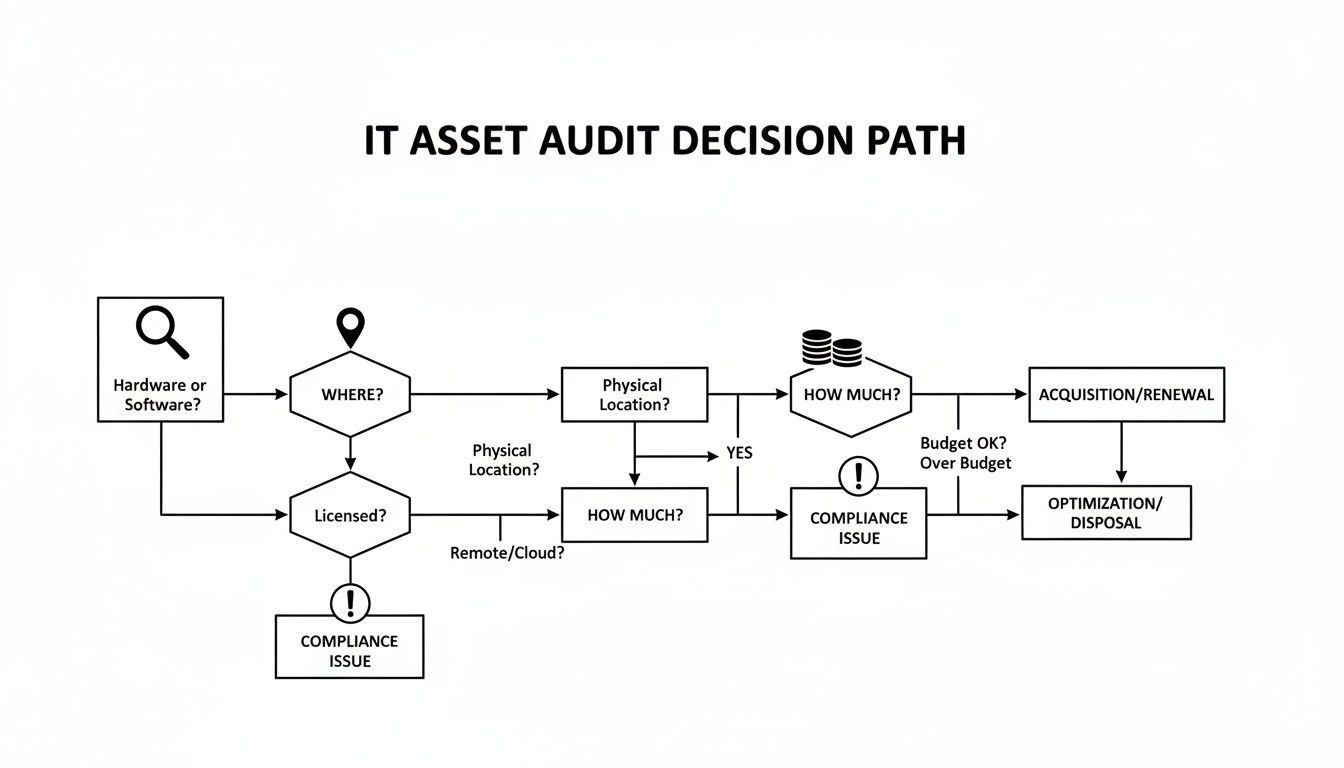
Once you know what hardware needs to be retired, you can decide how to handle the data on it.
The Two Pillars of Data Destruction
When you need to make sure your data is gone for good, you've really got two main paths: software-based data wiping and good old-fashioned physical destruction. They each have their place, and the right choice depends on your gear's age and your company's security rules.
H3: Software Data Wiping
This is the digital sanitation approach. We use specialized software to overwrite every single part of a hard drive with random data. The gold standard here is the DoD 5220.22-M method, which involves a three-pass overwrite. It effectively erases the original data, making it next to impossible to get back with conventional tools.
- When to use it: Wiping is perfect for newer or high-value equipment, like laptops and servers you're hoping to resell. The drive stays intact, so the machine keeps its value.
- Our approach: We actually provide this three-pass DoD wipe for free as part of our recycling services. Your data is secured without an extra line item on the invoice.
H3: Physical Destruction
This is exactly what it sounds like—the brute-force method. We pull the hard drive out and feed it into an industrial shredder. That machine turns it into a pile of tiny, mangled metal bits. There is no coming back from this.
- When to use it: Shredding is the only answer for old, broken, or worthless hard drives. It's also the go-to for any organization with iron-clad security policies that demand total annihilation of data-bearing media.
- On-site option: For total peace of mind, we can bring our mobile shred truck right to your office in the Metro Atlanta area. You can watch your drives turn into confetti.
The single most critical piece of paper you'll get from your recycling partner is the Certificate of Data Destruction. This is your official, auditable proof that every drive was properly destroyed in line with regulations like HIPAA or the FTC Disposal Rule. Never, ever work with a vendor who can’t provide one.
Matching the Method to Your Needs
So, how do you choose? Let’s walk through a common scenario.
Imagine a software company in Kennesaw is refreshing 50 two-year-old employee laptops. Those machines still have a lot of life and resale value. Here, software wiping is the obvious choice. The data gets securely erased, and the company can recoup a nice chunk of its original investment.
Now, picture a Marietta hospital retiring a rack of servers that are a decade old and have been storing sensitive patient records. The hardware is worthless, and the data falls under strict HIPAA rules. The only acceptable path here is physical shredding. The potential cost of a data breach is infinitely higher than any tiny value left in that ancient equipment.
This table breaks down the key differences to help you decide.
Data Destruction Methods Compared
| Method | Process | Best For | Compliance Level | Montclair Crew Service |
|---|---|---|---|---|
| Software Wiping | Overwrites the drive with random data (e.g., DoD 5220.22-M 3-pass). | Newer, functional devices with resale value (laptops, servers). | High. Meets most compliance needs (HIPAA, SOX, GLBA). | Free with pickup. |
| Physical Shredding | The hard drive is mechanically shredded into small metal fragments. | Obsolete, damaged, or non-functional drives; highest security needs. | Absolute. Exceeds all compliance standards. | Available on-site or off-site. |
| Degaussing | Uses a powerful magnet to instantly destroy the magnetic field on a drive. | Magnetic media like hard drives and tapes; very fast process. | Very High. Often used with shredding for extra security. | Available upon request. |
Ultimately, choosing the right method depends on balancing asset value, risk, and your company's specific compliance requirements.
If you're still curious about the nuts and bolts, we cover the process in more detail in our guide on how to wipe a computer before recycling, which applies to both business and personal scenarios.
Your Final Proof of Compliance
At the end of the day, this is all about removing every last bit of doubt. A certified, fully documented data destruction process is your shield against legal trouble and brand damage. It’s what lets you sleep at night.
By working with a professional, certified recycler, you effectively transfer that liability. You get the assurance that every single drive is handled according to federal regulations and industry best practices—and you get the paperwork to prove it.
Managing Pickup and Logistics Across Metro Atlanta
You’ve done the hard work of auditing your IT assets and you have a solid plan for destroying the data. So, what’s next? Now comes the real-world challenge: getting all that old equipment out of your building without bringing your business to a halt.
This is where the logistics come in, and frankly, it’s where a professional recycling partner proves their worth.
For most businesses in Georgia, it boils down to two choices: you can haul it all yourself, or you can have a team handle it for you. While both have their place, a coordinated pickup is the only practical option for most companies we work with.
Drop-Off vs. Full-Service Pickup
Our drop-off service at the Smyrna facility is great for small businesses or anyone with just a couple of items. If you've got a few old desktops that fit in the back of a car, dropping them off is a simple way to get the job done right.
But let's be realistic. Once you have more than ten items, or you're dealing with heavy gear like servers, printers, or networking racks, a DIY approach just doesn't make sense. A full-service pickup from a team that specializes in business electronics recycling services in Georgia is about more than just a truck showing up. It’s about handling every single logistical headache for you.
Think about the true cost of doing it yourself. Every hour your IT team spends lugging old computers is an hour they aren't managing your network or supporting your employees. A professional pickup service handles the heavy lifting—literally—so your team can stick to their actual jobs.
This is especially true if your office is in a busy commercial hub. Imagine trying to get 50 workstations out of a high-rise in Sandy Springs, or clearing a secure data room in Kennesaw. You have to deal with loading docks, freight elevator schedules, and building security. It’s a project in itself.
What a Seamless Pickup Looks Like
A smooth pickup is all about planning and execution. The whole point is to get the old equipment out of your hair with zero disruption to your workday. For our clients across Metro Atlanta, we've refined this into a simple, efficient process.
Here’s what you can expect:
- Coordination: We’ll talk with your office or facilities manager to figure out the best time for removal—even if that means after hours. We handle all the details, from site access to insurance paperwork.
- The Right Team & Tools: Our crew arrives in uniform with everything needed: dollies, pallet jacks, and packing supplies. We do all the work, from disconnecting PCs to palletizing servers.
- Secure Transport: Every item is loaded into a secure, GPS-tracked vehicle and brought straight to our facility. There are no detours.
- Chain of Custody: You get a detailed receipt listing every piece of equipment we removed. This document matches up perfectly with the inventory you created, closing the loop on asset management.
We recently did a project for a law firm in Alpharetta that needed to clear out over 100 desktops and monitors. Our team went in after 5 PM, packed everything up, and had the space completely cleared in under three hours. The next morning, they walked into a clean office, ready for their new equipment. No downtime, no hassle.
You can get a better feel for how we manage the whole removal by reading our guide on electronics recycling pickup services in Atlanta. This is the final step that takes those retired assets from a problem in your storage closet to a securely recycled resource.
How to Choose the Right E-Waste Recycling Partner

Choosing a company to handle your old electronics is one of the most critical decisions you'll make in the asset retirement process. It’s easy to think all recyclers are the same, but a bad choice can leave your Georgia business facing serious financial, legal, and PR headaches. A great partner protects you; a bad one creates a whole new set of problems.
This is about much more than just getting old equipment out of your storeroom. You need a partner you can trust to manage your sensitive data, navigate the maze of environmental rules, and hopefully, even put some money back in your pocket. You need someone who knows the local landscape, from the sprawling corporate campuses in Sandy Springs to the busy industrial parks in Norcross.
Start with the Certifications—They’re Non-Negotiable
When you start looking at business electronics recycling services in Georgia, the very first thing you should check for is their certifications. These aren't just logos for their website; they are your proof that a vendor follows the absolute strictest industry standards for handling data and protecting the environment.
The two big ones you must insist on are R2v3 and e-Stewards.
R2v3 (Sustainable Electronics Recycling International): This is the gold standard, globally. It guarantees the recycler has a documented, audited process for everything—from data destruction and worker safety to tracking every last component to its final destination.
e-Stewards: Developed by the Basel Action Network, this certification is laser-focused on preventing toxic e-waste from being illegally dumped in developing countries. It's another top-tier mark of a truly responsible recycler.
A vendor without one of these certifications is a huge red flag. It means they have no independent proof they handle your old equipment and the data on it responsibly. If your e-waste is mishandled, your company could be on the hook for it, even long after it has left your property.
Dig Into Their Data Destruction Process
Once you've confirmed they're certified, your next move is to grill them on data security. As we've discussed, this is where the biggest risks lie. You need a partner with a clear, documented, and fully auditable process for destroying the information on every single hard drive.
Get specific with your questions:
- Do you offer both DoD 5220.22-M software wiping and physical shredding?
- Can you bring a shredder to our office and destroy the drives on-site?
- Will we get a Certificate of Data Destruction that lists the serial number of every single asset you destroyed?
You want to hear a confident "yes" to all three. This gives you the flexibility to choose the right path for each device, balancing security with the potential for resale. For example, our own process at Montclair Crew includes free three-pass wiping on reusable assets and offers on-site shredding, all in line with our R2v3 standards.
Ask How You Get Paid (Value Recovery)
A real IT Asset Disposition (ITAD) partner doesn't just recycle—they find the remaining value in your old tech. Before you sign anything, make sure you understand exactly how their profit-sharing or value recovery program works. A transparent partner will be happy to walk you through it.
You need to know:
- How do you decide what an item is worth?
- What percentage of the resale revenue do we get?
- Are there any hidden fees that come out of our check?
A professional outfit will give you a detailed report showing what they sold, how much it went for, and what your cut is. This can turn a disposal project from an expense into a revenue source, especially if you have data center gear or large quantities of newer laptops.
Choosing the right partner is especially important here in Georgia. While the state generated around 21,000 tons of e-waste back in 2014, that number is projected to climb to 52,000 tonnes by 2027. With no statewide ban on landfilling electronics, your choice of a certified recycler is the only thing standing between you and a federal compliance issue.
Go with a Strong Local Partner
While national providers have their place, there’s a massive advantage to working with a partner who has boots on the ground right here in Metro Atlanta. A local company knows the area. They know how to deal with downtown traffic for a pickup, and they understand the logistics of getting into busy office parks in Alpharetta or Marietta.
Local providers mean faster response times, lower transport costs, and a more personal touch. You’re not just an account number in a giant system. Having a team that's just a short drive away gives you a level of peace of mind and practical support you just can't get from someone several states away. As you start weighing your choices, getting familiar with how to properly vet different IT recycling companies can give you a solid game plan.
Your Top Questions About Business Electronics Recycling Answered
When it's time to clear out old IT gear in Georgia, you've got questions. We've heard them all from business owners and IT managers across Metro Atlanta, and we've got the straightforward answers you need to make smart, fast decisions.
What’s the Real Cost of Business Electronics Recycling in Georgia?
This is always the first question, and the honest answer is: it depends. There's no simple flat fee because the final cost is a calculation based on what you have and the services you need. Our goal is always to get you the most value back while making sure everything is disposed of securely and by the book.
For many companies we work with, the final bill is surprisingly low—often zero. If you have a decent quantity of standard office IT equipment, services like data wiping and the actual removal are frequently included at no charge with a scheduled pickup.
A few things will shape your final quote:
- Asset Value: Do you have newer servers, laptops, or networking gear? This equipment can have serious resale value. That value can offset or even completely cover your recycling costs. Sometimes, we end up writing you a check.
- Hazardous Materials: Some older items require special handling. Think old-school CRT monitors or big, heavy uninterruptible power supplies (UPS). These have materials that come with a small, necessary disposal fee.
- Logistics: The complexity of the job matters. Do we need to de-install servers from racks? Is the equipment on the fifth floor with no elevator? These factors can influence the cost.
Any trustworthy partner will give you a transparent, itemized quote right from the start. You should never have to guess what you're paying for.
Are We Actually Legally Required to Recycle Our Business Electronics?
While Georgia is one of the states without a specific law forcing businesses to recycle e-waste, don't get a false sense of security. You are absolutely not off the hook. Federal laws are in full effect, and they have teeth.
The big one is the Resource Conservation and Recovery Act (RCRA). This is an EPA regulation that makes it illegal for businesses to dump hazardous waste in a landfill. And guess what? A lot of your old electronics, from lead-filled CRT monitors to the lithium-ion batteries in every company laptop, fall right into that category.
The lack of a state mandate isn't a free pass. Federal regulations and data privacy laws create a real-world requirement for professional electronics recycling. Trying to skirt these rules opens your business up to serious legal and financial trouble.
On top of that, you have data privacy laws to worry about. If you're in healthcare, you know about HIPAA. For anyone handling customer info, there's the FTC Disposal Rule. Both legally require you to completely destroy the data on your old devices. Using professional business electronics recycling services in Georgia is simply the smartest way to check all these boxes and manage your company's risk.
What Kinds of Electronics Can My Business Recycle?
Most professional B2B recyclers, like us, are set up to take a massive range of common IT and office equipment. That means you can clear out an entire storage closet or decommission a whole data center in one go.
Typically, you can recycle:
- Computers and Servers: Desktops, laptops, all-in-ones, server racks, and blade servers.
- Networking Gear: Switches, routers, firewalls, and modems.
- Telecom Equipment: Old office phone systems, VoIP phones, and video conferencing units.
- Monitors and Displays: LCD flat-panel monitors are easily recycled.
- Mobile Devices: All those old company cell phones and tablets.
- Peripherals: Boxes of keyboards, mice, and tangled computer cables.
A good vendor will be crystal clear about what they take. If you have something specialized they don't handle, like lab or medical equipment, they should be able to point you to a trusted partner who does.
How Can I Be 100% Sure My Company’s Data Is Gone for Good?
This is, without a doubt, the most important question. Your proof and your protection come in the form of a Certificate of Data Destruction.
This isn't just a piece of paper; it's your official, audit-proof record. It confirms that every single hard drive and data-bearing device was professionally sanitized or physically destroyed. Never, ever work with a recycler who won't provide one.
A certified vendor will use methods that comply with strict standards like NIST 800-88. This involves either using specialized software for a multi-pass data overwrite (like the DoD 5220.22-M method) or, for ultimate security, physically shredding the drives into tiny, confetti-like pieces that can never be reassembled.
This certificate is what protects you during an audit. It's what lets you sleep at night, knowing your company's sensitive information—and your clients'—is permanently destroyed. With the sheer volume of e-waste growing, this is more critical than ever. Worldwide, small IT gear like computers and routers will create over 4.7 million metric tons of e-waste in 2025, but recycling rates remain dangerously low. You can read more about these e-waste statistics and see why secure disposal is a must for every business.
Ready to decommission your old IT assets with complete confidence? The team at Montclair Crew Recycling provides certified, secure, and responsible electronics recycling for businesses all over Metro Atlanta. We make it simple, from on-site pickup to certified data destruction, so you stay compliant and your data stays safe. Get a free quote for your business electronics recycling project today.
