

In today's data-driven environment, simply disposing of old IT equipment is not enough. You need verifiable proof that it was done securely, responsibly, and in compliance with all relevant regulations. A Certificate of Destruction (COD) is your official record, serving as a critical legal document that protects your organization from liability, validates your commitment to data security, and ensures regulatory adherence. Without it, your business is exposed to potential data breaches, hefty non-compliance fines, and significant reputational damage.
This guide moves beyond theory to provide practical, actionable resources. We will break down the essential types of CODs by providing a detailed certificate of destruction sample for every major business need. You will find annotated examples that highlight the specific fields, crucial legal language, and strategic considerations for each document. This will help you understand precisely what to look for and how to ensure your documentation is ironclad. Beyond basic destruction receipts, formal documentation like a certificate of destruction serves as an important legal notice, and exploring various legal notice templates can be highly beneficial for understanding the broader scope of formal business communications.
From standard hardware disposal and DoD-compliant data wipes to industry-specific certifications like HIPAA or PCI-DSS, these examples will equip you to manage your IT asset disposition process with absolute confidence and full accountability.
1. Standard IT Equipment Destruction Certificate
A Standard IT Equipment Destruction Certificate is a critical legal document that provides official proof that electronic assets like computers, servers, hard drives, and networking gear have been physically destroyed. This certificate is the final step in the IT Asset Disposition (ITAD) lifecycle, serving as a formal record that all data-bearing devices were rendered permanently unreadable and unrecoverable, closing the chain of custody and mitigating liability for the asset owner.
This document is essential for organizations that handle sensitive information, as it provides a verifiable audit trail for compliance with data privacy regulations like HIPAA, GDPR, and FACTA. It formally transfers liability from your organization to the destruction vendor, certifying that the disposal process was handled securely and responsibly. Without this proof, a company could face severe penalties if a discarded device is later found with intact data.

Core Components of a Standard IT Equipment COD
A comprehensive certificate of destruction sample for IT equipment must contain specific, non-negotiable details to be considered valid for audit and compliance purposes. These elements ensure transparency and accountability.
- Unique Certificate ID: A serialized number for tracking and verification.
- Customer Information: Full legal name and address of the organization whose assets were destroyed.
- Vendor Information: Name, address, and contact details of the certified destruction company (e.g., Montclair Crew).
- Date and Location of Destruction: Specifies when and where (on-site or off-site facility) the destruction occurred.
- Detailed Asset List: An itemized inventory of all destroyed equipment, including type (e.g., laptop, server, SSD), make, model, and, most importantly, the unique serial number for each item.
- Destruction Method: A clear description of the process used, such as "physical shredding," "crushing," or "degaussing," often referencing specific standards like NIST 800-88 or DoD 5220.22-M.
- Chain of Custody Statement: Confirms the secure handling of assets from collection to final destruction.
- Authorized Signature: The signature of a representative from the destruction company, legally attesting to the accuracy of the certificate.
When to Use This Certificate
This type of certificate is indispensable in numerous scenarios. Data centers decommissioning servers, financial institutions retiring old banking systems, and healthcare providers disposing of medical devices containing patient information all rely on this document to meet strict regulatory requirements. For any organization, this certificate is the definitive proof needed to close out asset management records and demonstrate due diligence in protecting sensitive data.
Actionable Tips for Implementation
To maximize the value and validity of your certificate, follow these best practices:
- Pre-Destruction Inventory: Always create a detailed internal inventory list with all serial numbers before handing assets over to a vendor.
- Cross-Reference: Once you receive the certificate, meticulously cross-reference every serial number against your internal list to ensure 100% accuracy.
- Request Photographic/Video Evidence: For high-value or highly sensitive assets, ask your vendor for visual proof of destruction to supplement the certificate.
- Verify Compliance Standards: Ensure the certificate references recognized industry standards like R2 (Responsible Recycling) or e-Stewards, which signal adherence to secure and environmentally sound practices.
By treating the Certificate of Destruction as a vital legal record, you protect your organization from data breach risks and ensure a compliant end to your equipment's lifecycle. Professional services are key to ensuring this process is handled correctly; for a deeper understanding of secure disposal methods, you can explore certified IT asset destruction services that provide these guarantees.
2. Data Destruction Certificate with DoD Compliance
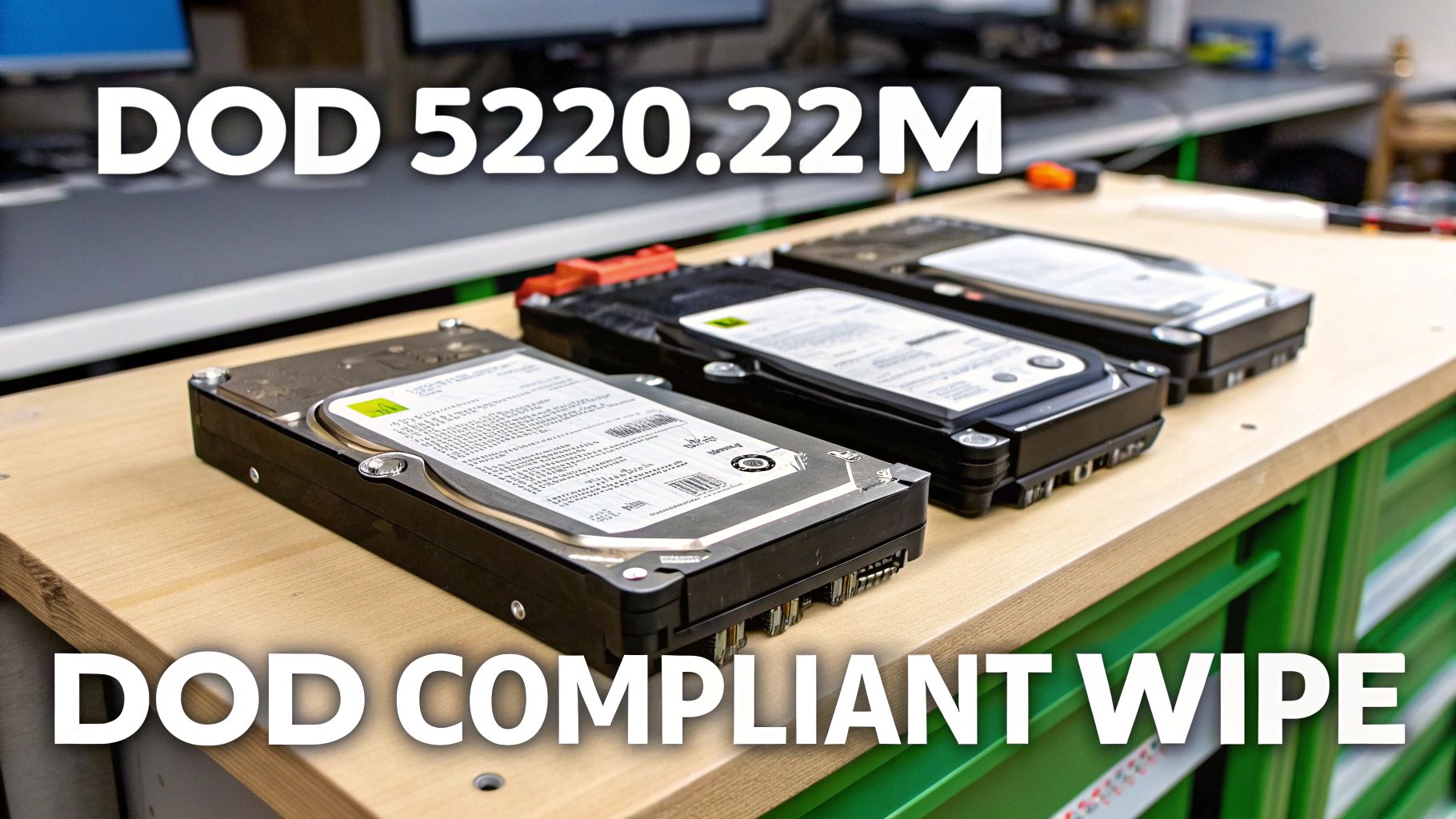
A Data Destruction Certificate with DoD Compliance is a highly specialized document that certifies data-bearing devices, such as hard drives and solid-state drives, have been sanitized or destroyed in accordance with the U.S. Department of Defense standard DoD 5220.22-M. This standard outlines a specific method for overwriting data, making it exceptionally difficult to recover. This certificate serves as authoritative proof that sensitive information has been rendered permanently inaccessible, meeting some of the most stringent data security requirements.
This type of certificate is crucial for organizations in regulated industries like government, defense, healthcare, and finance. It provides an auditable record demonstrating due diligence and adherence to rigorous data sanitization protocols. By certifying compliance with a recognized federal standard, the document helps organizations mitigate risks associated with data breaches and prove they have taken advanced measures to protect confidential information on retired assets.
Core Components of a DoD-Compliant COD
To be valid, a certificate of destruction sample claiming DoD compliance must contain precise details that go beyond a standard certificate. These elements ensure the process is verifiable and meets federal guidelines.
- Unique Certificate ID: A serialized tracking number for audit purposes.
- Customer and Vendor Details: Full legal names and addresses for both the client and the certified destruction provider.
- Specific Compliance Statement: An explicit declaration that data destruction was performed in accordance with DoD 5220.22-M.
- Sanitization Method Details: A clear description of the process, such as "3-pass overwrite (passes of zeros, ones, and random characters)" or "physical destruction following failed sanitization."
- Itemized Asset Log: A detailed list of all sanitized or destroyed media, including the make, model, and unique serial number of each device.
- Verification Statement: A clause confirming that a verification process was performed after the final overwrite pass to ensure no data remained.
- Technician Credentials: The name and signature of the certified technician who performed or supervised the destruction.
- Date and Location: The specific date and physical location where the data destruction took place.
When to Use This Certificate
This certificate is essential for any organization handling sensitive government data, client financial records, or protected health information (PHI). Government agencies and contractors are often mandated to use this level of sanitization. It is also the document of choice for law firms eliminating confidential client files, financial institutions retiring customer data systems, and healthcare organizations decommissioning drives containing patient records to comply with HIPAA.
Actionable Tips for Implementation
To ensure your DoD-compliant certificate is robust and defendable, follow these strategic steps:
- Verify Vendor Certification: Before engaging a service, explicitly ask for proof of their capability to perform and certify DoD 5220.22-M compliant data wipes.
- Compare Standards: While DoD 5220.22-M is well-known, compare it with modern standards like NIST 800-88, which may be more appropriate for your industry and device types (especially SSDs).
- Request Batch Certificates: If you have multiple destruction events, request a separate certificate for each batch to maintain a clear and organized audit trail.
- Audit the Asset List: Meticulously check every serial number on the final certificate against your internal asset records to confirm every single device is accounted for.
By demanding a DoD-compliant certificate, you are adopting a defense-grade standard for data protection. For more information on processes that meet these high standards, consider exploring professional services for secure hard disk disposal that guarantee regulatory compliance.
3. Environmental Compliance and Recycling Certificate
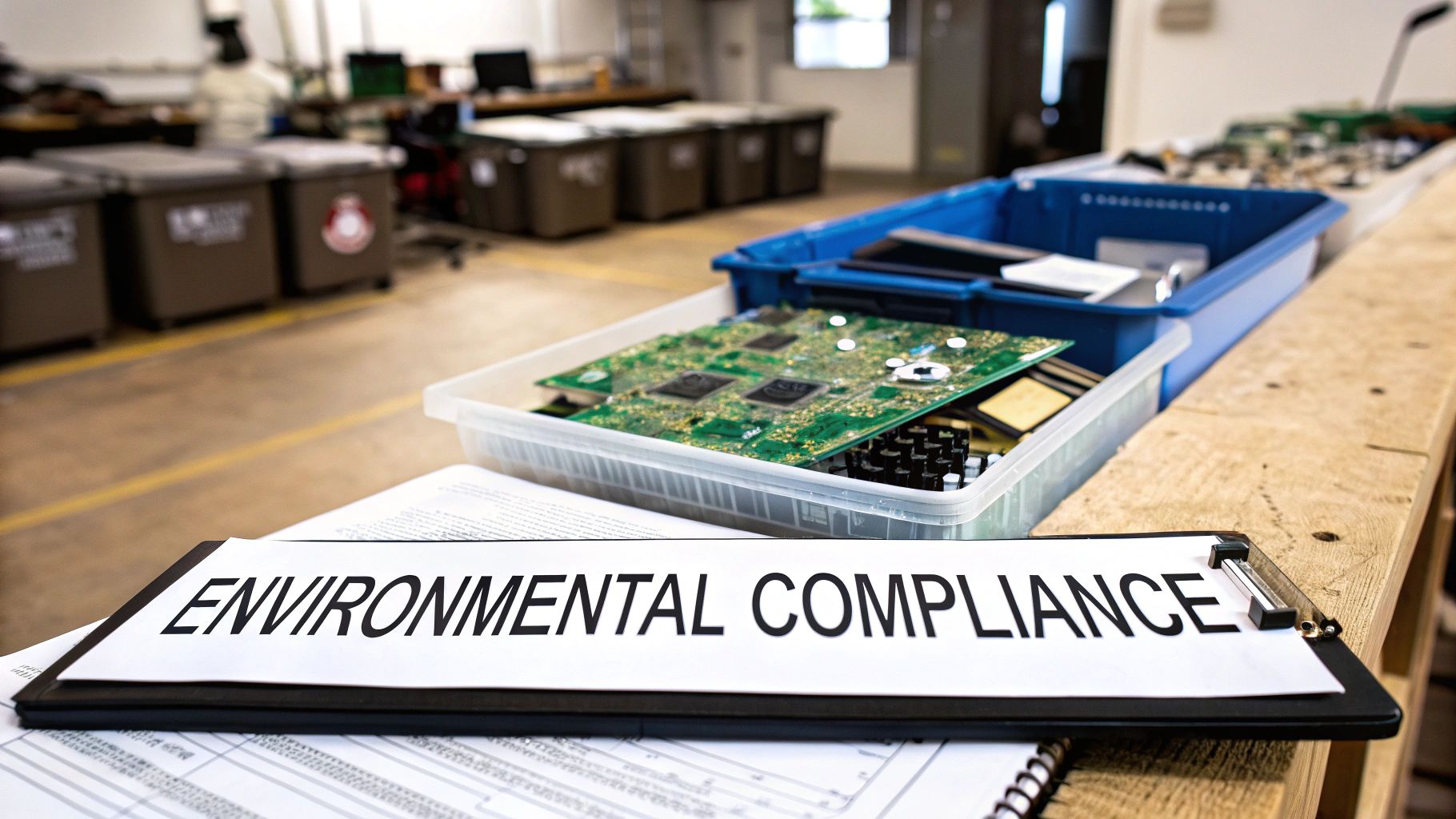
An Environmental Compliance and Recycling Certificate is a document that verifies IT assets were disposed of in an environmentally responsible manner, adhering to all local, state, and federal regulations. Unlike a standard COD focused solely on data destruction, this certificate confirms the proper handling of hazardous materials (e.g., lead, mercury, cadmium), the recycling of recoverable components (metals, plastics), and the diversion of e-waste from landfills.
This document is crucial for organizations committed to sustainability, corporate social responsibility (CSR), and environmental stewardship. It serves as tangible proof that the end-of-life process for electronic equipment aligns with standards like ISO 14001 and supports green initiatives. For businesses, it is a key tool for building a positive brand image and meeting the expectations of environmentally conscious stakeholders.
Core Components of an Environmental Compliance COD
A robust certificate of destruction sample focused on environmental compliance must include specific details to validate sustainable practices and satisfy regulatory audits. These elements demonstrate a commitment to responsible e-waste management.
- Unique Certificate ID: A traceable serial number for auditing and record-keeping.
- Customer and Vendor Information: Full legal names and addresses of both the organization and the certified recycling partner.
- Processing Date and Location: Specifies when and where the recycling and processing activities took place.
- Detailed Asset Summary: An inventory of processed items, often categorized by type (e.g., monitors, desktops, servers) and total weight rather than individual serial numbers.
- Statement of Environmental Compliance: A declaration that all processing was performed in accordance with EPA regulations and relevant state laws.
- Material Recovery Breakdown: A summary of recycled materials, often listing percentages or weights of recovered commodities like steel, aluminum, plastic, and copper.
- Landfill Diversion Rate: A metric, usually a percentage, indicating how much of the total e-waste was successfully diverted from landfills.
- Recycling Vendor Certification: Explicit reference to the vendor’s certifications, such as R2 (Responsible Recycling) or e-Stewards, which guarantee adherence to high environmental and safety standards.
- Authorized Signature: A signature from a recycling vendor representative, legally attesting to the environmental claims made on the certificate.
When to Use This Certificate
This certificate is essential for organizations that prioritize and report on their environmental performance. Enterprises seeking ISO 14001 certification, schools participating in sustainability programs, and government agencies bound by green procurement mandates all require this documentation. It is also invaluable for corporations looking to bolster their annual sustainability reports and demonstrate tangible progress toward carbon neutrality goals.
Actionable Tips for Implementation
To ensure your environmental certificate is meaningful and verifiable, follow these best practices:
- Verify Vendor Certifications: Before engaging a partner, confirm their R2 or e-Stewards certification is active and valid. These standards are the industry benchmark for responsible recycling.
- Request Material Recovery Reports: Ask for detailed downstream reports that show where specific materials were sent for processing, providing a transparent view of the recycling chain.
- Integrate into CSR Reporting: Use the data from these certificates, such as landfill diversion rates and recovered material weights, in your corporate sustainability and shareholder communications.
- Track Metrics Over Time: Maintain a record of all certificates to track environmental performance across multiple disposition events, demonstrating continuous improvement.
By leveraging an Environmental Compliance and Recycling Certificate, your organization not only meets its legal obligations but also actively mitigates the environmental impact of electronic waste, turning a compliance requirement into a powerful statement of corporate responsibility.
4. Asset Audit and Disposition Summary Certificate
An Asset Audit and Disposition Summary Certificate is a comprehensive document that goes beyond simple destruction. It integrates asset inventory auditing with the final disposition outcomes, providing a complete lifecycle record for each piece of equipment. This certificate details not just what was destroyed, but also what was received, how each item was categorized (for resale, refurbishment, or recycling), and the final status of every single asset.
This type of certificate is crucial for organizations focused on value recovery and meticulous financial tracking within their IT Asset Disposition (ITAD) programs. It bridges the gap between IT asset management and secure disposal, creating a single source of truth for both compliance and financial reporting. For businesses decommissioning large-scale operations, this summary offers transparency into which assets generated revenue and which were securely destroyed, satisfying both finance and IT departments.
Core Components of an Asset Audit and Disposition Summary COD
A robust certificate of destruction sample that includes audit and disposition details must provide a clear, itemized breakdown to be effective for both operational and financial governance.
- Unique Certificate ID: A serialized number for referencing the entire disposition project.
- Customer and Vendor Information: Full legal names, addresses, and contact details for both parties.
- Project Dates: Includes the date of asset collection, processing, and final certificate issuance.
- Master Asset Inventory List: A complete list of all assets received, including type, make, model, serial number, and any internal asset tags.
- Disposition Status per Asset: A clear code or description for each line item indicating its final outcome, such as "Destroyed," "Resold," "Recycled," or "Refurbished."
- Financial Recovery Data: For resold or remarketed items, this section includes the value recovered for each asset, providing clear financial reporting.
- Destruction Details (if applicable): For all destroyed assets, this must include the method (e.g., "shredded to 2mm particles"), date, and a statement of data sanitization compliance (e.g., NIST 800-88).
- Authorized Signatures: Signatures from both the customer and the ITAD vendor, confirming the accuracy of the audit and disposition results.
When to Use This Certificate
This comprehensive certificate is ideal for organizations managing complex technology refresh cycles where not all assets require destruction. Corporations decommissioning data centers use it to track which servers are destroyed and which components are resold for value recovery. Similarly, educational institutions and healthcare systems rely on this summary to document the multi-year lifecycle of their equipment, ensuring both data security for retired assets and financial accountability for reusable ones.
Actionable Tips for Implementation
To ensure this certificate delivers maximum value, strategic preparation is key:
- Conduct a Pre-Pickup Audit: Create a detailed internal inventory with serial numbers, asset tags, and notes on the condition of each item before the vendor arrives.
- Define Disposition Criteria: Work with your vendor to establish clear, written criteria for what qualifies an asset for resale, refurbishment, or mandatory destruction based on age, condition, and data sensitivity.
- Demand Itemized Reporting: Do not accept a summary without line-item detail. Insist that the final certificate matches every asset from your pre-pickup audit to its final disposition status.
- Leverage Financial Data: Use the financial recovery data to offset the costs of new IT equipment and to demonstrate the ROI of a structured ITAD program to stakeholders. A full understanding of the ITAD process can highlight these financial benefits; for more information, you can explore the fundamentals of what IT asset disposition is and how it supports your business goals.
By implementing an Asset Audit and Disposition Summary Certificate, your organization gains a powerful tool for compliance, financial oversight, and strategic asset management.
5. On-Site Shredding Verification and Chain-of-Custody Certificate
An On-Site Shredding Verification and Chain-of-Custody Certificate is a specialized document that confirms the immediate, witnessed destruction of IT assets at an organization's own location. This certificate is crucial for high-security scenarios where assets containing sensitive data cannot leave the premises before being rendered completely unrecoverable. It documents the entire process, from the deployment of a mobile shredding unit to the final, verified destruction, providing an unbroken and auditable chain of custody.
This type of certificate offers the highest level of assurance, as stakeholders can physically witness the destruction process, eliminating any risk associated with transporting intact data-bearing devices. For organizations in highly regulated industries like government, finance, and healthcare, this on-site verification is often a mandatory requirement to prove absolute compliance and mitigate the most severe data breach risks. It serves as irrefutable proof that specific assets were destroyed at a specific time and place, under direct supervision.
Core Components of an On-Site Shredding COD
A robust certificate of destruction sample for on-site services must include detailed verification elements to be considered legally defensible and compliant. These components document the real-time nature of the service.
- Unique Certificate ID: A serialized number for internal tracking and audit purposes.
- Customer Information: The full name and physical address of the facility where the destruction took place.
- Vendor Information: Details of the certified on-site destruction provider, including information about the mobile shredding unit used.
- On-Site Service Details: The exact date, start time, and end time of the shredding operation. It should explicitly state "On-Site Destruction."
- Witness Verification: A designated section for the signature of the client representative(s) who witnessed the destruction, confirming their direct observation of the process.
- Itemized Asset List: A comprehensive inventory of all shredded assets, including type, make, model, and the unique serial number for each device.
- Destruction Method: A specific description such as "On-site physical shredding via mobile industrial shredder," referencing particle size if applicable (e.g., to 2mm).
- Chain of Custody Log: A detailed log confirming that the assets never left the client’s control until the moment of destruction, signed by both the client and vendor.
- Reference to Evidence: A clause mentioning the existence of supplementary photographic or video evidence, often with file reference numbers.
- Authorized Vendor Signature: The signature of the lead technician from the destruction company, certifying the successful completion of the on-site service.
When to Use This Certificate
This certificate is non-negotiable for organizations that cannot afford any risk in the chain of custody. Government agencies destroying classified hardware, financial institutions decommissioning legacy systems with sensitive customer data, and healthcare facilities retiring servers containing patient records all mandate on-site destruction. It is also ideal for corporations where board members or legal counsel must witness the process to close out liability on high-stake assets.
Actionable Tips for Implementation
To ensure your on-site destruction process is seamless and the resulting certificate is ironclad, follow these best practices:
- Facility Prep: Before the mobile shredding unit arrives, ensure there is adequate physical space, clear access, and security clearance for the vendor's vehicle and personnel.
- Appoint Official Witnesses: Designate specific internal stakeholders (e.g., IT manager, compliance officer) to officially witness the entire process and sign the certificate.
- Document Everything: Request both high-resolution photos and a continuous video recording of the shredding process from start to finish.
- Confirm Equipment Capability: Verify beforehand that the vendor’s mobile shredder is capable of destroying the specific types of assets you have, such as enterprise-grade servers or SSDs.
- Immediate Sign-Off: Review and sign all documentation, including the certificate and chain-of-custody forms, on-site immediately after the destruction is complete.
Using a professional vendor for on-site services is critical to guaranteeing security and compliance. For more details on this high-security solution, you can explore certified secure hard drive shredding services that provide witnessed, on-location destruction.
6. Compliance-Specific Certification (HIPAA, PCI-DSS, GDPR)
A Compliance-Specific Certification is a specialized Certificate of Destruction (COD) tailored to meet the stringent data protection requirements of specific industry regulations like HIPAA, PCI-DSS, or GDPR. This document goes beyond standard verification by explicitly confirming that the destruction process adhered to the precise protocols mandated by these legal frameworks. It serves as irrefutable proof of compliance for organizations handling highly sensitive information, such as Protected Health Information (PHI) or cardholder data.
This type of certificate is non-negotiable for sectors where a data breach can lead to catastrophic legal, financial, and reputational damage. It provides a detailed audit trail that satisfies regulators, auditors, and legal counsel by formally documenting that all necessary steps were taken to protect specific data types according to law. The language and details are customized to mirror the requirements of the governing regulation, providing a direct line of evidence that due diligence was performed.
Core Components of a Compliance-Specific COD
To be valid, a certificate of destruction sample for regulated industries must include targeted information that directly addresses compliance mandates. These elements are critical for passing audits and demonstrating adherence to legal standards.
- Unique Certificate ID: A traceable serial number for official record-keeping.
- Customer and Vendor Information: Full legal names and addresses of both the client organization and the certified destruction partner.
- Regulatory Statement of Compliance: A direct and explicit declaration stating that the destruction process was performed in accordance with a specific regulation (e.g., "in compliance with HIPAA Security Rule physical safeguard requirements" or "adhering to NIST 800-88 guidelines as required by GDPR").
- Detailed Asset Inventory: A complete list of all destroyed devices, including media type, make, model, and serial number, to ensure every data-bearing asset is accounted for.
- Sanitization Method: A clear description of the technique used (e.g., "physical shredding to a 2mm particle size," "cryptographic erasure," or "degaussing"), often cross-referenced with the specific standard accepted by the regulation.
- Chain of Custody Record: A documented log confirming secure handling from the moment of collection to the point of final destruction, a key requirement for most compliance frameworks.
- Authorized Attestation: The signature of an authorized representative from the destruction vendor, legally certifying that the stated compliance standards were met.
When to Use This Certificate
This certificate is mandatory for any organization governed by strict data privacy laws. Hospitals and healthcare systems destroying devices containing electronic health records (EHR) must have a HIPAA-compliant COD. Similarly, payment processors retiring point-of-sale (POS) systems or financial institutions decommissioning servers with cardholder data require a PCI-DSS-compliant certificate. Any company handling the personal data of EU citizens must obtain a GDPR-compliant certificate to prove data erasure upon request.
Actionable Tips for Implementation
To ensure your compliance-specific certificate is robust and audit-proof, follow these essential practices:
- Identify Applicable Regulations: Before engaging a vendor, work with your legal or compliance team to pinpoint every regulation your organization is subject to.
- Request Explicit Compliance Statements: Insist that your destruction partner includes specific language on the certificate that directly references the relevant regulations (e.g., "HIPAA," "PCI-DSS").
- Verify Vendor Certifications: Ensure your vendor holds relevant certifications like NAID AAA, which demonstrates their adherence to secure destruction protocols recognized by these regulatory bodies.
- Maintain Comprehensive Records: Store your compliance-specific CODs alongside your internal asset management records and copies of the relevant regulatory guidelines for easy access during an audit.
By securing a Compliance-Specific Certificate of Destruction, you build a powerful defense against regulatory scrutiny and affirm your commitment to protecting the most sensitive data entrusted to your organization.
Certificate of Destruction: 6-Point Comparison
| Certificate | Implementation Complexity 🔄 | Resource Requirements ⚡ | Expected Outcomes 📊 | Ideal Use Cases 💡 | Key Advantages ⭐ |
|---|---|---|---|---|---|
| Standard IT Equipment Destruction Certificate | Medium — requires accurate pre‑destruction inventory and record-keeping | Inventory system, basic destruction service (shredding/incineration), authorized signatory | Legal proof of disposition; chain-of-custody; audit-ready records | General compliance: data centers, hospitals, finance, education | Audit evidence; liability protection; compliance baseline |
| Data Destruction Certificate with DoD Compliance | High — multi‑pass wiping, verification, and technical attestations | Specialized wiping tools, trained technicians, time for multiple passes, verification tools | Technical proof of irrecoverable data; regulatory‑grade evidence | Highly sensitive data: healthcare, finance, government, legal | Meets DoD/NIST standards; strong defensibility; widely recognized |
| Environmental Compliance and Recycling Certificate | Medium — requires certified partners and material tracking | R2/e‑Stewards certified recyclers, material recovery reporting, environmental compliance checks | Proof of lawful recycling; landfill diversion metrics; ESG reporting support | Sustainability-focused organizations, enterprises, government, schools | Supports ESG reporting; regulatory compliance; sustainability credentials |
| Asset Audit and Disposition Summary Certificate | High — comprehensive audits, valuation, and multi‑path coordination | Asset auditors, inventory/ITAM systems, logistics, resale/refurb partners, finance coordination | Full lifecycle visibility; recovery value reporting; complete audit trail | Large IT refreshes, datacenter decommissions, enterprises, universities | Financial recovery insight; governance support; planning data |
| On‑Site Shredding Verification & Chain‑of‑Custody Certificate | High — mobile shredding logistics, safety, and witness protocols | Mobile shredding unit and crew, scheduling, site access, photo/video evidence, safety gear | Immediate witnessed destruction; strongest chain‑of‑custody; visual proof | Highest‑security needs: government, banks, healthcare, board‑witnessed disposals | Maximum assurance; eliminates transport risk; compelling visual documentation |
| Compliance‑Specific Certification (HIPAA, PCI‑DSS, GDPR) | Very high — requires deep regulatory expertise and frequent updates | Specialized providers, legal/compliance review, tailored templates, third‑party audits | Regulatory defensibility; reduced audit findings/fines; insurance support | Regulated sectors: healthcare (HIPAA), payments (PCI‑DSS), EU data (GDPR) | Satisfies specific legal requirements; lowers audit risk; builds stakeholder trust |
Partnering for Certified Compliance: How Montclair Crew Delivers Peace of Mind
Navigating the landscape of IT asset disposition (ITAD) requires more than just physical disposal; it demands meticulous documentation that serves as your legal and regulatory shield. Throughout this guide, we have explored a diverse range of certificate of destruction sample documents, each tailored to specific compliance needs and operational scenarios. From standard IT equipment certificates to highly specialized forms verifying HIPAA or PCI-DSS compliance, the common thread is clear: a Certificate of Destruction (CoD) is not a mere formality. It is a critical business asset that provides auditable proof of due diligence, data security, and environmental responsibility.
We've seen how slight variations in language can distinguish between a simple record of disposal and a robust, legally defensible document. The inclusion of serial numbers, specific destruction methods like DoD 5220.22-M wiping or physical shredding, and clear chain-of-custody details are the building blocks of trust and compliance. The samples provided offer a blueprint, but their true value is only realized when executed by a certified and trustworthy partner.
Key Takeaways for Implementing a Compliant ITAD Program
Mastering the nuances of these certificates empowers your organization to move from a reactive to a proactive compliance posture. Here are the essential takeaways to implement immediately:
- Specificity is Non-Negotiable: Vague descriptions like "10 laptops" are insufficient. Your CoD must list unique identifiers for each asset, such as serial numbers or asset tags, to create an unambiguous audit trail. This links the certificate directly to the physical items that were destroyed.
- Method Matters: Always demand that your certificate details the exact method of data destruction. Was it a three-pass wipe? A degaussing procedure? Physical shredding to a specific particle size? This information is crucial for meeting standards like NIST 800-88.
- Chain-of-Custody is Your Proof: The document must clearly outline the journey of your assets from your facility to their final disposition. This includes dates, signatures, and the names of the entities involved at each stage, proving an unbroken and secure line of responsibility.
- Compliance Alignment is Crucial: Select a certificate format that directly addresses your industry's specific regulations. A healthcare provider needs explicit mention of HIPAA compliance, while a financial institution must reference standards like GLBA or PCI-DSS.
Actionable Next Steps for Your Business
Understanding a good certificate of destruction sample is the first step. The next is to operationalize this knowledge. Begin by reviewing your current ITAD vendor's documentation. Does it meet the standards we've outlined? If not, it's time to demand a higher level of detail and transparency.
Use the templates and annotated examples from this article as a benchmark to create a standardized CoD requirement for your organization. Present this requirement to any potential ITAD partner during the vetting process. This ensures that any vendor you work with understands your compliance expectations from day one. For global operations and stricter regulatory compliance, particularly concerning standards like HIPAA or GDPR, organizations might also require their certificates of destruction to undergo certified document translation services for international legal recognition.
Ultimately, the certificate of destruction is the final chapter in an IT asset's lifecycle. It is the tangible evidence that your organization has fulfilled its legal and ethical obligations to protect sensitive data and the environment. By prioritizing detailed, compliant, and verifiable documentation, you not only mitigate risk but also build a reputation for security and corporate responsibility that resonates with clients, stakeholders, and auditors alike. Your data security program is only as strong as its final, documented step.
Ready to transform your IT asset disposition process from a liability into a documented, compliant, and secure asset? Partner with Montclair Crew Recycling to receive certified, audit-proof Certificates of Destruction tailored to your specific industry needs. Visit Montclair Crew Recycling to learn how our transparent and secure services provide peace of mind for businesses across Metro Atlanta.
