

Your telecom bill probably isn't just a bill anymore. It's a stack of carrier invoices, mobility charges, cloud voice licenses, circuit IDs, old branch lines, and contract terms that nobody on your team has touched since the last office move. In Dallas, that problem gets bigger fast because the market is deep, competitive, and full of options that look similar until implementation starts.
That's why businesses here hire outside help. Not because they can't buy telecom on their own, but because buying telecom well is a different skill from running a company. In Dallas, where enterprise connectivity, carrier presence, and network upgrades move quickly, the right advisor can turn telecom from a monthly frustration into an operational asset.
Navigating the Dallas Telecom Maze Why Your Business Needs a Guide
Dallas businesses sit in one of the most active telecom environments in the country. That sounds like an advantage, and it is, but only if someone on your side knows how to evaluate carriers, spot billing waste, and match network design to how your team operates.
A lot of owners first feel the pain in a simple place. A renewal lands in their inbox. A provider says the new agreement is competitive. The invoice has dozens of line items. The office has grown, remote staff have been added, and nobody is sure whether the current setup still fits the business. That's the point where telecom stops being an IT side task and becomes a management problem.
Why Dallas is harder than it looks
Dallas has density. Carrier reps cover the market aggressively. Buildings vary widely in fiber access. Some locations have excellent provider competition. Others look connected on paper but become difficult once construction schedules, service delivery, and contract language enter the picture.
That's also why telecom consulting has grown into a serious specialty. The global telecom consulting market reached USD 7,291.0 million in 2024 and is projected to reach USD 14,519.6 million by 2030, reflecting demand for expert guidance in places like Dallas where businesses are dealing with next-generation network decisions and expense optimization, according to telecom consulting market analysis from PS Market Research.
A local business owner usually doesn't need another sales pitch. They need someone who can answer practical questions:
- Are we paying for services we no longer use
- Is this contract flexible enough for growth or downsizing
- Do we need fiber, SD-WAN, UCaaS, wireless failover, or a mix
- What happens to old telecom hardware after the upgrade
- Who owns the implementation timeline when carriers miss dates
Practical rule: If your telecom environment spans multiple offices, remote users, mobile devices, and legacy services, you're no longer making a simple purchasing decision. You're managing a portfolio.
What a guide actually does
A good telecom consultant doesn't replace your IT team or your facilities team. They fill the gap between operations, finance, procurement, and carrier management. They know where billing errors hide. They know which project assumptions usually break first. They know that the cheapest quote often becomes the most expensive option once delays, change orders, and poor support hit the business.
In Dallas, that guidance matters because the market moves quickly and rewards preparation. If you're expanding, relocating, consolidating, refreshing voice systems, or cleaning up years of telecom sprawl, you need a plan that covers both service selection and the end of life for replaced equipment.
That last part gets missed more often than it should. A network upgrade isn't finished when the new circuit goes live. It's finished when the old services are disconnected correctly, the old assets are documented, and the retired gear is handled securely and responsibly.
Decoding Telecom Consulting What Services to Expect
Most buyers start with the wrong assumption. They think telecom consulting services Dallas means someone shops rates, sends back a cheaper quote, and disappears. Real consulting is broader than that. It covers audit, sourcing, implementation, invoice governance, and often the cleanup work after a migration.

The audit is where value usually appears first
A proper engagement usually starts with discovery. That means collecting contracts, invoices, carrier portals, inventory lists, and service addresses. Then the consultant matches what you're paying for against what you use.
That sounds basic, but it's where a lot of hidden waste sits. A documented optimization approach starts with a full audit to identify unused lines and billing errors. In one reported case, a client saved $24,000 annually by removing 50+ phantom lines, and many consultants structure this work with success-based fees of 20-30% of the first year's savings, as described in InnoWave Telco's discussion of telecom consulting myths.
What matters in practice is not just finding the obvious disconnects. It's tracing the messy middle:
- Legacy voice lines left active after a site migration
- Duplicate billing where a disconnected service still appears on invoices
- Mobility plans that no longer fit user behavior
- Cloud licenses assigned to former employees or inactive departments
- Circuits without ownership because nobody internally is accountable for them
Strategic sourcing is different from carrier sales
After the audit, the next layer is sourcing and negotiation. At this point, an independent consultant earns their keep. A carrier rep works for the carrier. An independent advisor works from your requirements, your locations, your risk tolerance, and your budget model.
That distinction matters in Dallas because buildings and serviceability vary so much. One office may support multiple strong options. Another may force a more creative design that blends primary connectivity, backup wireless, and careful contract timing.
A solid consultant should be able to help with:
- Contract benchmarking against current market terms
- Service design for voice, data, cloud connectivity, and mobility
- Vendor comparison that goes beyond monthly recurring cost
- Renewal strategy before expiration pressure narrows your options
- Implementation ownership so somebody tracks every order, milestone, and escalation
Businesses that need day-to-day support after sourcing often move toward managed telecom services for ongoing oversight, especially when internal teams don't want to spend their week reconciling invoices and chasing service tickets.
The consultant's job isn't to recommend the fanciest architecture. It's to recommend the one your business can operate, support, and afford.
Project management is where many upgrades succeed or fail
This is the part buyers underestimate. The quote is only the beginning. The hard part is turning signed paperwork into live, stable service without damaging operations.
If you're moving from PRI to SIP, MPLS to a modern WAN design, or a legacy PBX to UCaaS, someone has to coordinate dependencies across carriers, cabling teams, internal IT, building management, and leadership. A good consultant keeps the project from drifting through missed handoffs and vague ownership.
Here's what competent project control usually looks like:
| Service Area | What you should expect |
|---|---|
| Audit and inventory | A line-by-line view of circuits, licenses, devices, contracts, and billing responsibility |
| Expense management | Ongoing invoice review, dispute handling, and trend monitoring |
| Contract negotiation | Competitive bids, redline support, renewal timing, and service-level review |
| Migration planning | Porting schedules, cutover sequencing, fallback plans, and site coordination |
| Lifecycle support | Disconnect management, asset tracking, and retired equipment disposition planning |
TEM keeps savings from leaking back out
A one-time cleanup helps. Ongoing telecom expense management is what keeps costs under control after the cleanup. Bills drift. Services get added. Teams move. Vendors make mistakes. Without governance, old waste comes back.
The best TEM setups combine process and software. Consultants may use inventory systems, automated discovery, reconciliation workflows, and API-connected monitoring platforms. The technology matters, but discipline matters more. Somebody has to review anomalies, challenge bad charges, and confirm that every active service has a business owner.
If a Dallas consultant can't explain how they handle post-implementation monitoring, they're probably selling a project, not building a telecom management function.
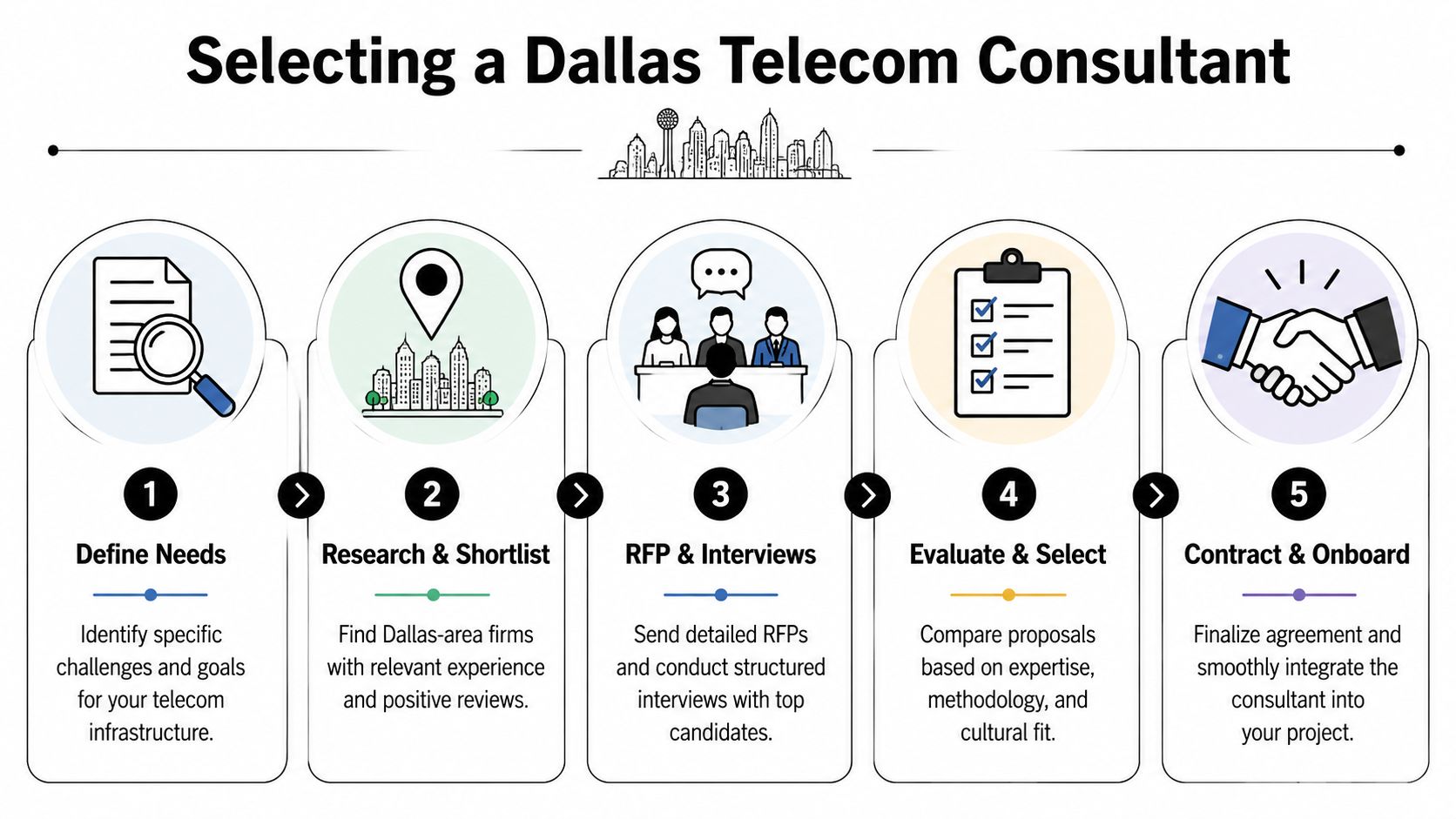
Your Step-by-Step Guide to Selecting a Dallas Consultant
Hiring a telecom consultant is its own business project. The wrong choice creates another vendor to manage. The right choice gives you a specialist who reduces confusion, tightens spending, and keeps telecom decisions aligned with operations.
Start inside your own business
Before you contact firms, get clear on what problem you need solved. “We need better telecom” is too vague. A consultant can't price, scope, or prioritize around that.
Write down what's happening in plain English. Maybe your contracts are up for renewal. Maybe your office move exposed weak carrier support. Maybe your team adopted cloud voice too quickly and now user complaints are piling up. Maybe you've got a closet full of retired handsets, routers, and switches from the last refresh and nobody owns the disposition process.
Use a simple internal brief with these categories:
- Business drivers such as growth, consolidation, cost control, remote work, or resilience
- Current pain points like invoice confusion, poor support, outages, or contract lock-in
- Technical scope including voice, WAN, internet, wireless, mobility, and hardware
- Operational constraints such as timeline, compliance needs, internal staffing, and site access
- Success definition so you know how to judge the engagement
Build a shortlist that fits your environment
In Dallas, the field includes local boutiques, large broker-consultants, TEM firms, and national players with a local footprint. Don't pick purely on size. Pick on fit.
If you run a multi-site operation, ask about multi-location implementation experience. If you're in healthcare, finance, manufacturing, or education, ask how they deal with compliance, downtime risk, and user adoption in those settings. If your project includes hardware retirement, ask whether they can coordinate with facilities, security, and certified disposition partners.
A useful signal is whether the consultant understands Dallas-specific service realities. They should know the difference between a building that looks carrier-rich in marketing language and one that's difficult in practice to service on schedule. Businesses comparing providers often also review Dallas telecommunications service options across the market to understand where consulting support fits relative to direct carrier relationships.
Use a short RFP, not a bloated one
A concise RFP often reveals more than a giant procurement package. If a consultant can't respond clearly to a focused request, they probably won't manage a messy implementation well either.
Ask for their process, not just their pricing. Ask who does the work. Ask how they measure savings. Ask how they escalate carrier issues. Ask what happens after the contract is signed.
Here's a practical checklist.
| Category | Essential Questions to Ask |
|---|---|
| Company fit | What types of Dallas businesses do you work with most often, and where does our environment fit |
| Audit process | How do you collect invoices, contracts, inventories, and service data, and what tools do you use |
| Carrier neutrality | How are you compensated, and how do you avoid steering recommendations toward one provider |
| Project management | Who owns cutovers, escalations, status reporting, and change control during implementation |
| TEM support | Do you provide ongoing invoice reconciliation and dispute management after the initial project |
| Technical scope | Have you handled projects involving UCaaS, WAN redesign, mobility, and retired telecom gear |
| Reporting | What reports do we receive, how often, and what decisions will those reports support |
| References | Can you point to work for firms of similar size and complexity without relying on vague testimonials |
| Commercials | Is your fee fixed, hourly, retainer-based, or tied to realized savings |
| Exit terms | What happens if the project scope changes or we need to transition management back in-house |
Buyer's note: If a firm talks only about “getting better rates,” that's not enough. Dallas businesses usually need invoice control, implementation discipline, and contract structure, not just a lower quote.
Interview for operating style, not presentation polish
A polished slide deck doesn't tell you what happens when a carrier misses a delivery date two days before your office opening. Ask scenario questions. Force the conversation into real operating detail.
For example:
- Tell us about a failed port or delayed circuit and how you handled it
- Who joins weekly project calls
- What do you need from our IT lead, finance lead, and office manager
- How do you validate disconnects so we don't keep paying
- How do you coordinate retired equipment after a migration
The answers should sound specific. You want names of tools, examples of workflows, and clear ownership. Mention of systems like Jira, Smartsheet, MS Project, or structured service inventories usually indicates they've done the work at scale. Vague language about “white glove support” usually means very little.
Read the contract like an operator
Scope language matters more than marketing language. So do assumptions. If your consultant says they'll manage implementation, verify whether that includes carrier follow-up, reporting, disconnect validation, user coordination, and post-cutover stabilization.
Pay close attention to:
- Fee mechanics
- Savings definitions
- Billing start dates
- What counts as out-of-scope work
- Termination rights
- Data ownership for inventories and reports
If a contingency model is involved, make sure everyone agrees on how savings are measured and over what period. If a retainer is involved, define response expectations and reporting cadence.
The best Dallas telecom consultants reduce ambiguity before the project starts. That's usually a better predictor of success than whatever they promise in the sales meeting.
Evaluating Costs and Calculating Your ROI
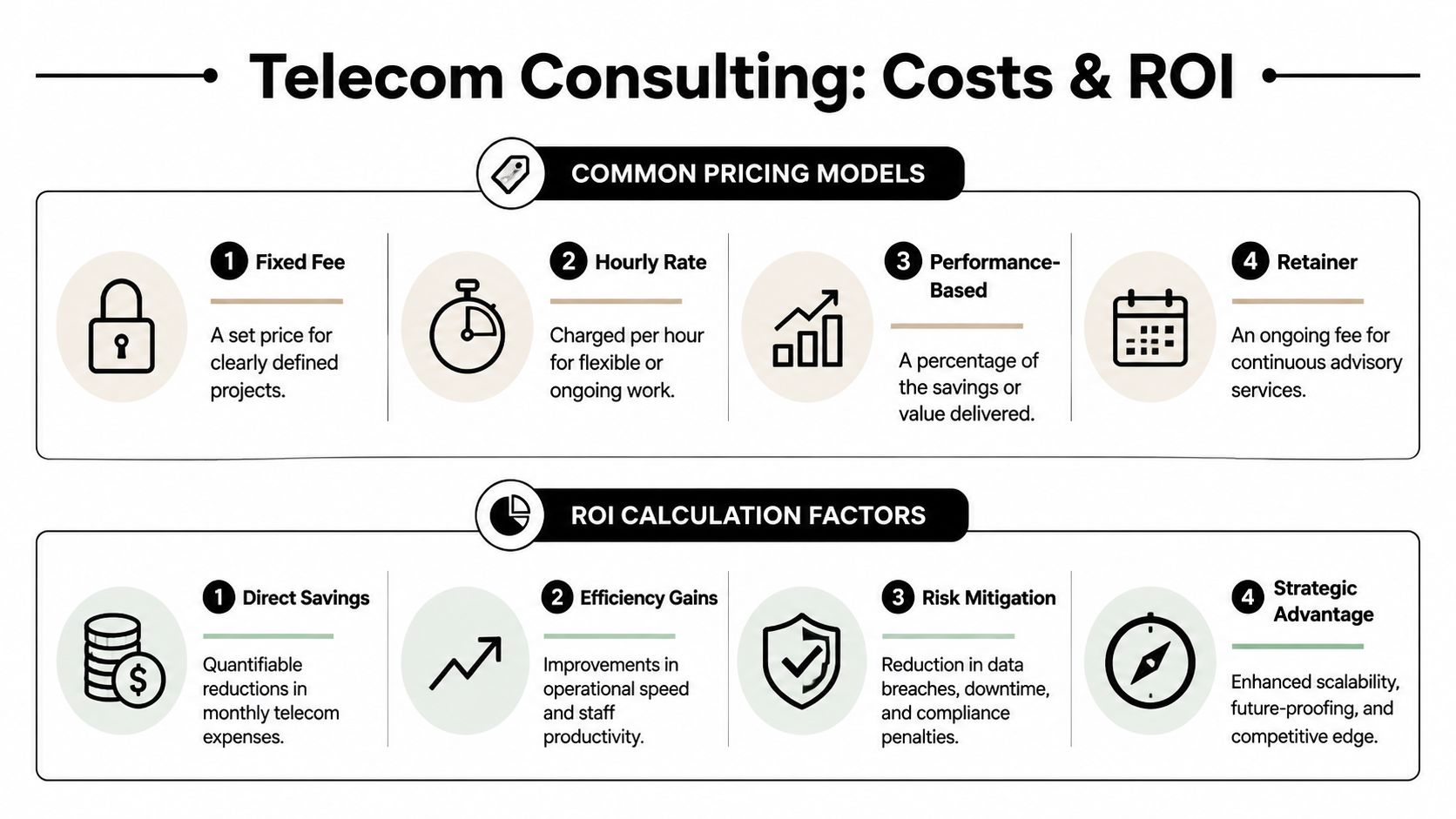
The pricing question comes up early because it should. A consultant may save money, but only if the engagement is structured well and tied to actual outcomes. The mistake buyers make is looking only at the consulting fee and not at the cost of bad telecom decisions left uncorrected.
The fee model should match the work
Different engagements call for different pricing.
A fixed fee makes sense when the scope is narrow and defined. Think contract review, a carrier bid process, or a single-site migration plan. An hourly model can work for advisory support, though many businesses dislike the uncertainty if the project stretches. A retainer fits companies that want ongoing telecom oversight, TEM support, and regular vendor management. A performance-based model is often attractive when the core objective is expense reduction.
None of these is automatically best. The right one depends on whether you need cleanup, strategy, execution, or long-term governance.
Here's a practical perspective:
- Fixed fee works when deliverables are obvious
- Retainer works when telecom needs recurring attention
- Performance-based works when savings are measurable
- Hourly works when you need targeted expertise without a large commitment
ROI has hard dollars and operating value
Direct savings matter, but they're only one part of return. If a consultant removes unused services, renegotiates contracts, and improves inventory control, that's the easy math.
The harder and often more important ROI comes from avoided mistakes. Internal teams often treat telecom as a side task. That's how projects drift. According to BCG's work on scaling agile telcos, 62% of self-managed technology projects exceed budgets, 71% overrun timelines, and 45% fail to deliver full intended benefits. Those numbers explain why many Dallas businesses would rather pay for specialist oversight than absorb delays, miscommunication, and weak execution.
Good telecom consulting doesn't just lower spend. It reduces the chance that your team burns months managing a project nobody has time to own.
A simple ROI lens for buyers
You don't need a complex model to pressure-test whether a proposal makes sense. Ask four questions.
| ROI Factor | What to examine |
|---|---|
| Direct savings | Which services, contracts, or billing issues are likely to be reduced or removed |
| Labor recovery | How much staff time will finance, IT, and operations stop spending on telecom cleanup |
| Risk reduction | Does expert management lower the chance of outage, billing leakage, or project rework |
| Future flexibility | Will the new contract or architecture make future moves, adds, and changes easier |
For procurement teams, this is closely related to broader IT procurement best practices for controlling vendor and lifecycle decisions. Telecom is one branch of that same discipline. The best buyers compare price, operational burden, and long-term flexibility at the same time.
What doesn't work
Two things usually go wrong.
First, companies chase the lowest monthly rate and ignore implementation risk, support quality, and contract rigidity. Second, they assume internal staff can absorb a complex migration without tradeoffs. In practice, that work gets layered onto people who already have full jobs.
That's why ROI should be framed as a business outcome, not just a discount percentage. If the consultant leaves you with a cleaner inventory, better governance, fewer carrier headaches, and a network that matches your operations, the return is usually larger than the fee line suggests.
The Dallas Advantage Local Market and Regulatory Factors
Dallas is not a generic telecom market. It has a dense mix of carriers, enterprise customers, data center activity, and long-standing telecom infrastructure. That creates real opportunity for buyers, but it also raises the penalty for choosing badly.

Dallas gives you options, but not equal options
The region's telecom depth is one reason so many companies base network-heavy operations here. But “many providers are in Dallas” doesn't mean every location gets the same advantage. Service availability depends on building access, last-mile realities, local construction constraints, and how quickly providers can deliver.
That matters for office users, industrial sites, distributed operations, and any business planning a move or expansion. A consultant with local knowledge can often identify where competition is strong, where timelines are fragile, and where backup connectivity should be planned from the start.
That kind of local coordination often intersects with broader building operations. If you're evaluating site readiness, security access, vendor coordination, and infrastructure dependencies together, it helps to view telecom inside the bigger framework of core Dallas facility services rather than as an isolated technology purchase.
AI traffic is changing the cost conversation
A lot of Dallas businesses are now dealing with network demand that didn't exist a few years ago. Cloud collaboration was one shift. AI-driven workloads are another. More traffic, more edge processing, more demand for consistent throughput, and more pressure on already uneven local availability.
Recent analysis tied to the Dallas market found that emerging AI workloads can raise bandwidth costs for Dallas SMBs by 25-40%, with local fiber conditions making the issue harder for some businesses, according to Dallas telecom consultant listings and related market analysis referenced by BBB. That doesn't mean every business should overbuy capacity. It means your network and contract strategy needs to account for how AI use changes traffic patterns.
A contract that looks fine under today's usage can become expensive fast if your business adds AI-heavy workflows without planning for them.
What local consultants should help you anticipate
In this market, a consultant should help you think beyond current invoices. Dallas businesses need guidance on where growth pressure is coming from and how to avoid locking themselves into the wrong design.
Look for help with:
- Location-specific carrier strategy for current and future sites
- Bandwidth planning tied to collaboration, cloud, and AI usage
- Wireless failover or redundancy for operations that can't tolerate downtime
- Contract language that won't punish reasonable shifts in usage
- Coordination across voice, data, mobility, and facilities
Businesses comparing telecommunications services in Dallas for multi-site and evolving network needs should ask not only what service is available now, but what will still make sense after the next office change, platform rollout, or traffic increase.
Dallas rewards businesses that treat telecom as infrastructure, not just an expense line. The companies that do this well stay flexible while others spend their time unwinding rushed decisions.
Beyond the Audit Integrating Sustainability and Future-Proofing
Most telecom projects stop too early. The new circuit is live, the phones work, invoices start arriving, and everyone moves on. Meanwhile, old switches, handsets, routers, access points, and cabling hardware get pushed into a closet or loaded into a storeroom with no plan.
That's not a finished project. It's deferred risk.

Old telecom gear creates three problems at once
Retired telecom hardware takes up space, but space is the least important issue. The bigger concerns are data security, environmental compliance, and missed value recovery.
Some of that gear still contains sensitive information. Some of it can't be discarded casually. Some of it may still have resale potential if handled quickly and documented properly. For these reasons, telecom consulting should overlap with IT asset disposition, even though many firms still treat them as separate worlds.
That gap matters more now. A 2025 Gartner report indicated that 68% of enterprises prioritize ESG in telecom procurement, while recent Dallas data showed telecom waste surged 15% year over year due to 5G rollouts, creating an opening for consultants who can address compliant handling of decommissioned equipment, as noted in Bearstone's Dallas telecom consulting discussion.
What good end-of-life planning looks like
A forward-looking consultant should raise the equipment question before the migration begins, not after. If they don't, you should.
The right process usually includes:
- Asset identification so retired hardware is tracked by site and type
- Data destruction coordination for any storage-bearing device
- Resale assessment for reusable equipment with market value
- Certified recycling for equipment that can't be remarketed
- Documentation for internal records, security teams, and sustainability reporting
Business priorities overlap at this critical stage. The finance team seeks value recovery. Security requires proof of destruction. Operations needs the site cleared quickly. Leadership expects the project to be closed cleanly. Sustainability teams require documentation that supports broader corporate sustainability goals tied to responsible equipment disposition.
If replaced telecom gear sits untracked after a migration, the organization hasn't reduced risk. It has simply moved the risk out of sight.
Why this belongs in the consulting scope
Some buyers still treat equipment disposition as an afterthought or a separate procurement event. That usually creates delays and confusion. The consultant who designed the upgrade already understands the hardware being replaced, the timing of cutovers, and the operational constraints at each site. That makes them the logical party to coordinate the disposition handoff.
This is also where Dallas businesses can separate mature providers from shallow ones. A mature telecom advisor thinks in lifecycle terms. They don't just ask what you're buying. They ask what you're retiring, who's responsible, how data will be handled, and how the disposition process affects project closeout.
Future-proofing isn't only about faster bandwidth or newer platforms. It's also about building a repeatable process for refreshing technology without leaving behind security exposure, compliance issues, or preventable waste.
FAQs About Dallas Telecom Consulting
Some questions still come up after the major decisions are clear. Here are concise answers to the ones Dallas buyers ask most often.
| Question | Answer |
|---|---|
| How early should we bring in a telecom consultant | Earlier than most companies do. Bring one in before renewals, relocations, or major upgrades, while you still have time to compare options and shape the contract instead of reacting to a deadline. |
| Can a consultant work with our internal IT team instead of replacing them | Yes. That's often the best setup. Internal IT knows your users, systems, and business priorities. The consultant adds carrier expertise, procurement discipline, and project control. |
| Do small businesses in Dallas benefit, or is this mainly for enterprises | Smaller firms benefit when they lack in-house telecom depth, have multiple services across voice and internet, or need help avoiding expensive mistakes during a move or refresh. Complexity matters more than company size. |
| What should we prepare before the first meeting | Gather recent invoices, contracts, renewal dates, a site list, known service issues, and a rough inventory of phones, circuits, and network equipment. If old hardware is piling up, include that in the discussion from day one. |
For businesses that need a compliant way to handle retired telecom and IT equipment after a network refresh, Montclair Crew Recycling helps organizations decommission hardware, destroy data, and keep reusable assets out of landfills. If your telecom project leaves behind servers, phones, switches, or related gear, their team can help you close the loop responsibly.
