
Most companies do not decide to look for corporate electronics disposal services in Georgia because they suddenly care about recycling policy. They do it because a storage room is full, an office move is coming, a server refresh is overdue, or an auditor asked a question no one wants to answer twice.
The pattern is familiar across Metro Atlanta. Retired laptops sit on a shelf because nobody is sure whether they were wiped. Old switches and phones are boxed in a back office. A stack of decommissioned drives waits for “later.” Later turns into quarters, then years. At that point, the issue is no longer clutter. It is data exposure, chain-of-custody risk, and a compliance problem that gets harder to fix the longer assets sit.
Businesses in Georgia need more than haul-away service. They need a process that accounts for media sanitization, state disposal rules, downstream recycling, documentation, and any resale value still left in the equipment.
Your Office Tech Graveyard The Hidden Risks
The “tech graveyard” usually starts as a practical decision.
An IT manager keeps a few retired desktops in case someone needs parts. Finance asks that written-off laptops stay on site until records are reconciled. A facilities team moves old monitors into a closet before a renovation. Nobody intends to create a disposal problem, but that is exactly what happens.
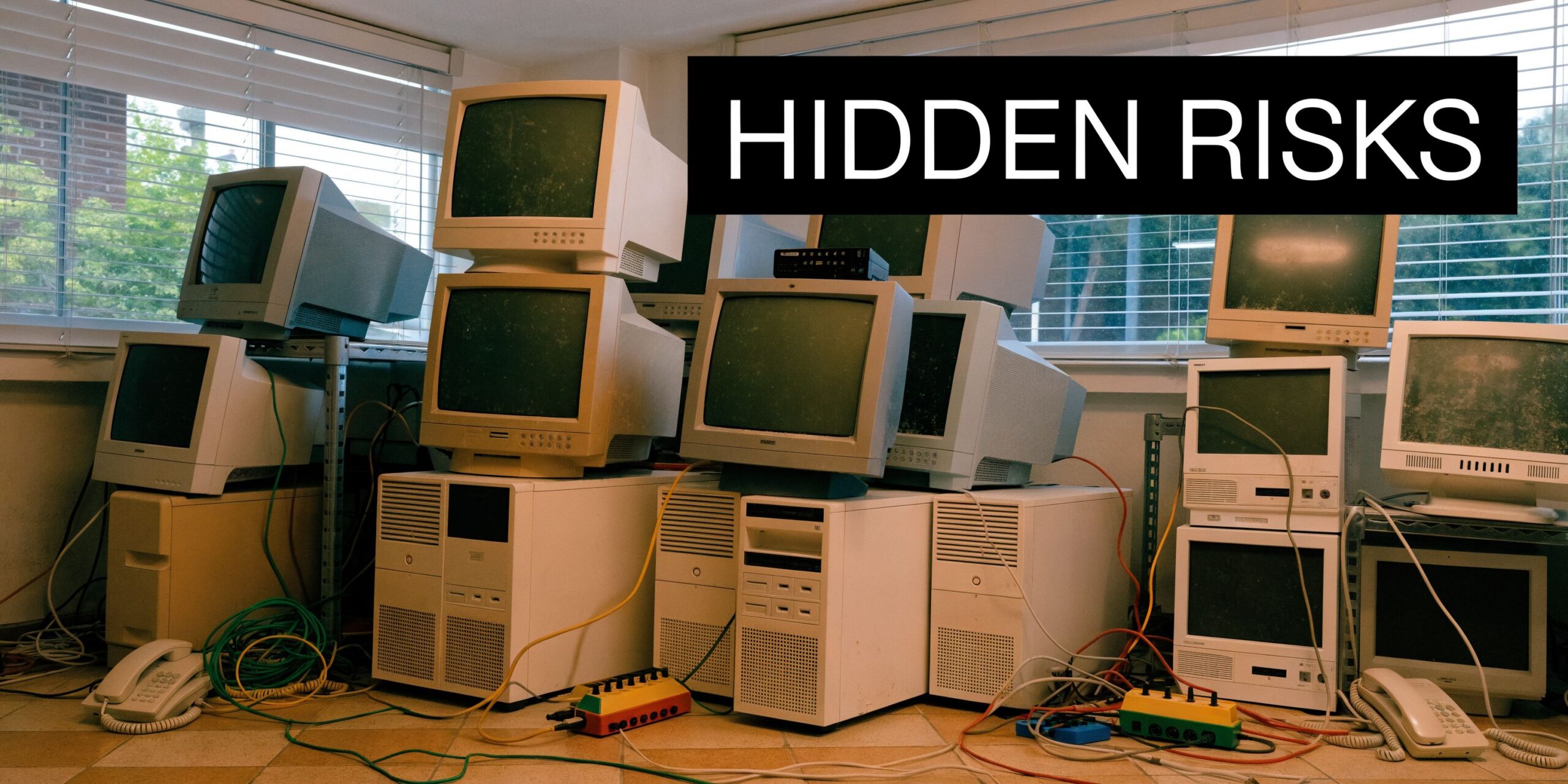
The danger is hidden because the equipment looks inactive. It is not inactive from a risk standpoint. A retired laptop can still hold customer files. A phone can still contain email access. A failed server can still contain regulated data on drives that no one has formally destroyed.
Why stored electronics become a business risk
Three problems show up repeatedly:
- Data stays recoverable: If no documented sanitization happened, you should assume the media still contains business data.
- Assets lose value while they sit: Equipment that could have been remarketed often turns into scrap if it is left too long.
- Disposal gets pushed into facilities instead of compliance: Once electronics become “junk,” teams make bad decisions like mixing them with general cleanout material.
Nationally, the volume of discarded electronics is not small. The U.S. EPA estimated that in 2009, consumers and businesses discarded approximately 2.37 million tons of televisions, computers, and cell phones, with only 25% collected for recycling according to the Georgia Department of Public Health recycling document citing EPA data.
That number matters for one reason. It shows how easy it is for electronics to leave controlled channels and end up in landfills or unmanaged streams.
What works better than storage and guesswork
A proper disposal program treats retired equipment as controlled assets until final disposition is documented.
That means:
- inventory first
- secure pickup or internal consolidation
- verified data destruction
- triage for reuse, resale, or recycling
- final reporting
Practical takeaway: If your company has a pile of retired devices and no matching destruction records, do not treat that as a housekeeping issue. Treat it as an unresolved security and compliance event.
Such situations are where professional corporate electronics disposal services in Georgia become useful. The right provider does not just remove equipment. The provider closes the loop.
What Is Corporate Electronics Disposal
Corporate electronics disposal is usually called IT Asset Disposition, or ITAD.
The simplest way to explain it is this. ITAD is a specialized exit process for business technology. It handles what happens when your equipment is no longer needed, but still carries data, financial value, regulatory obligations, or all three.
A general junk hauler moves things out of your building. An ITAD provider manages the controlled retirement of digital assets.
For a deeper overview of the discipline itself, see Montclair Crew’s explanation of what IT asset disposition is.
What falls under ITAD
Most business owners think first about desktops and laptops. The actual scope is much wider.
Corporate electronics disposal services in Georgia often cover:
- User devices: laptops, desktops, tablets, smartphones, monitors, docks
- Infrastructure gear: servers, storage arrays, firewalls, switches, routers
- Office technology: printers, scanners, copiers, conferencing systems
- Telecom equipment: VoIP phones, PBX hardware, network appliances
- Data center hardware: racks, UPS units, blades, decommissioned compute nodes
The point is not the item category. The point is whether the item was part of your operating environment and now needs controlled retirement.
How ITAD differs from basic recycling
A lot of businesses make the same mistake. They assume electronics recycling and ITAD are interchangeable. They are not.
Basic recycling focuses on material handling.
Corporate IT disposal focuses on material handling, data protection, records, and business value recovery.
Here is the practical difference:
| Service type | Typical focus | What is usually missing |
|---|---|---|
| Junk removal | Clearing space | Data controls, audit trail, resale review |
| Public drop-off recycling | Consumer convenience | Business chain-of-custody, asset-level reporting |
| Scrap buyer | Commodity recovery | Media sanitization standards, compliance documentation |
| ITAD service | Secure business disposition | Not just removal, but full lifecycle control |
Why businesses use it
Businesses usually need ITAD for one of these reasons:
- Refresh cycles: old fleets of laptops or workstations need retirement.
- Office moves: gear must be removed on schedule without losing track of anything.
- Mergers or closures: mixed inventories need audit, pickup, and data destruction.
- Data center changes: servers and storage come out fast, often in high volume.
- Compliance pressure: legal, audit, or sector requirements force a more disciplined process.
The strongest ITAD programs also look at value recovery. If equipment still has a secondary market, the process should identify it before anything is dismantled.
Key distinction: Good ITAD is not “recycling plus wiping.” It is a documented asset disposition workflow that balances security, compliance, environmental handling, and residual value.
The End to End Disposal Process Explained
A good disposal project is predictable. If the process feels improvised, risk goes up.
The workflow below is what business owners should expect from competent corporate electronics disposal services in Georgia. Montclair Crew outlines this kind of service model on its IT asset disposal page.
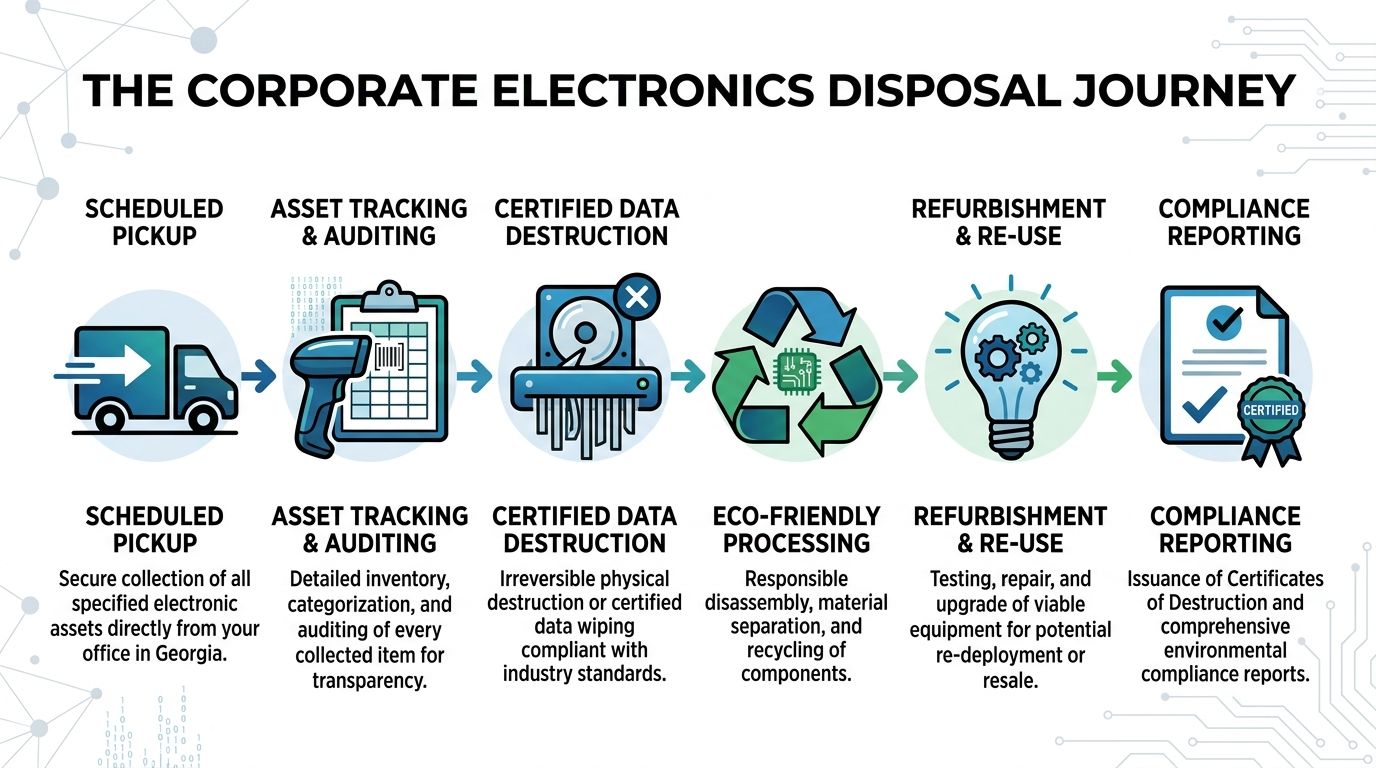
Start with an asset audit
The first step is not loading a truck. It is defining scope.
That usually includes a site walk, device categories, likely media types, pickup constraints, building access rules, and any items requiring special handling. For a small office, that can be straightforward. For a hospital wing, school district, or server room, it needs tighter planning.
An audit should answer practical questions:
- What exactly is leaving the site?
- Which assets likely contain data?
- Which items may still have resale potential?
- What documentation does the client need at the end?
If this step is skipped, downstream reporting gets messy fast.
Secure collection and transport
Pickup is a chain-of-custody event, not a moving job.
Equipment should be consolidated, labeled, and transferred in a way that preserves accountability from the client site to the processing location. If drives or sensitive devices are singled out for immediate destruction, that should be documented separately.
For Metro Atlanta companies, this step matters because pickups often happen during office transitions, data center work, or multi-floor decommissions. Confusion during loading is where assets get lost, mixed, or misclassified.
Intake and inventory at the facility
Once equipment reaches the processing facility, each item should be received into a tracked inventory.
Professional programs distinguish themselves from informal recyclers here. Every asset should have a disposition path. Some will be wiped and resold. Some will be dismantled. Some will go directly to destruction because age, condition, or policy makes reuse inappropriate.
Data destruction comes before final disposition
This is the control point most businesses care about, and rightly so.
Media-bearing assets should move into a sanitization workflow based on the storage type and the client’s requirements. Some organizations allow certified wiping for eligible hard drives. Others require shredding for all retired media. The right answer depends on the device, the data category, and internal policy.
A credible provider should be able to produce documentation that ties the destruction action back to the inventory.
Triage for reuse, resale, or recycling
After data-bearing devices are handled, the rest of the process is mostly about decision quality.
A disciplined triage process sorts equipment into three channels:
- Reuse or redeployment when gear is still serviceable and the client wants it preserved.
- Remarketing when equipment has residual market value.
- Recycling when reuse no longer makes economic or operational sense.
The mistake I see most often is sending everything straight to scrap. That is fast, but often wasteful.
Tip: Ask vendors when they decide an asset is recyclable versus remarketable. If they cannot explain that decision clearly, you will have trouble verifying value recovery later.
Responsible downstream processing
Material recycling still matters, especially for obsolete gear, broken monitors, and low-value peripherals.
The issue is not whether items are recycled. The issue is whether downstream handling is documented and aligned with recognized standards. Businesses should know whether materials are tracked, where they go next, and how the vendor manages non-reusable output.
Final reports close the project
The project is not complete when the truck leaves or when the shredder runs. It is complete when you receive the records.
Final documentation may include:
- Asset inventory reports
- Certificates of destruction
- Serial-based disposition records
- Recycling or downstream summaries
- Settlement reports for resale or profit-sharing
For the client, these records do two jobs. They support audits, and they settle internal questions later when someone asks what happened to specific equipment.
What does not work
Some disposal approaches sound convenient but create avoidable problems:
- Office self-storage: risk sits unresolved.
- One-time cleanout with no serial tracking: impossible to verify later.
- Consumer drop-off for business assets: poor fit for chain-of-custody needs.
- Scrap-first thinking: destroys resale value and can bypass proper data handling.
A sound end-to-end process is not complicated, but it does need discipline. That discipline is what turns electronics disposal from a liability into a controlled business operation.
Navigating Data Security and Compliance Standards
A Metro Atlanta company can clear out a storage room, send every device to a recycler, and still end up with a reportable incident months later. The failure usually starts with media handling. A laptop, firewall, copier hard drive, or retired server leaves the building without the right sanitization method, and the business is left proving after the fact what happened to the data.
Businesses evaluating disposal projects in Georgia should review the process details in Montclair Crew’s Georgia secure data destruction services guide.
NIST 800-88 sets the baseline
For corporate disposal, NIST SP 800-88 is the standard that should drive the decision. It matches the sanitization method to the media type and the risk level, which is exactly where many internal cleanouts go off track.
A magnetic hard drive and a solid-state drive should not be handled the same way. HDDs can often be sanitized through approved overwrite methods under the right conditions. SSDs are different because wear-leveling can leave data in cells an overwrite routine may not fully address. Analysts at Data Destruction’s Georgia compliance guide note that SSDs generally require physical destruction or cryptographic erase, while HDDs may qualify for approved overwrite under NIST-aligned procedures.
I see this mistake often during office decommissions. Staff assume a drive is a drive, run one wipe process across the batch, and mark the job complete. That shortcut creates risk, especially in mixed fleets with laptops, desktops, network gear, and multifunction printers.
Documentation matters as much as destruction
A secure process produces evidence, not just a clean warehouse.
For regulated businesses, the paperwork is what holds up under audit, legal review, or an internal investigation. That usually means serialized inventory, pickup records, custody transfers, the sanitization method used, exception logs, and a Certificate of Destruction tied back to the assets collected.
NAID AAA-certified vendors matter here because they provide the chain-of-custody documentation and Certificates of Destruction many healthcare, finance, and public-sector clients need to support compliance.
Georgia exposure is not theoretical
Georgia businesses have breach notification obligations under O.C.G.A. § 10-1-911. If data walks out inside a retired device, disposal stops being a facilities issue and becomes a legal, operational, and reputational problem.
That is why generic statements like “all drives are wiped” are not enough. Ask what happened to the SSDs. Ask whether copier drives were removed and destroyed. Ask whether failed drives, encrypted media, and nonfunctional devices follow the same chain-of-custody controls as working equipment.
What regulated sectors should verify before pickup
Healthcare groups, financial firms, schools, retailers, manufacturers, and government offices usually need tighter controls than a standard office cleanout.
Review these points before approving a vendor:
- Media-specific sanitization methods: HDD wiping is different from SSD sanitization.
- On-site destruction options: Often necessary when policy requires media destruction before transport.
- Serialized asset tracking: Needed to match each device to the final disposition record.
- Certificates of Destruction: Useful for audits, insurer questions, and internal compliance files.
- Chain-of-custody records: Important from pickup through final processing.
- Records retention and staff training: Ask how long the vendor keeps destruction records and how technicians are trained on secure handling.
The practical standard is simple. Every device is identified, every storage component is handled according to its media type, and every step is documented well enough that your business can defend the process later.
Understanding Georgias E-Waste Rules and Regulations
A lot of disposal advice online is technically correct and locally incomplete.
It tells businesses to recycle responsibly, wipe drives, and work with certified vendors. All of that is fine. It does not answer the Georgia question. What state-specific rules affect how a Metro Atlanta business should dispose of its equipment?
The EPD angle businesses often miss
In Georgia, electronics disposal intersects with the Georgia EPD and with hazardous waste handling obligations that do not disappear because the equipment is “just old IT stuff.”
The local issue many businesses overlook is documentation and proper handling under state rules, especially when they are dealing with higher-risk materials, bulk loads, or old display equipment. Generic recycling advice often ignores the EPD Universal Waste Rule and the recordkeeping discipline businesses need if they are ever asked to show how assets moved from office use to final disposition.
The verified data also notes an underserved issue in the market. Many providers mention broad certifications but do not explain Georgia-specific requirements such as the EPD Universal Waste Rule (391-3-11-.09) and the need for chain-of-custody documentation for audits, as highlighted in the R2 Recycling Georgia service area page referenced in the verified data.
The EPR Act matters more than most companies realize
Georgia’s Computer Equipment Disposal and Recycling Act applies Extended Producer Responsibility, requiring manufacturers to offer free take-back programs for covered branded equipment, as described by Montclair Crew’s page on Georgia electronics recycling.
That has two practical implications.
First, some assets may have a manufacturer return path that reduces what your business has to manage directly. Second, you still need to think carefully about data and internal documentation before using any take-back option. Free return is not the same as enterprise-grade ITAD.
The same verified source states that disposal must comply with RCRA hazardous waste rules, enforced by Georgia EPD, and that improper disposal of items like CRT monitors containing lead can risk substantial fines.
What certifications tell you
Businesses in Georgia see labels like R2 and e-Stewards and often stop there. Those labels are useful, but they are not interchangeable with your internal compliance program.
Here is the practical read:
| Certification or rule | What it signals | What you still need to verify |
|---|---|---|
| R2 | Structured electronics recycling controls and downstream accountability | Your exact chain-of-custody, reporting format, and data handling method |
| e-Stewards | Stronger restrictions on landfill and export practices, plus data privacy clauses | Whether the provider’s service model fits your operations |
| Georgia EPD rules | State-level handling and enforcement environment | Whether your items are packaged, documented, and transferred correctly |
| EPR take-back | Manufacturer responsibility for certain branded equipment | Whether you handled sanitization and asset records before release |
The local trade-off in Metro Atlanta
For an Atlanta-area business, the wrong choice is often the “easy” one.
A public drop-off may be fine for a household TV. It is usually a poor fit for a law firm with retired workstations, a school district with carts of devices, or a healthcare office with mixed media and audit obligations. Those organizations need serial-based records, secure transport, and a known downstream path.
Key takeaway: In Georgia, compliance is not only about recycling something instead of throwing it away. It is about handling it under the right state and federal framework, with documentation that holds up when someone asks for proof.
How to Choose the Right Disposal Vendor in Georgia
A Metro Atlanta office closes a refresh project on Friday. By Monday, retired laptops, phones, and switches are stacked in a conference room, and someone wants them gone before the next client meeting. That is the moment bad vendor choices happen. Fast pickup feels helpful, but speed means little if the provider cannot document custody, separate data-bearing assets correctly, or explain where material goes after it leaves your site.
Georgia businesses need a vendor that can do more than haul electronics away. The provider has to fit your internal controls, your data destruction standard, and the state rules that apply to storage, transfer, and recycling. For companies comparing IT asset disposition companies in Georgia, that means screening for process discipline first, then service options.
The local detail many buyers miss is Georgia-specific handling. If a vendor works in Metro Atlanta every day, they should be able to speak clearly about how they manage items covered under the Georgia EPD Universal Waste framework, how they separate business pickups from consumer-style collection, and when manufacturer take-back under the state’s EPR structure may or may not help your organization. If they stay vague on those points, keep looking.
The questions that separate serious vendors from convenient ones
Ask direct questions. A qualified vendor should answer without marketing language or evasive generalities.
- What certifications do you hold, and what do they cover? R2, e-Stewards, and NAID AAA can each matter, but the key question is which controls apply to your project.
- How do you handle hard drives, SSDs, and other media types? A vendor should explain the method for each one, not give one blanket answer.
- What records will I receive at closeout? Ask for sample asset reports, destruction certificates, and disposition summaries before you sign.
- How is chain-of-custody documented from pickup through final processing? The answer should include labeling, tracking, intake, and exception handling.
- Do you remarket reusable equipment? If yes, ask how devices are tested, how value is calculated, and how settlements are reported.
- Who handles downstream recycling? You need a clear answer on where non-reusable material goes and how those downstream vendors are screened.
One factual example in the Georgia market is Montclair Crew Recycling, which offers B2B pickup, asset audit, hard drive wiping, optional on-site shredding, and remarketing support for Metro Atlanta organizations. Treat that as one vendor profile to evaluate, not a reason to skip the checklist.
Georgia-specific checks that belong in vendor selection
A national vendor can look qualified on paper and still miss the operational details that matter in Georgia.
Ask how they package and move universal waste streams from your site. Ask whether they have a documented process for mixed loads that include batteries, monitors, networking gear, and data-bearing devices. Ask what happens if your team has older equipment that falls into manufacturer take-back channels versus equipment that clearly belongs in a business ITAD workflow.
These questions matter in Atlanta because many pickups are mixed. A law office may have laptops, dock stations, UPS units, and loose batteries in one load. A medical practice may have workstations plus storage media. A school may have carts of damaged Chromebooks and accessories. The right vendor knows how to separate those categories without creating reporting gaps or handling mistakes.
Value recovery should be part of the decision
Disposal cost is only one line item.
Usable devices may still have resale value, especially business-grade laptops, late-model desktops, servers, and network hardware. That does not mean every pallet will produce meaningful recovery. It does mean a vendor should have a documented remarketing process and a clear settlement method instead of defaulting everything to scrap.
If the provider cannot explain how they decide between resale, redeployment, parts harvest, and recycling, you are not looking at a mature ITAD program.
Vendor Selection Checklist for Electronics Disposal
| Criteria | What to Look For | Why It Matters |
|---|---|---|
| Data destruction method | NIST-aligned process, separate handling for HDDs and SSDs, certificates | Lowers breach exposure and gives you records that hold up in audits |
| Chain-of-custody | Documented pickup, tracking, intake, and transfer controls | Reduces loss, mix-ups, and custody disputes |
| Certifications | R2, e-Stewards, NAID AAA where relevant | Shows the vendor follows defined operating controls |
| Reporting | Serial-level inventories and final disposition records | Lets you prove what happened to each asset |
| Georgia regulatory awareness | Clear handling process for universal waste and mixed electronics streams | Helps avoid local compliance mistakes during pickup and transfer |
| On-site service capability | Pickup, packing, shredding, or decommission support as needed | Useful for offices, server rooms, and regulated facilities |
| Resale and settlement process | Transparent remarketing, testing, and value reporting | Helps recover value from reusable equipment |
| Downstream transparency | Clear explanation of recycling partners and material flow | Limits blind spots after assets leave your site |
Red flags worth taking seriously
Some warning signs show up in the first call.
Watch for unclear answers about SSD destruction, no sample reporting, no distinction between household recycling and business ITAD, or vague statements about “responsible recycling” without naming downstream controls. Be cautious with vendors who talk like scrap buyers when you are handing over data-bearing assets. Also be cautious with providers that know federal certifications but cannot explain Georgia handling requirements in plain language.
Ask for a sample Certificate of Destruction and a sample asset report before approving pickup. Serious vendors already have those documents ready.
The right disposal vendor in Georgia protects data, documents every handoff, understands the state rules that affect your load, and gives you a clean record at the end of the job.
Your Next Steps with Montclair Crew Recycling
If your business has retired equipment stacking up, the next move is not to keep storing it until the pile becomes urgent. It is to identify what you have, what contains data, and what must be documented before anything leaves the building.
Corporate electronics disposal services in Georgia work best when the project starts with a clear inventory and a defined policy for destruction, resale, and recycling. That is how businesses avoid the two common failures. First, data-bearing assets leaving without proof. Second, reusable equipment being treated as scrap because nobody reviewed it in time.
For organizations in Metro Atlanta, the practical next step is to request a pickup plan and asset review from a B2B provider that understands local business requirements. Montclair Crew Recycling serves companies across Alpharetta, Smyrna, Marietta, Kennesaw, Norcross, Sandy Springs, Roswell, and nearby areas with on-site removal, audit support, certified data destruction, and compliant disposition for computers, servers, telecom gear, and other IT assets.
If you need to move quickly, contact Montclair Crew Recycling by phone or email through the website and ask for three things up front: the service area confirmation, the data destruction method for your media types, and the reporting package you will receive at closeout.
That keeps the conversation grounded in operations, not marketing.
Frequently Asked Questions About Electronics Disposal
Can my IT team just wipe drives in house?
Sometimes, but that depends on the media, your internal controls, and your need for proof.
Internal wiping can work for certain workflows if your team uses a recognized standard, tracks every serial number, validates the results, and retains records. Where businesses get into trouble is assuming an informal process counts as a defensible one. If there is no documented method and no certificate trail, your company may struggle to prove proper sanitization later.
SSDs are where DIY approaches often break down. As covered earlier, the method has to match the media.
What affects the cost of corporate electronics disposal services in Georgia?
Cost usually depends on the mix of assets, the amount of labor involved, pickup logistics, on-site destruction requirements, and whether any equipment can be remarketed.
A box of old keyboards is different from a data center decommission. A small office pickup is different from removing equipment from multiple floors with building restrictions. The right way to think about pricing is net project cost after any applicable resale value, not just truck-and-labor charges.
Does Montclair Crew handle residential recycling too?
Montclair Crew is focused on B2B electronics disposal and IT asset disposition.
That makes sense because business jobs often require audit records, chain-of-custody, data destruction, and coordinated pickup. For residential electronics or specialized categories outside the company’s scope, the better approach is usually a local public program or a referral partner that handles those streams.
What happens to equipment that still works?
If the equipment is suitable for reuse, it may be tested, refurbished, and remarketed or redeployed rather than dismantled.
That matters for more than cost recovery. Proper reuse supports the circular side of electronics management. Globally, e-waste remains a major issue, and some regions such as the EU averaged 18.7 kg per inhabitant annually in 2014, according to the Current and future e-waste flows in Georgia report. When Georgia businesses resell or properly recycle equipment, they help keep hazardous materials out of landfills and keep useful materials in circulation.
Should we use manufacturer take-back or an ITAD vendor?
It depends on the assets and your internal obligations.
Manufacturer take-back can be useful for certain branded equipment covered under Georgia’s EPR framework. An ITAD vendor is usually the better fit when you need business-grade pickup, asset-level documentation, data destruction records, or remarketing support. Many organizations use both, but they do so intentionally rather than by default.
If your company is ready to clear retired IT equipment without creating security or compliance problems, contact Montclair Crew Recycling. They work with Metro Atlanta businesses that need pickup, audit support, data destruction, and responsible disposition for corporate electronics.
