
For any business in Atlanta, that closet full of old hard drives is more than just clutter—it's a ticking time bomb. Just hitting 'delete' on a file doesn't cut it. For real data security, you need to go a step further. Professional hard drive shredding in Atlanta, GA, is the only way to be 100% sure that sensitive data is gone for good, protecting your company from a potential disaster.
Why Physical Hard Drive Destruction Is Non-Negotiable
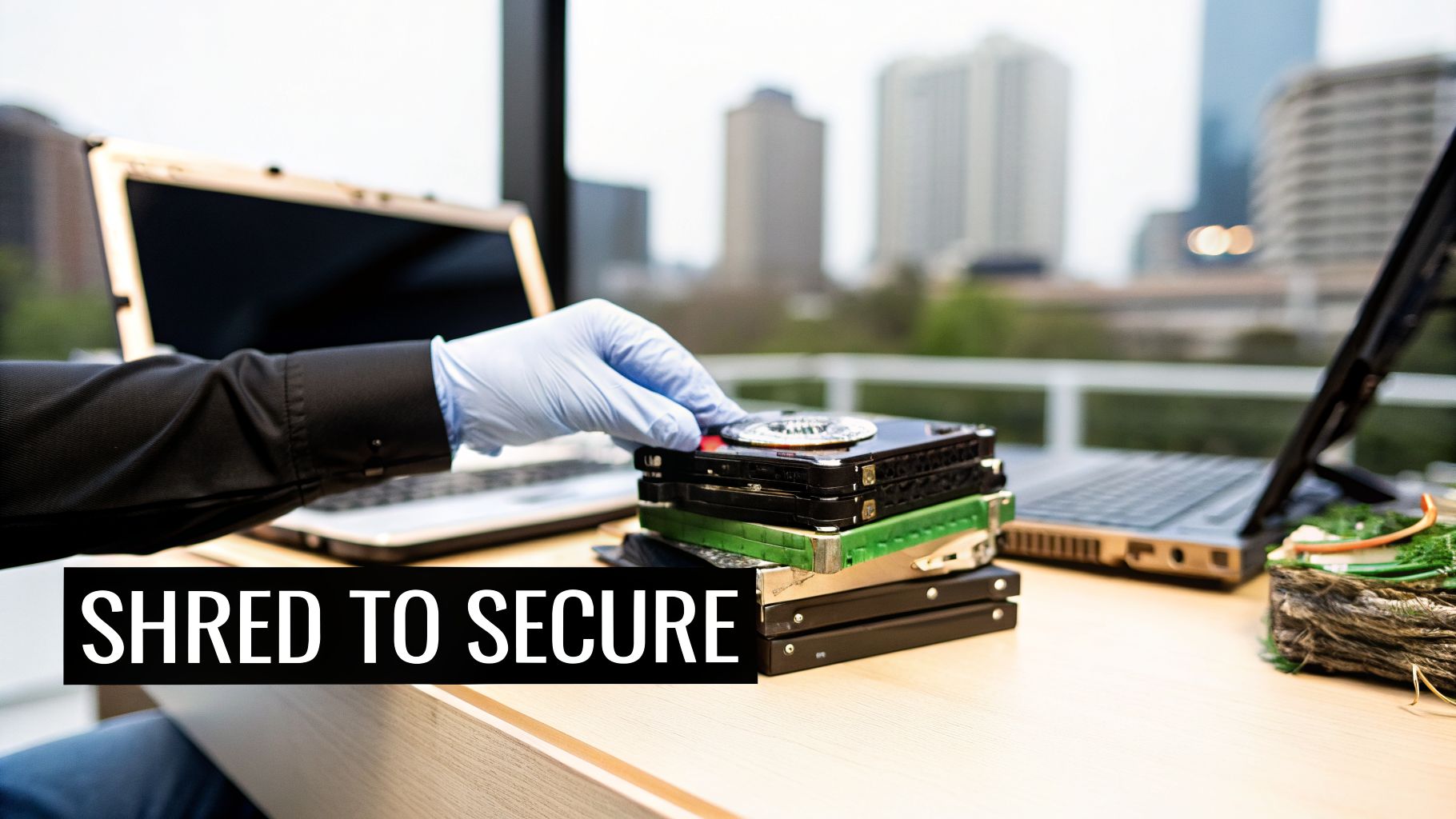
Think about it this way. Deleting a file is like crumpling up a sensitive document and tossing it in the wastebasket. Anyone can pull it out, smooth it over, and read it. Formatting the drive? That’s like scribbling over the paper with a pen. The original text is still there, just hiding underneath.
This is exactly why software-based wiping is always a gamble. These methods almost always leave recoverable data fragments behind, creating a massive security hole. If your organization handles any kind of client records, employee files, or trade secrets, that's a risk you just can't afford to take.
The Real-World Consequences of Improper Disposal
The danger of not properly destroying old hard drives isn't just some theoretical problem; the consequences are real, and they can be devastating for a business. All it takes is one drive falling into the wrong hands.
- Identity Theft and Fraud: Social Security numbers, financial records, and other personal data from customers or employees can be stolen and used for fraud.
- Corporate Espionage: Imagine a competitor getting their hands on your client lists, secret formulas, or strategic business plans from a discarded server drive.
- Massive Compliance Fines: If you're in an industry governed by HIPAA, FACTA, or GLBA, a data breach from improperly disposed IT assets can trigger crippling financial penalties.
- Irreparable Brand Damage: A public data breach can destroy customer trust overnight. The loss of business and a tarnished reputation can hurt far more than any fine.
Physical destruction isn't just a security checklist item; it's a core business strategy. It slams the door shut on data recovery, transfers liability off your shoulders, and gives you a paper trail to prove you did your due diligence.
At the end of the day, professional hard drive shredding is an investment in certainty. It takes old, obsolete hardware—a huge potential liability—and turns it into nothing more than inert, recycled scrap metal. This simple step is critical for protecting your business, your clients, and your reputation in the competitive Atlanta market.
You can learn more about how our complete process provides secure data destruction on our services page. We handle everything from pickup to the final certificate, giving you total peace of mind.
Choosing Your Data Destruction Method: Wiping vs. Shredding
So you have a stack of old hard drives. What now? The decision between wiping them clean or shredding them into tiny pieces really comes down to one thing: risk versus asset value.
Imagine you have an old painting. Wiping a drive is like carefully painting over the canvas so it can be used again. Shredding is like feeding that canvas into a woodchipper—there's absolutely no coming back from that. Each approach has its place, and the right call for your business depends on the hardware, the data, and what you plan to do with it next.
When to Choose Data Wiping
Data wiping, which you might hear called data sanitization, is a software-based method. It works by overwriting every single part of a hard drive with random data, making the original information practically unreadable. When done to a professional standard like DoD 5220.22-M, this can be a smart, green, and cost-effective option.
Wiping is a good fit when:
- Your equipment has resale value. If you're retiring newer laptops, servers, or desktops, wiping keeps them intact so they can be refurbished and sold. This helps you get some money back.
- You're reusing computers internally. Moving a machine from your finance team to the marketing department? A professional wipe makes sure no sensitive financial records accidentally go with it.
- The data isn't under strict compliance rules. For everyday business files, a certified wipe often provides all the security you need.
Be aware, though: wiping isn’t a magic bullet. While a DoD-compliant wipe makes data recovery incredibly difficult for most, it's not technically impossible for a determined expert. For your most sensitive data, it’s not the ironclad guarantee many businesses need.
When Hard Drive Shredding Is Essential
For many businesses in Atlanta, especially those in healthcare or finance, nothing beats the certainty of physical destruction. Hard drive shredding in Atlanta, GA provides the highest security possible, guaranteeing that data is 100% unrecoverable. Period.
Shredding is the only answer when:
- The hard drives are old or broken. If a drive is already dead or the computer it's in is worthless, there's no point in trying to save it. Shredding is the most secure and direct way to dispose of it.
- You have to meet tough compliance standards. Regulations like HIPAA (healthcare), GLBA/FACTA (finance), or government contracts often demand physical destruction to protect sensitive information.
- The data is irreplaceable or high-risk. If you're dealing with trade secrets, intellectual property, or critical personal information (PII), the cost of a potential data breach is astronomical compared to the value of the old hardware.
Here’s a quick comparison to help you decide.
Data Wiping vs. Hard Drive Shredding At a Glance
| Feature | Data Wiping (DoD 5220.22-M) | Hard Drive Shredding |
|---|---|---|
| Method | Software-based overwriting | Physical destruction |
| Data Recovery | Extremely difficult but not impossible | 100% Impossible |
| Hardware Outcome | Drive is preserved and reusable | Drive is destroyed, metal is recycled |
| Best For | Newer, valuable hardware | Old, obsolete, or damaged drives |
| Use Case | Resale, internal redeployment | Strict compliance, maximum security |
| Security Level | High | Absolute |
At the end of the day, making the right choice is about assessing your risk. While wiping has its uses, hard drive shredding offers total peace of mind and a rock-solid defense against any possibility of a data breach.
If you want to dive deeper into the technical side of wiping, you might find our guide on what data sanitization entails helpful.
Navigating Data Security Regulations in Georgia
For a lot of businesses here in Georgia, getting rid of old hard drives securely isn't just a good idea—it's the law. The rules around data privacy are a tricky maze, and one wrong turn can have some serious consequences for any Atlanta company. Making sure your old drives are handled correctly is a huge part of staying compliant.
You can think of these regulations as different blueprints for keeping data safe. A doctor's office in Marietta has to follow the HIPAA blueprint. A financial firm over in Buckhead is looking at GLBA rules. And if you're a government contractor, you've got your own set of DoD standards. They're all different, but they all demand the same thing: you must have solid proof that sensitive data was destroyed for good.
The Paperwork That Proves You're Compliant
To satisfy these legal requirements, two documents are non-negotiable: the Chain of Custody and the Certificate of Destruction. These aren't just pieces of paper; they're your legal armor if an auditor comes knocking or you're ever facing a data breach investigation.
- Chain of Custody: This document is a detailed log that follows your hard drives every step of the way, from the moment we pick them up at your Atlanta office to the second they hit the shredder. It creates a complete, unbroken trail of who handled your assets and when.
- Certificate of Destruction (CoD): This is the final, official document confirming your hard drives have been physically destroyed. It lists out the unique serial numbers of every device, the date, and exactly how they were destroyed.
A Certificate of Destruction is your official proof that you did everything right. It effectively transfers the liability off your shoulders, showing you took the necessary steps to protect your client, patient, or company data. Without one, you're left exposed.
Just look at the potential for business litigation that can follow data breaches, as legal experts point out. It really drives home why having these strict data security protocols in place is so important.
Key Regulations Hitting Atlanta Businesses
While there are many laws on the books, a few big federal acts directly tell local companies how they must handle the data on their old IT equipment. That's why partnering with a vendor for hard drive shredding in Atlanta, GA who actually understands these rules is so important.
HIPAA (Health Insurance Portability and Accountability Act)
For anyone in healthcare, from a small practice in Roswell to a major hospital, HIPAA is the law of the land. It says all Protected Health Information (PHI) must be made completely unreadable and unusable before you get rid of the device it's on. Fines for getting this wrong can hit $1.5 million per year, which is why certified shredding is a must-have.
GLBA (Gramm-Leach-Bliley Act)
This one is for the financial world—banks, investment firms, mortgage brokers, you name it. It forces them to protect customers' private financial information. The "Safeguards Rule" in GLBA specifically calls out the need for secure disposal of customer data.
FACTA (Fair and Accurate Credit Transactions Act)
FACTA's Disposal Rule applies to almost every business out there that handles consumer reports. It requires you to shred, burn, or pulverize documents and electronic media to stop identity thieves in their tracks.
A certified destruction process takes this confusing legal mess and turns it into a simple, straightforward part of your IT asset management. It protects you from huge fines and the brand damage that comes with a data breach. It ensures your end-of-life hardware doesn't turn into your next big headache. And as you manage your IT assets, remember that responsible disposal goes beyond just hard drives; our guide to Georgia electronics recycling can help you build out a full, sustainable program.
The Hard Drive Shredding Process: A Step-by-Step Walkthrough
Ever wonder what really happens to your hard drives after they leave your office? It’s not magic. It’s a highly secure, transparent process designed to turn a massive data liability into a pile of certified, recycled scrap metal.
Understanding how it works from start to finish gives you the confidence that your sensitive information is handled correctly. Let's walk through it.
Step 1: Initial Inventory and Secure Collection
The first move is always to create a detailed inventory. Before a single piece of equipment is moved, every hard drive or data-bearing device gets accounted for. This means scanning the unique serial number of each drive—a critical step for creating a perfect audit trail.
Once inventoried, the drives are immediately placed into locked, secure containers for transport. This initial handoff is where the chain of custody begins. It’s an unbroken log that documents every single person who handles your assets and every location they go. This isn't just a pickup; it's a formal transfer of liability, all backed by solid documentation.
This diagram shows how different compliance rules all lead to the same secure destruction workflow.
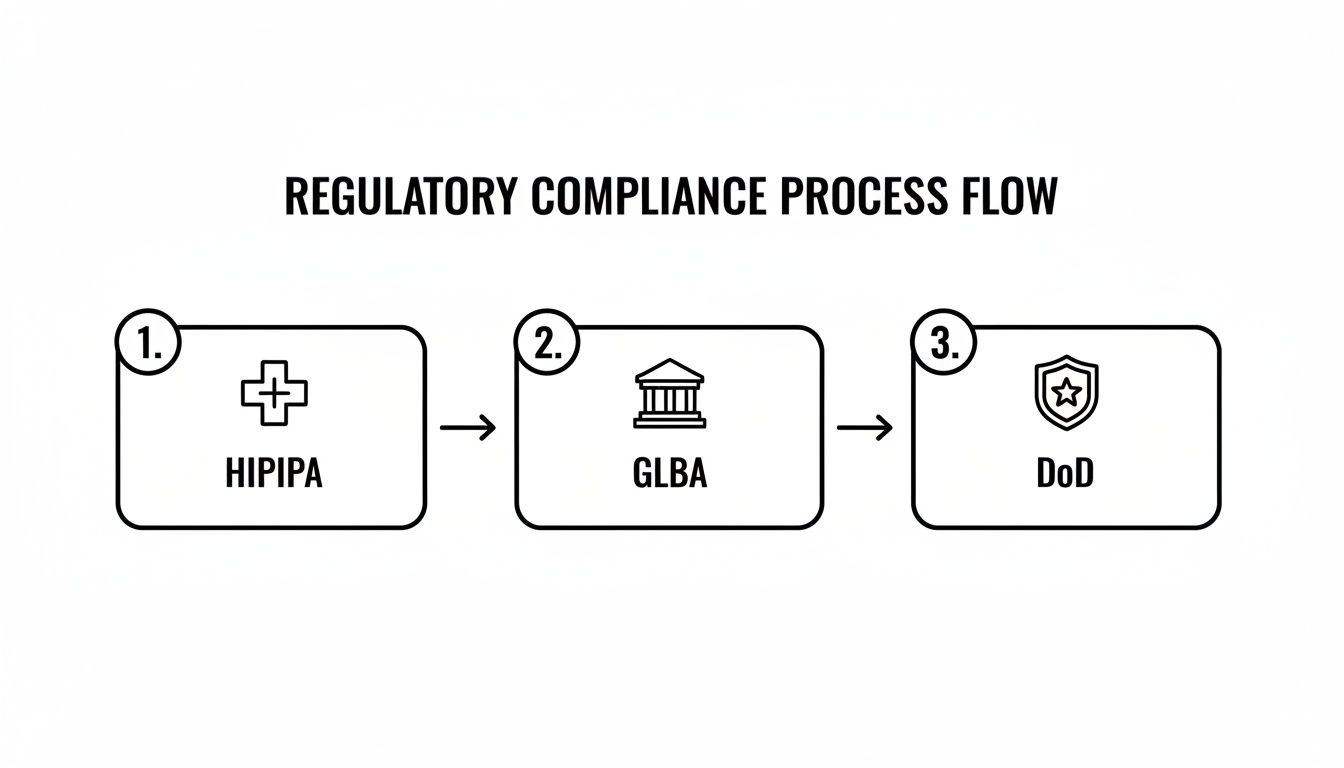
As you can see, whether your business is governed by HIPAA, GLBA, or DoD standards, the path to compliance ends with secure, fully documented destruction.
Step 2: On-Site vs. Off-Site Shredding
Next, you have a choice to make. Your decision really comes down to your company's internal security policies and whether you need to see the destruction happen with your own eyes.
- On-Site Shredding: We bring a specialized shredding truck right to your location in the Atlanta area. Your hard drives are brought out to the truck, and you can personally watch as they're fed into the industrial shredder. This option offers the ultimate peace of mind because you witness it firsthand.
- Off-Site Shredding: Your drives, secured in locked containers, are transported in a GPS-tracked vehicle to our secure destruction facility. There, they are shredded under constant video surveillance, following the exact same rigorous chain-of-custody protocols.
Both on-site and off-site services deliver the exact same result: complete and total data annihilation. The choice is simply about your preference for witnessing the process versus the convenience of a secure pickup and transport service.
For businesses that need absolute, witnessed proof for an audit or just for stakeholder assurance, you can learn more about how our on-site hard drive shredding service works right at your facility.
Step 3: Final Destruction and Certification
This is the moment of truth. Whether it's happening in our truck at your curb or back at our facility, the hard drives are fed into a powerful, industrial-grade shredder. These machines don't just bend or break the drives; they use immense force to grind everything—including the platters where your data lives—into tiny, confetti-like metal fragments.
Once shredded, the data is 100% unrecoverable. Period. This physical destruction is the only method that guarantees permanent data elimination, blowing software-based wiping methods out of the water.
Finally, we reconcile the initial serial number list against the now-destroyed devices. Once we confirm every single drive has been processed, we issue a Certificate of Destruction (CoD). This legal document is your official, auditable proof that every drive was destroyed in compliance with industry standards, protecting your Atlanta business from any future liability.
Understanding Hard Drive Shredding Costs in Metro Atlanta
Figuring out your budget for data security shouldn't be a guessing game. When you're looking into hard drive shredding in Atlanta, GA, knowing how the pricing works helps you find a solution that's both secure and affordable. The final price you see on a quote isn't random; it's built on a few key details about your project.
Most professional shredding companies in the Atlanta area stick to a few common pricing methods. This keeps things fair and transparent, whether you're a small business with a handful of old computers or a data center clearing out an entire server room.
Common Pricing Models for Shredding
How you're billed usually comes down to how many drives you have and what kind they are. These are the most common models you'll come across:
- Per-Drive Pricing: This one is as simple as it sounds. You pay a fixed price for every single hard drive, SSD, or tape you need destroyed. It's perfect for smaller jobs where you know exactly how many items you have.
- Per-Pound Pricing: When you're dealing with a massive amount of media, like thousands of drives from a data center refresh, billing by weight is just more practical. The total cost is based on the combined weight of all your devices.
- Flat Fee or Project-Based Pricing: For more complex jobs that go beyond just shredding, a provider might quote a single flat fee. This often covers everything from removing the drives from machines to logistics and final destruction.
These models make sure you only pay for what you actually need, making professional-grade data destruction an option for any Metro Atlanta business.
Key Factors That Influence Your Quote
Besides the basic billing model, a few other things will shape your final cost. When you ask for a quote, a shredding provider will need these details to give you an accurate number.
The two biggest cost drivers are almost always volume and the service type. A large, off-site shredding project will cost much less per drive than calling a truck out to your office for just a few items.
Here’s what goes into calculating your final price:
- Volume: Like with most services, bigger jobs get better pricing. The more drives you have, the lower your per-unit cost will be.
- Service Type (On-site vs. Off-site): On-site shredding, where we bring a mobile shred truck to you, costs a bit more because of the specialized truck and dedicated time. Off-site shredding is usually the more budget-friendly option.
- Location: Getting our trucks to business hubs like Alpharetta, Kennesaw, and Sandy Springs is all in a day's work. However, if you're located far outside the metro area, a small trip charge might be added to cover travel.
- Drive Type: Regular hard disk drives (HDDs) are straightforward. Denser solid-state drives (SSDs) can sometimes have a slightly different cost because they require more thorough destruction.
- Additional Services: If you need us to pull the hard drives out of old laptops, desktops, or servers, that labor will be factored into the quote.
Knowing these details helps you get a fast, accurate quote. Our work as an electronic waste company is all about transparency, so you can be confident you’re getting a fair price for keeping your data safe.
Your Hard Drive Shredding Questions Answered
We get a lot of questions from Atlanta businesses about how professional hard drive destruction actually works. Let's clear things up so you know exactly what to expect and can get your data security handled.
Do I Need to Remove the Hard Drives From Our Computers?
No, you don’t have to pull the drives yourself. Let us handle it. Our team comes prepared to professionally remove hard drives from all your equipment—desktops, laptops, servers, you name it.
This saves your IT staff a ton of time and hassle. More importantly, it ensures no device gets overlooked. We account for every single piece of equipment from start to finish, so you can be sure all your data is destroyed.
What Happens to the Shredded Hard Drive Pieces?
After we turn your drives into a pile of confetti-sized metal bits, they aren't just tossed in a dumpster. That mangled metal is securely transported to a certified recycling facility.
There, it’s all sorted and processed under strict environmental certifications like R2 or e-Stewards. This makes sure your old gear stays out of landfills. It's how your business can meet its data security obligations and its green initiatives at the same time.
This is the final, crucial step. You're turning a data liability into a verified, eco-friendly commodity. It's a non-negotiable part of any modern hard drive shredding Atlanta GA service.
Can You Shred SSDs, Phones, and Backup Tapes Too?
Absolutely. Our industrial shredders are powerful enough to destroy much more than just the old spinning hard drives (HDDs).
If you want to close every security gap, you need a service that can handle everything. We take care of it all:
- Solid-State Drives (SSDs) from your newer laptops and servers.
- Backup Tapes (LTO, DLT) that might be holding years of archived company files.
- Company Cell Phones and Tablets full of emails, contacts, and sensitive app data.
- Miscellaneous Media like USB flash drives, CDs, and DVDs.
Using one certified provider for all your media makes the whole project simple and guarantees nothing gets left behind.
How Do I Get an Accurate Quote for Service in Atlanta?
Getting a quote is easy. Just reach out with a few details about your project, and we can get you a price right away.
All you need to tell us is a rough count of how many devices you have, what they are (e.g., standard hard drives, SSDs, phones), and what kind of service you need. Let us know if you want us to come to your location for on-site shredding or if you're good with off-site service. We'll give you a clear, no-obligation quote so you can plan your budget and schedule.
Ready to secure your business's data with certified destruction? Montclair Crew Recycling provides transparent, reliable, and compliant hard drive shredding services across Metro Atlanta. Contact us today for a fast, no-obligation quote and take the final step in protecting your sensitive information.
