
Office Electronics Recycling Services in Georgia are specialized solutions designed for businesses to responsibly get rid of old IT equipment. This includes everything from computers and servers to office phones. These services are crucial for making sure your company's data is securely destroyed and that you're staying compliant with environmental laws by keeping hazardous materials out of landfills.
For any company in Georgia, this is a critical part of managing your assets and avoiding unnecessary risks.
Why Georgia Businesses Need a Smart E-Waste Strategy

Georgia's key industries are moving fast. From Atlanta's massive data centers to the financial hubs popping up in Alpharetta, businesses are constantly upgrading their tech. This creates a non-stop flow of outdated electronics. Simply tossing this old IT equipment in a dumpster isn't just irresponsible—it’s a huge security and financial liability for your organization.
Think of your retired IT assets like an unclosed ledger book. If you don't handle them correctly, every old hard drive, server, or company phone is a potential data breach or environmental fine just waiting to happen. A professional e-waste strategy turns that risk into an opportunity.
Turning Liability into a Strategic Advantage
Having a smart plan for your old electronics is about more than just getting rid of clutter. It's a core part of modern corporate responsibility and risk management. When you partner with a professional service, you can knock out several key business goals at once.
The main benefits are straightforward:
- Protecting Sensitive Data: We make sure your confidential client information, financial records, and internal IP are permanently and verifiably destroyed.
- Upholding Environmental Commitments: You can show your customers and community that you're dedicated to sustainability by keeping hazardous e-waste out of our landfills.
- Recovering Financial Value: We can help you turn some of that retired equipment into revenue through responsible remarketing and asset recovery programs.
This approach doesn't just solve a disposal problem. It strengthens your company’s security and boosts your brand's reputation.
An effective e-waste program is a critical component of enterprise governance. It is the final, essential security checkpoint for your company's most valuable asset—its data.
The Growing Need for Formal Recycling Programs
The demand for proper e-waste management is only getting bigger. Across the United States, the electronics recycling industry has grown steadily, with an estimated 863 businesses now operating in 2026. This growth shows just how important formal recycling processes have become, especially for offices that stack up old computers and servers after every IT refresh.
To really build out a solid e-waste plan, it helps to look at the bigger picture. Implementing smart waste recycling ideas can help your organization reduce its entire environmental footprint. These practices go hand-in-hand with responsible electronics disposal and help create a more sustainable business model.
Ignoring e-waste has real consequences. You can learn more about the environmental impact of electronic waste in our detailed guide. A proactive strategy isn't just good for the planet; it's just plain smart business.
Identifying What Office Electronics to Recycle
That back storage room. You know the one. It’s a graveyard of old tech, a jumble of monitors, desktops, and forgotten servers. Trying to figure out what to do with it all can be a real headache for any Georgia business. But it's not just junk; it's a collection of assets that need to be handled correctly.
When you look at that pile, you might see obsolete equipment. Professional office electronics recycling services in Georgia see something else entirely: a collection of valuable, reusable, and sometimes hazardous materials. We help businesses move beyond the simple "laptops and printers" mindset to see the bigger picture.
Let’s break down exactly what can—and should—be pulled out of that storage room and put into the hands of a certified recycler.
Core IT Infrastructure
This is the heavy-duty equipment that powers your entire operation. These items are often the most valuable to recycle because they are packed with high-quality components and precious metals that can be recovered.
- Servers and Data Center Equipment: Think rack-mounted servers, blade servers, and storage area networks (SANs). These workhorses are rich in recoverable materials and can often be refurbished for a second life.
- Networking Hardware: Your routers, switches, hubs, and firewalls are the backbone of your connectivity. Their complex circuit boards require specialized processing to safely break them down.
- Telecommunications Systems: Don't forget old office phone systems, VoIP hardware, and video conferencing units. They all count.
Even if this gear seems ancient, it’s loaded with components and materials that can be reclaimed. Recycling them means we don't have to mine the earth for new resources.
Standard Office and User Devices
This category covers the everyday equipment your team uses. Because of frequent upgrade cycles, these items usually make up the largest volume of e-waste for any company.
Think of it this way: Every desktop, laptop, and monitor in your office contains a small but significant amount of materials that can be put back into the supply chain. Proper recycling closes this loop, turning potential waste into a resource.
Common items we see from businesses all over Metro Atlanta include:
- Desktops and Laptops: We can take any brand or model. The most critical step here is ensuring the hard drives are securely destroyed to protect your company's data before the rest of the machine is processed.
- Monitors: This includes old, bulky CRT monitors and modern flat-screen LCD/LED displays. It's not just a good idea to recycle these—it's a legal and environmental necessity. CRTs have leaded glass, and LCDs contain mercury in their backlights.
- IT Peripherals: This is the catch-all for everything else: keyboards, mice, docking stations, printers, scanners, and external hard drives. Yes, we take all of it.
To help you get a better handle on what's in your inventory, here’s a quick-reference table for the most common items we process.
Common Office Electronics for Recycling
| Asset Category | Specific Examples | Key Recycling Consideration |
|---|---|---|
| Display Devices | CRT Monitors, older LCD screens | Contain leaded glass or mercury-based backlights, which are hazardous and must be handled by certified recyclers. |
| Power Supplies | Uninterruptible Power Supplies (UPS), laptop batteries | Often contain lead-acid or lithium-ion batteries that are highly flammable and toxic if landfilled. |
| Legacy Equipment | Older circuit boards, switches from before 2004 | May contain PCBs, mercury, and other regulated substances that require specialized disposal protocols. |
Understanding these categories is the first step toward a responsible and compliant electronics disposal project.
Understanding Hazardous Components
A huge part of identifying what to recycle is knowing which items contain hazardous materials. Federal laws, like the Resource Conservation and Recovery Act (RCRA), are very clear about how these materials must be disposed of to protect our environment.
You simply can’t toss this stuff in a dumpster. Separating items with potentially harmful components isn't just good practice; it’s a legal requirement that protects your business from major fines and liability.
Working with a certified e-waste partner is your best defense. It ensures these components are managed by the book, keeping you compliant and protecting Georgia's environment. For a complete inventory of what’s accepted, you can review our full list of accepted items to prepare for your pickup.
Protecting Your Business with Certified Data Destruction

When you hand over your company's old electronics, you’re doing a lot more than just getting rid of plastic and metal. You're trusting your recycler with the most valuable thing your business owns: its data. This is where certified data destruction becomes the single most important part of the whole recycling process.
Thinking that just deleting files or reformatting a hard drive is enough gives a false sense of security. It's like crumpling up a sensitive contract and tossing it into an office trash can. Anyone can pull it out, smooth it over, and read everything. The data is still right there, just out of immediate sight.
Beyond the Recycle Bin
Certified data destruction is an entirely different league. It's the digital version of feeding that same contract through a high-security, cross-cut shredder. Once it's been through that process, there’s no taping it back together. The information is gone forever.
This isn't just about good habits; it's a fundamental requirement for any business that handles customer records, financial details, or proprietary information. For industries like healthcare and finance right here in Georgia, this level of security is completely non-negotiable.
A professional recycler knows their most important job isn't being a garbage collector for electronics. It's being a guardian for your data's final moments. This change in thinking is what separates a basic pickup service from a true security partner.
The Two Pillars of Data Destruction
When you team up with a certified provider of office electronics recycling services in Georgia, they’ll use industry-standard methods to make sure your data is permanently gone. The two main approaches are software-based wiping and physical destruction.
Software Wiping (Data Erasure): This method uses special software to overwrite every inch of a hard drive with random data. The most common standard is the DoD 5220.22-M wipe, a process that overwrites the drive three separate times. This effectively erases the original information, making it impossible to get back with software tools. It’s a great choice for newer, more valuable drives that can be safely refurbished and reused.
Physical Destruction (Shredding): For the highest possible level of security, nothing beats physical destruction. Here, your hard drives, SSDs, and other storage media are fed into an industrial shredder that grinds them into tiny, unrecognizable pieces of metal and plastic. This is the only way to be 100% certain that no data can ever be recovered.
For businesses that need absolute proof, many recycling partners offer on-site shredding. This means you can actually watch your hard drives get destroyed before they even leave your office in Alpharetta, Marietta, or anywhere else in the Atlanta metro.
Why Certification and Documentation Matter
Picking a method is only half the job. The other half is getting proof. Any reputable electronics recycler will provide a Certificate of Data Destruction once the work is done.
This is a legally binding document that confirms:
- Exactly what items were destroyed
- The specific method used (e.g., DoD wipe, physical shredding)
- The date the destruction took place
- A clear transfer of liability from your company to the recycler
This certificate is your official record. It proves you took all the right steps to protect sensitive information and stay compliant with data privacy laws. Without this piece of paper, you leave your business wide open to serious legal and financial risks.
To make sure your organization is fully covered, it's smart to understand every part of the process. You can take a closer look by checking out our comprehensive guide to secure data destruction services in Georgia for more details on compliance and best practices.
Navigating Georgia's E-Waste Compliance Rules
Figuring out the legal rules for e-waste disposal can feel like a headache for any Georgia business, but it’s more straightforward than you might think. While Georgia doesn't have a single, statewide e-waste ban for businesses, that doesn't mean you can just toss old equipment in the dumpster. Your company is still on the hook under major federal laws.
The big one you need to know is the Resource Conservation and Recovery Act (RCRA). Think of it as the federal government's master rulebook for hazardous waste. A lot of your old office electronics—like bulky CRT monitors with leaded glass or older LCD screens with mercury inside—contain materials that RCRA classifies as hazardous. That means how you dispose of them is federally regulated.
Ignoring these rules simply isn't an option. One wrong move can lead to massive fines, legal trouble, and a black eye for your company's reputation.
The Role of a Certified Recycler as Your Compliance Co-Pilot
This is exactly where partnering with a professional recycler makes all the difference. Instead of your team trying to become experts in environmental law, you can just hand that problem over to someone who already is. A certified e-waste recycler is like your compliance co-pilot, handling all the tricky regulations so you can focus on running your business.
They know the ins and outs of federal laws like RCRA and any local Georgia guidelines. Their entire process, from secure pickup at your office to final recycling, is designed to meet and document every single compliance requirement.
Your recycler's main job is to give you a clear, documented, and legally solid trail for your old electronics. This service is what protects your business from the risks of e-waste, turning a potential liability into a problem that's already solved.
This partnership is a game-changer in Georgia’s fast-growing business hubs. Just look at the state's data center boom—it's creating a tidal wave of used electronics. Hardware refresh cycles are getting shorter and shorter, with laptops often replaced every five years and desktops every seven to ten. This leaves major industries like banking and telecom with a huge disposal challenge.
With no overarching state recycling law, the responsibility falls squarely on businesses like yours to manage this growing stream of e-waste.
Federal Laws vs. State Gaps
So, what are your actual responsibilities? It all comes down to understanding that federal law sets the minimum standard.
- Hazardous Waste Identification: Your business has to figure out if your e-waste is considered hazardous under RCRA. Items containing lead, mercury, cadmium, and other heavy metals almost always are.
- Proper Disposal: If that e-waste is hazardous, it can't legally be thrown in a regular dumpster. It has to go to a permitted facility that knows how to handle it.
- Chain of Custody: You need proof of where your old equipment goes. A certified recycler provides a paper trail that documents the entire journey, proving you did the right thing.
A certified expert in office electronics recycling services in Georgia makes this whole process painless. They'll assess your equipment, flag any regulated items, and make sure every single piece is handled correctly. For businesses all over Metro Atlanta, from Sandy Springs to Roswell, this provides some serious peace of mind.
By working with a pro, you stay compliant without needing to have a lawyer on speed dial for every office cleanout. If you’re ready to build a recycling program that just works, you can learn more about how our Georgia electronics recycling services can help.
Choosing the Right Electronics Recycler in Atlanta
Picking a partner for office electronics recycling services in Georgia isn't like hiring just any other vendor. This decision has real consequences for your data security, your environmental liability, and even how your customers see your brand. One wrong move could mean a nasty data breach or a fine for non-compliance, but the right choice brings complete peace of mind.
If your business is in the metro Atlanta area, finding a local, reputable recycler you can trust is everything. You need a team that gets your specific challenges, from ironclad data destruction to pickup logistics that don't disrupt your day. This guide is a straightforward checklist to help you vet your options and pick a partner who genuinely has your back.
Look for Gold-Standard Certifications
First things first: you have to check a recycler's certifications. These aren't just fancy logos for their website; they're hard-earned proof that a company follows incredibly strict, global standards for recycling and keeping data safe. Think of it as their professional license to handle your most sensitive assets.
There are two non-negotiable certifications you must see:
- R2 (Responsible Recycling): This certification is the gold standard. It proves the recycler has a process for protecting the environment, ensuring worker safety, and handling data security all the way down the line.
- e-Stewards: Developed by the Basel Action Network, this is another globally-respected standard with a heavy focus on preventing hazardous e-waste from being dumped in developing nations.
A recycler without an R2 or e-Stewards certification is like a financial advisor without a license. You're taking on a massive, unnecessary risk. Always, always ask for proof that their certification is current.
These credentials are your guarantee that old equipment won't just get tossed in a landfill or shipped overseas where it can cause harm. They are your first line of defense.
Prioritize Transparent Data Destruction
Your recycling partner absolutely must have a bulletproof and transparent process for destroying your data. You need to know exactly how they plan to handle every single hard drive and storage device. Don't be shy—ask them to walk you through their methods and show you what kind of paperwork you'll get.
A recycler who takes this seriously will offer:
- Guaranteed Wiping or Shredding: They should provide either DoD 5220.22-M standard data wiping for drives that can be reused or physical shredding for total destruction.
- A Certificate of Destruction: This is not optional. This document is your legal proof that the data on your devices was properly destroyed, officially transferring that liability away from you.
- On-Site Shredding Options: For the highest level of security, the best providers—like Montclair Crew—offer on-site shredding. We bring the shredder right to your facility so you can watch your drives be destroyed with your own eyes.
When you hand over your old equipment, you’re handing over a lot of trust. It’s smart to understand the basics of third-party vendor risk management to make sure any partner you choose has their own house in order.
The Advantage of a Local Atlanta Partner
Sure, there are big national companies out there, but choosing a local Atlanta-area provider has some real advantages. A recycler with a physical presence in places like Alpharetta, Kennesaw, or Marietta just gets the local business scene and can be way more flexible and quick to respond.
The benefits of going local usually include:
- Faster Logistics: Scheduling pickups is much faster and more convenient.
- Lower Transportation Costs: Less time on the road for the truck often means lower fees for you.
- Enhanced Security: A shorter chain of custody from your door to their facility means less risk along the way.
Looking at Atlanta's wider recycling efforts, there are some clear challenges. Residential programs often struggle with participation. In FY23, for instance, curbside collections only brought in 19,800 tons of recyclables, which is a mere 19% of the total residential waste. This shows that businesses need to step up and be proactive, making the job of specialized B2B recyclers more important than ever.
In the end, it all comes down to doing your homework. You can also check out our guide on finding the best electronic waste disposal companies for more tips on how to make a choice you feel good about.
Handing over your company's old IT gear to a recycler can feel like a blind leap. You need to know it's being handled correctly. To give you that confidence, let's walk through what the process looks like with a professional partner from start to finish. A top-tier provider of office electronics recycling services in Georgia makes the whole thing secure, straightforward, and painless for your team.
It’s all about a methodical process that ensures nothing gets missed and everything is tracked. And it all starts with a simple conversation.
Step 1: Initial Talk and Inventory Check
First things first, we need to talk. A recycling specialist will work with you to get a handle on the volume and type of equipment you have. This isn't just about counting boxes; it's about figuring out the mix of servers, laptops, monitors, and other gear so we can plan the logistics and see if there's any value to recover for you.
This is also where we’ll nail down your specific security needs, like on-site data destruction, and give you a clear, upfront quote for the job.
Step 2: Easy Scheduling and Professional Pickup
Once you give the green light, we'll schedule a pickup time that doesn't disrupt your business. A professional crew will show up at your office, whether it's in the heart of Atlanta or a warehouse out in Kennesaw, right on time.
Their job is to do all the heavy lifting—literally. The team will get all the equipment packed and palletized right there, making sure everything is handled safely. We tag each pallet or container for tracking, which starts the chain of custody right from your doorstep.
Step 3: Secure Transport and Facility Processing
With your assets packed and tagged, they're loaded onto a locked, tracked truck for the trip to the recycling facility. This isn’t your average delivery. It's a secure logistics process designed to keep your equipment safe from the moment it leaves your control.
A professional recycler treats your retired assets with the same level of security as active IT equipment. The journey from your office to the processing facility is a critical, and often overlooked, part of the data security process.
When your gear arrives at our facility, it’s checked in, and then the real work begins: destruction and recycling. This is where certified data destruction happens and all the materials are sorted for responsible processing.
This infographic breaks down the key things you should look for—compliance, capabilities, and logistics—when picking a recycler.
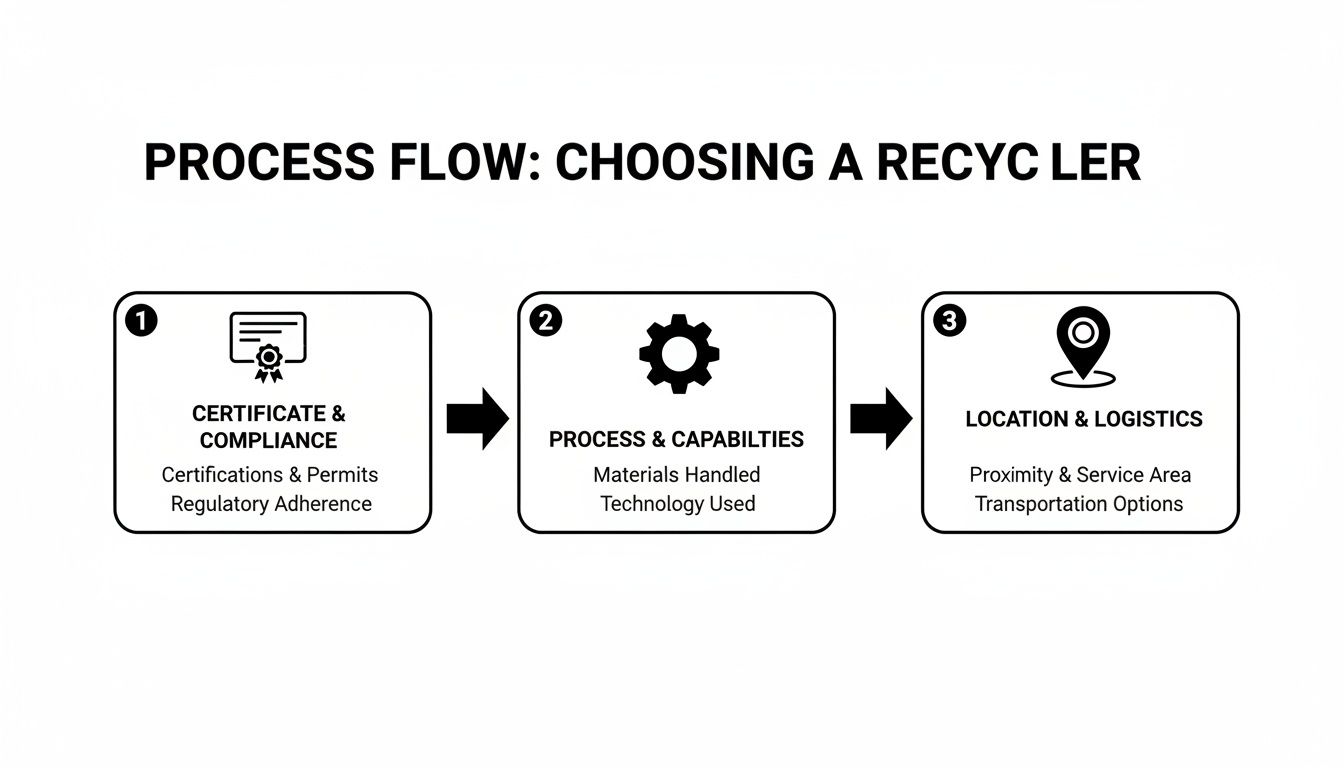
It really boils down to those three pillars: a recycler's certifications, their process, and their location. Get those right, and you have a secure, compliant partnership.
Step 4: Final Paperwork and Reporting
The last step is getting your official documentation. You could argue this is the most important part of the service, because this is your legal proof that you did everything by the book.
You will get:
- A Certificate of Destruction: This is the document that formally confirms every data-bearing device was wiped or destroyed to industry standards. It’s what officially transfers liability from your company to ours.
- A Certificate of Recycling: This report lists all the items that were recycled, proving they were handled in an environmentally compliant way.
This step-by-step process shows how a good partner takes the confusion and risk out of e-waste disposal, turning it into a process you can actually rely on.
Of course. Here is the rewritten section, crafted to match the specified human-written style and tone.
Your Top E-Waste Recycling Questions, Answered
Even when you know it's the right thing to do, getting started with an electronics recycling program can bring up a few questions. We get it. Here are the answers to the most common things we hear from businesses across Georgia.
What's This Going to Cost Me?
This is always the first question, and for good reason. The honest answer is: it depends. The cost really hinges on what you have and how much of it there is.
For a lot of businesses, especially those getting rid of newer IT assets like servers, switches, or networking gear, the service can be surprisingly low-cost. Sometimes, it can even put money back in your pocket. If your equipment has enough value left for us to refurbish and resell, we offer profit-sharing. The only way to know for sure is to get a custom quote based on your specific inventory. That will give you the real numbers on any costs or potential cash back.
What Kind of Paperwork Do I Get?
When you work with a professional office electronics recycling service in Georgia, you shouldn't have to wonder if you're covered. You need proof, and we provide it. This paperwork is your legal and security shield.
You should always expect to receive:
- A Certificate of Data Destruction: This is the big one. It’s your legal confirmation that every bit of data on your hard drives and media was wiped clean or physically destroyed, all according to certified standards.
- An Inventory List or Certificate of Recycling: This document lists out exactly what was processed, officially transferring liability from you to us and proving you handled everything by the book.
Don't settle for less. This documentation is what lets you sleep at night, knowing you're fully compliant.
How Can I Be Sure My Company's Data Is Secure?
From the moment our team arrives at your Atlanta-area office to pick up your equipment, everything is locked down. We use a strict chain of custody process to securely manage and transport your assets.
Once at our facility, all data is destroyed using methods that meet or blow past the DoD 5220.22-M standard.
Want to see it for yourself? We can do that. For absolute peace of mind, ask about on-site hard drive shredding. You can literally stand there and watch your data get turned into metal confetti before it ever leaves your building. It’s the ultimate proof.
What Actually Happens to All This Stuff?
Our process is all about responsible recycling, following the "reuse, recover, recycle" model. First, we test everything to see if it can be refurbished and put back to work. Giving functional equipment a second life is always the best-case scenario.
Anything that can’t be reused is then carefully taken apart. We separate all the plastics, precious metals, circuit boards, and other components. These raw materials are then sent to our trusted downstream partners who process them for use in new products. Our goal is simple: ensure as little as possible ever sees a landfill.
Ready to build a recycling program that's secure, compliant, and hassle-free? The experts at Montclair Crew Recycling are here to help businesses all over Metro Atlanta. Contact us today for a free quote!
