
So, what exactly is a medical equipment recycling program? Think of it as a structured game plan for dealing with all the medical devices that are outdated, retired, or simply no longer in use. Instead of letting them pile up and become a problem, this process turns a potential waste stream into a managed asset. We’re talking about everything from old infusion pumps to massive imaging machines—all handled in a secure, compliant, and environmentally responsible way.
Why Your Facility Needs a Recycling Program Now

Let's be clear: implementing a formal recycling program for medical equipment isn't just a nice-to-have environmental initiative anymore. It's a fundamental part of running a modern healthcare operation. The reasons go way beyond just "going green." It's about smart risk management, better financial health, and bolstering your facility’s reputation in the community.
Without a solid plan, those retired assets quickly become a liability. They take up precious storage space and, more importantly, create some serious compliance headaches.
If you just wing it with improper disposal, the consequences can be severe. Imagine sensitive patient data lingering on a retired diagnostic machine—that’s a direct path to a costly HIPAA violation. Or picture devices with hazardous materials being tossed out incorrectly, leading to steep environmental fines. A well-designed recycling program tackles these challenges head-on.
Moving from Cost Center to Strategic Asset
Many facilities get stuck thinking of equipment disposal as just another expense on the balance sheet. But a strategic recycling program can completely flip that script.
When you team up with the right certified vendor, you can often generate revenue from remarketable assets like newer monitors or functional lab equipment. Even the components pulled from older, obsolete devices have real value as recycled commodities.
This shift directly benefits your bottom line in a few key ways:
- Slash Disposal Fees: Landfill and specialized disposal fees for bulky or hazardous equipment are expensive. Recycling dramatically lowers, or even eliminates, these costs.
- Reclaim Your Space: Freeing up closets and storage rooms jammed with old equipment means you can put that square footage to much more productive use.
- Boost Your Public Image: Showing a real commitment to sustainability resonates with patients, staff, and the wider community. It reinforces your image as a responsible healthcare leader.
The Growing E-Waste Challenge in Healthcare
The healthcare industry is a huge contributor to the global e-waste problem. Technology is advancing at a breakneck pace, which means medical devices become obsolete faster than ever, creating a constant flow of retired electronics.
This e-waste is often packed with hazardous materials like lead and mercury, which can wreak havoc on the environment if not managed correctly. If you're curious about the specifics, you can learn more about the environmental impact of electronic waste and see why getting proactive is so crucial.
A formal medical equipment recycling program isn't just about disposal. It's an integrated strategy that addresses data security, environmental stewardship, and financial responsibility, turning a potential liability into a measurable asset for your facility.
By setting up a program, you become an active participant in the circular economy. Valuable materials are recovered and put back into use, cutting down the need to mine and process new resources. This approach ensures your facility doesn't just stay compliant with regulations—it becomes a leader in sustainable healthcare.
Assembling Your Team and Defining a Framework
A successful medical equipment recycling program doesn't just happen. It's built on a solid foundation, and that foundation is the right team of people empowered to make smart decisions.
Here's a common mistake I see: a hospital will just hand this off to one department, like facilities or environmental services, and hope for the best. That approach is a recipe for failure. Your first real move is to build a dedicated, cross-functional task force.
Think of this group as your program's steering committee. You absolutely need people from every corner of your facility because retired equipment touches multiple operations. Pulling in key players from clinical, IT, facilities, and finance from the very beginning means every angle is covered. This isn't just about collaboration; it's about preventing huge roadblocks down the line and building support from day one.
This team is the engine that will drive your program forward, taking it from a vague idea to a concrete plan that gets leadership genuinely on board.
Building Your Cross-Functional Recycling Task Force
The whole program hinges on the expertise of your team. Each person brings a critical viewpoint to the table, making sure you cover all your bases—from clinical workflows and logistics to the nitty-gritty of data security compliance. A well-rounded team stops crucial details from slipping through the cracks.
So, who gets a seat at this table? Clinical Engineering is a must-have; they live and breathe the lifecycle of medical devices. Facilities Management knows the reality of storage space and logistical headaches. And of course, your IT department is the final word on any device that holds patient data.
Let's break down the essential roles for a task force that gets things done.
Key Roles for Your Recycling Program Task Force
This table outlines the core members you'll need on your team. Having representatives from each of these areas ensures that no critical aspect of the program is overlooked, from the initial equipment audit to final vendor selection and compliance checks.
| Role/Department | Primary Responsibilities | Key Contributions |
|---|---|---|
| Clinical Engineering | Identify retired/end-of-life equipment, confirm operational status, and manage inventory logs. | Provides deep knowledge of device types, their condition, and potential for refurbishment or resale. |
| IT/Information Security | Oversee data destruction for all devices containing ePHI, ensuring HIPAA compliance. | Develops and verifies data sanitization procedures, preventing costly breaches. |
| Facilities Management | Coordinate equipment collection, temporary storage logistics, and vendor pickup schedules. | Manages the physical movement and staging of assets, ensuring minimal disruption to hospital operations. |
| Finance/Procurement | Track disposal costs, analyze potential revenue from asset resale, and manage vendor contracts. | Builds the business case, demonstrating cost savings and ROI to secure executive approval. |
| Environmental Health | Ensure compliance with EPA and state regulations for handling hazardous materials (e.g., lead). | Guides the team on safe handling protocols and proper disposal methods for regulated components. |
By bringing these specific skill sets together, you create a powerful group capable of navigating the complexities of medical equipment disposal.
Conducting a Thorough Waste Audit
Before you can set any goals, you have to know what you're actually dealing with. That's where a comprehensive waste audit comes in. This isn't just about counting old machines; it's a deep dive to figure out the volume, type, and condition of equipment waiting for retirement across your entire organization.
Start by checking those forgotten storage closets, basements, and any off-site warehouses. You'll probably be surprised by what you find. It could be dozens of outdated infusion pumps and patient monitors, or even larger gear like decommissioned lab analyzers or portable X-ray machines.
Pro Tip: Create a simple spreadsheet to track everything. Log the equipment type, manufacturer, model number, and a quick note on its condition (functional, broken, good for parts). This data is the backbone of your business case.
This audit provides the hard data you need to set realistic goals. It shows you the true scale of the challenge and helps you figure out what kind of recycling partner you'll need later.
Setting Clear Goals and Crafting the Business Case
With your audit data in hand, it's time for the task force to set clear, measurable objectives. Vague goals like "recycle more" just don't cut it. You need specific targets that show real progress and value.
Here are a few examples of strong, data-driven goals:
- Achieve a 75% waste diversion rate for retired electronic medical equipment within the first 18 months.
- Reduce annual equipment storage costs by $50,000 by clearing out designated holding areas.
- Generate $20,000 in the first year through the resale of viable, remarketable assets.
These kinds of specific goals are the core of your business case for leadership. Your proposal needs to clearly lay out the problem (like rising disposal costs or compliance risks), present your solution (the recycling program), and project the financial and reputational payoff. This shifts the program from a simple "green" initiative to a smart business strategy.
It also helps to point out the industry trend. The global market for these services is projected to hit $2,241.4 million by 2033, which shows just how seriously other organizations are taking professional medical waste management.
Finally, never forget the asset management side of this. Tracking equipment properly from purchase to disposal is critical for both financial accountability and compliance. If you need to tighten up your internal processes, check out our guide on IT asset management best practices—many of the same principles apply directly to medical devices.
Navigating Data Security and Compliance Rules
When your medical equipment recycling program starts dealing with devices that stored or handled patient information, you’re stepping into one of the most regulated parts of healthcare. This isn't just about being green anymore—it’s a serious data security mission, and the laws are strict. One wrong move could lead to massive fines and completely wreck your facility’s hard-earned reputation.
The big one you need to worry about is the Health Insurance Portability and Accountability Act (HIPAA). Under the HIPAA Security Rule, you’re required to have safeguards in place to protect electronic protected health information (ePHI). That rule doesn't just stop when you unplug a device; it follows that piece of equipment all the way to its final disposal. Any device with a hard drive or memory—think patient monitors, diagnostic systems, or even infusion pumps that log patient history—is a potential data breach waiting to happen.
Ensuring Complete Data Destruction
Just hitting 'delete' on a file does absolutely nothing. To stay on the right side of HIPAA, you have to make sure that any ePHI is rendered completely and permanently unrecoverable. This process is called data sanitization, and it's not optional. It has to happen before any equipment leaves your possession. Skipping this step is a direct violation, and the penalties can easily run into the millions.
Your recycling partner has to offer certified data destruction that meets government standards. The gold standard is the DoD 5220.22-M standard, a three-pass overwriting method that essentially scrubs the data clean. For devices that can't be wiped, like those with solid-state drives (SSDs), physical destruction—shredding it into tiny pieces—is the only way to go. To get a better handle on these critical processes, you can learn more about what data sanitization entails and why it’s so important.
The single most important piece of paper you will get in this entire process is the Certificate of Destruction. This is your official, legally-defensible proof that you did your part and complied with HIPAA. Never, ever work with a vendor who can’t give you a detailed, serialized certificate for every single data-bearing device.
Establishing an Unbreakable Chain of Custody
A clear and detailed chain of custody is your best defense if anything ever goes wrong. It's the paper trail that documents every single person who handled a piece of equipment, from the moment it leaves your loading dock until it's completely destroyed.
A good partner will have a solid tracking system in place that includes:
- Serialized Asset Lists: Every device gets a tag and its serial number is logged.
- Secure Logistics: All equipment is moved in locked, sealed trucks. No exceptions.
- Detailed Reporting: You should get updates confirming when your assets arrived at their facility, when the data was destroyed, and when the physical device was recycled.
This kind of meticulous record-keeping proves you took every reasonable step to protect patient data. It turns a simple disposal task into a fully auditable security protocol.
Managing Hazardous Materials and Environmental Rules
Beyond the data, you also have to think about environmental regulations. A lot of older medical gear contains hazardous materials, which are regulated by the Environmental Protection Agency (EPA) and state agencies.
For example, old-school CRT monitors and X-ray machines are often full of lead. Some of the fluorescent backlights in screens contain mercury. You can’t just toss this stuff in a landfill. A big part of managing medical equipment is following the complex web of regulatory requirements for medical devices to steer clear of violations.
Make sure any partner you choose is certified to handle these hazardous materials properly and legally. Look for certifications like R2 (Responsible Recycling) or e-Stewards. These are strong indicators that a vendor takes both environmental safety and data security seriously, ensuring every single component is managed the right way.
Designing Your Collection and Logistics Workflow
A brilliant strategy for your medical equipment recycling program means nothing without a smart, efficient workflow to back it up. Logistics are the true engine of any successful program, especially within the fast-paced, high-stakes environment of a hospital or clinic. Without a clear process for collecting, sorting, and moving retired assets, even the best intentions can lead to chaos, contamination, and low staff participation.
The goal here is to make the process as seamless and intuitive as possible for your clinical staff. Their primary focus is patient care, so the "right" way to dispose of old equipment must also be the easiest way. A clunky, confusing system will just be ignored, and you'll find retired devices piling up in storage closets all over again.
Establishing Clear and Convenient Collection Points
First things first: you need to decide where and how your staff will drop off equipment. The model you choose depends entirely on your facility's layout and daily operations. There's no single right answer, but I can tell you from experience that the most effective systems are always built around existing staff behaviors rather than forcing new, inconvenient ones.
Consider a few proven operational models:
- Centralized Drop-Off Zones: This works really well in larger facilities. You designate a single, secure area—maybe a specific room in the basement or a caged-off section of the loading dock—as the main collection point. The key is to make it highly visible with bold, clear signage that leaves no room for confusion.
- Department-Level Bins: For a more decentralized approach, you can place smaller, clearly labeled collection bins in individual departments or on each floor. This is incredibly convenient for staff, as they only need to move a retired infusion pump a few feet instead of trekking to a different part of the building.
- On-Demand Pickup Service: Some facilities implement a ticket-based system where departments submit a request through an internal portal for equipment removal. This gives you excellent tracking but requires dedicated facilities staff to manage the pickups.
Whichever model you land on, use simple, color-coded labels and visual aids. A poster with pictures of accepted versus non-accepted items can prevent contamination and save your team countless hours of resorting items later. This visual approach ensures everyone from nurses to technicians can make the right choice in seconds. Our detailed guide to medical equipment removal offers more strategies for managing this process smoothly.
Training Staff and Scheduling Pickups
Once your collection points are set, your focus has to shift to training and communication. Your staff needs to understand not just what to do, but why it matters. A brief training session during regular staff meetings can cover the essentials: how to sort equipment, where the drop-off points are, and who to contact with questions.
This is also a great time to emphasize the program's impact, connecting their actions to positive outcomes like cost savings and environmental stewardship. When people feel like part of a meaningful initiative, their engagement skyrockets.
Key Takeaway: The success of your workflow isn't measured by its complexity, but by its adoption rate. A simple, well-communicated process that 90% of staff follow is far better than a perfect-on-paper system that only 10% use correctly.
Scheduling pickups with your recycling partner is the final piece of the logistical puzzle. This needs to be done thoughtfully to avoid disrupting patient care or clogging busy hallways. Work with your vendor to establish a regular pickup schedule—perhaps weekly or bi-weekly—during off-peak hours. For larger, bulkier items like imaging machines, you'll need to coordinate a special pickup well in advance.
This kind of proactive logistical planning keeps the flow of materials moving and prevents your designated collection areas from becoming overwhelmed. A smooth, predictable workflow transforms your recycling program from a special project into a routine part of daily operations.
The following infographic outlines the essential compliance steps that fit within this workflow.
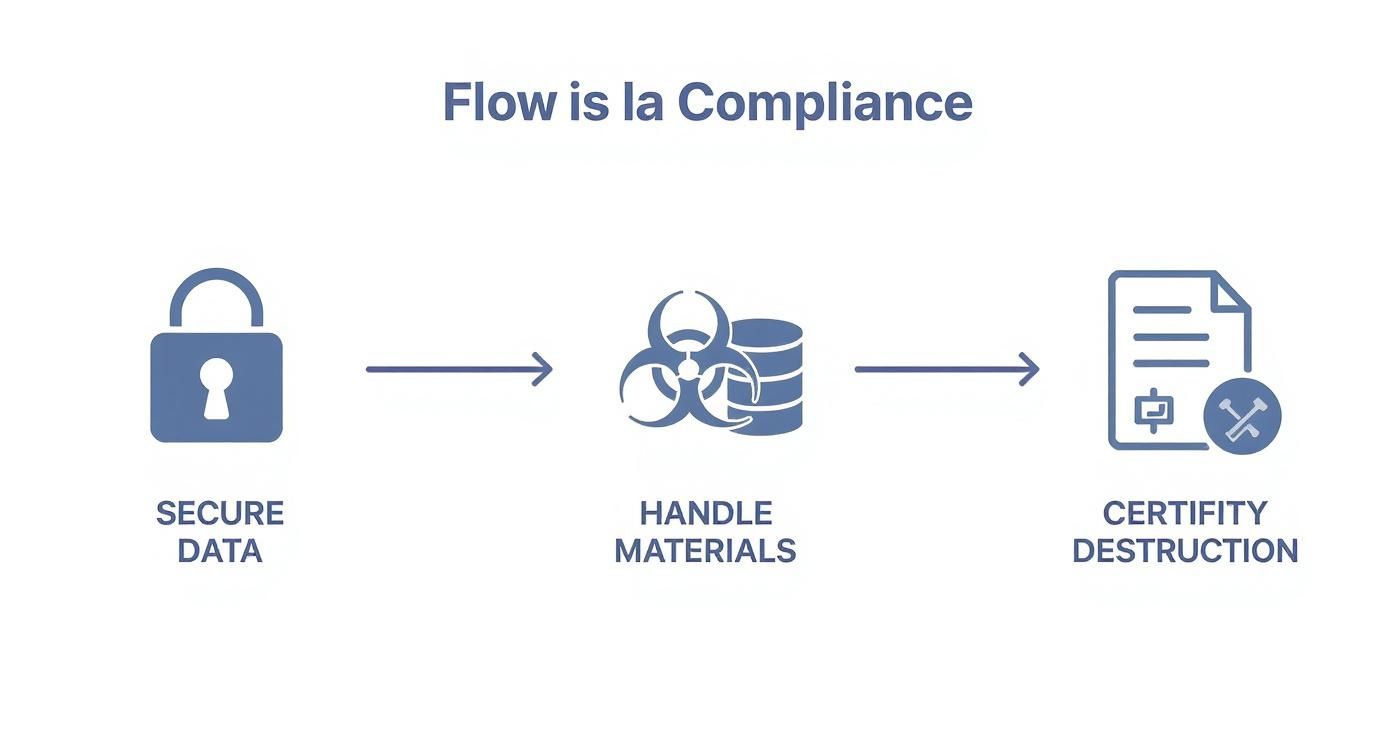
This process highlights the critical checkpoints—securing data, safely handling materials, and certifying destruction—that must be integrated into your logistical plan. As a global leader in this space, North America has set high standards for these workflows. In 2024, the region held the largest share of the medical waste management market, driven by robust infrastructure and strict regulations in the United States. Discover more insights about the growing medical waste market on GlobeNewswire.
How to Choose the Right Recycling Partner
Picking a vendor for your medical equipment recycling program is one of the most critical decisions you'll make. This isn’t like hiring your regular waste hauler; this partner becomes an extension of your facility's compliance and security team. The right choice makes your program run like a well-oiled machine. The wrong one can open you up to a world of hurt, from staggering data breach fines to environmental penalties.
This decision is about so much more than just getting a quote for a pickup. You're handing over devices loaded with protected health information (ePHI) and, in many cases, potentially hazardous materials. Because of that, your vetting process has to be absolutely meticulous. You need to focus on certifications, transparency, and a proven track record working with healthcare organizations.
Non-Negotiable Certifications to Demand
Before you even think about looking at a price sheet, your very first filter should be industry certifications. These aren't just fancy logos they slap on a website; they are hard-earned proof that a vendor follows the highest standards and is regularly audited by an independent third party. For medical equipment, two certifications are king.
- R2 (Responsible Recycling): This standard is all about protecting the environment, ensuring worker health and safety, and locking down data security across the entire electronics recycling chain.
- e-Stewards: Many in the industry consider e-Stewards to be the toughest standard out there. It has a strict zero-landfill policy and flat-out prohibits exporting hazardous e-waste to developing nations.
If a potential vendor holds one or both of these, you know they’re serious about ethical and secure processing. If a company can't produce these credentials? It's an immediate "no." This is the fastest way to weed out operators who are likely to cut corners and put your facility at serious risk.
A vendor’s certifications are your first line of defense. They provide independently verified assurance that the company follows rigorous protocols for data destruction, environmental safety, and downstream accountability, protecting your organization from significant legal and financial risks.
Critical Questions for Potential Vendors
Once you've confirmed a vendor has the right certifications, it’s time to start digging into their actual processes. A reputable partner will welcome these questions and give you clear, direct answers. If you get vague responses, that’s a major red flag.
You need to come prepared with a list of pointed questions that cover everything they do. Here are a few essential ones to get the conversation started:
- Data Destruction: "Can you provide a serialized Certificate of Destruction for every single data-bearing device we give you?" This is your legal proof of HIPAA compliance, so don't settle for anything less.
- Downstream Transparency: "Can you show us your downstream vendor map? Where do our assets—and their components—actually end up after leaving your facility?" This proves they aren’t just shipping hazardous materials overseas.
- Logistics and Security: "Describe your chain of custody process from the moment you pick up to the final disposition. Are your trucks sealed and GPS-tracked?"
- Reporting Capabilities: "What kind of reporting can we expect? Can we get detailed asset lists, weights, and environmental impact metrics through an online portal?"
Their answers will tell you everything you need to know about how they really operate. Don't forget, their logistics are a core part of the service. Expert advice on finding the best courier service shows just how vital reliability and tracking are, and those same principles apply here on a much larger and more sensitive scale.
Comparing Different Types of Recycling Partners
Not all recycling vendors are built the same. They often specialize in different niches, and the best one for you depends entirely on your facility’s needs—from the sheer volume of equipment you have to the level of data security you require. For a closer look at vetting specific companies, our guide to the top e-waste disposal companies offers some great additional context.
To help you get a handle on the landscape, let's break down the most common types of vendors.
Comparing Medical Equipment Recycling Vendor Types
Choosing a partner is a balancing act of expertise, cost, and risk management. This table breaks down the main players to help you decide who's the best fit for your facility's unique needs.
| Vendor Type | Key Strengths | Potential Drawbacks | Best For… |
|---|---|---|---|
| Specialized Medical Recyclers | Deep expertise in HIPAA, FDA regulations, and handling complex diagnostic and lab equipment. | May have higher service fees due to specialization and compliance overhead. | Large hospitals and healthcare systems with a high volume of diverse and data-sensitive medical devices. |
| General IT Asset Disposition (ITAD) Firms | Excellent at certified data destruction for standard IT hardware (computers, servers) and remarketing viable assets. | May lack experience with specialized medical devices or hazardous materials specific to healthcare. | Clinics and facilities where the bulk of retired assets are administrative IT equipment rather than clinical hardware. |
| Local E-Waste Recyclers | Often provide more flexible scheduling and potentially lower costs for basic electronic waste like monitors and peripherals. | May lack the robust certifications (R2, e-Stewards) and serialized reporting needed for HIPAA compliance. | Small practices disposing of non-data-bearing electronics, but not suitable for patient-connected devices. |
In the end, it all comes down to aligning a vendor’s capabilities with your organization's risk profile. For pretty much any healthcare facility, a specialized medical recycler or a top-tier ITAD firm with proven healthcare experience is going to be the safest and most compliant bet.
Tracking Your Program's Impact and Success

Getting your medical equipment recycling program off the ground is a huge win, but the real work has just begun. To keep it going and maintain support from leadership, you have to prove it’s working. Simple as that.
If you can't measure the program's impact, you can't manage it, and you certainly can't improve it. It’s time to move past feel-good stories and dig into the hard numbers. The right data turns a "green initiative" into a strategic asset with a real, measurable return.
Defining Your Key Performance Indicators
First things first: what numbers actually tell the story? Your key performance indicators (KPIs) should tie directly back to the goals your task force set in the beginning, covering everything from financials to environmental impact.
Your recycling partner should be your primary source for this information, ideally providing detailed reports through an online portal or at least sending regular summaries.
Here are the metrics that matter most:
- Total Weight Recycled: This is the big one, usually tracked in pounds or tons. It’s a straightforward, high-level look at the sheer volume of material you’re keeping out of the waste stream.
- Waste Diversion Rate: This percentage shows exactly how much of your retired equipment is being recycled versus trashed. It’s a powerful number for demonstrating your program's efficiency.
- Cost Savings: This is where you get leadership's attention. Tally up what you would have spent on landfill tipping fees or specialized disposal and compare it to the cost of recycling. The difference is your savings.
- Revenue Generated: Does your program involve reselling usable assets? Track that income. It has the potential to flip this initiative from a cost center into a revenue generator for your facility.
Creating Compelling Sustainability Reports
Raw data is one thing; a compelling story is another. You don’t need a fancy design agency—a simple, visually clean sustainability report is your best friend for communicating success. A clean one-page summary often works wonders.
Let the KPIs build the narrative for you. Imagine a headline like, "Diverted 15,000 Pounds of E-Waste and Saved $25,000 in Disposal Fees in Q3." That gets straight to the point. Back it up with simple charts to show trends over time.
A well-crafted sustainability report is more than just numbers on a page. It's proof that your program is delivering on its financial and environmental promises, reinforcing its value to the entire organization.
And don't just keep this report for the C-suite. Sharing these wins with your entire staff is how you build and maintain momentum from the ground up.
Promoting Your Success and Building Momentum
Celebrating your wins is a critical step that too many programs skip. When you share positive results, you validate all the hard work your team is putting in and encourage everyone else to stay involved.
It doesn't have to be complicated. Try these simple ideas:
- Internal Shout-Outs: Feature your program's milestones in staff newsletters, post results on the intranet, or give a quick update during department meetings. Publicly recognizing the teams that are really leaning in goes a long way.
- External Promotion: Post your key sustainability metrics on your facility's website or share them on social media. This is great for your public image and shows a real commitment to corporate social responsibility.
By consistently tracking, reporting, and celebrating, you create a powerful feedback loop. This not only proves the program's worth but builds the energy needed to expand its scope and deepen its impact for years to come.
Navigating the complexities of IT and medical equipment disposal requires a trusted, certified partner. Montclair Crew Recycling provides secure, compliant, and environmentally responsible solutions for healthcare providers across Metro Atlanta, ensuring your data is protected and your assets are handled correctly. Learn more about our certified e-waste recycling services.
