
When it comes time to dispose of old servers in Georgia, you need a process that's secure, compliant, and environmentally sound. The easiest way to handle this is by working with a certified IT Asset Disposition (ITAD) vendor. A good partner will manage the entire project for you, from pickup and data wiping all the way to providing a Certificate of Destruction for your records.
Why Secure Server Disposal Is a Priority in Georgia

Georgia's tech scene, especially around Atlanta, is exploding. This has created a major headache for businesses, schools, and healthcare providers: a mountain of old servers that need to go. This isn't just about making space in a closet. Getting rid of them the wrong way can lead to huge data breaches and steep environmental fines.
The growth we're seeing is unbelievable. In 2024, Metro Atlanta had the highest net absorption in the entire U.S. data center market at 705.8 MW. On top of that, construction activity shot up by 76 percent from 2023. With nearly 160 data centers operating across the state and more being built, the pile of retired servers, storage arrays, and network gear is growing faster than ever.
From Liability to Opportunity
Figuring out how to dispose of old servers in Georgia shouldn't be an afterthought—it needs to be part of your core business strategy. Every single server you retire is a potential ticking time bomb packed with sensitive data, whether it's customer lists, financial records, or patient information. One slip-up can destroy your reputation and cost you dearly.
A professional IT Asset Disposition (ITAD) partner turns this problem into a real opportunity. They secure your data, keep you compliant, and can often find ways to get you cash back for your old equipment.
This approach is just good business. It treats responsible disposal as a fundamental part of your operations. Knowing when your equipment has reached its End-Of-Life support for servers is the first step to planning a secure retirement process.
Beyond the Server Room
This isn't just about the servers, either. You have to consider the whole IT ecosystem, from network switches to backup power supplies. Everything needs to be handled properly. Our guide on https://www.montclaircrew.com/georgia-electronics-recycling/ covers how to manage all kinds of business e-waste.
By putting a formal disposal plan in place, your organization can:
- Protect sensitive data: Guarantee complete data destruction that meets or even exceeds tough industry standards.
- Maintain regulatory compliance: Stay on the right side of laws like HIPAA and other data privacy rules.
- Support sustainability goals: Keep hazardous e-waste out of landfills by using a certified recycler.
- Potentially recover value: Get money back from newer components that can be reused.
Building Your Server Decommissioning Inventory
Before a single server leaves your facility, the absolute first step is to build a detailed inventory. Don't even think about unplugging a cable until this is done. Whether you’re a small office in Marietta or a massive data center out in Alpharetta, skipping this step is a recipe for disaster.
Think of it as your first line of defense. This isn't just paperwork—it's the foundation of your entire chain of custody. This list is the undisputed record of every single asset, making sure nothing gets "lost" between your server room and its final destination. It's what protects you and gives you peace of mind.
What to Document for Each Server
Your inventory needs to be meticulous. You can use a simple spreadsheet or a dedicated asset management system, but the details you capture are what really matter.
For every piece of hardware on its way out, your team needs to log these key details:
- Unique Serial Number: The original manufacturer's serial number.
- Internal Asset Tag: Your company’s own tracking tag or sticker.
- Server Make and Model: Be specific, like Dell PowerEdge R740 or HPE ProLiant DL380.
- Physical Location: Note the exact rack, row, and room where it was located.
- Hard Drive Serial Numbers: This is critical. You must list the serial number for every single drive inside that server.
This isn't negotiable. If an auditor ever comes knocking, this document is your proof that you did things the right way. Our comprehensive server decommissioning checklist is a great resource for keeping this process organized.
Preparing the Hardware for Pickup
Once your inventory is locked in, you can start getting the hardware ready for removal. This isn't a job for the summer intern. It requires careful work to prevent injuries and damage.
Physical prep is more than just yanking plugs. Your IT team should be methodically disconnecting all power and network cables and carefully un-racking the servers. These units are often incredibly heavy and awkward. We always recommend using proper lifting techniques or a server lift to keep your team safe and the equipment intact.
Pro-Tip from the Field: As you pull each server, tape a printed copy of its inventory sheet directly to the chassis. This simple move makes a world of difference. It helps our on-site team verify everything at a glance during pickup, which speeds up the whole process and cuts down on potential errors.
Choosing The Right Data Destruction Method
You've got a detailed inventory of every server. Great. Now comes the most important part of the entire decommissioning process for your Georgia business: making absolutely sure the data on those drives is gone forever.
And I don't mean just hitting "delete." You need a bulletproof, irreversible method that proves sensitive information is unrecoverable.
Ultimately, it boils down to two industry-standard choices: software-based wiping or physical shredding. The right call hinges on your company's risk tolerance, compliance rules, and budget. For a lot of businesses, a professional software wipe is more than enough. But for others, particularly in healthcare or finance, nothing short of turning those drives into metal confetti will do.
This flowchart gives you a quick visual roadmap for the server decommissioning journey, from the first inventory count to the final disposal.
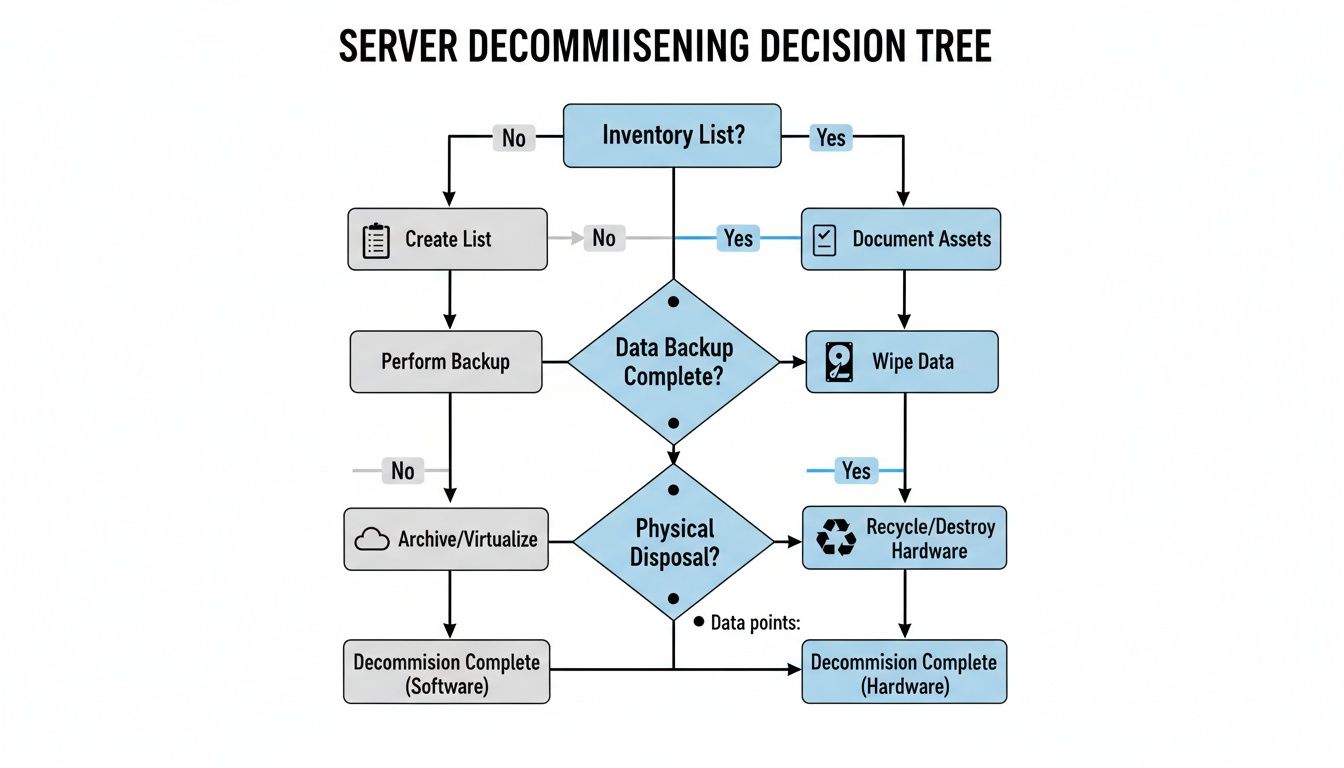
As you can see, it all starts with knowing exactly what you have. That inventory list is what guides every decision that follows, especially how you choose to destroy the data.
Data Destruction Methods: On-Site Wiping vs. Shredding
Making the right choice between wiping and shredding is critical for compliance and security. Here’s a quick breakdown to help you decide what’s best for your Metro Atlanta organization.
| Feature | Software Wiping (e.g., DoD 5220.22-M) | Physical Shredding |
|---|---|---|
| Security Level | High. Data is overwritten multiple times, making it forensically unrecoverable. | Absolute. The drive is physically destroyed, eliminating any possibility of data recovery. |
| Best For | Resale/reuse of assets, standard corporate data, budget-conscious projects. | Highly sensitive data (HIPAA, financial), end-of-life drives, and mandated compliance. |
| Value Recovery | Excellent. Wiped drives and servers can be remarketed, recovering value for your business. | None. The hardware is reduced to scrap metal, making it impossible to reuse or resell. |
| Compliance | Meets NIST 800-88 "Clear" and DoD 5220.22-M standards. | Meets NIST 800-88 "Destroy" standards and is often required for the highest security protocols. |
| Proof of Destruction | A detailed Certificate of Data Destruction is issued with drive serial numbers. | A Certificate of Destruction is issued, often with the option for you to witness the shredding process. |
| On-Site Process | A technician connects to each drive and runs the wiping software. Can take several hours per batch. | A mobile shredding truck pulverizes drives on-site in minutes. It's fast and definitive. |
| Cost | Generally more cost-effective, and often included for free by ITAD vendors as part of a larger project. | Typically more expensive due to the specialized equipment and labor involved. |
Both methods are valid, but shredding offers that final, indisputable end to the data's life cycle. If your compliance officer needs to sleep at night, shredding is usually the answer.
When To Use Software Wiping
Software wiping is a process where specialized programs bombard a hard drive, overwriting every single sector with random 1s and 0s. We often use the DoD 5220.22-M standard, which does this in three separate passes to ensure the original data is completely obliterated.
This method is your best bet when:
- You want to get some money back. Wiped servers and their components can be safely resold. This is perfect if you're retiring newer equipment that still has market value.
- Your data doesn't fall under extreme security mandates. For most routine business information, a DoD-level wipe provides all the security you need to be compliant.
- Budget is a key concern. Wiping is almost always more affordable than shredding, and many IT asset disposition (ITAD) vendors will include it at no charge.
No matter which method you choose, demand a Certificate of Data Destruction. This is your legal get-out-of-jail-free card. It's official proof that you followed data privacy laws, listing the serial numbers of every single drive and confirming how and when they were destroyed. If a vendor won't provide one, walk away.
When To Choose Physical Shredding
Physical shredding is as straightforward as it gets. A massive industrial shredder, often inside a truck that comes right to your loading dock, pulverizes your hard drives into tiny, unrecognizable metal fragments. You can literally watch it happen.
You'll want to go with shredding if:
- You're handling the really sensitive stuff. Think healthcare records (HIPAA), financial data, or government contracts. Physical destruction is the only way to eliminate 100% of the risk.
- Your compliance policy demands it. Some internal security rules or industry regulations don't leave any gray area—they flat-out require shredding.
- The drives are ancient or worthless. If the hardware has zero resale value, there's no financial reason to keep it intact. Shredding becomes the safest and simplest path.
The e-waste problem from old servers in Georgia is no joke. It's not just about data security; it's about environmental responsibility. Back in 2017, the state produced about 29,100 tonnes of e-waste. By 2027, that number is expected to explode to 52,000 tonnes. This is a massive headache for schools, hospitals, and businesses across Metro Atlanta, where every retired machine is a potential data breach and an environmental liability.
For a more detailed breakdown of your options, check out our guide on secure hard drive destruction services in Georgia.
Navigating Georgia’s Compliance and Regulations
When you’re getting rid of old servers, it’s not just about doing the right thing for security. In Georgia, it's a hard-and-fast legal requirement. Messing this up can lead to some seriously painful fines, legal trouble, and a hit to your reputation that’s hard to come back from. Compliance isn't a box-ticking exercise; it's about proving you're a responsible caretaker of the sensitive data people trust you with.
The first job is figuring out which rules actually apply to your business. If you're running a healthcare practice in Sandy Springs, you live and breathe the Health Insurance Portability and Accountability Act (HIPAA). A single misplaced server could easily spiral into a multi-million dollar data breach headache. For a financial firm down in Buckhead, it's all about laws like the Gramm-Leach-Bliley Act (GLBA), which has strict rules on how you must destroy client financial records.
Adhering to National Standards in Georgia
You won't find one single, massive Georgia law covering data disposal. Instead, the state points to established federal standards, and that's what you'll be measured against in any audit.
The big one you absolutely have to know is NIST 800-88. This is the Guidelines for Media Sanitization from the National Institute of Standards and Technology. Think of it less as a guideline and more as the rulebook that auditors and lawyers will use. It lays out three methods for sanitization:
- Clear: This involves using software to overwrite data. It’s fine for a machine that you plan on reusing somewhere else inside your company.
- Purge: This is a much more thorough wipe, making data recovery practically impossible even with advanced lab tools. It’s the minimum you should consider for gear leaving your direct control.
- Destroy: This is the most final step—physically wrecking the drive by shredding, disintegrating, or even incinerating it. Data recovery is completely impossible.
Working with a vendor who lives by the NIST 800-88 framework isn't optional. It’s your proof that the method used was defensible and up to code.
The most important document in this whole process is your Chain-of-Custody report. This is your unbroken paper trail, tracking every server from the moment it leaves your building to its final destruction. It needs to have asset serial numbers, dates, the exact methods used, and technician signatures. If you don't have this, you have zero proof you did anything right.
Why Your Vendor's Compliance Matters
Hiring a non-certified vendor to handle data destruction is like hiring an unlicensed plumber to fix a major leak—when things go wrong, the liability is all on you. A truly compliant ITAD partner takes that risk off your shoulders the second they take possession of the equipment. They are the ones who provide the Certificates of Data Destruction and Recycling.
These certificates are your legal shield. They are the official documents proving you did your due diligence. When you want to get into the nitty-gritty, you can read our complete Georgia secure data destruction services guide for a deeper dive. In the end, turning compliance from a major worry into a simple checklist really just comes down to picking the right partner for the job.
Managing Logistics and Unlocking Value Recovery
Once your data has been wiped clean or the drives have been shredded, you're on the home stretch. But the job isn't over yet. Now it's time to get the physical hardware off your property and see if you can turn that retired equipment into cash.
This is where server disposal goes from being a line item on your expense sheet to a smart financial move.
Getting the equipment out of your data center is usually simple. Any certified ITAD vendor in the Atlanta area will work with your team to schedule an on-site pickup that doesn't disrupt your operations. If you only have a small batch of servers, some providers like us also have convenient drop-off locations in places like Smyrna for added flexibility.
Turning Old Servers Into New Revenue
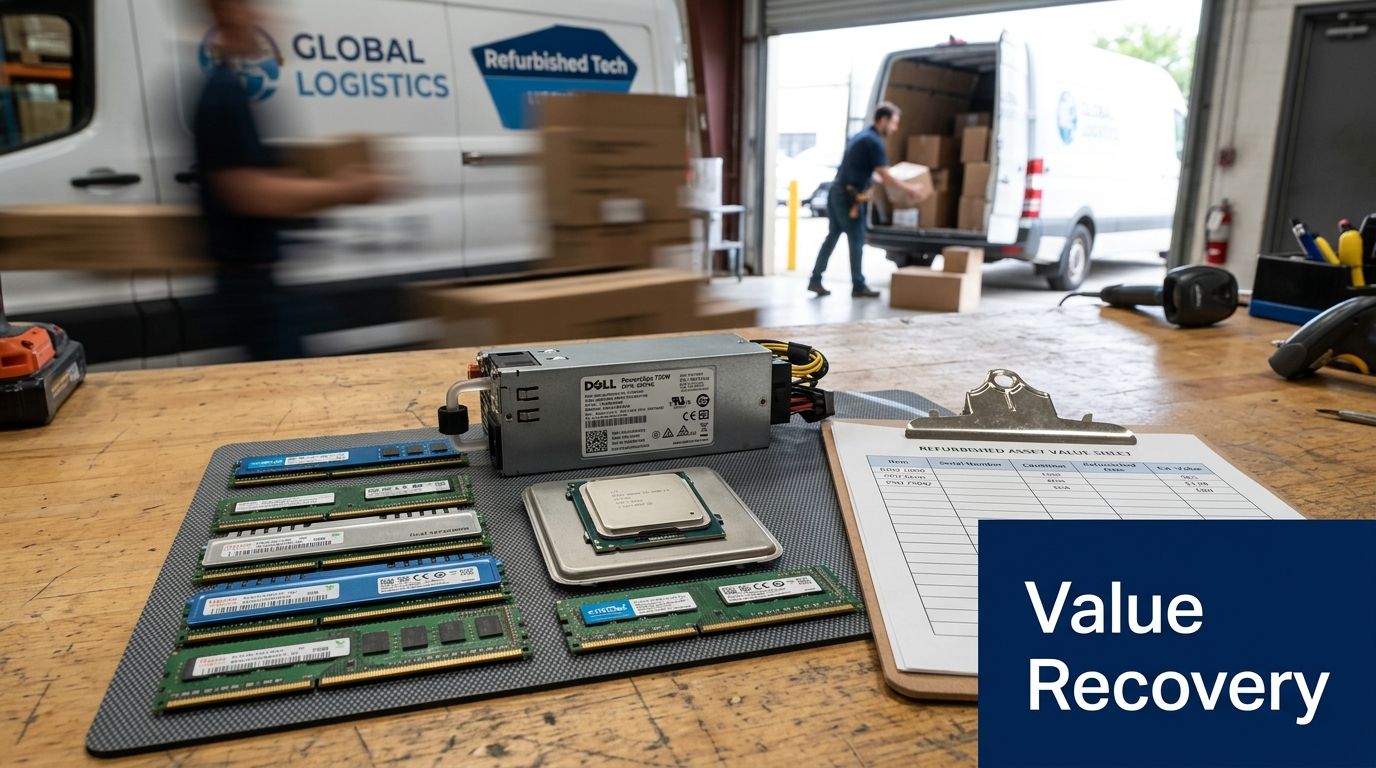
This brings us to value recovery. Don't assume your old servers are worthless junk. Even if a server is just a few years old, its core components—think RAM, CPUs, and enterprise-grade SSDs—often hold significant value on the secondary market. A good ITAD partner sees more than just a pile of metal; they see a chance to remarket those parts.
The process is straightforward but makes all the difference:
- Testing and Auditing: Technicians will test every component to see what's working and what it's worth.
- Refurbishment: Good parts get cleaned, re-tested, and prepped for resale.
- Remarketing: The vendor then uses its sales network to find buyers for the refurbished components.
With a transparent profit-sharing model, your business gets a cut of the final sale price. This can turn a disposal project into a surprising revenue stream, helping to offset the cost of your next IT upgrade.
The Financial Case for Value Recovery in Georgia
For businesses here in Georgia, squeezing value out of every asset is becoming more critical. As the state's data center industry booms, it's also set to lose an estimated $2.5 billion in tax revenue by fiscal year 2026 due to industry-specific exemptions. That puts pressure on everyone.
Tapping into the circular economy by reselling server parts is a direct way to pad your bottom line while also being more sustainable. For a deeper dive on this, you can learn more about Georgia's data center tax policies and see how these trends are shaping the local market.
Knowing how to properly liquidate assets can totally change the financial outcome of your server disposal project. If you want to master the playbook, check out this guide on how to liquidate inventory to maximize your returns.
Finding the Right Disposal and Recycling Partner
Choosing the right partner is what ties this all together. You need a vendor who not only handles the secure logistics but also has a proven and transparent program for getting you paid for your old gear. This is how you close the loop on your IT assets the right way.
A strong ITAD partner transforms the disposal of old servers in Georgia from a logistical headache into a strategic asset recovery process. By managing both the secure removal and the potential for remarketing, they ensure you meet compliance goals while maximizing financial return.
Ultimately, this is about more than just recycling. You’re participating in a circular economy that helps your budget and the environment.
If you’re dealing with other types of tech, you might find our guide on where businesses can recycle IT equipment in Georgia helpful, too.
Common Questions About Server Disposal in Georgia
Even with a solid plan, you’re bound to have questions when it's time to get rid of old servers. We hear them all the time from businesses across the Metro Atlanta area, so we’ve put together some quick, straight-to-the-point answers.
What Does It Cost to Dispose of Servers in the Atlanta Area?
The price tag can swing quite a bit, but here's the good news: many certified ITAD vendors, including us, offer free services. This often includes pickup for businesses with enough qualifying equipment and DoD-standard data wiping.
The final cost really boils down to a few things: how much gear you have, what kind it is, where you're located, and if you need special services like on-site hard drive shredding.
If you're retiring newer servers, a good vendor will have a value recovery program that could actually put money back in your pocket. Always insist on a detailed quote upfront. It should spell out every service, cost, and any potential rebates or profit-sharing. No surprises.
How Can I Be Sure My Company’s Data Is Actually Destroyed?
Any partner worth their salt will provide a formal Certificate of Data Destruction. This isn't just a simple receipt—it’s a legal document that acts as your proof of compliance.
It will list the serial numbers for every single hard drive that was destroyed. It also specifies the exact method used, whether that was a multi-pass data wipe or physical shredding.
For absolute peace of mind, a lot of Georgia businesses are choosing on-site shredding. We bring a mobile shredding truck right to your facility, and you can physically watch your drives get turned into metal confetti before they ever leave your property. This creates a rock-solid, verifiable chain of custody that’s impossible to argue with.
This level of proof is non-negotiable for anyone in healthcare, finance, or government. For you, data security isn't just a good idea—it's the law.
Do You Recycle IT Equipment Besides Servers?
Yes, and honestly, this is a huge deal. A true ITAD provider should be your one-stop shop for all your business electronics. This makes your life easier and ensures everything is handled under the same secure, compliant process.
Your disposal partner should be ready to take all sorts of assets off your hands, including:
- Desktops and workstations
- Laptops and tablets
- Networking gear like switches, routers, and firewalls
- Telecom equipment and office phones
- Monitors, cables, and all the other peripherals
Using one certified partner for all your B2B IT assets gives you a clean, consistent, and auditable trail for everything. It just makes the logistics so much simpler for your team.
Why Not Just Wipe Drives Myself and Use a Scrap Yard?
This path might look easy and cheap on the surface, but it's loaded with hidden risks that can cost your company a fortune down the road. That DIY wipe probably won't meet the strict standards of regulations like HIPAA or NIST. If just one file is recovered later, your company is the one on the hook for the data breach.
And scrap yards? They aren’t certified e-waste recyclers. Your equipment could be dumped improperly, maybe even ending up in a landfill. That’s not just an environmental problem that violates the law; it’s a public relations nightmare waiting to happen. A certified ITAD vendor gives you a secure, documented process that protects you from legal trouble and financial pain.
Ready to dispose of your old servers the right way? The experts at Montclair Crew Recycling offer certified data destruction, on-site logistics, and value recovery for businesses all over Metro Atlanta. Contact us today for a free quote!
