
You might be looking at a stack of retired office hard drives and think a simple 'delete' or reformat is all you need to do. It’s not.
Think of it this way: deleting a file is like tearing the table of contents out of a book. The story is still there, just a bit harder to find. For a determined data thief, it's easily recoverable. This is a huge, and common, risk for Georgia businesses.
Why Deleting Files Is Not Enough
Retired and old hard drives are just ticking time bombs filled with your company’s confidential information. They might seem useless, but they are often ghosts of your most sensitive data—employee records, financial reports, client lists, and even intellectual property.
Simply deleting these files only gets rid of the signpost pointing to the data, not the data itself.
With software that's easy to find online, almost anyone can recover those "deleted" files. This leaves your business exposed to data breaches, identity theft, and corporate espionage. Relying on basic deletion or reformatting is a dangerous gamble. The only way to be certain that information is gone for good is through permanent, professional destruction.
The Real-World Consequences for Georgia Businesses
For a business here in Georgia, the fallout from a data breach from one improperly discarded hard drive can be devastating. It goes way beyond just losing data; it can destroy your company's reputation and financial health.
- A healthcare provider in Marietta could face millions in HIPAA fines if patient records get out from an old server.
- A law firm in Alpharetta could lose the trust they’ve built over decades if confidential case files are pulled from a tossed-out laptop.
- A tech startup in Norcross might see its proprietary code stolen, jeopardizing its entire future over a single overlooked drive.
These aren't just hypotheticals. They are real, everyday risks for companies that don't have a formal data destruction policy. You can learn more about the different methods used to ensure data is unrecoverable in our guide to data sanitization. It’s crucial to understand these options to make the right choice for your business.
A single data breach now costs a business an average of $4.45 million. That number has climbed fast. For small and medium-sized businesses, an event like that is often impossible to recover from.
An Investment, Not an Expense
Thinking of professional data destruction as just another business expense is a big mistake. It's a critical investment in your company's security, compliance, and survival.
The cost of certified destruction is tiny compared to the financial ruin and public relations nightmare of a breach. Choosing secure hard drive destruction services in Georgia means you are taking a proactive step to protect your customers, your employees, and your brand. It’s about ensuring that when a hard drive leaves your office, its data is gone forever. That peace of mind is priceless.
Decoding Your Data Destruction Options
Figuring out the best way to destroy your data can feel like a chore, but it doesn't have to be. For any business looking for secure hard drive destruction services in Georgia, getting a handle on your options is the first step toward creating an ironclad security process. Not all methods are created equal, and the right choice really boils down to your specific compliance rules, budget, and whether you want to reuse the hardware.
Let's break down the three main methods with some simple analogies. Think of them as different tools for very different jobs, each offering its own level of security.
The image below shows just how much is at stake with a single, improperly handled hard drive. What starts with a few "deleted" files can quickly spiral into a full-blown data breach and costly regulatory fines.
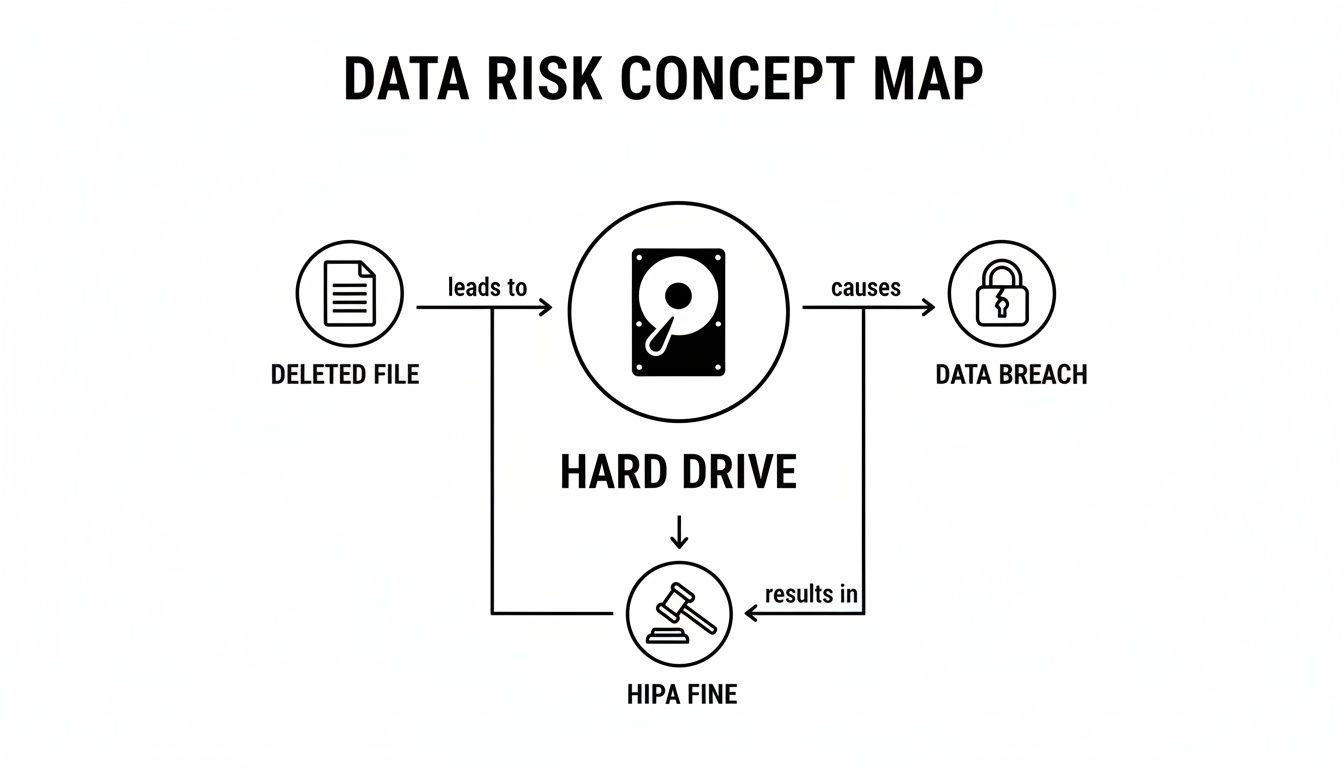
As you can see, one old hard drive is a single point of failure that can trigger major financial and legal headaches for your entire organization.
Comparing Data Destruction Methods
To make it even clearer, let's put these methods side-by-side. This table gives you a quick snapshot of how wiping, shredding, and degaussing stack up against each other.
| Method | Process Analogy | Security Level | Allows for Reuse/Resale? | Best For |
|---|---|---|---|---|
| Wiping | Power-washing a whiteboard | High | Yes | IT asset refreshes, reselling/donating equipment, and value recovery. |
| Shredding | Industrial metal shredder | Absolute | No | Maximum security needs, damaged drives, and strict HIPAA/FACTA compliance. |
| Degaussing | Wiping a VHS tape with a magnet | Very High | No | Destroying data on magnetic media like HDDs and backup tapes quickly. |
Each method serves a purpose. The best one for your business depends entirely on what you need to achieve—whether that's getting value back from old assets or ensuring data is gone forever, no questions asked.
Digital Power-Washing with DoD Wiping
One of the most common and effective techniques is data wiping, which you might also hear called data sanitization. Think of your hard drive as a whiteboard full of sensitive company secrets. If you just wipe it with a cloth, faint traces of the writing can still be seen.
Data wiping is the equivalent of power-washing that whiteboard with a special solvent, writing random nonsense over the entire surface, and then doing it all over again, multiple times. This is exactly what standards like the DoD 5220.22-M wipe do—it overwrites every single part of the drive with new data in three separate passes.
The biggest plus here is that the hard drive itself remains physically fine and works perfectly. This makes wiping the go-to choice for businesses that want to refurbish, sell, or donate old IT gear, turning a potential risk into a real asset.
This is a highly secure and fully auditable process. When it's done, a certified partner will give you a report that confirms the sanitization was successful, giving you the paperwork you need for your audit trail.
Industrial Shredding for Ultimate Security
When there is absolutely no room for error and data has to be gone for good, physical shredding is the undisputed champion. Imagine an industrial-strength woodchipper, but instead of branches, it’s eating metal, plastic, and silicon for lunch.
In this process, hard drives are fed into a beast of a machine that grinds them into tiny, mangled fragments. The internal platters—the shiny discs where your data actually lives—are shattered into countless pieces and mixed in with the remains of hundreds of other drives. Putting that data back together isn't just hard; it's physically impossible.
Physical shredding is the only choice for:
- Maximum Security Needs: Government agencies, healthcare providers handling HIPAA data, and financial firms choose shredding for absolute peace of mind.
- Damaged or Non-Functional Drives: If a drive is toast and can't be wiped, shredding is the only way to guarantee the data is destroyed.
- Strict Compliance Mandates: Regulations like HIPAA and FACTA often demand physical destruction to satisfy their tough data disposal requirements.
This method delivers the highest level of security possible, and you get a Certificate of Destruction to prove it. Many Georgia businesses prefer on-site shredding, where a mobile shred truck comes right to your office for an extra layer of security. To learn more, check out our guide on the best ways to destroy a hard drive for a deeper look.
Digital Amnesia Through Degaussing
A third option, which is less common but still incredibly effective, is degaussing. This process hits the hard drive with an extremely powerful magnetic field. Think of it as giving the drive a sudden, severe case of digital amnesia.
Traditional hard drives (HDDs) store information by arranging tiny magnetic particles on their platters. A degausser creates a magnetic pulse so strong that it scrambles these particles into a completely random, unreadable mess. The drive is instantly and permanently useless.
While degaussing is fast and very secure, it's critical to know it only works on magnetic media like HDDs and old backup tapes. It is completely ineffective on Solid-State Drives (SSDs), which use flash memory and have no magnetic parts. Because most modern offices use a mix of HDDs and SSDs, shredding is often the more practical and foolproof solution.
Navigating Data Privacy and Compliance in Georgia
Getting rid of old hard drives in Georgia is more than just spring cleaning for your IT closet. It’s a serious business decision tangled in a complex web of data privacy laws.
Regulations like HIPAA and FACTA aren't just suggestions—they're strict rules with serious teeth. A single mistake can lead to staggering fines and destroy the reputation you've worked so hard to build. Understanding your obligations isn't just a good idea; it's essential to protect your business.
The Alphabet Soup of Data Laws
For any business in Georgia, a few key regulations are always in play. Each one has specific requirements for how you must handle and, more importantly, destroy sensitive data before you get rid of the hardware.
- HIPAA (Health Insurance Portability and Accountability Act): If you're in healthcare—from a major Atlanta hospital to a small dental practice in Kennesaw—this is the big one. HIPAA demands that all patient health information (PHI) is made completely unreadable and impossible to reconstruct. The penalties for failing? Fines can hit $1.5 million per violation category, per year.
- FACTA (Fair and Accurate Credit Transactions Act): Does your business handle any kind of consumer data for credit, insurance, or employment? Then FACTA's Disposal Rule applies to you. It requires you to take "reasonable measures" to destroy that information, and it specifically names physical destruction like shredding as a compliant method.
- GPIPA (Georgia Personal Identity Protection Act): While Georgia doesn't have a massive consumer privacy law on the books yet, GPIPA is still a factor. It forces businesses to notify affected residents "without unreasonable delay" if their unencrypted personal info is ever compromised. An improperly discarded hard drive is a fast track to a data breach that you'd have to report under this state law.
You simply can't afford to ignore these rules. Working with a professional provider for secure hard drive destruction services in Georgia is your best move. It creates a vital safe harbor, shifting the heavy burden of compliance onto a certified expert who knows the ins and outs.
Think of it like this: A Certificate of Destruction is your legal receipt. It's the official, auditable proof that you fulfilled your duty to protect sensitive data, shielding you from liability in the event of an investigation.
This document is your ace in the hole if an auditor ever comes knocking.
The Gold Standard NAID AAA Certification
So, how do you know if a vendor really walks the walk on security? The answer is NAID AAA Certification. This isn't just some logo they can buy; it's a tough, third-party audit that proves a data destruction company follows the absolute strictest security protocols in the industry.
A NAID AAA Certified vendor gives you peace of mind with:
- Secure Chain of Custody: A fully documented, unbroken trail of control over your hard drives from the moment they leave your hands until they are destroyed.
- Vetted and Trained Employees: Every team member goes through rigorous background checks and continuous security training.
- Audited Processes: Their facilities and trucks are subject to unannounced audits to ensure they are always compliant.
- Insurance and Liability: They carry the right insurance to protect you and your business.
Insisting on NAID AAA Certification is the single most important step you can take to make sure your data destruction process is secure, compliant, and legally sound. Businesses are clearly taking this seriously. The commercial sector's investment in hard disk destruction equipment is now pegged at over $450 million globally—more than half the total market. This shows just how committed companies are to preventing breaches. You can see the full report on these market dynamics and projections.
Ultimately, staying compliant isn't just about avoiding penalties. It's about being a responsible business and making sure the final step in your equipment’s life is as secure as every other. And once the data is gone, what about the hardware? To learn more about environmentally responsible disposal, check out our guide on Georgia electronics recycling.
The Unbroken Chain: Securing Your Hard Drives From Pickup to Destruction
A hard drive is at its most vulnerable the moment it leaves your Georgia office for a destruction facility. This is exactly why a strict chain of custody is the one thing you can't afford to skip. Think of it like tracking an armored car delivery—every single move is documented, secured, and accounted for, leaving zero opportunity for data to get into the wrong hands.
This documented trail provides a complete, auditable history of your assets from the second we pick them up to the moment they are physically destroyed.
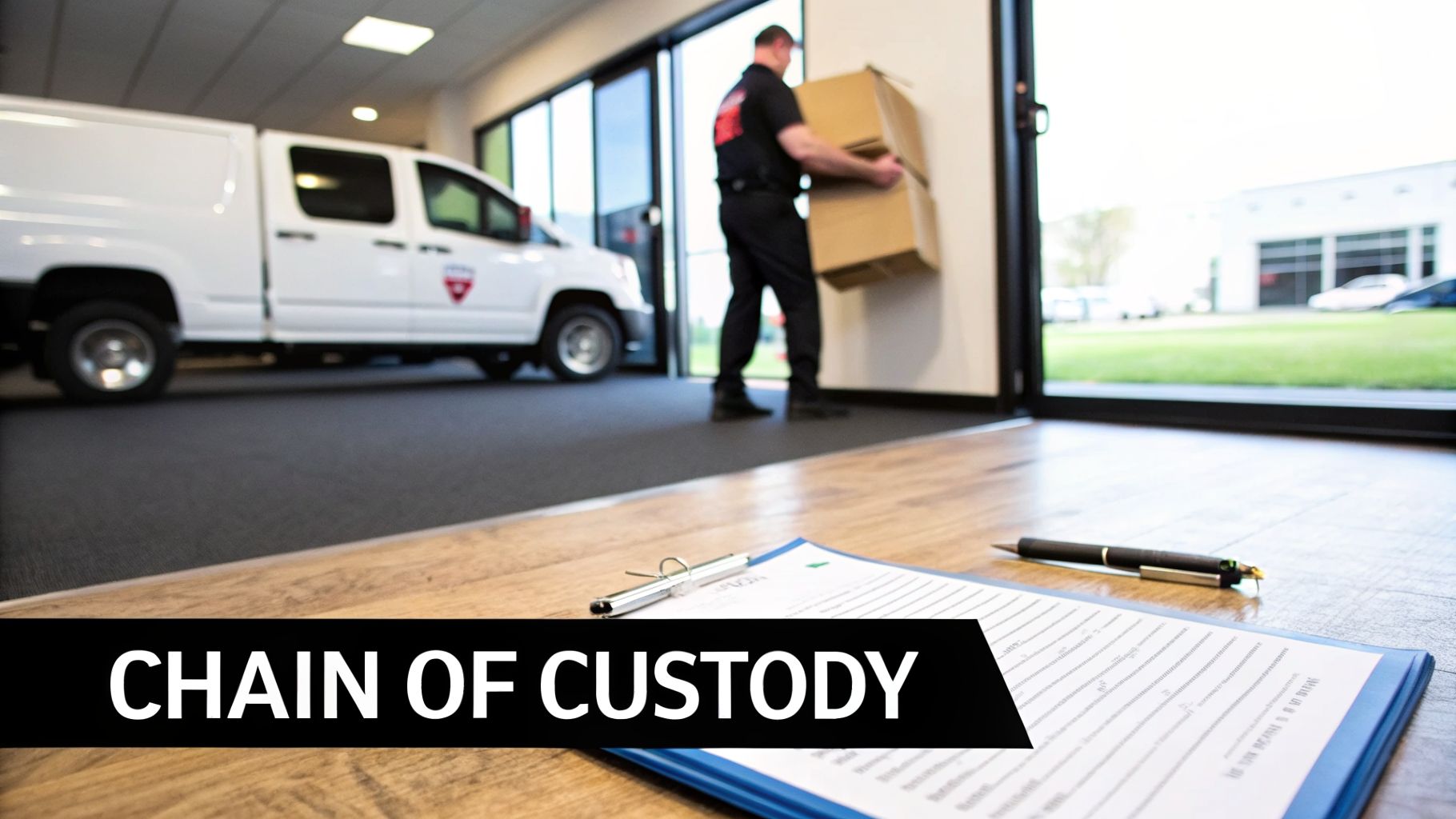
For any business here in Metro Atlanta, this process isn't just a formality. It’s the only real guarantee that your sensitive information stays secure throughout its entire final journey.
Tracing the Journey of a Retired Server
Let's walk through a real-world example. Imagine you're decommissioning a server at your office in Roswell. A secure chain of custody documents its entire lifecycle from that point on.
Secure On-Site Collection: Our uniformed, background-checked technicians arrive at your site. They scan the serial number of every single hard drive, logging each one into a master inventory list. The drives are then sealed in locked, tamper-evident containers before they even leave your building.
GPS-Tracked Transport: Those sealed containers are moved in a locked, GPS-tracked vehicle. We can monitor its location in real-time, ensuring it follows a direct, pre-approved route to our secure facility with no unauthorized stops.
Secure Facility Check-In: Once the truck arrives, the containers are unsealed inside our controlled-access facility, all under video surveillance. We scan the serial numbers again to verify that every drive that left your office has arrived safely for destruction.
This isn't just our preference; this meticulous process is a core part of our NAID AAA Certification and gives you true peace of mind.
Why Every Step Matters
Think of the process like a real chain—it's only as strong as its weakest link. An unlocked truck, an unvetted driver, or a single missing serial number is all it takes for a drive to go missing. When that drive contains your client's PII or company financials, the fallout can be devastating.
Hard drive reliability stats show just how urgent this is. Across hundreds of thousands of drives, the average annualized failure rate is about 1.36%, but that rate can spike for certain models. For every 100 drives you retire, you can bet at least one is a ticking time bomb, making a documented chain of custody your best defense.
The chain of custody is so much more than paperwork. It’s your verifiable proof of due diligence, showing auditors, clients, and regulators that you took every possible step to protect sensitive data the moment it left your control.
Properly meeting security compliance regulations is non-negotiable for any business that handles sensitive data, and this secure process is how you get there.
Once the documented journey and destruction are finished, you receive the final, crucial piece of evidence. This is the ultimate proof for your compliance records, and you can see exactly what to expect when you get your hard drive destruction certificate. This document officially closes the loop on the chain of custody, giving you the formal proof needed for any audit.
How to Choose the Right ITAD Partner in Georgia

Picking an IT Asset Disposition (ITAD) partner is a huge security decision for any Georgia business. You're not just getting rid of old computers—you're handing over your company's sensitive data, legal compliance, and hard-earned reputation to a third party.
The best partners are more than just a vendor; they operate like a specialized extension of your security team. They get what makes your industry tick, whether you're a hospital in Roswell dealing with strict HIPAA rules or a data center in Norcross where total data destruction is non-negotiable.
Finding that perfect fit starts with asking the tough questions.
Your Vendor Vetting Checklist
Don't just take a vendor at their word. You need to vet them properly, and a true professional will have zero issues answering these questions with confidence.
- "Are You NAID AAA Certified?" This is your first and most important question. NAID AAA Certification is the gold standard, proving a vendor meets the toughest protocols for hiring, facility security, and the destruction process itself. It’s not just a logo they buy—it's earned through rigorous, ongoing audits.
- "Can I Witness the Destruction?" A vendor you can trust will always offer on-site shredding. This means you can physically watch your drives get destroyed at your own facility, giving you absolute certainty.
- "What Does Your Chain of Custody Look Like?" Make them walk you through their entire process. A secure chain of custody isn't just a phrase; it's a system of locked bins, GPS-tracked trucks, fully background-checked staff, and meticulous serial number tracking from the moment an asset leaves your building.
- "What Kind of Documentation Will I Receive?" The only right answer is a legally defensible Certificate of Destruction. This is your official paper trail, your proof of compliance that details what was destroyed, how, where, and when.
This simple checklist will help you quickly tell the real security experts from the rest. The demand for verified, professional service is exploding. The global hard drive destruction market was valued at over USD 1.65 billion in 2026 and is on track to hit USD 5.05 billion by 2035, all driven by the critical need for compliant data disposal. You can explore the full market analysis on Spherical Insights to see just how fast things are growing.
Matching Services to Your Industry Needs
The best secure hard drive destruction services in Georgia are never one-size-fits-all. When a partner can tailor their approach to your specific industry, it’s a sure sign they know what they’re doing.
Healthcare (Hospitals, Clinics, and Private Practices)
If you're an Atlanta-area organization handling patient records, HIPAA isn't a suggestion—it's the law. Your ITAD partner absolutely must guarantee that all Protected Health Information (PHI) is made 100% unrecoverable.
- Key Need: Absolute, documented destruction to meet HIPAA's strict disposal rules.
- Best Solution: On-site physical shredding. It eliminates all risks during transport and gives you that crucial visual proof.
Finance and Legal (Banks, Credit Unions, and Law Firms)
These industries deal with huge amounts of Personally Identifiable Information (PII) and are watched over by laws like the Fair and Accurate Credit Transactions Act (FACTA).
- Key Need: A flawless, auditable paper trail. Every single step has to be documented to prove you did your due diligence.
- Best Solution: A rock-solid chain of custody combined with a detailed Certificate of Destruction that itemizes every single drive by serial number.
Data Centers and Corporate IT
For the big players in places like Norcross or Alpharetta, it's a balancing act between security, efficiency, and getting value back from old gear.
- Key Need: A streamlined process for handling tons of assets securely while recovering as much money as possible from retired equipment.
- Best Solution: A flexible partner offering both on-site shredding for the most sensitive data and certified data wiping for newer assets that can be safely refurbished and resold.
When you choose a partner, you're not just buying a service. You're investing in a risk management strategy that protects your entire organization from the ground up.
Beyond Destruction Value Recovery and Sustainability
A truly great ITAD partner does more than just destroy things; they find the hidden cash in your old equipment. Once data is securely wiped, plenty of assets like servers, laptops, and networking gear still have market value and can be resold.
Look for a vendor with a transparent profit-sharing or value recovery program. This simple step can turn your IT retirement from a line-item cost into a new source of revenue.
On top of that, a responsible partner should be R2 or e-Stewards certified. This is your guarantee that any materials that can’t be resold are recycled according to strict environmental standards, keeping toxic e-waste out of Georgia's landfills for good.
Finding the right firm means striking the perfect balance between security, compliance, and value. For an even deeper dive, our guide on selecting from IT asset disposition companies offers more great tips.
Taking the Next Step to Secure Your Data
You’ve seen the risks. Now you know that just hitting "delete" on a hard drive is like leaving your front door wide open. Real security comes from professional, permanent data destruction. The next move is up to you, and it's simpler than you think.
Protecting your data isn't just an IT problem—it's a core business responsibility. Whether you're a healthcare provider in Marietta worrying about HIPAA, a law firm in Alpharetta handling client secrets, or a Smyrna school district protecting student records, a data breach is a very real threat. Fortunately, the solution is just as real.
Secure Your Business Today
Don't wait for a data breach to force your hand. That's a gamble no business can afford to lose. The steps you take now are what will keep your organization safe down the road.
Here’s how you can take action right away:
- Know Your Data: Take a quick inventory of the information you’re storing and what compliance rules apply to your industry.
- Find a Certified Pro: Don't settle for less than a NAID AAA Certified partner who gives you a solid chain of custody and a Certificate of Destruction.
- Book the Service: Whether you need on-site shredding for total peace of mind or certified data wiping to recover asset value, a professional service is just a phone call away.
At the end of the day, secure hard drive destruction is a critical piece of your overall plan for comprehensive data security.
A Certificate of Destruction isn't just a receipt—it's your legal proof that you did things right. It's your best defense if an auditor or investigator ever comes knocking.
Ready to lock down your business's data for good? Montclair Crew provides certified secure hard drive destruction services in Georgia. Get in touch with our experts for a free assessment and make sure your data is gone forever, professionally.
Frequently Asked Questions About Hard Drive Destruction
When Georgia businesses start thinking about professional data destruction, a lot of the same questions come up. We get it. You need clear, straight answers to make sure your company is protected and you can move forward with confidence. Here are the most common questions we hear every day.
Is Hitting My Hard Drive with a Hammer Good Enough?
It might feel good to take a hammer to an old hard drive, but it’s definitely not a secure way to destroy data. Those internal platters where the data lives are tougher than they look. Even if you shatter the casing, the pieces of the platter can often survive.
A determined thief with the right lab equipment could piece those fragments back together and pull your data right off them. The only way to guarantee your data is 100% unrecoverable and meet compliance rules like HIPAA is with professional shredding. It grinds the platters into tiny, mixed-up metal fragments, leaving nothing behind to recover.
What Is the Difference Between On-Site and Off-Site Shredding?
Both methods are secure, but the choice really comes down to your company's security policies, budget, and how much oversight you want.
- On-Site Shredding: This is the ultimate in security and peace of mind. We bring a specialized mobile destruction truck right to your location, whether you're in Alpharetta, Marietta, or downtown Atlanta. You can stand there and physically watch your hard drives get turned into scrap metal.
- Off-Site Shredding: With this option, your drives are collected under a strict chain of custody, locked in secure containers, and safely transported to our facility for destruction. For larger quantities of drives, this can often be the more budget-friendly choice.
A good partner will offer both. We work with you to find the right balance between your security needs, your budget, and what's most convenient for your team.
How Much Do Hard Drive Destruction Services Cost in Georgia?
The cost for secure hard drive destruction services in Georgia really depends on a few things. We look at how many drives you have, the service you need (wiping vs. physical shredding), and the logistics (do you want us to come to you, or will you drop them off?).
At Montclair Crew, we actually include free DoD-compliant data wiping with our standard electronics recycling service. For physical shredding, the best bet is to ask for a custom quote based on how many drives you have. No matter what, the small cost of professional destruction is nothing compared to the massive financial hit of a data breach, which can easily cost millions.
Think of it this way: the price of a single data breach far outweighs the cost of destroying every hard drive your company will ever own. Certified destruction is an investment in risk prevention.
Do I Get Proof That My Drives Were Destroyed?
You bet. Any legitimate data destruction company will give you a formal Certificate of Destruction once the job is complete. This isn't just some receipt—it's a legal document that acts as your official audit trail.
The certificate shows what was destroyed, when it happened, how it was done, and who did it. This is your proof for staying compliant with laws like HIPAA and FACTA, and it formally closes the loop on that asset's life.
Ready to ensure your company's retired data is gone for good? Montclair Crew offers NAID AAA Certified on-site shredding and data destruction services for businesses across Metro Atlanta. Contact us today for a free assessment and protect your business from a costly data breach.
