

That storage closet filled with old computers and servers isn't just taking up space—it's a ticking time bomb for your Johns Creek business. Getting a handle on e-waste recycling in Johns Creek is about way more than just decluttering. It’s a critical security and compliance move, and working with a local partner is the smartest way to manage it all without the headaches.
The Hidden Risks of Old Tech in Your Office
Let's be honest, that forgotten storage room of outdated IT hardware is more than an eyesore. For any Johns Creek business, it's a collection of liabilities just waiting for a reason to surface. Ignoring that pile of old tech leaves you wide open to data breaches, compliance penalties, and even environmental fines. It’s a quiet problem that can become a loud and expensive one overnight.
And this isn't some small issue. The world generated a staggering 62 million tonnes of e-waste back in 2022. That's an 82% jump from 2010. This explosion of old tech is outpacing recycling efforts fivefold, with only 22.3% being properly handled. The numbers don't lie—this is a massive, growing problem.
Beyond the Clutter: Data and Compliance Risks
The most immediate threat is the sensitive information still sitting on those old hard drives. Think about it: a single improperly discarded server or laptop could contain years of confidential data. We're talking employee records, client financial details, proprietary information—the works. A breach from a tossed-out piece of equipment can absolutely devastate a company's reputation and lead to some very painful legal battles.
An effective IT asset disposition (ITAD) plan isn't a "nice-to-have" anymore. It's a core part of modern business security and corporate responsibility. It flips a potential liability into a controlled, secure, and fully compliant process.
Beyond the data, there are strict environmental regulations for disposing of electronics. You can't just toss old monitors or PCs in a dumpster. Doing so can land you some significant fines. Proper e-waste recycling ensures you're meeting all your legal requirements, protecting both the environment and your bottom line. You can learn more about the environmental impact of electronic waste and see why responsible disposal is so vital for our local communities.
Why a Proactive Plan Is Essential
Getting ahead of your IT asset disposition puts you back in control. Instead of panicking when the storage room is bursting at the seams, a planned strategy gives you some serious advantages:
- Enhanced Security: You get peace of mind knowing every device is professionally wiped or physically destroyed. No more lingering data breach risks.
- Guaranteed Compliance: You receive official documentation proving you disposed of everything according to local and federal rules. This is your proof if anyone ever comes asking.
- Improved Efficiency: You reclaim valuable office space and take the burden of managing obsolete junk off your IT staff's plate so they can focus on what matters.
- Potential Value Recovery: You might be surprised what's still worth something. We can help identify equipment that has resale value, turning old assets into unexpected revenue.
By partnering with a local expert for e-waste recycling in Johns Creek, you can tackle these hidden risks head-on. A clear plan keeps your business secure, compliant, and focused on growth—not on the problems lurking in the back closet.
Creating Your IT Asset Inventory
Before you can even think about scheduling an e-waste pickup here in Johns Creek, you need a crystal-clear picture of what you actually have. A detailed IT asset inventory is your roadmap for this entire process. Don't worry, this isn't about getting bogged down in some complex software; it’s about creating a simple, functional list that gives you total control over your retired tech.
Think of it as a pre-flight check. A good inventory prevents nasty surprises down the road, ensures you get an accurate quote for any services, and provides a clear chain of custody for every single asset you’re handing over. Without it, you're flying blind, and it’s impossible to guarantee that every device holding sensitive data has been accounted for and properly sanitized.
Starting Your Audit Without the Headache
The goal here is practicality, not perfection. You don’t need a fancy, expensive system to get started. Honestly, a basic spreadsheet is often more than enough to capture the essential details for your e-waste recycling project.
To get a running start and make sure you're tracking the right info, you can find some helpful inventory tracking templates that guide you on what to collect.
Your main focus should be on three key areas for each piece of equipment:
- Categorization: Group similar items together. Think in broad strokes—servers, laptops, desktops, networking gear (like switches and routers), and peripherals (monitors, keyboards, mice).
- Condition Assessment: Take a second to note the condition. Is it functional and potentially valuable for resale, or is it purely destined for the recycling pile? A simple "Good," "Fair," or "Recycle" is all you need.
- Data Check: This is the most critical part. Mark every single device that contains a hard drive, SSD, or any form of flash storage. This includes the obvious stuff like servers, PCs, and laptops, but don't forget about some office printers or network appliances that might have internal storage.
An accurate inventory does more than just list what you have. It shines a spotlight on every potential data security risk, allowing you to create a targeted plan for secure data destruction and responsible disposal.
Building a Clear and Actionable Record
To make this even more straightforward, here's a simple checklist you can adapt for your own inventory audit. It helps you quickly sort through your equipment and decide on the next steps for each item.
E-Waste Inventory Checklist for Your Business
| Asset Type | Condition Assessment (Resale/Recycle) | Data Storage (Yes/No) | Action Required |
|---|---|---|---|
| Dell Latitude Laptop | Good | Yes | Set aside for resale evaluation, schedule DoD wipe |
| HP ProLiant Server | Recycle | Yes | Schedule on-site drive shredding |
| Cisco Catalyst Switch | Fair | No | Tag for recycling pickup |
| ViewSonic Monitor | Recycle | No | Tag for recycling pickup |
| Apple MacBook Pro | Good | Yes | Set aside for resale evaluation, schedule DoD wipe |
This kind of simple tracking turns a chaotic storage room into an organized list of assets, each with a clear, designated outcome. Items marked for resale can be set aside for a proper valuation, while those tagged for recycling are ready to go.
For businesses looking to refine their approach beyond a one-time cleanout, digging into established IT asset management best practices can help you build a sustainable system for the entire lifecycle of your technology. At the end of the day, an organized inventory is the foundation of any successful e-waste recycling Johns Creek initiative, making the next steps of data destruction and logistics both straightforward and secure.
Ensuring Your Company Data Is Truly Gone
After you've inventoried all your IT assets, we get to the most critical step: making sure every last byte of company data is gone for good. Just hitting 'delete' on a file doesn't cut it. That data is almost always recoverable with pretty basic software tools. For any business here in Johns Creek, skipping proper data destruction isn't just lazy—it's a massive risk to your company, your customers, and your hard-earned reputation.
Data security isn't just a "best practice" when you're recycling electronics; it's a non-negotiable part of the process. You need a method that's verifiable, certified, and meets whatever compliance standards your industry demands. The good news is, you have some powerful options to guarantee that information is permanently erased.
The Gold Standard Data Wipe
The go-to method for securely wiping data with software is the DoD 5220.22-M three-pass wipe. This is the process the U.S. Department of Defense originally specified, and it’s become the industry benchmark for a reason. It works by overwriting every single sector of a hard drive multiple times, making the original data impossible to piece back together.
Here’s a quick breakdown of how it works:
- Pass One: Writes a pattern of zeros across the entire drive.
- Pass Two: Writes the opposite pattern—a string of ones.
- Pass Three: Writes random characters and then verifies the write was successful.
This process is incredibly thorough and is more than enough for most business needs. The best part? It sanitizes the drive while keeping the hardware intact, so you can still potentially resell or reuse the equipment. If you want to get into the nitty-gritty, our guide breaks down exactly how to wipe a computer before recycling to meet these standards.
When Physical Destruction Is Necessary
For some organizations, software wiping just doesn't provide enough certainty. If you're in finance, healthcare, or work with government contracts here in Johns Creek, the only acceptable proof of destruction is often physical. That's where on-site hard drive shredding comes in.
We're talking about a mobile shredding truck pulling up to your facility. You can literally watch as your old hard drives, SSDs, and backup tapes are fed into a machine and turned into a pile of tiny, mangled metal fragments. It's final.
This visual confirmation gives you an undisputed audit trail and completely eliminates any worries about the chain of custody. It's the ultimate peace of mind when you're dealing with highly sensitive data and can't afford to take any chances.
Choosing between wiping and shredding really boils down to your company's risk tolerance and compliance mandates. Wiping preserves asset value for resale, while shredding offers absolute, verifiable finality.
This decision tree gives you a great visual for how to think about the asset disposition process, from identifying what has data on it to choosing the right path forward.
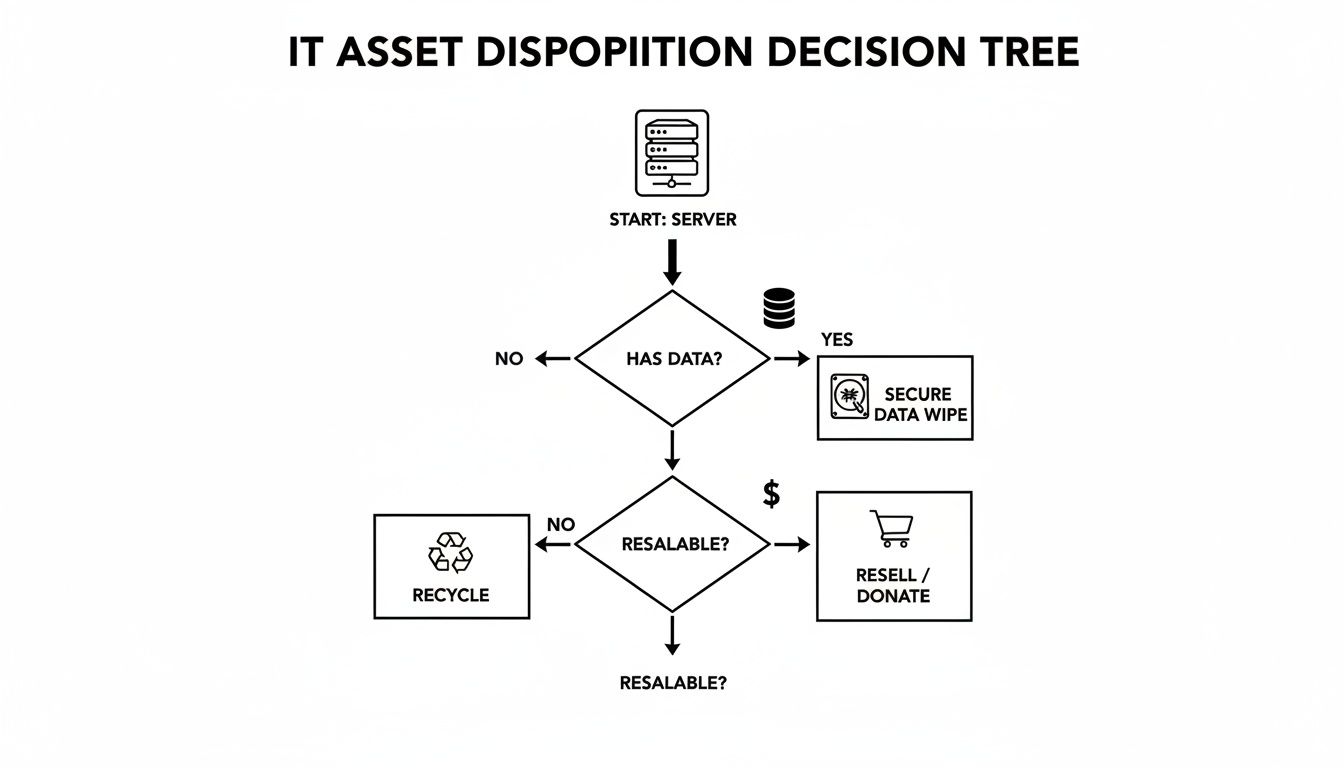
The key takeaway here is that every asset's journey should start with an assessment of its data and its potential value. That initial check guides you toward the most secure and responsible disposal method.
No matter which path you take—certified wiping or on-site shredding—make sure you get a Certificate of Data Destruction. This document is your official proof that you did your due diligence. It’s a vital piece of your compliance puzzle. And remember, secure disposal is just one part of the equation; pairing it with comprehensive data security management practices is what truly protects your Johns Creek business from lingering digital threats.
Scheduling Your E-Waste Pickup
Alright, you’ve inventoried your assets and dealt with the sensitive data. Now for the easy part: getting all that old equipment out of your Johns Creek facility without disrupting your workday. This last logistical step is all about smooth, efficient removal, and a professional e-waste service handles all the heavy lifting for you.
For most businesses, a scheduled on-site pickup is the way to go. It’s a white-glove service where a dedicated team shows up, professionally packs everything you’ve designated, and securely transports it for processing. Your staff doesn’t have to lift a finger—they can keep focusing on their actual jobs while the hardware disappears.
Coordinating an On-Site Removal
Setting up a pickup is pretty straightforward. The single most important thing you can do is have your completed inventory list ready to go. When we have that list, we can send the right size truck and the right number of people for the job, whether you're clearing out a small office or decommissioning an entire data center.
When you call to schedule, we'll quickly run through a few details:
- Location specifics: Do you have a loading dock? Elevators? Are the items on the third floor? Little details like these make a big difference.
- Preferred timing: We'll find a date and time that works for you, so we aren't in the way of your team or your customers.
- Special equipment: Let us know if you have any unusually large or heavy items, like full server racks or big enterprise storage arrays.
Nailing down these details ahead of time is how we make the pickup day quick and seamless. The goal is to be in and out with as little impact on your business as possible.
Having your inventory ready and knowing your building's logistics are the two most important factors for a smooth pickup. It transforms a potentially chaotic day into a predictable and efficient operation.
Drop-Off Options for Smaller Loads
But what if you only have a few items? A full-blown pickup might be overkill. For smaller batches of electronics, dropping them off can be a much more practical solution.
Businesses in the Johns Creek area are welcome to bring their pre-inventoried e-waste to our Smyrna facility. This is a fantastic option if you just have a handful of PCs, monitors, or a box of miscellaneous cables and peripherals. It offers you more flexibility while ensuring your equipment is handled with the exact same security and care as a large-scale removal.
No matter which route you take, you’ll need the paperwork in order. This usually just means a copy of your inventory list and a signed service agreement. On the day of the pickup or drop-off, a Bill of Lading is created to officially transfer custody of the assets. That document kicks off the certified recycling process and gives you a clear paper trail. To see how it all comes together, check out our guide on how to recycle electronics with a free pickup service.
Uncovering Value in Your Old IT Assets
Responsible e-waste recycling is way more than just a disposal chore—it's a genuine business opportunity. If you can shift your mindset from "getting rid of old junk" to "recovering asset value," you can turn a necessary expense into a surprising new revenue stream. A proper IT Asset Disposition (ITAD) strategy doesn't just keep you compliant; it unlocks the hidden cash in your retired equipment.
The first step is always partnering with a certified recycler. This is non-negotiable. It protects your company’s reputation by making sure every single component is handled according to strict environmental laws. This isn't just about avoiding fines; it shows corporate responsibility, which matters more and more to your customers and stakeholders.
From Cost Center to Profit Center
The real game-changer here is value recovery. We see it all the time—businesses are genuinely shocked to learn that their "outdated" equipment still has plenty of life and value on the secondary market. A professional "refurbish and reuse" approach is how you tap into that potential.
Instead of just shredding everything, a skilled ITAD partner audits your inventory piece by piece to identify what can be resold. And we're not just talking about old laptops. Some of the most valuable assets we see include:
- Enterprise Servers: Models that are just a few years old are often in high demand from other businesses.
- Networking Switches: High-port-count switches from brands like Cisco almost always hold excellent value.
- Storage Arrays (SANs): These can be refurbished and find a new home with companies that have different performance needs.
- Bulk Laptops/Desktops: Batches of matching, newer models are perfect for schools or corporate refurbishment programs.
Suddenly, a simple disposal project becomes a strategic financial decision.
By focusing on resale first, you actively participate in the circular economy. You extend the life of valuable electronics, reduce the demand for new manufacturing, and recover a portion of your original investment.
How Profit-Sharing Works for You
This is where a true partnership model really shines. A top-tier e-waste recycling Johns Creek service will offer a profit-sharing arrangement for the good stuff. The whole process is transparent and designed to put money back in your pocket.
Here’s a quick rundown of how it usually works:
- Asset Evaluation: We test and grade your equipment to determine its fair market value.
- Remarketing: Your partner uses their established sales channels to find buyers for the refurbished gear.
- Revenue Split: Once the items sell, you get a predetermined percentage of the net profits.
This approach completely flips the script. The cost of data destruction and recycling for your worthless items is often offset—and sometimes completely covered—by the revenue from your valuable ones.
For businesses in Johns Creek looking to manage their technology lifecycle intelligently, exploring your options for IT asset disposition in Johns Creek, GA can reveal significant financial returns you might be leaving on the table. Instead of just paying to have old tech hauled away, you could be getting a check back in the mail.
Your E-Waste Recycling Questions Answered
When it comes to getting rid of old IT assets, we know you've got questions. Sorting out the details of e-waste recycling in Johns Creek can seem complicated, but it doesn't have to be. We've put together some straightforward answers to the questions we hear most often from local businesses.
What Kind of Business Electronics Can You Recycle?
We take just about any IT hardware your business runs on. Think servers, entire computer setups, laptops, and the networking gear that keeps you connected—like routers and switches. We also handle the usual office electronics that pile up over time.
Whether you're clearing out a single storage closet full of old desktops or decommissioning an entire data center, our team manages the whole process. If you have highly specialized equipment or residential items, we can point you to trusted local partners who are set up for that.
We stick to commercial-grade IT hardware because that's our sweet spot. It's where our expertise in data security and getting you a return on your assets really shines. Our entire operation is built for the scale and security demands of a business, not a household.
How Do I Know My Data Is Securely Destroyed?
For us, data security isn't just an add-on service—it's the core of what we do. It's a non-negotiable step for every single project. Any device that holds data gets a complimentary DoD 5220.22-M three-pass data wipe. This is a rigorous, government-recognized standard designed to make data completely unrecoverable.
Some of our clients in healthcare or finance need to meet even stricter compliance rules. For them, we offer on-site physical hard drive shredding, turning drives into tiny, useless pieces of metal right before your eyes.
Once the job is done, we provide a Certificate of Data Destruction. This is your official record, giving you a clear, verifiable audit trail that proves you’ve handled your data destruction responsibilities correctly.
Do I Have to Haul Everything to Your Facility?
Absolutely not. We come to you. Our team provides full-service on-site pickup and removal across Johns Creek and the entire Metro Atlanta area. We handle the logistics, the packing, and the secure transport right from your office, warehouse, or data center.
Of course, if you just have a few items, arranging a full truck pickup might be overkill. In those cases, you’re more than welcome to drop off your equipment at our Smyrna facility. We offer that flexibility to make sure every business, big or small, can access secure and responsible recycling.
Is It Possible to Earn Money Back from Our Old Tech?
Yes, and you'd be surprised how often it happens. We're huge advocates for recovering the value left in your retired assets. For newer equipment or high-demand hardware (especially enterprise-grade gear), we have strong profit-sharing and resale programs.
After we inventory your equipment, we’ll flag anything with good resale potential. Our team taps into our established remarketing channels to turn that old tech into revenue for your business. It's a great way to transform what you thought was just an expense into an unexpected plus for your bottom line.
Ready to clear out your old IT equipment with a partner you can trust? Montclair Crew Recycling offers secure, compliant, and efficient e-waste solutions tailored for Johns Creek businesses. Get in touch today to schedule your pickup and unlock the hidden value in your assets at https://www.montclaircrew.com.
