
So, you're a business in Peachtree Corners with a pile of old computers, servers, and hard drives. What do you do with them? Tossing them in the dumpster isn't just irresponsible—it's a massive security risk. The real solution is professional data destruction, a process that guarantees every last bit of sensitive information is permanently gone, protecting you from crippling data breaches and legal headaches.
Let's break down exactly what that means for your company.
Your Guide to Secure Data Destruction in Peachtree Corners
When a piece of IT equipment hits the end of its road, hitting the 'delete' key and hoping for the best is a recipe for disaster. Those old devices are treasure troves of confidential data: customer lists, employee PII, financial statements, and your company's secret sauce. For any organization here in Peachtree Corners, leaving that data exposed is like leaving the front door wide open for thieves. A single breach can cost you dearly in fines, lawsuits, and the trust you've built with your customers.
True data destruction isn’t just about deleting files. It’s about making that data completely, utterly, and permanently unrecoverable. Think of it as the final, critical step in your cybersecurity defense—a non-negotiable part of your compliance strategy. Having a documented, certified process is your ironclad proof that you've met your legal duties and protected your most valuable asset: your information.
What This Guide Covers
We put this guide together to give Peachtree Corners businesses a straight-shot understanding of what a secure disposal process really looks like. We'll get into the methods, the must-know compliance rules, and why calling in a pro is always the right move.
Here's what you'll learn:
- The Two Main Methods: We’ll compare certified data wiping (great for asset reuse) with on-site shredding (the ultimate for physical destruction). Knowing the difference is crucial for making the right call for your equipment.
- Legal & Compliance 101: Regulations like HIPAA, FACTA, and DoD standards aren't suggestions—they're the law. We'll show you why a documented process is your best shield against hefty fines.
- The Full Rundown: From establishing a chain of custody to getting that all-important Certificate of Data Destruction in your hands, we’ll walk you through the entire process from start to finish.
Getting rid of old equipment the right way is a huge piece of a smart IT asset disposition plan. This guide gives you the foundational know-how to make smart choices, turning what could be a huge liability into a secure, documented, and compliant win for your business.
Why Dragging Files to the Trash Is Not Enough
For most of us, deleting a sensitive file feels like a done deal. You drag it to the trash or recycling bin, empty it, and figure that information is gone for good. But for any organization in Peachtree Corners handling confidential data, this common habit creates a dangerously false sense of security.
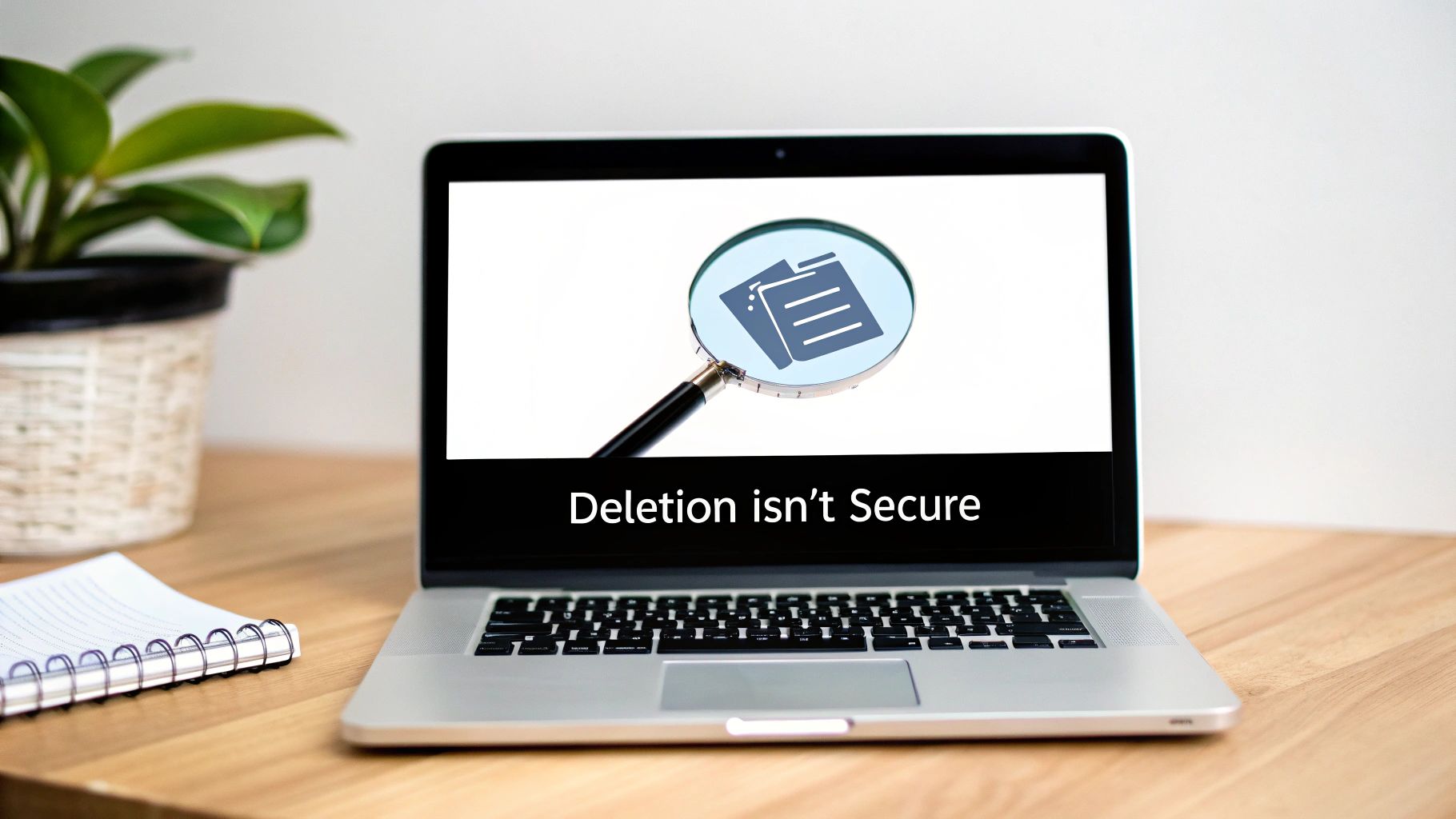
Think of your hard drive like a giant library and its file system as the old-school card catalog. When you "delete" a file, you aren't actually burning the book. You're just pulling its card from the catalog. The book itself—your data—is still sitting right there on the shelf, perfectly intact, just waiting for another book to take its place.
This means the original data is still physically on the drive. Your computer just marks that space as "available" for something new. Until that happens, the old information can be recovered with widely available, often free, software. That's a massive vulnerability for any business.
The Real Risk of Incomplete Deletion
This isn't some theoretical tech problem; it's a real-world security threat. Studies have found that sensitive, recoverable data is present on a shocking number of secondhand hard drives bought online. For a business, this translates to serious risk.
Just think about the kinds of information living on your company's devices:
- Client Information: Names, addresses, contact details, and private account histories.
- Employee Records: Social Security numbers, payroll data, and confidential performance reviews.
- Financial Data: Bank accounts, credit card numbers, and internal financial reports.
- Intellectual Property: Trade secrets, proprietary designs, and crucial research.
Leaving this information accessible on old IT equipment is like leaving the front door of your office wide open. A competitor, a cybercriminal, or even just a curious individual could easily bring back files you thought were long gone.
For a Peachtree Corners business, a single improperly wiped hard drive can lead to devastating consequences, including regulatory fines, reputational damage, and a total loss of customer trust. It turns an old piece of equipment into a ticking time bomb.
What True Data Destruction Looks Like
This is where professional data destruction services come in. Instead of just pulling the card from the library catalog, these methods make sure the book itself is completely and utterly unreadable. It’s all about achieving true data sanitization—a process that makes the data forensically unrecoverable.
This is the only way to guarantee your sensitive information is permanently destroyed. If you'd like a deeper explanation, you can learn more about the specifics of what data sanitization is in our detailed guide.
Professionals get this done in one of two ways: either by overwriting the data or by physically destroying the device.
1. Software-Based Wiping: This technique uses specialized software to write patterns of meaningless characters (like 1s and 0s) over every single part of the hard drive. By doing this multiple times, the original data is effectively scrubbed out of existence.
2. Physical Destruction: This is the brute-force approach. It involves mechanically destroying the storage device, most commonly by shredding it. The hard drive is fed into a powerful machine that grinds it into tiny, unrecognizable pieces of metal.
At the end of the day, relying on the trash bin isn't a data security strategy—it's a gamble. For businesses here in Peachtree Corners, putting a professional data destruction process in place is a fundamental requirement for protecting your information and staying compliant.
Data Disposal and Compliance in Georgia: What Every Business Needs to Know
For any business here in Peachtree Corners, getting rid of old IT gear isn't just about clearing out a storage closet. It's a serious legal responsibility. The truth is, your organization is on the hook for protecting sensitive information from the moment it’s created until it's completely and securely destroyed.
Messing this up isn't an option. The financial penalties for non-compliance can be crippling, and the damage to your hard-earned reputation can be even worse. These aren't just vague rules; they have very real consequences for how you handle that old server or box of hard drives.
The Laws You Can't Ignore
Several federal and state laws set the standard for data destruction. While they each have a slightly different focus, the goal is the same: to make sure sensitive data is gone for good, with zero chance of recovery. If you're running a business in Peachtree Corners, you absolutely need to know about these.
-
HIPAA (Health Insurance Portability and Accountability Act): If you handle any kind of Protected Health Information (PHI), HIPAA is your rulebook. It demands that patient data on old devices be made “unreadable, indecipherable, and otherwise cannot be reconstructed.” Simply deleting files doesn't cut it. You need certified data wiping or physical shredding.
-
FACTA (Fair and Accurate Credit Transactions Act): This one is all about preventing identity theft. FACTA’s Disposal Rule requires any business with consumer information to destroy it properly. That means burning, pulverizing, or shredding documents and completely destroying or erasing electronic files so no one can ever piece them back together.
-
DoD 5220.22-M Standard: This protocol started with the Department of Defense, but it’s now the gold standard for data sanitization in the private sector. It lays out a specific three-pass overwriting process that scrubs a hard drive clean, leaving no trace of the original data.
The rules around data privacy are only getting tighter. Having a documented data destruction process isn't just a defensive move against fines—it’s proof that you’re doing your due diligence to protect your clients, patients, and employees.
Why Certified Destruction is No Longer Optional
The explosive growth in data breaches is why these regulations are becoming so strict. It’s also why professional data destruction is becoming a massive industry. The global market is expected to jump from $7.70 billion USD in 2024 to an incredible $16.82 billion USD by 2030. That number tells a story: businesses are feeling immense pressure to comply and avoid a costly disaster.
This trend highlights a crucial point. Managing your company's risk goes way beyond firewalls and antivirus software. A proactive website security audit can help prevent data breaches on the digital front, but that’s only half the battle. You have to secure your physical assets, too.
Your responsibility for the data on a device doesn't end when you pull the plug. Certified data destruction gives you a verifiable, legally sound process that closes that final security gap. And once the data is gone, the hardware itself needs to be handled correctly. That’s where our Georgia electronics recycling services come in, ensuring every component is disposed of in an environmentally responsible way.
Choosing Between Certified Wiping and On-Site Shredding
When it comes to data destruction Peachtree Corners businesses really have two main roads they can go down: software-based wiping or physical, on-site shredding. Both get you to the same destination—data that’s gone for good—but they take very different routes. Picking the right one for your company comes down to what you need most: asset value, bulletproof compliance, or total operational transparency.
One option is certified data wiping, which you can think of as a deep digital scrub for your hard drives. Instead of just hitting 'delete,' we use specialized software to blast the entire drive with random 1s and 0s. This isn't a one-and-done process; we often run multiple passes to meet tough standards like the DoD 5220.22-M protocol. The original data gets so thoroughly buried under layers of digital noise that it's impossible to recover, even in a forensic lab.
The big win here is that the hardware is saved. Because the drive is still perfectly functional, it can be refurbished and put back to work in your organization or sold to recoup some of its value. This is great for sustainability, but it’s also just smart business—turning old gear from a liability into a cash asset.
What is On-Site Shredding
Then you have on-site hard drive shredding. It's exactly what it sounds like: the brute-force, no-questions-asked method of data destruction. A mobile shredding truck, basically a metal-eating monster on wheels, rolls right up to your office in Peachtree Corners.
The process is incredibly satisfying to watch. Your old hard drives, SSDs, and backup tapes are fed into the shredder and, in a matter of seconds, turned into a pile of mangled metal fragments. The real advantage here is the proof. You and your team can literally stand there and witness every drive being destroyed. That kind of visual confirmation offers a level of certainty that nothing else can, especially if your company has strict security rules to follow.
For businesses in sensitive sectors like healthcare or finance, being able to watch their data-bearing devices get physically torn apart is often a non-negotiable part of their risk management. It completely closes the chain-of-custody loop right there on-site, leaving no room for doubt.
Comparing Your Options Head-to-Head
So, which way should you go? Honestly, both methods are incredibly secure when handled by professionals. The real difference is what you want to do with the hardware after the data is gone.
Let's break it down side-by-side.
| Feature | Certified Data Wiping | On-Site Shredding |
|---|---|---|
| Security Level | High (Forensically Unrecoverable) | High (Physically Irreversible) |
| Asset Outcome | Preserved for Reuse or Resale | Destroyed and Recycled |
| Environmental Impact | Promotes circular economy | Material is recycled, not reused |
| Verification Method | Certificate of Destruction | Visual Confirmation & Certificate |
| Best For | Value recovery, sustainability goals | Maximum transparency, strict compliance |
If your organization is trying to offset the cost of an IT upgrade, certified wiping often makes the most financial sense. The money you can get back from selling newer, high-capacity drives can be pretty substantial. But if a data breach, no matter how small the risk, would be a disaster for your business, the absolute finality of on-site shredding is tough to beat. You can get a much deeper look into the process by reading about our secure hard drive shredding services.
At the end of the day, the choice isn't about which option is "more secure." It's about what lines up best with your company's financial, operational, and compliance goals. A good partner in Peachtree Corners will help you look at your equipment and figure out the most effective path forward, making sure your sensitive data is handled the right way from start to finish.
What to Expect from a Professional Destruction Process
So, what does a professional data destruction job in Peachtree Corners actually look like? It should be a straightforward, secure, and completely transparent process. The goal is to take the guesswork out of the equation and give you solid proof that your company’s sensitive information is gone for good.
It all kicks off with a simple consultation. This first chat is key for us to get a handle on what you need—what kind of devices are we talking about, how many of them are there, and what specific compliance rules you're working under. This lets a provider map out the smartest, most cost-effective plan for you.
Once we have a plan, our team handles the logistics. We'll come to your site to carefully inventory and pack up everything, making sure every single device is accounted for right from the start.
Establishing an Unbroken Chain of Custody
The second an old server or hard drive leaves your office, its security is everything. This is where a strict chain of custody is non-negotiable. Think of it as a documented paper trail that follows your assets at every single point—from pickup and transport all the way to their final destruction.
This detailed tracking means there are no blind spots where a device could get lost, stolen, or fall into the wrong hands. Every piece of equipment gets a serial number and is logged, giving you a clear, auditable record that proves your assets were handled securely from beginning to end.
This level of diligence has never been more important. With global cybercrime costs expected to hit a staggering $10.5 trillion USD annually by 2025, no business can afford a weak link in its security—and that includes how you get rid of old hardware. As these numbers show, the motivation for data thieves is huge, making a documented chain of custody absolutely essential. You can read the full analysis on cybercrime cost projections at Cybersecurity Ventures.
The Final Steps and Your Proof of Compliance
Whether your assets are brought to a secure facility or we handle it on-site, the actual destruction is next. Depending on what you chose—certified wiping or physical shredding—our technicians follow exacting protocols to make the data 100% unrecoverable, sticking to standards like those laid out by the DoD.
This flow chart breaks down the two main paths for professional data destruction Peachtree Corners businesses can take.
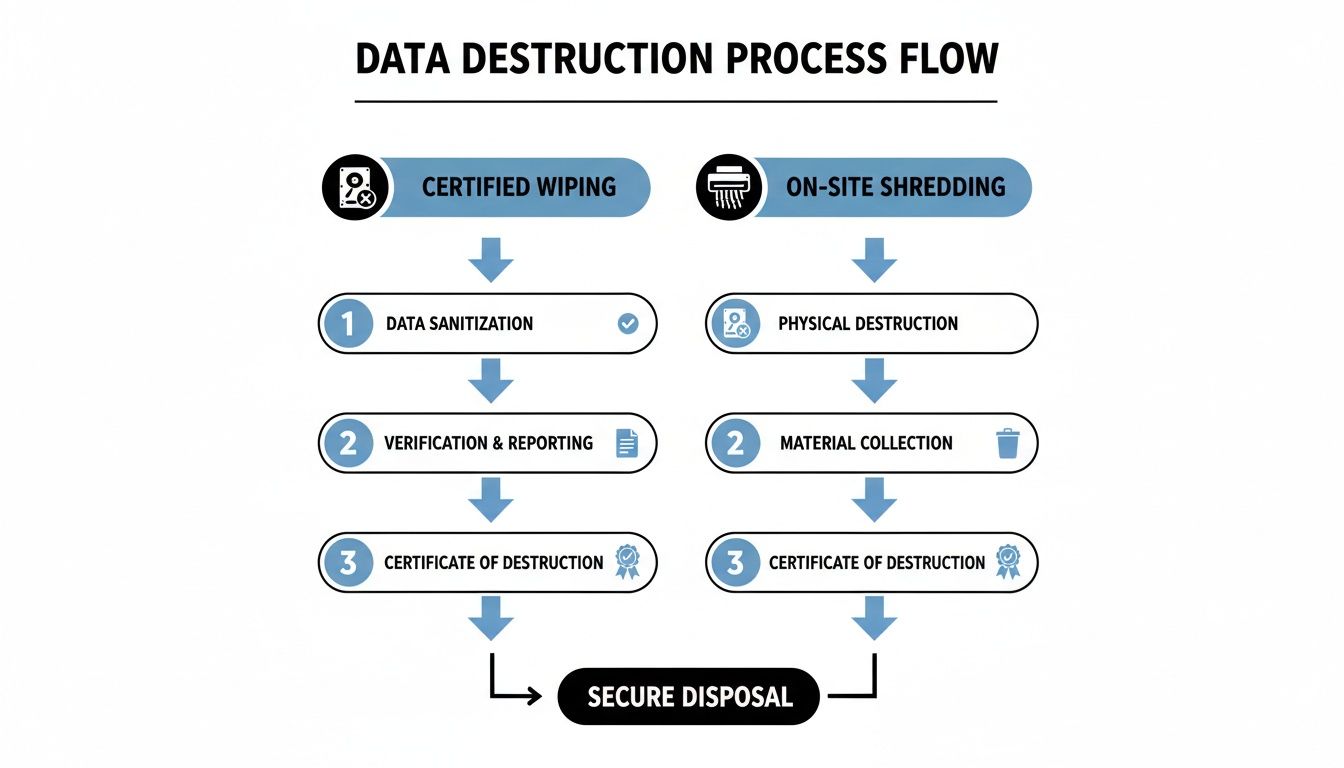
As you can see, both wiping and shredding get the job done, but the process and what happens to the physical hard drive are quite different.
The most important thing you'll get after the job is done is the Certificate of Data Destruction. This isn't just a piece of paper; it's a legal document.
This certificate is what officially transfers liability from your company to us. It itemizes the serial numbers of every device we processed and confirms the destruction method used, acting as your official proof of compliance for any audit. It’s your ultimate peace of mind that you’ve met your legal and ethical duties to protect sensitive data.
Going Beyond Security with Responsible E-Waste Recycling
Making sure your data is gone for good is a huge part of the job, but it’s really only half the story when it comes to your old IT gear. Once the hard drives are wiped clean or shredded into confetti, what’s next for the actual hardware? For any business in Peachtree Corners, a solid IT Asset Disposition (ITAD) plan answers that question, turning what could be a pile of waste into a real opportunity.
This is where the decision between wiping and shredding really matters. Both methods get the security job done, but only certified wiping keeps the physical asset intact. That simple difference opens up a world of sustainability and financial recovery that physical destruction slams the door on.
The Value of Refurbishment and Resale
You’d be surprised how much life is left in most corporate IT equipment. That three-year-old server or fleet of laptops might not cut it for your high-demand operations anymore, but they’re often exactly what someone else is looking for on the secondary market.
Choosing certified wiping makes it possible to refurbish and resell that equipment, which brings two massive wins for your Peachtree Corners business:
- Financial Return: Instead of paying someone to haul away your old tech, you can actually make money from it. That revenue can go a long way toward offsetting the cost of your next hardware upgrade.
- Environmental Responsibility: The best form of recycling is reuse. By giving your electronics a second life, you’re cutting down on the demand for new manufacturing and keeping perfectly good hardware out of a landfill.
This is a practical, no-nonsense way to hit your ESG (Environmental, Social, and Governance) targets. It’s a move that’s both financially smart and great for your company’s reputation.
Handling End-of-Life Electronics Responsibly
Of course, not every piece of equipment can be given a second chance. Some gear is just too old, broken, or specialized to find a new home. For those assets, responsible e-waste recycling is the only way to go. Just tossing old electronics is a huge environmental risk.
Electronic waste is full of nasty stuff like lead, mercury, and cadmium. If that ends up in a landfill, those toxins can seep into the soil and groundwater, causing all sorts of problems. A certified recycler makes sure these materials are handled correctly and by the book.
A professional partner will break down these devices to recover valuable materials like gold, copper, and aluminum, which can then be used to make new products. It’s a key part of building a circular economy. To see how this works right here in our community, you can learn more about our certified e-waste recycling services in Peachtree Corners.
Working with a partner who gets sustainability means your business isn't just secure—it's a good corporate citizen. It closes the loop on the ITAD lifecycle, ensuring that whether your old tech is resold or recycled, it’s handled with the highest environmental standards. Your data destruction plan becomes more than just a security task; it becomes a complete, responsible, and often profitable asset management strategy.
Common Questions About Data Destruction Services
When it’s time to think about professional data destruction, businesses in Peachtree Corners usually have a few questions that pop up right away. Getting this right is a big deal for your security and compliance, so we’ve pulled together the most common ones we hear to give you clear, straight-up answers.
How Can I Be Sure My Data Is Actually Destroyed?
This is the big one, and rightly so. Verification is everything. Any professional service worth its salt will give you concrete proof in two ways, so you can have total peace of mind.
First, you’ll always get a formal Certificate of Data Destruction. Think of this as your legal receipt. It’s an official document that lists the specific serial numbers of every device we processed and confirms the exact method used—whether that was certified wiping or good old-fashioned shredding.
Second, if you choose on-site shredding, the proof is literally right there in front of you. You and your team can stand and watch as every single drive is turned into a pile of metal fragments at your Peachtree Corners office. You can’t get more undeniable than that.
Which Is More Secure: Wiping or Shredding?
It's a question we get all the time, but the answer might surprise you: both are equally secure when a certified pro does the job. Both certified wiping and physical shredding make data 100% unrecoverable, even against sophisticated forensic tools. The "better" choice isn't about security—it's about what you plan to do with the hardware afterward.
The decision between wiping and shredding isn't about security, but about strategy. Wiping preserves asset value for resale and reuse, while shredding provides immediate, visible proof of destruction. Both achieve the same end result of total data elimination.
On-site shredding is popular with organizations that have super-strict internal rules requiring someone to physically witness the destruction. On the flip side, certified wiping gives you the exact same level of data security but also lets you tap into the financial and environmental upside of reselling or repurposing the physical drive.
What Kinds of Devices Can You Destroy Data On?
A solid data destruction plan has to cover every single place sensitive information might be hiding. We’re set up to handle pretty much any piece of IT gear or media you can throw at us.
Our data destruction capabilities include:
- Traditional Hard Disk Drives (HDDs) from desktops, servers, and external drives.
- Solid-State Drives (SSDs) you find in modern laptops, servers, and high-performance computers.
- Backup Media like LTO and DLT tapes, plus other older magnetic formats.
- Mobile Devices, including all those old company smartphones and tablets packed with personal and corporate data.
- Other Data-Bearing Devices like network appliances, USB flash drives, and memory cards.
The whole point is to offer a complete solution for every piece of hardware your business retires. Nothing slips through the cracks.
What Is the Typical Cost for Data Destruction in Peachtree Corners?
The price really depends on the job. A few things factor into the final cost, like how many devices you have, whether you choose wiping or shredding, and if we're doing the work at your place (on-site) or ours (off-site).
Here's the good news: for a lot of IT asset disposal projects, certified wiping is often included at no cost as part of a full equipment recycling pickup. For services that need specialized trucks and gear, like on-site hard drive shredding, it's always best to ask for a custom quote. That way, you get clear, accurate pricing based on exactly what you need.
Ready to put a secure and compliant data destruction plan in place for your Peachtree Corners business? Contact Montclair Crew Recycling today for a free chat and a customized quote. Let us handle the details, so you can get back to running your business. Get started at https://www.montclaircrew.com.
