
Embarking on a data center migration is one of the most complex and critical initiatives an IT organization can undertake. It's a high-stakes project fraught with potential pitfalls, from unforeseen downtime and data loss to spiraling costs and security vulnerabilities. When executed correctly, it unlocks transformative benefits: enhanced performance, greater scalability, improved security, and significant cost savings. The key to navigating this labyrinth isn't just about moving servers from point A to point B; it's about strategic planning and meticulous execution grounded in proven methodologies.
This guide moves beyond generic advice to provide a comprehensive, actionable checklist. We will detail the essential data center migration best practices that distinguish a seamless transition from a costly failure. By following this roadmap, you can de-risk your project, ensure business continuity, and achieve your migration objectives with confidence, whether you are moving to a colocation facility, a private cloud, or a hybrid environment. For those specifically moving towards cloud environments, exploring successful strategies for cloud migration can provide a valuable foundational roadmap to complement these physical and logical migration steps.
From comprehensive assessment and dependency mapping to rigorous testing and post-migration optimization, each step is critical. We will cover key areas including business continuity planning, data integrity verification, security compliance, and effective cutover execution. This framework is designed to equip your team with the insights needed to manage every phase of the project, ensuring all applications and services are migrated securely, on time, and within budget, with minimal disruption to your core business operations.
1. Comprehensive Assessment and Planning
The foundation of any successful data center migration is a meticulously detailed assessment and planning phase. This initial stage acts as the architectural blueprint for the entire project, mitigating risks and ensuring alignment with business objectives. Skipping or rushing this step is a common cause of migration failures, leading to unexpected downtime, budget overruns, and performance issues. A comprehensive plan involves a deep dive into your current IT environment to understand precisely what you have, how it works, and what it depends on.
What It Involves
This process begins with a complete inventory of all physical and virtual assets. This includes servers, storage arrays, networking gear, and the applications running on them. The goal is to move beyond a simple asset list to create a rich, detailed map of your entire ecosystem.
Key activities in this phase include:
- Inventory & Asset Discovery: Use automated discovery tools to scan your network and create a detailed inventory. Manually verify this data to ensure accuracy, cataloging server specifications, software versions, and patch levels.
- Dependency Mapping: The most critical step is identifying and visualizing the intricate connections between applications, databases, and infrastructure components. This prevents the classic migration pitfall where a seemingly isolated server is moved, only to break a critical business application.
- Performance Baselining: Collect current performance metrics for key applications and systems. This data provides a crucial baseline to validate the success of the migration and ensure performance meets or exceeds pre-migration levels.
Why It's a Top Best Practice
A robust assessment and planning phase transforms a data center migration from a high-risk technical maneuver into a predictable, strategic business initiative. The benefits are clear: it provides an accurate scope, enables realistic timelines, and allows for precise budget forecasting. Leading cloud providers like Amazon Web Services (AWS) and Microsoft Azure have built entire frameworks, such as the AWS Migration Acceleration Program (MAP) and Azure Migrate tools, around this foundational principle.
Key Insight: Treat the assessment phase not as a prelude to the migration, but as the most critical part of the migration itself. The quality of your data and planning here will directly correlate with the success of the project. A well-executed assessment is also a core tenet of strong IT governance. You can explore these concepts further by reading about IT asset management best practices.
2. Phased Migration Approach
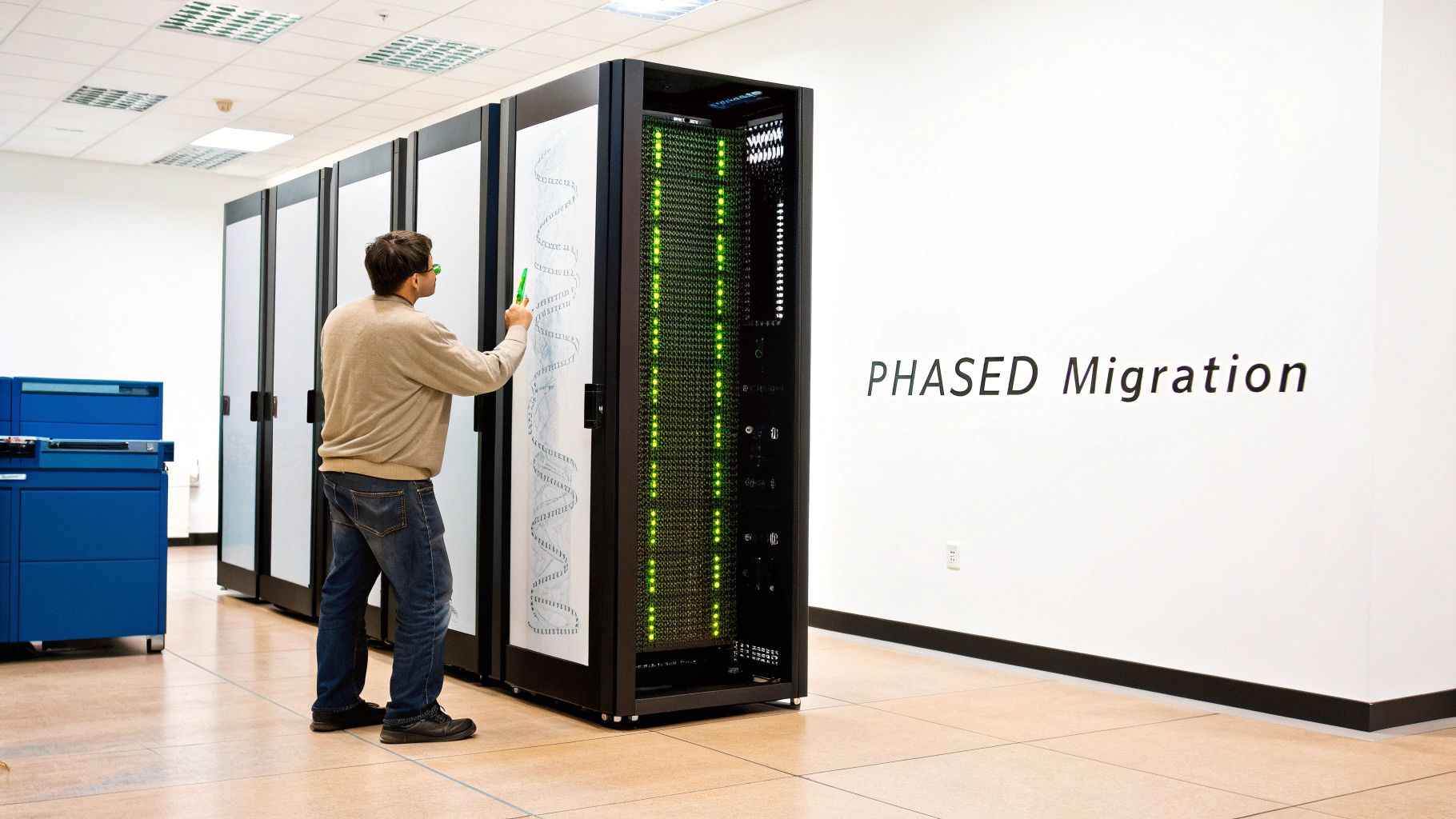
A 'big bang' migration, where all systems are moved simultaneously, is an incredibly high-risk endeavor that leaves no room for error. A far more prudent and strategic method is the phased migration approach. This best practice involves segmenting the migration into smaller, manageable waves or batches of applications and infrastructure. This methodology systematically reduces risk, allows for learning and optimization between phases, and ensures business continuity is maintained throughout the project.
What It Involves
Adopting a phased approach means breaking down the monolithic task of a full data center move into a series of mini-migrations. Each phase has its own planning, execution, testing, and validation cycle, allowing the team to apply lessons learned from one wave to the next. This iterative process builds momentum and team confidence.
Key activities in this phase include:
- Workload Grouping: Use the dependency mapping data from the assessment phase to group applications and infrastructure into logical migration waves. The goal is to move interconnected systems together.
- Pilot Phase Execution: Start with low-risk, non-critical applications to serve as a pilot. This initial wave helps test migration processes, tools, and team coordination in a controlled environment.
- Iterative Rollout: Schedule subsequent waves based on business criticality and technical complexity. After each phase, conduct a thorough post-mortem to identify successes and areas for improvement before proceeding to the next.
Why It's a Top Best Practice
The phased approach is a cornerstone of modern data center migration best practices because it transforms an unpredictable event into a controlled, repeatable process. This strategy minimizes the potential impact of any single failure, as issues are contained within a smaller, specific wave. Major enterprise technology leaders like Microsoft and IBM heavily advocate for this incremental model for their large-scale Azure and data center consolidation projects. It provides the flexibility to adapt to unforeseen challenges without jeopardizing the entire project timeline or budget.
Key Insight: A phased migration isn't just about moving systems in batches; it's about building an organizational muscle for change. The knowledge gained in early phases is invaluable. This approach also simplifies the final stages, such as the handling of decommissioned hardware, allowing you to better plan for your hardware lifecycle management. You can learn more about this by reading about IT asset disposition best practices.
3. Business Continuity and Disaster Recovery Planning
Integrating business continuity (BC) and disaster recovery (DR) planning into a data center migration is not an optional add-on; it is a core component of risk management. While the migration's goal is a seamless transition, a well-structured BC/DR plan is the safety net that protects the organization from unforeseen disruptions. This proactive approach ensures that if a migration event fails, a clear, tested process exists to restore services, protect data, and minimize the impact on business operations.
What It Involves
This process goes beyond standard enterprise DR to address risks specific to the migration itself. It involves defining how the business will maintain operations during the transition and how it will recover from a partial or total migration failure. This planning must be woven into every stage of the project, from initial assessment to post-cutover support.
Key activities in this phase include:
- Define Migration RTO/RPO: Establish specific Recovery Time Objectives (RTO) and Recovery Point Objectives (RPO) for the migration events. How quickly must a service be restored, and how much data loss is acceptable if a rollback is needed?
- Develop Rollback Procedures: Create detailed, step-by-step plans for reverting to the source environment. This includes data synchronization strategies, network configuration rollbacks, and application state restoration.
- Conduct Migration-Specific Drills: Before the actual cutover, perform tabletop exercises or partial failover simulations. These drills test the validity of the BC/DR and rollback plans, identifying gaps in a low-risk setting.
Why It's a Top Best Practice
A dedicated migration BC/DR plan transforms potential project disasters into manageable incidents. For regulated industries like healthcare or finance, this is non-negotiable. Healthcare providers must maintain HIPAA compliance and patient data access even during a migration, while financial institutions with 99.99% uptime requirements cannot afford unmanaged failures. Having a robust, pre-tested recovery strategy is a cornerstone of responsible data center migration best practices, providing confidence to stakeholders and regulators.
Key Insight: Your migration-specific DR plan is as critical as your primary migration plan. Document every recovery step meticulously and ensure all team members understand their roles. This plan should be the first document opened when something goes wrong, not something created in the heat of the moment. Proper planning here is what separates a minor hiccup from a major business outage.
4. Data Validation and Integrity Verification
A data center migration is fundamentally a data-moving exercise, and its ultimate success hinges on whether that data arrives at its destination complete, accurate, and uncorrupted. Rigorous data validation and integrity verification processes are non-negotiable checkpoints that ensure the information powering your business remains trustworthy post-migration. This practice moves beyond simply confirming that files have been copied; it involves a meticulous, evidence-based comparison of source and target data to guarantee a bit-for-bit perfect transfer.
What It Involves
This process starts long before the final cutover and continues after the new environment is live. It requires a systematic approach to check data at multiple stages, using both automated tools and carefully planned manual reviews to ensure nothing is lost or altered in transit.
Key activities in this phase include:
- Pre-Migration Scripting: Develop and test automated validation scripts before the migration begins. These scripts can perform checksums, row counts, and other checks to compare datasets between the source and target systems.
- Batch-Level Validation: Instead of waiting until the end to verify everything, validate data in manageable batches or chunks as it is moved. This approach makes it significantly easier to isolate, troubleshoot, and remediate any discrepancies that arise.
- Business-Logic Testing: Go beyond technical checks. For a financial institution, this might mean running reconciliation reports on both systems to ensure balances match. For an e-commerce platform, it involves verifying that product catalogs and historical transaction data are identical.
Why It's a Top Best Practice
Implementing a robust validation strategy is the ultimate safeguard against data corruption, which can have catastrophic business consequences. It provides tangible proof that the migration has not compromised the integrity of your most valuable asset: your data. This is a critical component of any data center migration best practices checklist, as it builds confidence among stakeholders and significantly de-risks the cutover process. By validating early and often, you can catch potential issues before they impact live operations, preventing costly rollbacks and reputational damage.
Key Insight: Treat data validation not as a final sign-off but as an ongoing quality assurance process woven throughout the migration lifecycle. The goal is to create a chain of custody for your data, with documented proof of its integrity at every step. This discipline is essential for maintaining compliance in regulated industries and is a core principle of good data governance.
5. Cutover Planning and Execution
The cutover is the moment of truth in any data center migration, where operations transition from the legacy environment to the new one. A detailed cutover plan is the minute-by-minute playbook for this critical transition, outlining every task, dependency, owner, and timeline. Without precise orchestration, the cutover phase can quickly devolve into chaos, leading to extended downtime, data loss, and severe business disruption.

What It Involves
Developing a cutover plan involves sequencing all migration activities into a detailed, time-bound schedule. This plan must be a living document, refined through multiple rehearsals and dry runs. It's not just a technical checklist; it’s a communication and coordination tool for the entire migration team.
Key activities in this phase include:
- Go/No-Go Checklists: Establish a final checklist of criteria that must be met before initiating the cutover. This includes successful final data replication, stakeholder sign-off, and confirmation that all resources are in place.
- Sequenced Runbook: Create a step-by-step runbook detailing every action, from shutting down services in the old environment to validating application functionality in the new one. Each step should have a designated owner, estimated duration, and rollback procedure.
- Communication Plan: Define clear communication channels, including a "war room" (physical or virtual), escalation paths, and regular status update schedules for stakeholders. Everyone involved must know their role and who to contact for any issues.
Why It's a Top Best Practice
Meticulous cutover planning minimizes the window of risk and business impact. By rehearsing the process, teams can identify and resolve potential issues before they cause an actual outage. This level of preparation is how organizations like major financial exchanges migrate complex trading platforms over a weekend with minimal disruption. It turns a high-stakes event into a predictable and controlled procedure, one of the most vital data center migration best practices. The plan also smoothly transitions the project into its final phase, which includes the secure shutdown of the old site. Discover how this final step is managed by learning more about professional data center decommissioning services.
Key Insight: The cutover plan should be so detailed that a knowledgeable team member who was not part of the planning process could theoretically step in and execute it. Assume nothing and document everything, including explicit rollback triggers that define the point of no return.
6. Network and Infrastructure Optimization
A data center migration is not just about moving servers and data; it's fundamentally a network-centric operation. The performance, reliability, and speed of your network infrastructure will directly determine the success of both the migration process and post-migration operations. Overlooking this critical layer can lead to bottlenecked data transfers, extended downtime during cutover, and poor application performance in the new environment, completely undermining the project's goals.
What It Involves
This phase focuses on architecting a network that can handle the massive data transfers during the migration and support the performance requirements of your applications afterward. It requires a forward-looking assessment of your current and future connectivity needs, moving beyond a simple "lift and shift" of your existing network topology.
Key activities in this phase include:
- Bandwidth and Latency Analysis: Conduct a thorough assessment of your existing network traffic to determine the bandwidth required for the migration itself and for ongoing operations. This includes analyzing latency between the source and target data centers, which is critical for real-time applications.
- Connectivity Strategy: Evaluate and select the right connectivity model. For large-scale enterprise migrations to the cloud, this might involve dedicated, private connections like AWS Direct Connect or Azure ExpressRoute to ensure secure, consistent, and high-throughput data transfer.
- Infrastructure Modernization: Use the migration as an opportunity to modernize. This could mean implementing a more resilient network architecture, deploying a Content Delivery Network (CDN) to improve application performance for a global user base, or upgrading to higher-speed switches and routers.
Why It's a Top Best Practice
Proactive network and infrastructure optimization is a cornerstone of modern data center migration best practices because it prevents performance degradation and ensures the new environment can meet or exceed business expectations. By planning for peak load scenarios and future growth, you build a resilient and scalable foundation. Major cloud providers emphasize this by offering specialized networking solutions designed specifically to facilitate large-scale, low-latency migrations, highlighting the network's central role in the entire process.
Key Insight: Do not treat the network as mere plumbing for the migration. Instead, view it as the central nervous system of your new IT environment. A well-designed network strategy ensures a smooth transition and is a key enabler of digital transformation, allowing you to fully leverage the capabilities of your new data center or cloud platform. This strategy should align with your broader IT governance and compliance framework.
7. Security and Compliance Verification
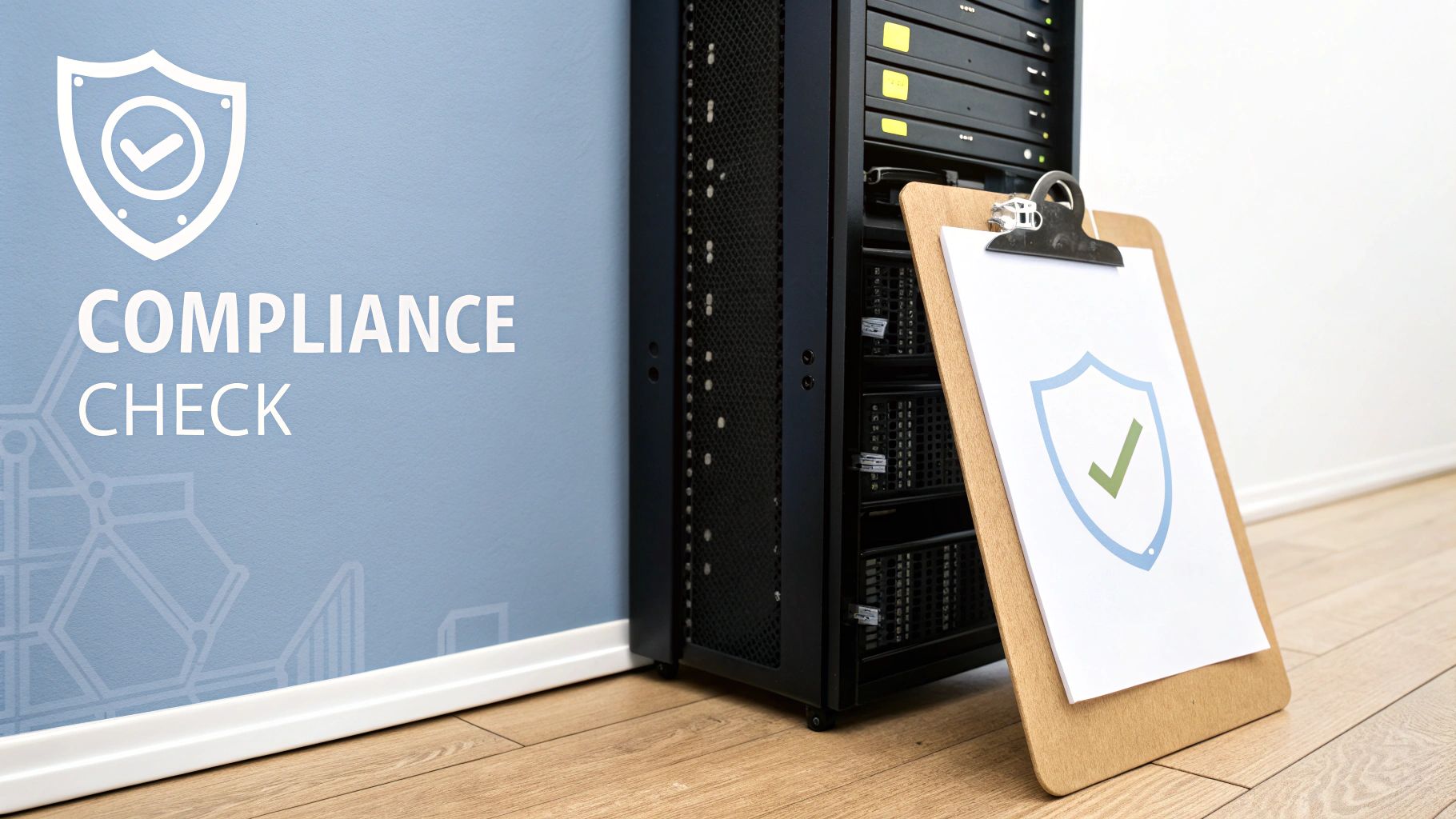
A data center migration is not just a logistical or technical challenge; it is a critical security event that can introduce significant vulnerabilities if not managed properly. This phase involves a rigorous process of ensuring that all security controls and compliance mandates are maintained, or ideally enhanced, throughout the entire migration lifecycle. From data in transit to its final destination, every step must align with organizational security policies and regulatory requirements like HIPAA, PCI-DSS, SOC 2, or GDPR.
What It Involves
This process starts with a pre-migration security assessment to baseline your current posture and identify potential risks in the target environment. It requires close collaboration between the migration team, security officers, and compliance stakeholders to ensure all controls are mapped and validated. This is not a final-step check; it is an ongoing activity woven into every stage of the project.
Key activities in this phase include:
- Pre-Migration Security Assessment: Perform a thorough audit of existing security controls, access policies, and compliance documentation. This forms the basis for the security requirements in the new environment.
- Data Encryption: Implement strong encryption for all data, both in transit during the move and at rest in the new location. This is a non-negotiable step for protecting sensitive information from interception or unauthorized access.
- Identity and Access Management (IAM) Review: Re-evaluate and re-implement IAM policies based on the principle of least privilege. Ensure that only authorized personnel have access to systems during and after the cutover.
- Post-Migration Validation: Conduct penetration testing and vulnerability scans immediately after the migration. For organizations moving to cloud environments, a detailed cloud penetration test guide can provide a structured approach to validating the new infrastructure's defenses.
Why It's a Top Best Practice
Integrating security and compliance verification into your data center migration best practices is essential for risk management and business continuity. A security failure during a migration can lead to devastating data breaches, regulatory fines, and irreparable damage to brand reputation. By proactively addressing these concerns, organizations ensure a secure transition and maintain the trust of their customers and partners. This diligence also extends to the secure disposal of decommissioned assets; you can explore the specifics by reading about data sanitization methods.
Key Insight: View the migration as an opportunity to strengthen your security posture. Use it to eliminate legacy vulnerabilities, implement modern security controls, and simplify your compliance framework. Security should not be an afterthought but a core design principle of your new data center environment.
8. Application Refactoring and Optimization
Moving beyond a simple "lift and shift" migration allows an organization to unlock the full potential of its new environment. Instead of just replicating your existing setup, application refactoring involves modifying and optimizing applications to leverage modern architectures and cloud-native services. This strategic approach transforms the migration into an opportunity for modernization, ensuring your software is not just relocated but also re-architected for superior performance, scalability, and efficiency.
What It Involves
This process means re-coding or re-designing portions of an application to better align with the target infrastructure. It’s a deliberate effort to shed legacy constraints and adopt more agile, resilient patterns. This is a key step in any forward-thinking data center migration best practices checklist.
Key activities in this phase include:
- Containerization: Packaging applications and their dependencies into standardized units, like Docker containers, which can be easily managed by orchestrators such as Kubernetes. This provides portability and consistency across different environments.
- Microservices Decomposition: Breaking down large, monolithic applications into smaller, independent services. Each service can be developed, deployed, and scaled individually, increasing agility and fault tolerance.
- Leveraging Managed Services: Offloading operational burdens by migrating from self-managed components (like databases or message queues) to cloud-provider-managed services (e.g., Amazon RDS, Azure SQL Database).
Why It's a Top Best Practice
Application refactoring future-proofs your IT investments and directly impacts the bottom line. While a "lift and shift" is faster, it often carries legacy technical debt and operational inefficiencies to the new environment. Refactoring, in contrast, reduces long-term operational costs, improves developer productivity, and enhances system scalability and resilience. For example, Airbnb's famous transition from a monolithic architecture to microservices allowed them to scale development teams and deploy features much faster.
Key Insight: Don't view your applications as static assets to be moved. See them as dynamic components that can be improved during the migration. Prioritize refactoring for high-impact applications where the return on investment in terms of performance, cost savings, or scalability is highest. The Strangler Fig Pattern is a valuable, low-risk technique for gradually replacing parts of a legacy system with new services.
9. Training and Knowledge Transfer
A data center migration best practice that is often overlooked is the human element. Technology and infrastructure are only half the equation; the teams who manage, operate, and use the new environment must be fully equipped for the transition. Comprehensive training and knowledge transfer programs are essential to bridge the gap between the old and new systems, ensuring operational continuity and maximizing the return on investment from the migration project.
What It Involves
This process focuses on systematically educating all affected personnel, from the IT operations team to end-users. It involves creating and delivering targeted learning materials that cover new technologies, updated operational procedures, and different management tools. The goal is to build confidence and competence before the final cutover.
Key activities in this phase include:
- Role-Specific Learning Paths: Develop customized training plans for different groups. System administrators will need deep technical training on the new platform, while business users may only need a high-level overview of how to access their applications.
- Hands-On Labs & Sandboxes: Provide safe, isolated environments where technical teams can practice new procedures and experiment with new tools without impacting the production environment. This is crucial for building practical skills.
- Documentation & Runbooks: Create detailed, accessible documentation such as runbooks, wikis, and standard operating procedures (SOPs). These documents serve as a critical reference point for troubleshooting and daily operations post-migration.
Why It's a Top Best Practice
Effective training directly reduces post-migration support tickets, minimizes human error, and accelerates the adoption of new systems. By empowering your teams with the right knowledge, you transform a potentially disruptive technical shift into a smooth operational evolution. This proactive approach ensures that the benefits of the migration, such as improved performance or new features, are realized quickly. Major cloud providers invest heavily in this area, offering extensive programs like AWS Training and Certification and Microsoft Learn for Azure to ensure their customers' success.
Key Insight: Treat training not as a post-migration cleanup task, but as an integrated project workstream that begins early. Establishing internal champions or "super-users" who receive advanced training can create a scalable, peer-to-peer support network that proves invaluable during and after the cutover. For more on building robust operational documentation, consider reviewing guides on creating effective IT runbooks.
10. Post-Migration Monitoring and Optimization
The migration project does not conclude the moment the final server goes live in the new environment; this milestone marks the beginning of a new, equally critical phase. Post-migration monitoring and optimization ensure that the migrated systems operate efficiently, meet performance expectations, and deliver on their promised business value. Neglecting this ongoing activity can erode the benefits gained from the migration, leading to performance degradation, user dissatisfaction, and spiraling operational costs over time.
What It Involves
This phase transitions the project from a one-time move to a continuous improvement cycle. It involves deploying robust monitoring tools to track the health and performance of the new environment against the baselines established during the initial assessment phase. The goal is to proactively identify issues, validate success, and find opportunities for refinement.
Key activities in this phase include:
- Performance Validation: Continuously compare post-migration performance metrics against the pre-migration baselines. Use tools like Amazon CloudWatch, Azure Monitor, or third-party platforms like Datadog to track CPU usage, memory, latency, and application response times.
- Alerting & Anomaly Detection: Configure automated alerts for critical performance thresholds and unusual activity. This allows IT teams to address potential problems before they impact end-users or business operations.
- Cost & Resource Optimization: Regularly analyze resource utilization reports to identify over-provisioned or underutilized assets. This is especially vital in cloud environments where rightsizing instances can lead to significant cost savings.
Why It's a Top Best Practice
Effective post-migration monitoring is fundamental to realizing the long-term return on investment (ROI) of the project. It provides the empirical data needed to confirm that business objectives have been met and justifies the significant investment of time and resources. This practice transforms the migration from a "lift and shift" exercise into a strategic platform for future growth and efficiency. By analyzing performance data, organizations can make informed decisions about scaling, resource allocation, and future architectural improvements, ensuring the new data center environment remains agile and cost-effective.
Key Insight: Treat the post-migration phase as an active management responsibility, not a passive observation period. The data gathered here is invaluable for not only optimizing the new environment but also for planning the final decommissioning of legacy hardware. This data-driven approach is a key part of responsible IT lifecycle management, which you can learn more about by reading our guide to the server decommissioning process.
10-Point Data Center Migration Best Practices Comparison
| Approach | 🔄 Implementation Complexity | ⚡ Resource Requirements & Efficiency | 📊 Expected Outcomes | ⭐ Key Advantages | 💡 Ideal Use Cases / Tips |
|---|---|---|---|---|---|
| Comprehensive Assessment and Planning | High — thorough discovery & mapping | Medium–High — automated tools + stakeholder time; front-loaded effort | Clear roadmap, identified dependencies, reduced surprises | Reduces risk; better resource/budget planning; measurable success criteria | Ideal before any migration; use automated discovery; involve stakeholders; document assumptions |
| Phased Migration Approach | Medium — iterative coordination across waves | Medium — longer timeline, dual environments increase overhead | Incremental migrations with validation checkpoints; maintained continuity | Lower risk; easier troubleshooting; progressive improvements | Use for complex or critical estates; start with non‑critical apps; plan waves by dependency |
| Business Continuity & Disaster Recovery Planning | High — requires detailed RTO/RPO design and testing | High — backup/replication, failover automation, regular drills | Minimal downtime, rapid recovery, compliance alignment | Protects data/availability; reduces financial impact of outages | Mandatory for regulated services; define RTO/RPO early; automate failover; run DR drills |
| Data Validation & Integrity Verification | Medium–High — extensive verification steps | Medium — validation tools, compute time, expertise | Accurate, consistent data; early detection of migration errors | Prevents data loss/corruption; supports compliance | Automate checks; validate in batches; create acceptance criteria and scripts beforehand |
| Cutover Planning and Execution | High — time‑critical, precise coordination | High — rehearsals, 24/7 staffing, monitoring during window | Coordinated transition with minimal downtime | Clear roles/responsibilities; rapid issue resolution | Practice rehearsals; schedule low‑traffic windows; maintain detailed runbooks and logs |
| Network & Infrastructure Optimization | Medium–High — complex networking and vendor coordination | High — bandwidth, direct links, CDNs, specialized tools | Faster transfers; improved latency and post‑migration performance | Reduces transfer time; ensures capacity and resiliency | Assess capacity early; use direct connections for bulk data; plan for peak loads |
| Security & Compliance Verification | High — policy, IAM, encryption, and audits | High — security tooling, specialists, potential performance tradeoffs | Maintained or improved security posture; audit readiness | Reduces breach risk; ensures regulatory compliance | Perform pre‑migration security assessment; encrypt in transit; update IAM; preserve audit trails |
| Application Refactoring & Optimization | Very High — architectural redesign and testing | Very High — development effort, CI/CD, testing environments | Improved scalability, resilience, and long‑term cost savings | Enables cloud‑native benefits; faster innovation; better resource use | Prioritize high‑ROI apps; start with containerization; use strangler‑fig pattern |
| Training & Knowledge Transfer | Medium — curriculum and delivery planning | Medium — trainers, labs, time; ongoing maintenance | Faster adoption, fewer support tickets, stronger operations | Builds internal capability; reduces operational errors | Begin early; create role‑specific paths; use hands‑on labs and internal champions |
| Post‑Migration Monitoring & Optimization | Medium — continuous monitoring and tuning | Medium — monitoring tools and analyst effort | Ongoing performance validation, cost control, issue detection | Enables proactive fixes; continuous improvement; validates ROI | Baseline before migration; set alerts; perform regular optimization reviews |
From Planning to Performance: Finalizing Your Migration Journey
Embarking on a data center migration is a monumental undertaking, a complex choreography of technology, process, and people. It's a journey that transforms the very foundation of an organization's IT operations. Moving from initial assessment to post-migration optimization requires more than just technical skill; it demands a strategic mindset that sees the project not as a one-time event, but as a continuous cycle of improvement and strategic evolution.
The best practices we've detailed, from comprehensive assessment to phased cutovers and rigorous testing, are the foundational pillars of success. Each step, whether it's mapping intricate application dependencies or validating data integrity down to the last byte, is a critical link in a chain that cannot afford to have a weak point. Overlooking even one of these core principles can introduce unacceptable risks, leading to costly downtime, data loss, or security vulnerabilities that undermine the entire project's value proposition.
Recapping the Cornerstones of a Successful Migration
To ensure your project remains on the path to success, let's distill the journey into its most essential takeaways. These are the non-negotiable elements that separate a smooth transition from a chaotic one:
- Meticulous Planning is Paramount: The success of your migration is determined long before the first server is moved. A comprehensive inventory, detailed dependency mapping, and a realistic timeline are the bedrock of the entire operation. This initial phase sets the stage for every subsequent action.
- Communication as a Core Function: A robust change management and communication plan is not an afterthought; it is a central pillar. Keeping stakeholders, from the C-suite to end-users, informed and prepared is crucial for minimizing disruption and securing buy-in across the organization.
- Test, Validate, and Test Again: The only way to move forward with confidence is through relentless testing. From individual application validation in a sandbox environment to full-scale dress rehearsals of the cutover event, each test cycle builds resilience and uncovers potential issues before they can impact production.
- Security is Not a Phase, It's a Constant: From the initial data audit to the final disposition of legacy hardware, security and compliance must be woven into every step. This includes physical security during transport, logical security in the new environment, and certified data destruction for retired assets.
The Final, Critical Chapter: Responsible Decommissioning
As your new, optimized data center hums with efficiency, a final, crucial responsibility remains: the secure and sustainable decommissioning of your legacy infrastructure. The old servers, storage arrays, and networking gear still contain sensitive corporate and customer data. Simply unplugging them and leaving them in a storage closet is a significant security risk and an environmental misstep.
Implementing data center migration best practices extends beyond the go-live date. A successful project lifecycle concludes with a certified IT Asset Disposition (ITAD) process. This ensures that every bit of sensitive data is irretrievably destroyed according to NIST 800-88 standards and that all electronic components are recycled or disposed of in compliance with federal, state, and local environmental regulations. Partnering with a certified expert for this final step protects your brand, secures your data, and fulfills your corporate social responsibility.
Your migration is a strategic investment in the future of your organization. By embracing these best practices from end to end, you are not just moving hardware; you are building a more resilient, secure, and high-performing foundation for future growth and innovation.
Ready to complete the final, critical step of your data center migration with confidence? Partner with Montclair Crew Recycling for certified ITAD services, ensuring your legacy assets are handled securely, sustainably, and in full compliance. Visit Montclair Crew Recycling to learn how we can help you finalize your migration journey responsibly.
