
So, your Georgia business has a growing pile of old servers, desktops, and other IT gear. What’s the right move? The answer is simple: find a professional computer recycling service. Don't think of it as just a spring cleaning—it’s a crucial strategy for your company's security and compliance.
Your Guide to Responsible IT Asset Disposal in Georgia
Whether it's an office closet in Kennesaw or a data center in Alpharetta, that mountain of old tech is more than just clutter. Every single device is a potential liability, holding sensitive company files, customer information, and trade secrets. Just tossing this equipment is a one-way ticket to a data breach and hefty regulatory fines.
This is exactly where IT Asset Disposition (ITAD) comes in. ITAD isn't just a fancy acronym; it's a formal, structured process for getting rid of IT hardware securely, legally, and in an environmentally friendly way. It takes a major risk and turns it into a managed, auditable solution.
Beyond Basic Recycling
Professional computer recycling services for companies in Georgia are a world away from dropping things in a standard e-waste bin. They give you a documented chain of custody, which means every piece of equipment is tracked from the moment it leaves your building until its final destruction. This paper trail is vital for proving compliance and protecting your business.
A real ITAD service will always include:
- Secure Logistics: Professional teams who know how to handle and transport your sensitive equipment safely.
- Certified Data Destruction: A guarantee that every bit of data is wiped clean and can never be recovered.
- Environmental Compliance: Making sure every component is recycled according to state and federal laws, with nothing ending up in a landfill.
- Auditable Reporting: You get certificates of destruction and detailed reports for your compliance records.
It’s this intense focus on security and documentation that sets the pros apart. The global computer recycling market was valued at USD 13,634.26 million in 2026 and is expected to hit USD 22,981.53 million by 2033. This boom shows just how much pressure is on companies to get this right, thanks to tougher environmental rules and a bigger focus on corporate responsibility.
For Georgia businesses, this means that doing IT disposal the right way is no longer optional—it's a core component of modern risk management and corporate responsibility.
Here's a quick look at the main factors you need to keep in mind.
Key Considerations for Computer Recycling in Georgia
| Consideration | Why It Matters for Your Business |
|---|---|
| Data Security | Protects sensitive company, customer, and employee data from breaches. Non-compliance can lead to massive fines. |
| Regulatory Compliance | Adheres to laws like HIPAA for healthcare and Georgia-specific e-waste rules, avoiding legal trouble. |
| Chain of Custody | Provides a documented audit trail from pickup to destruction, proving you handled assets responsibly. |
| Environmental Impact | Prevents toxic materials from polluting Georgia's landfills and ensures valuable materials are recovered. |
| Asset Value Recovery | Some newer equipment may still have resale value, which a good partner can help you recover. |
| Logistics & Cost | A professional service manages the pickup and transport, saving your team time and effort. |
Thinking through these points helps you see why a haphazard approach just doesn’t work anymore.
Working with a local expert like Montclair Crew Recycling gives you a clear, reliable process for retiring your old technology. Instead of a logistical nightmare full of security holes, your business gets a smooth process that protects your data and your good name.
To get the full picture, take a look at our comprehensive guide on electronics recycling in Georgia for businesses and offices. It walks you through exactly why proper disposal is a must-do for every company in the Peach State.
Why Generic E-Waste Bins Are Not Enough for Your Business
Tossing an old office laptop into a standard e-waste bin might feel like you're doing the right thing. But for a business, it’s like leaving your company’s digital front door unlocked and walking away. It’s a huge mistake to think all recycling is the same. The gap between a consumer drop-off bin and professional computer recycling services for companies in Georgia is massive—and it’s filled with risk.
Let's be blunt: using a generic bin is like putting a small bandage on a major injury. It might hide the clutter in your office, but it does absolutely nothing about the real dangers of data exposure, breaking the law, and environmental trouble. For any business, that's just not good enough.
Every retired device you have—whether it’s a server from an Alpharetta data center or a desktop in a Marietta office—is a container full of sensitive information. A public bin offers zero guarantees that the hard drives inside will be properly wiped. You get no paperwork, no chain of custody, and no legal proof that you did your due diligence.
The Real Risks Lurking in Unmanaged Disposal
When a company gets rid of IT equipment without a documented, professional process, it’s walking straight into a minefield of problems. These aren't just hypotheticals; they're real-world consequences that can cripple your operations and ruin your reputation.
The biggest and most immediate danger is a data breach. An improperly wiped hard drive is a goldmine for criminals. It could hold everything from employee records and customer lists to your company’s financial statements and trade secrets. A single breach can cause devastating financial losses, trigger huge regulatory fines, and do permanent damage to your brand.
Then there’s regulatory non-compliance. In the U.S., businesses have to follow EPA guidelines and various state laws aimed at zero-landfill IT disposal. If you’re in healthcare or finance, the rules are even tighter. Regulations like HIPAA require the complete and permanent destruction of protected health information (PHI). Just dropping your old equipment in a bin doesn't come close to meeting these legal standards.
The Scale of the E-Waste Problem
The amount of electronic waste is just staggering, and business hardware is a huge part of the problem. "Grey goods"—a category that includes PCs, servers, and telecom equipment—are piling up as companies constantly refresh their hardware. Globally, e-waste from small IT and telecom gear like laptops and servers hit 4.6 million tonnes in 2022. What’s truly shocking is that only 22% of this was officially documented as recycled. You can find more e-waste market insights on Mordor Intelligence. This massive gap shows why responsible B2B recycling services are so urgently needed.
This is exactly where a professional ITAD (IT Asset Disposition) partner becomes essential. They give you a documented, secure, and compliant solution that tackles all these risks head-on.
Professional computer recycling isn’t an expense; it’s an investment in risk management. It provides a certified, auditable process that protects your company from financial penalties, reputational harm, and environmental liability.
What a Professional Service Provides
Unlike a simple drop-off bin, a specialized recycling service delivers a complete process designed for business needs. It’s the difference between a self-service car wash and a professional detailing service—one is a quick rinse, while the other restores and protects your valuable asset.
A professional partner offers:
- Certified Data Destruction: Using methods like multi-pass wiping or physical shredding to make absolutely sure your data is gone forever.
- Chain of Custody: A complete audit trail that tracks your assets from your office to their final destination, giving you the documentation you need for compliance.
- Asset Recovery: Finding equipment that still has value, refurbishing it, and selling it to put money back into your business.
- Environmental Compliance: Making sure every single component is recycled according to all federal and Georgia state regulations, keeping hazardous materials out of our landfills.
By partnering with a specialist, you turn a potential liability into a secure, managed, and even profitable process. It’s the only way to truly close the book on your old IT assets and protect your organization from the hidden dangers of doing it wrong.
The Step-by-Step Decommissioning and Data Destruction Process
When it's time to get rid of your old company computers, it’s not just a matter of unplugging them and showing them the door. A proper decommissioning process is a security-focused operation designed to protect your sensitive data and keep your business out of trouble from the moment that equipment leaves your office.
Think of it as a documented, secure hand-off. Following a clear set of steps turns what could be a massive security risk into a straightforward, manageable task. For any business in Georgia, knowing this process is the key to protecting yourself.
This visual cuts right to the chase, showing how easily e-waste can spiral into a full-blown business crisis.
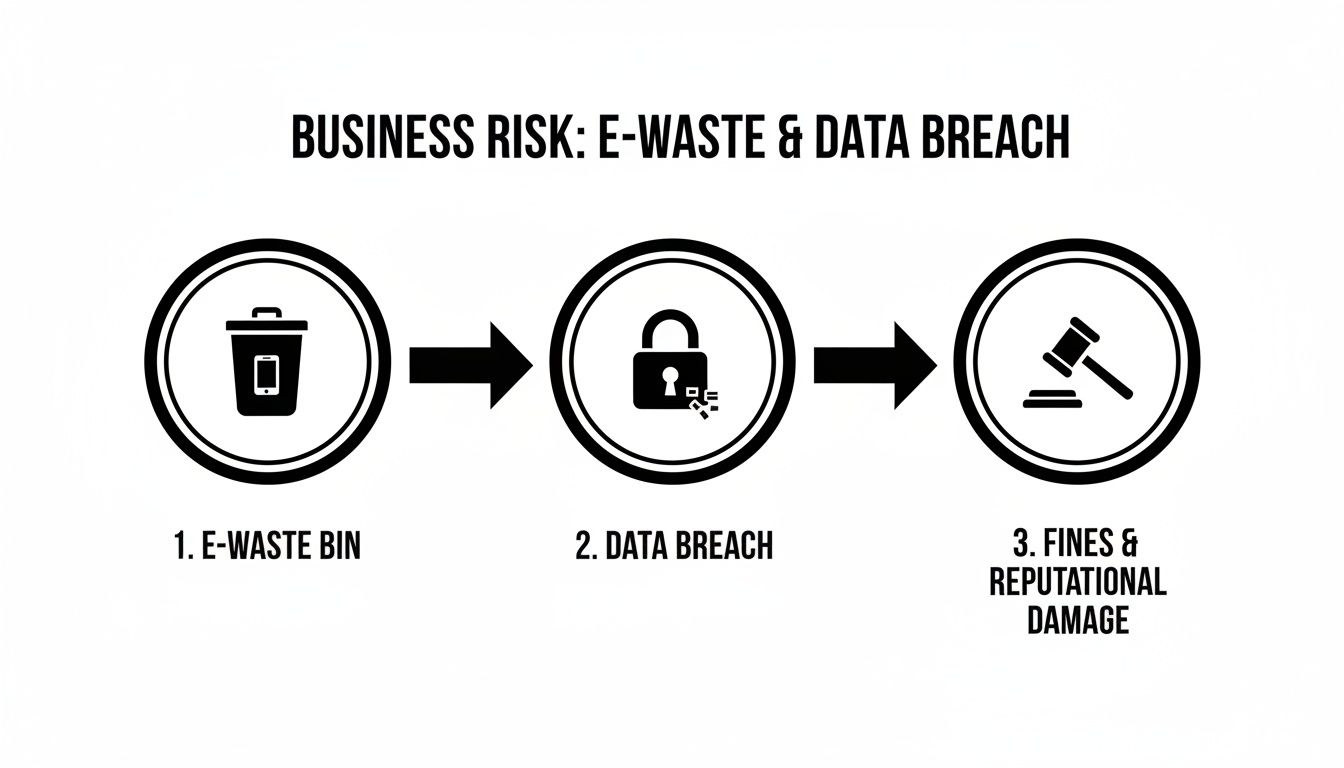
As you can see, one wrong move—like tossing old gear in a dumpster—can open the door to a data breach, which almost always comes with hefty fines and a damaged reputation.
Phase 1: On-Site Assessment and Inventory
It all starts at your office. A professional crew comes to you to see exactly what you’ve got and create a detailed inventory list. This isn't just a quick headcount; it's a careful audit of every single asset.
We're talking servers, desktops, laptops, networking gear, you name it. Each item is logged by its serial number or your company’s asset tag. This list is the foundation of the chain of custody—the single most important document for tracking your equipment.
This step guarantees no device is ever overlooked or misplaced. It's all about total accountability, right from the start.
Phase 2: Secure Logistics and Chain of Custody
With the inventory locked in, the physical removal gets underway. Trained technicians will pack and load everything onto a secure, GPS-tracked truck. This isn't your average moving job; it's a security detail for your old hardware.
The chain of custody document stays with your assets the entire time, tracking every hand-off until it reaches the secure processing facility. This completely walls off any chance for unauthorized access while your gear is in transit.
The chain of custody is your legal proof that you transferred responsibility to a certified vendor. It’s an essential document for any compliance audit, demonstrating your due diligence and commitment to data protection.
Phase 3: Certified Data Destruction
Now for the most important part: making sure your data is gone for good. Every hard drive in your office is a vault holding company secrets, customer information, and financial records. Our job is to make sure those vaults can never be cracked open again.
There are two main ways to do this, depending on your security needs and the age of your equipment.
Data Destruction Methods Compared
Choosing the right method comes down to balancing security needs with the potential for asset reuse. Here’s a quick comparison of the two industry-standard approaches.
| Method | Process | Best For | Security Level |
|---|---|---|---|
| Data Wiping (Sanitization) | Uses specialized software to overwrite the entire drive multiple times with random data, following standards like DoD 5220.22-M. | Newer, functional hard drives that can be safely refurbished and resold. | High |
| Physical Destruction | Feeds the hard drive into an industrial shredder, which grinds it into small, coin-sized metal pieces, making data recovery impossible. | Old, failed, or highly sensitive drives where absolute certainty is required. | Absolute |
For devices with newer drives that still have value, sanitization is a great, secure option. But for older equipment or maximum-security situations, nothing beats the certainty of physical shredding.
If you want to dig deeper into how these methods work, check out our business owner's guide to secure data destruction.
Phase 4: Recycling and Final Documentation
Once all data has been completely destroyed, the remaining hardware is responsibly taken apart. The focus here is on recycling as much as possible while safely managing any hazardous materials.
- Valuable materials like gold, copper, and aluminum are recovered and put back into the manufacturing stream.
- Hazardous materials like lead and mercury are handled strictly according to state and federal regulations, keeping them out of our landfills and water.
- Reusable components and wiped devices might be refurbished and given a second life, which is the most sustainable outcome.
The process wraps up when you receive your Certificate of Destruction. This is your official, legally-binding proof that the job was done right. It lists every asset, the destruction method used, and the date it was completed. This certificate is the final piece of the puzzle, giving you the documentation you need to satisfy any audit and prove your compliance.
Navigating Compliance Rules for Georgia Businesses
Compliance isn’t some box-ticking exercise; it’s the bedrock of responsible computer recycling. For any company in Georgia, whether you're a small shop in Sandy Springs or a major corporation in Marietta, the web of rules around IT asset disposal can feel like a tangled mess. But you can't just ignore them. One wrong move can lead to massive fines and a hit to your reputation that’s hard to shake.
Think about it this way: your old office computer isn't just a piece of junk. It's a vault holding sensitive data, and its guts are filled with regulated materials. Disposing of it the right way means following a strict set of rules, much like a pharmacy has to follow protocols for getting rid of expired medicine. A certified recycling partner is your guide through this legal maze, making sure every step is compliant and you’re fully protected.
Federal and State Environmental Laws
The big player at the federal level is the Environmental Protection Agency (EPA). Their Resource Conservation and Recovery Act (RCRA) is the main rulebook for how solid and hazardous waste gets handled. Because computers contain materials like lead, mercury, and cadmium, simply tossing them in a landfill is a huge environmental and legal no-no.
Georgia then adds its own regulations on top of these federal standards. The state is serious about encouraging responsible e-waste recycling to keep these toxic substances out of our landfills and groundwater. While Georgia might not have a blanket landfill ban on all business electronics, the financial and legal heat for improper disposal is very real. Working with a certified provider of computer recycling services for companies in Georgia is the only way to be sure you’re staying on the right side of the law.
The global numbers really put the issue into perspective for American businesses. Europe formally recycles an impressive 42.8% of its e-waste, but the Americas are far behind at just 30%. In 2021, a shocking 15% of the 6.92 million tonnes of e-waste from the U.S. was actually recycled properly. This gap is both a major risk and a huge opportunity for Georgia businesses to show leadership. You can get the full story by reading the UN's report on rising electronic waste.
Industry-Specific Data Protection Mandates
On top of the environmental laws, many industries have their own strict data security rules. This isn't about recycling the plastic and metal; it’s all about obliterating the information stored on your old devices for good.
HIPAA (Health Insurance Portability and Accountability Act): If you're in healthcare, this is non-negotiable. HIPAA demands that all Protected Health Information (PHI) is made completely unreadable and impossible to recover before you get rid of an IT asset. Just wiping a drive won't cut it—you need certified destruction.
GLBA (Gramm-Leach-Bliley Act): Financial institutions like banks, investment firms, and insurance companies are required to protect their customers' private financial data. The GLBA Safeguards Rule means you need a rock-solid security plan that includes how you securely dispose of customer information.
FACTA (Fair and Accurate Credit Transactions Act): This law is all about consumer information from credit reports. Businesses must destroy that data before disposal. Tossing a hard drive with that info in a dumpster is a direct violation.
Dropping the ball on any of these can lead to painful audits, fines that could cripple your business, and even criminal charges. Some businesses turn to modern tools to keep up with these complex legal duties; for example, using AI legal software can help with research and tracking compliance.
Partnering with a certified ITAD vendor is the simplest, most reliable way to meet all these requirements. They provide official Certificates of Destruction, which act as your legal proof that the data was destroyed according to these tough standards. For a closer look at the local rules, check out our overview of Georgia electronics recycling regulations. This is the paperwork that will shield you in an audit, proving you did everything right to protect sensitive information.
Finding Cash in Your Old Tech: Asset Recovery and Resale
Once your data is wiped clean and you’ve checked the compliance boxes, what's next? For a lot of Georgia businesses, it’s paying to have old equipment hauled away. But here’s something most people miss: your old IT gear isn't just junk. It can be a serious source of cash.
This is what we call asset recovery.
Think of it as a high-tech consignment shop for your company's used equipment. Instead of scrapping every single item, an expert partner figures out what’s still worth something on the market. This process, known as remarketing, flips a disposal bill into a revenue check for your business. It's that simple.
A good ITAD provider handles it all—testing, refurbishing, and finding buyers. You get to run your business while they work to get you the best possible return.
What Equipment Is Actually Worth Money?
Let's be realistic: not all old hardware is a goldmine. That ten-year-old desktop PC is probably headed for the shredder. But you'd be surprised what other equipment can fetch a decent price.
Here are some of the items that consistently hold their value:
- Enterprise Servers and Parts: Newer servers, memory (RAM), and high-end server CPUs are always in demand.
- Networking Gear: Business-grade switches, routers, and firewalls from brands like Cisco and Juniper have a strong secondary market.
- Newer Laptops and Desktops: Workstations and laptops that are only a few years old can be easily refurbished and resold.
- Data Center Hardware: Things like storage arrays (SANs), large uninterruptible power supplies (UPS), and server racks can often be remarketed.
The global market for IT asset disposition (ITAD) hit $18 billion in 2024 and is expected to soar to $41 billion by 2032. Why the boom? It's not just about security—it’s driven by the massive amount of value left in used enterprise hardware.
A partner who knows this market can tell you exactly what your equipment is worth. They’ll identify the best route for each piece, whether that’s selling it whole, breaking it down for valuable components, or just recycling it responsibly. You can find out more in our guide on how to sell computer parts for cash near you.
How Does The Asset Recovery Process Work?
Turning old tech into cash isn’t a mystery. It’s a straightforward, transparent process designed to get you a fair return while keeping everything secure and accounted for.
1. Testing and Grading: After all data has been securely destroyed, every asset gets tested. We figure out what works, what doesn't, and what shape it's in. Each item is then graded based on its function, age, and cosmetic condition.
2. Refurbishment: Gear that still has life in it gets cleaned up, repaired, and brought back to good working order. This simple step makes a huge difference in its final sale price.
3. Remarketing and Sales: This is where we tap into our global network of buyers. We find the right market for your refurbished assets to make sure you get the highest price possible.
4. Reporting and Profit Sharing: You get a crystal-clear report showing what each item sold for. We then split the proceeds based on our agreement, putting money directly back into your budget.
When you partner with a provider of computer recycling services for companies in Georgia that also specializes in asset recovery, you stop treating IT disposal as just another expense. It becomes a smart financial move and the final step in doing ITAD the right way.
Choosing Your Computer Recycling Partner in the Atlanta Area
Picking a partner for your company's IT equipment disposal is a big deal. Think of it like hiring someone for a position that requires a huge amount of trust. You wouldn't hand over your company's most sensitive financial records and client lists to just anyone, right? Well, your old computers and servers are stuffed with that exact same kind of critical data.
Choosing the right provider of computer recycling services for companies in Georgia is the single most important decision you'll make in this process. You need a partner with the right qualifications, a totally transparent process, and an ironclad commitment to security. Just like a job interview, you have to ask the right questions to vet potential vendors and make sure they're truly qualified to protect your business.
Key Questions to Ask Potential Vendors
Treat this like your interview checklist. Any reputable recycler will have clear, confident answers for every single one of these points. If you get hesitation or vague responses, consider it a major red flag.
Are You R2 or e-Stewards Certified?
This should be your very first question. Certifications like R2 (Responsible Recycling) and e-Stewards are the gold standard in the IT asset disposal industry. They are your proof that a vendor follows the absolute strictest rules for environmental safety, worker protection, and data security. A recycler without these certifications offers you no such guarantees.What Data Destruction Standards Do You Follow?
Make them get specific. A professional vendor should immediately mention standards like NIST 800-88 or DoD 5220.22-M. They should also be able to clearly explain the difference between data wiping (sanitization) and physical destruction (shredding), and then help you decide which method makes the most sense for your equipment.Can You Provide a Complete Chain of Custody?
A documented chain of custody is your legal proof. It shows that your assets were handled responsibly from the second they left your Atlanta-area office until they were finally disposed of. Ask to see a sample of their paperwork. It needs to be detailed, tracking every single asset by its serial number or your company's asset tag.What Are Your Insurance and Liability Protections?
You need to know what happens if something goes wrong. What if there’s a data breach that gets traced back to their process? A true professional ITAD partner will carry specialized insurance policies, including data breach and pollution liability coverage. This is what protects your business from the financial nightmare that could follow.
Spotting Red Flags and Ensuring Transparency
Beyond that initial round of questions, you need to keep your eyes open for signs of a trustworthy operation. In this business, transparency is everything. A partner who operates in the shadows is a partner you simply cannot trust with your company's data.
A truly reputable ITAD provider operates with full transparency. They should welcome your questions, provide detailed documentation without hesitation, and be able to clearly articulate every step of their process. Anything less is a compromise on your company's security.
Be on the lookout for these classic warning signs:
- No Physical Address: If a company only lists a P.O. box or won’t let you schedule a tour of their facility, that’s a massive red flag.
- Vague "Zero-Landfill" Promises: Don't just accept the promise; ask how they achieve a zero-landfill policy. A good partner can explain their entire downstream recycling process.
- Lack of Reporting: If they can't or won't provide you with sample Certificates of Destruction or asset summary reports, it's time to walk away.
- Cash-Only Deals: Unprofessional "under the table" transactions are a sure sign that corners are being cut somewhere, likely on compliance and data security.
By carefully interviewing potential vendors, you can find a partner that protects your data, your reputation, and your bottom line. To learn more about this crucial decision, you can dive deeper by reading our complete guide on choosing IT recycling companies in Metro Atlanta. This ensures you find a partner who acts as a true extension of your team, safeguarding your assets with the diligence they deserve.
Frequently Asked Questions About Corporate Computer Recycling
Even when you know you need to get rid of old equipment, a few questions always pop up. We get it. Here are the answers to the questions we hear most often from businesses right here in Georgia.
What Is the Difference Between Recycling and ITAD?
This is a big one. Think of it this way: recycling is just the final step, but IT Asset Disposition (ITAD) is the entire journey.
Basic recycling is about breaking down old hardware for raw materials. But ITAD is the complete security process that has to happen first. It covers everything from secure pickup and certified data destruction to figuring out if the gear has any resale value. Recycling only happens after your data is gone and your compliance is locked in.
How Much Does Computer Recycling Cost for Businesses?
It really depends on what you have. For newer, more valuable gear like servers, switches, or other networking equipment, our computer recycling services for companies in Georgia could be free. In some cases, we might even pay you through a profit-sharing deal.
On the other hand, for a truckload of old desktop PCs or broken monitors with no resale value, there will likely be a fee. This covers the cost of secure transport, guaranteed data destruction, and the actual certified recycling process.
A trustworthy partner will never hide their pricing. We always provide a clear quote based on your exact inventory, breaking down any service fees and showing you any potential money you could get back from reselling the assets.
How Do I Know My Data Is Actually Destroyed?
You don't have to take our word for it—you get proof. A certified ITAD vendor provides a Certificate of Destruction for every single job.
This isn't just a piece of paper. It's a legal document that serves as your audit trail. It lists every asset by its serial number and confirms exactly how and when the data was destroyed, whether through multi-pass software wiping or physical shredding.
Do We Have to Bring Our Equipment to You?
No, and you shouldn't have to. Hauling a bunch of servers and computers yourself is a hassle and a security risk.
Professional ITAD services include secure, on-site pickup from your office, data center, or storage unit anywhere in the Atlanta metro area. Our crew handles all the packing and loading, and we document a full chain of custody so you know your equipment is secure from the moment it leaves your building. It’s a completely hands-off process for your team.
Ready to stop worrying about old IT assets and turn them into a secure, compliant, and professionally managed process? Montclair Crew Recycling offers certified, full-service computer recycling for businesses all over Georgia. We make sure your data is destroyed and your equipment is handled the right way. Contact us today for a transparent quote.
