

A lot of Alpharetta businesses are dealing with the same problem right now. The company is growing, staff have newer laptops, a server refresh is underway, maybe a network closet cleanup is overdue, and a stack of retired equipment is sitting in an office, storage room, or data center cage waiting for someone to “handle it later.”
That backlog creates two risks at once. One is data exposure. The other is improper disposal of equipment that shouldn’t end up in the trash stream. In a market as active and technology-driven as the city of Alpharetta, those risks show up faster than many teams expect.
The challenge is that local business growth is easy to celebrate, but the operational residue of growth is less visible. Old desktops, failed drives, telecom gear, UPS units, lab devices, and racks don’t disappear on their own. Someone has to inventory them, move them securely, document disposition, and make sure the process holds up under internal review.
Thriving in the Technology City of the South
A typical Alpharetta growth story doesn’t start with recycling. It starts with expansion.
A firm adds headcount. A medical office upgrades workstations. A financial team replaces aging laptops before support issues pile up. A data-heavy operation retires hardware that no longer fits its workload. The business is moving forward, but the old equipment remains. It usually ends up pushed to the side because revenue work comes first.
That’s why the city of alpharetta creates both opportunity and responsibility for local organizations. The city has deep commercial roots. Alpharetta was officially incorporated on December 11, 1858, as the county seat of Milton County, and its original boundaries were set as a 0.5-mile radius from the courthouse, according to this history of Alpharetta’s early development. Its merger with Fulton County in 1932 helped drive the infrastructure growth that later supported the modern business environment.

Growth leaves an equipment trail
That history matters because Alpharetta has long functioned as a place where people build, move, and trade. Today, the cargo is different. It’s less cotton and freight, more endpoints, storage, compute, and networking gear. But the pattern is familiar. Economic activity creates physical assets, and physical assets have to be managed properly at the end of their useful life.
For businesses near North Point and the broader commercial corridor, that issue isn’t theoretical. Teams often need a local path for pickup, audit, and secure handling of retired devices. That’s one reason companies look for area-specific support such as IT equipment disposal services in Alpharetta near North Point.
Practical rule: If retired equipment has been sitting longer than your team can confidently track it, your disposal process already needs work.
What local operators actually need
Most organizations don’t need more slogans about innovation. They need answers to practical questions:
- What can leave the office now: Old laptops, desktops, monitors, servers, switches, and telecom gear usually can.
- What needs special handling: Storage media, devices with regulated data, and mixed asset lots need documented chain of custody.
- What fails in practice: Unlogged storage closets, ad hoc staff drop-offs, and “we’ll erase it later” workflows.
In Alpharetta, business momentum is real. So is the need for a disciplined end-of-life process for technology.
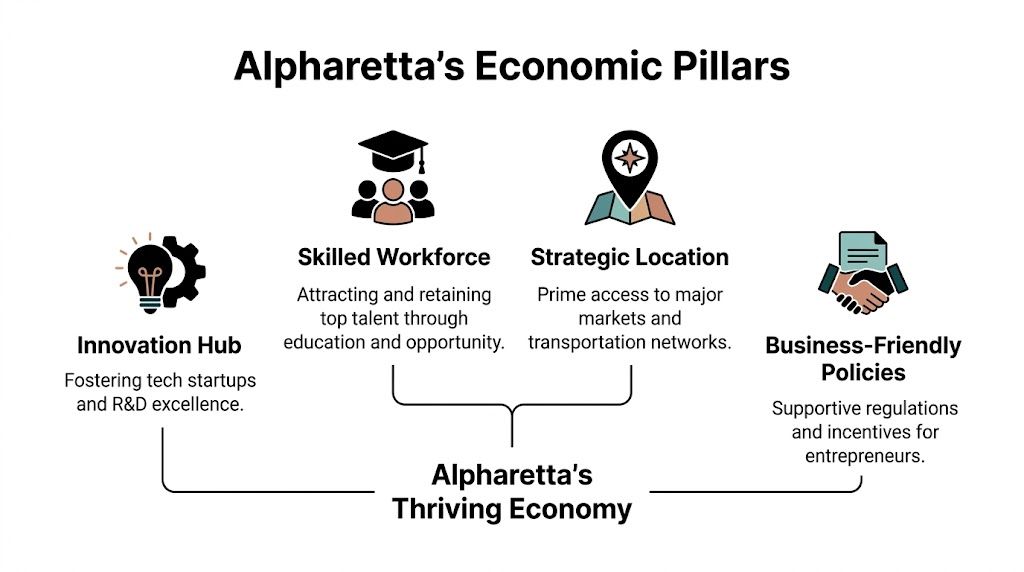
Alpharetta's Economic Engine and Business Climate
Alpharetta’s business appeal isn’t based on branding alone. It rests on infrastructure that supports serious technical operations.
The strongest sign is physical capacity. Alpharetta hosts multiple enterprise-grade data center facilities, including 365 Data Centers, Strategic Datasphere, and Flexential. Flexential’s Alpharetta data center is engineered for 80+ kW per cabinet capacity and includes liquid cooling infrastructure, according to Flexential’s Alpharetta data center specifications. That matters because high-density computing changes everything around it, from facility design to power planning to the eventual retirement of specialized hardware.
Infrastructure supports real operations
Businesses feel the difference between a market that talks about technology and one that can support it. Alpharetta supports it.
When a facility can accommodate high-density cabinets and liquid cooling, it signals a local environment prepared for advanced compute, GPU-heavy deployments, and newer server architectures. That also means the region will generate a steady stream of retired enterprise assets over time, especially from refresh cycles, consolidations, lab changes, and hardware standardization efforts.
A strong business climate also depends on visibility. Many local firms spend heavily to attract leads and talent, which makes operational follow-through even more important. If you’re thinking about how Alpharetta companies build market presence, A Practical Guide to Digital Marketing for Local Business is useful because it connects local growth efforts to practical execution, not just theory.
The operating advantages that matter
The city of alpharetta works well for businesses because several conditions stack together:
- Technical capacity: Enterprise infrastructure supports demanding compute environments.
- Regional reach: Alpharetta can serve firms operating across the broader Metro Atlanta footprint.
- Service concentration: IT vendors, support teams, and enterprise buyers are used to complex projects.
- Upgrade velocity: In a tech-focused market, equipment ages out because business needs change fast, not just because hardware fails.
The better a city is at helping companies deploy technology, the more important it becomes to handle retired technology with discipline.
Why this matters beyond the data center
Not every Alpharetta business runs cabinets full of high-density compute. Many run standard office environments, branch infrastructure, conference room technology, security systems, and endpoint fleets. But the same local business climate affects them too.
A strong tech ecosystem raises the baseline. Clients expect secure handling. Internal teams expect cleaner audit trails. Procurement teams expect a documented disposition path. Leadership wants risk reduced without creating another administrative burden.
That’s the practical reality of the city of alpharetta. It’s a place where growth often comes with more devices, shorter hardware cycles, and a greater need for disposal processes that can stand up to scrutiny.
Navigating Municipal Rules and Environmental Regulations
Most Alpharetta operators know how to handle the visible parts of compliance. They know where to look for city processes, property issues, public works coordination, and business-facing municipal resources. The trouble starts when retired technology enters the picture.
That’s where the guidance gets thin. The City of Alpharetta promotes business growth through efforts tied to Connected Alpharetta, but official resources don’t provide specific direction on compliant IT asset disposition or data destruction standards for sectors like healthcare, finance, and technology, as noted in the city’s studies and resources page. For a business trying to retire devices responsibly, that gap creates uncertainty at exactly the wrong point.
What businesses should treat as the baseline
If you operate in Alpharetta, don’t wait for a single city page to tell you exactly what to do with every retired device. Build your own internal baseline:
- Identify data-bearing assets first. Laptops, desktops, servers, phones, storage arrays, backup media, and network appliances all need review before they leave your control.
- Separate disposal from donation. Reuse can be valid, but only after data destruction and asset tracking are handled.
- Document every handoff. If equipment moves from office to truck to processor, each transfer should be traceable.
- Match the process to the industry. A school, bank, clinic, and software company won’t all have the same retention and risk profile.
For legal, compliance, and records teams that are modernizing internal workflows at the same time, these kinds of process upgrades often sit alongside broader digital operations. Resources on legal tech tools can help firms think more systematically about documentation, review, and audit readiness across departments.
Where businesses usually get exposed
The weak point isn’t usually intent. It’s inconsistency.
A facilities manager assumes IT handled the drives. IT assumes a vendor will erase them later. A department head stores old equipment for months because no approved process exists. Then a disposal event happens in a rush, with poor records and unclear custody.
That’s why many companies stop treating e-waste as a side task and instead build a defined recycling path through a provider focused on Georgia electronics recycling for business equipment.
If a process depends on people remembering what to do during office cleanup, it isn’t a process yet.
The city of alpharetta offers a strong operating environment. But each business still has to create its own workable system for secure disposal.
The E-Waste Challenge in a Growing Tech Community
E-waste is easy to underestimate because it often looks harmless when it’s idle. A laptop on a shelf doesn’t feel urgent. A pallet of old switches in a back room doesn’t feel dangerous. A retired server with no power cord doesn’t look like a liability.
That impression is wrong.
Electronic waste is more like an unclosed file cabinet than a pile of scrap. The outer shell may look inactive, but what matters is what’s still inside, especially data-bearing components and materials that require responsible downstream handling.

What counts as e-waste in real business environments
In Alpharetta, the list is broader than many office managers expect. It includes:
- User devices: laptops, desktops, tablets, thin clients, and monitors
- Core infrastructure: servers, storage hardware, switches, routers, firewalls, and telecom systems
- Support equipment: docking stations, printers, accessories, cables, and power equipment
- Specialized assets: test gear, lab-related electronics, and industry-specific systems
The city’s tech-focused environment makes this more pressing, not less. High-performance facilities, office expansions, and refresh cycles all produce retired equipment. Some assets still have resale potential. Others are only suitable for material recovery. Without triage, businesses treat all of it the same, which wastes value and raises risk.
Why casual disposal fails
The common shortcuts don’t hold up well.
One shortcut is storage without ownership. Equipment sits for months or years because nobody wants to approve the final step. Another is informal recycling through whoever is cheapest or fastest, without verifying how data destruction, downstream handling, or reporting works. A third is assuming deletion equals destruction. It doesn’t.
Old equipment doesn’t become low risk just because it’s inconvenient to deal with.
Businesses that want a clearer sense of the broader stakes should review the environmental impact of electronic waste. The environmental side matters, but for many Alpharetta organizations the immediate trigger is still security, custody, and internal accountability.
Why Alpharetta feels this challenge more sharply
A growing tech community generates more retired equipment because more technology is in use. Companies adopt faster systems, reconfigure offices, migrate workloads, standardize fleets, and decommission hardware that no longer fits policy or performance needs.
That means e-waste isn’t a fringe issue in the city of alpharetta. It’s a normal byproduct of being a modern business hub. The only question is whether each organization handles it deliberately or lets it accumulate until a rushed disposal event creates unnecessary risk.
A Blueprint for Responsible IT Asset Disposition
A workable IT asset disposition, or ITAD, program has to do more than remove clutter. It needs to protect data, document custody, recover value where appropriate, and route unusable material into responsible downstream channels.
That’s why good ITAD looks more like an operations function than a junk-hauling service. The strongest programs use repeatable steps, named owners, and records that can survive an audit or security review.
What a professional ITAD process includes
Start with the asset list. Before anything leaves the premises, the business should know what it has, which devices hold data, and which categories require special treatment. That sounds basic, but it’s where many organizations fail. Mixed piles create blind spots.
Next comes data destruction. There’s a practical difference between logical wiping and physical shredding. Wiping can work for certain reusable drives when a documented process is followed. Physical shredding is often the right choice when media is damaged, highly sensitive, or not worth remarketing.
Then comes chain of custody. Pickup logistics should be planned, not improvised. Assets need to move from office, server room, branch site, or data center to the next point in the process with clear records.
A complete program also addresses environmental disposition. Reusable equipment should be evaluated for remarketing or internal redeployment. Non-reusable equipment should move into compliant recycling channels rather than landfill disposal.
Comparing disposal methods in practice
| Method | Data Security Risk | Compliance Risk | Environmental Impact | Business Effort |
|---|---|---|---|---|
| Internal storage until later | High, because assets remain untracked or inconsistently tracked | High, because documentation is usually incomplete | Poor, because nothing is processed | High |
| Staff-directed ad hoc drop-off | High, especially for drives and mixed equipment | High, because custody and downstream handling are unclear | Mixed | Medium |
| General junk removal | High, unless specialized data handling is added | High, because IT-specific controls usually aren’t built in | Poor to mixed | Low at first, high later if issues surface |
| Professional ITAD program | Lower, because inventory, destruction, and custody are documented | Lower, because the workflow is designed around business records | Better, because reuse and compliant recycling are built in | Lower over time |
What works and what doesn’t
What works is boring on purpose. Scheduled pickups. Asset audits. Drive-by-drive handling rules. Certificates and reporting. Separation of reusable equipment from true scrap. A single internal owner who can approve disposition.
What doesn’t work is the patchwork approach:
- Cleanup days without prep: Staff gather equipment, but no one has verified serials or data-bearing status.
- Donation first, questions later: The intent is good, but the process skips the hard part.
- Vendor handoff without scope: If the vendor’s role isn’t defined, everyone assumes someone else handled the drives.
- One policy for all assets: Office monitors and decommissioned storage arrays don’t belong in the same workflow.
Field note: The best disposal event is the one that feels routine because the inventory, approvals, and handling rules were settled before the truck arrived.
A practical local option
For businesses that want a local B2B process in this market, Montclair Crew’s Alpharetta IT recycling services cover on-site removal, asset audit and logistics, certified data destruction, environmentally compliant disposition, and value recovery or resale when datacenter equipment qualifies. That combination is useful for organizations that need one workflow for computers, servers, telecom gear, and mixed IT assets rather than separate vendors for each category.
The most effective ITAD program is the one your team can repeat without reinventing it every quarter.
Your Next Steps for Compliant Disposal with Montclair Crew
Most Alpharetta businesses don’t need a massive policy rewrite to get control of e-waste. They need a sequence that turns a messy backlog into a managed process.
That’s where local logistics matter. Alpharetta sits 25 miles north of downtown Atlanta and benefits from an extensive fiber-optic network plus proximity to Hartsfield-Jackson Atlanta International Airport, according to Connected Alpharetta’s infrastructure overview. For service coordination, that makes on-site removal and secure transportation easier to organize across the broader metro area.

Start with control, not cleanup
If you’re responsible for technology, facilities, operations, or compliance, use this sequence:
Build a simple inventory
Don’t wait for perfection. List the main categories first: laptops, desktops, monitors, servers, switches, storage, phones, and loose drives. Mark which assets still hold data and which ones are just peripheral equipment.
Separate high-risk items
Drives, servers, backup devices, and retired network appliances should be identified before anything moves. If a device might store business or customer data, treat it as sensitive until it has been processed.
Choose the disposition path
Some equipment may be reusable. Some belongs in certified recycling. Some media may need on-site shredding rather than transport for later handling. The right answer depends on the asset and your internal risk tolerance.
Schedule collection and documentation
Once inventory and handling rules are clear, the actual removal becomes straightforward. That’s the point where a local business can schedule an equipment pickup in Alpharetta and move from storage-room backlog to documented disposition.
Keep the process repeatable
The goal isn’t one successful cleanup. It’s a routine.
Create one internal contact for approvals. Use the same intake categories every time. Decide in advance how your organization handles reusable devices versus scrap equipment. Keep records where IT, operations, and compliance can all find them.
A disposal process is mature when your team can answer three questions quickly: what left, how data was handled, and where the equipment went next.
The city of alpharetta rewards organized businesses. It also exposes weak operational habits quickly because technology moves fast here. Companies that manage end-of-life assets well reduce security risk, reduce confusion, and avoid turning old equipment into a recurring problem.
If your business has retired laptops, servers, networking gear, or mixed IT equipment waiting for a clear next step, Montclair Crew Recycling provides a practical path for pickup, data destruction, and responsible electronics recycling across the Alpharetta area.
