
Your office upgrade is done. The new laptops are out, the retired desktops are stacked in a conference room, and someone just asked what to do with the old firewall, a shelf of switches, and a few servers pulled from a rack refresh. That’s where many Alpharetta organizations get stuck. Buying technology is routine. Disposing of it correctly rarely is.
That problem is bigger in the city of alpharetta georgia than many teams realize. Alpharetta grew from 3,128 residents in 1980 to 65,818 by the 2020 Census, a surge of over 2,000%, and today it hosts nearly 4,000 businesses with over 700 high-tech firms, while weekday population rises to over 120,000 due to commuters according to the Georgia Encyclopedia profile of Alpharetta. In a city built around business growth and technology density, end-of-life equipment is not an occasional nuisance. It’s a standing operational issue.
Most city guidance is easy to find if you're a resident looking for general recycling information. It’s much harder if you're an IT manager, office administrator, facilities lead, compliance officer, school system, medical practice, or data center operator trying to move retired electronics without creating a data security or environmental problem. That gap leaves businesses to sort out practical decisions on their own.
An Essential Guide for Alpharetta's Growing Businesses
Success creates surplus hardware. A larger staff means more monitors, dock stations, laptops, VoIP phones, access points, storage arrays, and backup devices. Office relocations, M&A activity, lease-end cleanouts, and security upgrades accelerate that pile.
Alpharetta is the kind of market where that happens constantly. The city’s rapid growth and concentration of tech firms make hardware turnover normal, not exceptional. Teams move fast to deploy new equipment, but disposal often gets pushed to the bottom of the list until a deadline appears. Then the pressure starts. Legal wants proof of destruction. IT wants chain of custody. Finance wants asset records. Facilities wants the room cleared.
Why this issue is easy to underestimate
A lot of organizations still treat old electronics like bulky junk removal. That approach fails in business settings because retired devices often hold sensitive data or connect to regulated workflows. A decommissioned laptop might contain cached credentials. An old copier may still store scanned files. A network appliance can hold configurations that expose internal systems.
Practical rule: If a device ever touched business data, treat disposal as a compliance process, not a cleanup task.
The challenge is sharper in a market with this much business activity. In Alpharetta, equipment reaches end of life in waves. That includes branch offices, fast-growing SMBs, healthcare clinics, schools, and enterprise environments replacing infrastructure on a schedule.
The missing operational playbook
Municipal sustainability messaging often speaks to households and volunteers. Businesses need something more specific: asset inventory, secure data destruction, transportation, downstream handling, and documentation. That’s why many organizations end up searching for broader guidance on how to recycle electronics in Atlanta even when their operations are based in Alpharetta.
What works is a formal process. What doesn’t is waiting until a move-out date, piling devices in storage, and hoping a generic hauler can take everything. In the city of alpharetta georgia, smart growth needs a matching process for compliant IT asset disposal.
Understanding Alpharetta's Unique Business and Tech Landscape
Alpharetta didn’t become a tech-heavy business center by accident. Its infrastructure shaped the market. One of the most important drivers was its early optical fiber buildout.
A verified summary of the city’s development notes that Alpharetta’s tech boom was driven by its pioneering adoption of optical fiber infrastructure in the 1980s, and that this investment across 26.9 square miles created the low-latency, high-bandwidth environment needed for dense data center and IT operations, as described on the Alpharetta, Georgia reference entry.

Infrastructure changes disposal volume
Fiber matters because it attracts the kinds of organizations that generate high volumes of retired IT assets. Data-intensive firms don’t just buy laptops. They cycle through:
- Server hardware used in production, backup, and test environments
- Telecom equipment such as switches, PBX gear, routers, and access hardware
- Endpoint fleets that need standardized retirement after refreshes
- Storage media that requires verified wiping or physical destruction
- Specialized office electronics tied to operations, access control, or communications
When that infrastructure is concentrated in one business ecosystem, disposal becomes recurring. It’s not a once-a-year purge. It’s part of normal asset management.
Why Alpharetta creates a different ITAD profile
A company in a low-density office market might only retire a few machines at a time. Alpharetta businesses often operate in a more compressed cycle. Fast growth, higher technical maturity, and more frequent refreshes create mixed loads of reusable equipment, obsolete gear, and data-bearing media.
That matters because each category needs a different path. Reusable assets may support value recovery. Damaged devices may need materials recycling. Hard drives and solid-state media need secure handling from pickup through final disposition.
A practical local read on this market is that the city of alpharetta georgia combines corporate density, technical infrastructure, and regional access. That combination is why general junk removal doesn’t fit the job. Businesses here need a disposition process designed for IT equipment, not furniture and scrap.
For teams trying to understand the city’s commercial profile in more detail, the local Alpharetta business overview is useful context. The point isn’t just that Alpharetta has tech companies. It’s that the city’s physical and economic setup produces a steady stream of devices that must be retired securely and documented correctly.
In high-tech markets, disposal isn’t the last step. It’s part of the lifecycle you have to plan from the day equipment is deployed.
Navigating Local E-Waste Regulations and Compliance Gaps
Many business leaders assume a city with visible sustainability activity must also offer clear business guidance for electronics disposal. In Alpharetta, that assumption can cause problems.
A review of local public-facing materials found a strong emphasis on residential environmental programs and volunteerism, but a clear lack of specific guidance for businesses managing IT e-waste, as noted in this review of Alpharetta sustainability and outreach coverage. That doesn’t mean businesses are exempt from responsibility. It means they have to do more of the compliance work themselves.
What the city focus leaves out
Residential recycling content usually answers household questions. It doesn’t answer the business questions that matter during a hardware retirement project, such as:
- Who documents chain of custody when a law firm, clinic, or bank decommissions devices?
- How is data destroyed on hard drives, SSDs, and embedded storage?
- What happens to mixed loads that include reusable servers, broken laptops, monitors, and telecom hardware?
- Which records should be retained for internal audit, legal review, or vendor management files?
That gap creates a false sense of simplicity. Teams may think, “We’ll just recycle it,” when the underlying issue is whether they can prove secure and compliant handling later.
The business risks are not theoretical
The biggest mistake is separating environmental compliance from data security. They’re linked. An untracked load of retired electronics can become both a data exposure and a disposal failure.
Here’s where organizations get in trouble:
| Risk area | What goes wrong in practice | Better approach |
|---|---|---|
| Data security | Drives leave the site without wiping, shredding, or documentation | Match media handling to data sensitivity and retain destruction records |
| Vendor control | Equipment goes to an unvetted hauler or scrapper | Use a disposition partner with a defined process and documented custody |
| Internal accountability | Nobody owns the final signoff | Assign IT, compliance, and facilities roles before pickup |
| Audit readiness | Serials and asset tags aren’t reconciled | Build an inventory and closure report for retired assets |
What businesses should do when local guidance is thin
When a city doesn’t provide a detailed B2B e-waste playbook, strong operators fill the gap with internal policy. That usually means three actions.
First, define what counts as a data-bearing asset. It’s more than hard drives. Copiers, printers, firewalls, mobile devices, and some medical or industrial equipment can all store information.
Second, require a documented disposition method before anything leaves the site. If your team can’t explain where a device goes, who handles it, and what proof comes back, the process isn’t finished.
Third, use a business-specific recycling path instead of a general community option. For organizations reviewing broader compliance options, Georgia electronics recycling services for businesses gives a useful operating model.
Businesses in Alpharetta don’t need more generic recycling reminders. They need evidence, custody, and repeatable handling standards.
That’s the practical compliance gap in the city of alpharetta georgia. The local sustainability posture looks active. The business disposal instructions are still thin. Companies have to close that gap themselves.
A Practical Framework for Compliant IT Asset Disposition
Most disposal projects fail before pickup day. The breakdown usually happens earlier, when equipment is moved without inventory, business units disagree about ownership, or someone assumes the recycler will sort out security after the fact.
A compliant IT asset disposition process works better when you treat it as controlled offboarding for technology. The best workflows are boring. They’re documented, repeatable, and hard to improvise badly.
Start with an internal asset sweep
Before contacting any disposition partner, build a working list of what’s leaving service. This doesn’t need to be fancy, but it does need to be disciplined.
Use the records you already have if they’re reliable. That may include CMDB entries, lease schedules, procurement records, or spreadsheet inventories from IT and facilities. Then verify against what’s physically on-site.
Focus on these categories:
- User devices such as laptops, desktops, thin clients, tablets, and phones
- Infrastructure gear including servers, storage units, switches, routers, and firewalls
- Peripheral equipment like monitors, docks, printers, and conference room hardware
- Media and components such as hard drives, SSDs, backup tapes, and removable storage
The goal isn’t perfection on day one. The goal is enough visibility to prevent orphaned assets from slipping into the wrong disposal channel.
Classify by data and business risk
Not all equipment deserves the same handling. A dead monitor doesn’t need the same controls as a database server. A retired laptop from HR should not follow the same process as a broken keyboard.
Create a simple triage model. For example:
- High-risk data-bearing assets require wiping or physical destruction with documentation.
- Potentially reusable business hardware should be evaluated for remarketing or redeployment.
- Non-data electronics can move through standard compliant recycling once tracked and approved.
Field advice: If your team is debating whether a device stores data, assume it does until someone knowledgeable proves otherwise.
This is also where legal and compliance should weigh in for regulated departments. Healthcare, financial services, education, and public sector organizations often need tighter records even when equipment itself seems routine.
Vet the disposition partner like a risk vendor
Too many teams spend more time reviewing a software subscription than a company that will carry away data-bearing devices. That’s backwards.
A proper review should cover process, not just price. Ask how pickup is documented. Ask whether serial-number reporting is available. Ask how data destruction is handled. Ask what happens to reusable equipment versus non-repairable material. Ask who performs the downstream work.
For a more detailed operational model, IT asset disposal services for organizations show the kinds of controls a serious process should include.
Require chain of custody and closure records
Chain of custody is where good intentions become proof. If an auditor, client, insurer, or internal investigator asks what happened to retired equipment, your organization needs records that answer the question cleanly.
That generally means retaining:
- Pickup documentation tied to date, site, and responsible contact
- Asset reporting for tracked items or serialized equipment
- Data destruction records when media wiping or shredding applies
- Final disposition confirmation for recycled, resold, or destroyed material
The exact packet varies by organization, but the principle doesn’t. If your only evidence is “a truck came and took it,” you don’t have enough.
Compare the right process against the wrong shortcuts
| Factor | Compliant ITAD (Partnered Process) | Improper Disposal (e.g., Trash, Unvetted Scrapper) |
|---|---|---|
| Asset visibility | Equipment is inventoried and tracked | Items disappear without a reliable record |
| Data handling | Media is wiped or destroyed based on policy | Data-bearing devices may leave intact |
| Chain of custody | Pickup and transfer are documented | Responsibility becomes unclear quickly |
| Environmental handling | Electronics move through a defined recycling path | Material may be mishandled or dumped |
| Value recovery | Reusable assets can be evaluated for resale | Recoverable equipment is often lost as waste |
| Internal reporting | Teams receive documentation for audit files | Finance, IT, and compliance are left guessing |
What works is standardization. What doesn’t is one-off decision making by whoever happens to be available when the storage room gets full.
Arranging E-Waste Pickup or Drop-Off in Metro Atlanta
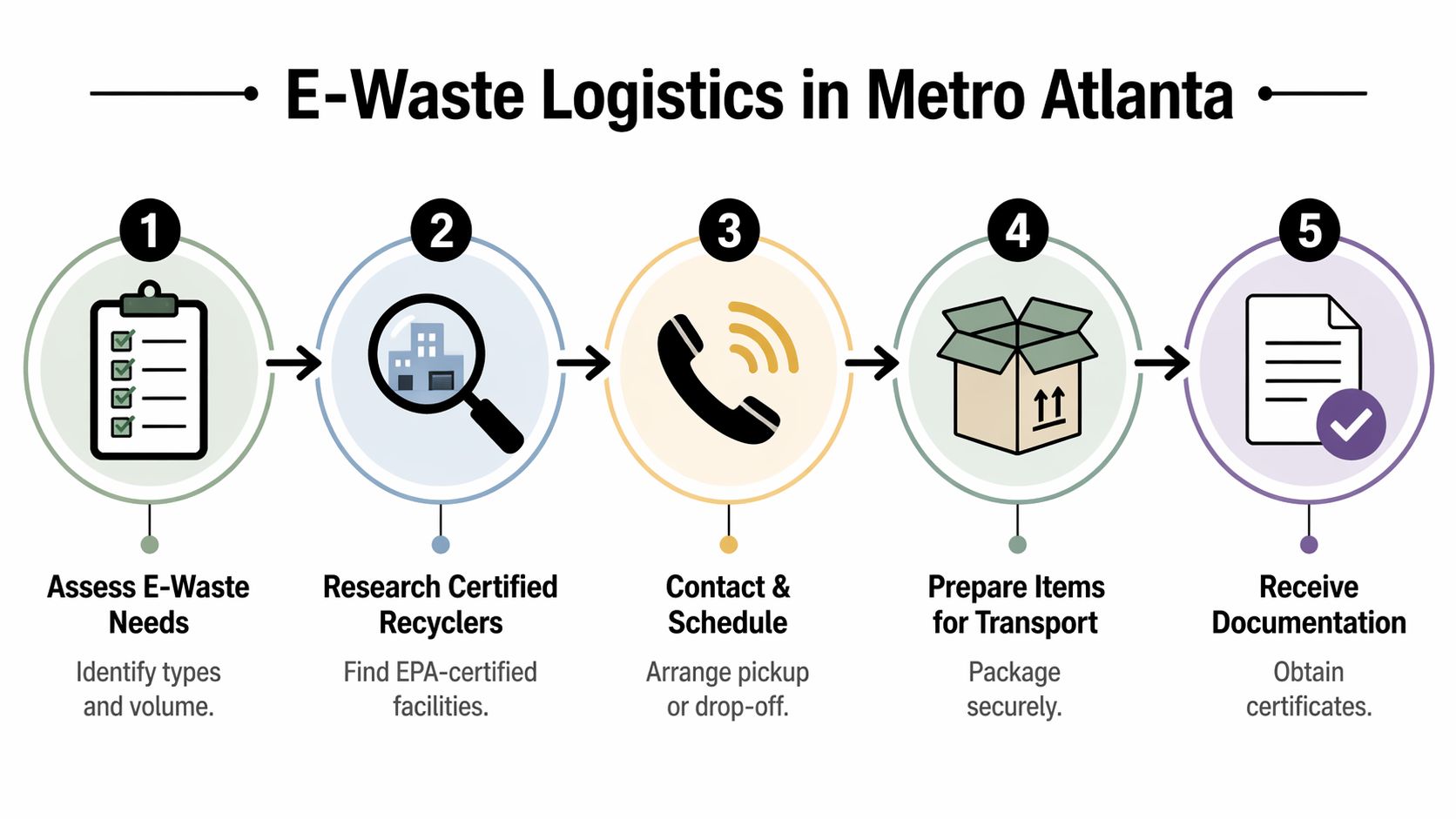
Once your internal process is set, logistics become straightforward. Most delays happen because the business requesting service hasn’t prepared a basic scope. The smoother approach is to gather the operational details before the first call or email.
In practical terms, Alpharetta businesses usually need one of two paths. Larger or sensitive loads are better handled through pickup. Smaller batches may be easier to move through an approved drop-off option in Metro Atlanta.
What to prepare before scheduling
A good service request answers four questions:
- What items are involved. List broad categories first, then note anything sensitive like servers, drives, network gear, or copiers.
- Where the equipment sits. Ground-floor loading dock is different from a top-floor office with elevator limits.
- Whether data destruction is needed. This changes handling, timing, and paperwork.
- What condition the equipment is in. Working, non-working, palletized, loose, rack-mounted, or still deployed.
If you can share photos, do it. Photos reduce surprises and help the logistics team send the right crew and vehicle plan.
Pickup versus drop-off
Pickup is usually the better fit when the load includes heavy equipment, multiple departments, or a controlled chain of custody requirement. It also makes sense when your team wants to minimize internal handling.
Drop-off works best for smaller, pre-sorted volumes where your staff can transport equipment safely. It’s often the simplest option for a modest office cleanout that doesn’t justify an on-site removal crew.
For organizations coordinating service in the region, Metro Atlanta electronics recycling pickup is the clearest route for evaluating which option fits the job.
Why local infrastructure helps execution
The city’s physical maintenance matters more than people think. Alpharetta’s FY2024 budget includes $2 million in drainage and stormwater projects, a commitment tied to reliable infrastructure and business access, according to the City of Alpharetta FY2024 financial report. For companies scheduling sensitive pickups, dependable road access and maintained city systems support timely transportation windows.
That doesn’t replace planning on your side. It just means the city environment supports professional logistics.
Day-of-service checklist
Use a short checklist so pickup day doesn’t become a scramble.
- Confirm site contact who can release equipment and answer questions.
- Separate excluded items if your recycler has acceptance limits.
- Label anything requiring special handling such as drives for shredding or assets for audit.
- Keep access routes clear from storage room to loading area.
- Collect documentation before closing the ticket internally.
Fast pickups come from clear prep, not rushed requests.
That’s the difference between a clean project and a stressful one.
How Montclair Crew Serves Alpharetta's Core Industries
Alpharetta businesses need a disposal partner that fits the market they operate in. This city grew from its 1858 incorporation as the seat of Milton County and entered a new phase in 1932, when it merged with Fulton County for financial stability during the Great Depression, a move described in this history of Alpharetta and Milton County. That long pattern of resilience matters. Businesses here tend to value stable vendors, not improvisation.
Montclair Crew Recycling fits that requirement because its service model is built for B2B technology disposal, not household drop-offs or generic hauling. The company is headquartered in Alpharetta and works across Metro Atlanta for organizations that need secure, documented handling of retired electronics.
For tech firms and data-heavy offices
Tech companies, SaaS firms, MSPs, and enterprise branch operations often retire mixed loads. Some devices still hold value. Others are obsolete but still data-bearing. Montclair Crew handles computers, laptops, servers, telecom gear, and related IT assets with an end-to-end process that includes on-site removal, asset audit support, and environmentally compliant disposition.
The practical advantage is that these projects don’t have to be broken into separate vendors for transport, data handling, and recycling. That lowers coordination risk.
For healthcare, finance, education, and government
These sectors usually care less about “getting rid of old stuff” and more about provable control. Montclair Crew offers DoD 5220.22-M three-pass hard drive wiping and optional on-site shredding, which gives organizations a defensible approach for media destruction. That matters when devices came from clinical settings, administrative departments, student systems, financial operations, or government offices.
Sensitive equipment should leave your control only through a process you can explain to an auditor without guessing.
That’s the actual standard. Not convenience alone.
For companies with resale potential
A lot of businesses assume every retired asset is just waste. That’s often wrong. Datacenter and enterprise environments may have reusable hardware that still carries secondary-market value. Montclair Crew’s model includes profit-sharing or resale when applicable, which can help organizations recover some value instead of treating every disposition event as a pure cost center.
That’s especially useful during infrastructure refreshes where the mix includes higher-end server or telecom equipment.
For SMBs that need simplicity
Small and midsize businesses usually don’t need a giant enterprise project. They need a reliable way to clear out old devices, protect business data, and avoid landfill mistakes. Montclair Crew simplifies that by offering local support, clear hours, pickup options, and access to a Smyrna drop-off center for appropriate loads.
The service area also fits how Alpharetta businesses operate. Many organizations have staff, branch locations, or storage spread across places like Marietta, Kennesaw, Norcross, Sandy Springs, and Roswell. A regional provider can keep the process consistent across those sites.
Where the fit is strongest
Montclair Crew is a strong fit when your organization needs one or more of the following:
- Data destruction controls for laptops, desktops, servers, and storage media
- On-site removal for offices, schools, clinics, and enterprise spaces
- Asset audit support to reconcile what was removed
- Responsible recycling for equipment that can’t be reused
- Value recovery for eligible datacenter or telecom assets
For residential electronics or certain specialized categories, the company can also direct people to trusted partners instead of forcing a poor-fit service model. That matters. A good disposal partner should know what to accept, what to route elsewhere, and how to keep the client’s compliance burden low.
Building a Sustainable Tech Lifecycle in Your Business
Retiring equipment responsibly is part of running a mature business in the city of alpharetta georgia. The same discipline that goes into procurement, deployment, and cybersecurity should carry through to end-of-life handling. If it doesn’t, the last stage of the asset lifecycle becomes the weakest control point.
That’s why many IT and operations teams benefit from thinking in terms of IT Asset Lifecycle Management rather than one-off disposal events. The strongest programs connect purchasing, tracking, support, refresh planning, and final disposition into one operating model.
What a sustainable lifecycle looks like
A workable business program usually includes:
- Standard retirement triggers so assets don’t linger in closets for years
- Documented data destruction rules based on device type and business sensitivity
- Approved disposition channels for reuse, resale, recycling, or destruction
- Final record retention for internal audit and vendor oversight
This approach does more than reduce clutter. It protects data, supports environmental responsibility, and keeps departments from improvising under deadline pressure.
Sustainable IT isn’t just about what you buy. It’s also about how cleanly you retire what you no longer need.
If your business has old equipment sitting in storage, now is the time to turn that pile into a process. Review your inventory, set your internal controls, and work with a qualified ITAD partner that can support secure, compliant disposition.
Frequently Asked Questions About E-Waste in Alpharetta
Do business electronics need a different process than household electronics
Yes. Business equipment usually carries more risk because devices may contain company data, customer information, network configurations, or regulated records. A household recycling event doesn’t typically provide the chain of custody, data destruction options, or audit documentation that an organization may need.
What happens after equipment is picked up
A proper B2B process sorts items by reuse potential, material recovery path, and data risk. Data-bearing assets are handled according to the agreed destruction method, such as wiping or shredding. Reusable equipment may be evaluated for resale or redeployment. Non-repairable electronics move into compliant recycling streams rather than informal disposal.
Is IT asset disposal always free
No. Cost depends on the mix of assets, labor involved, logistics, and whether there’s recoverable value in the load. Some projects include equipment with resale potential that can offset part of the service. Others require more labor or more stringent handling and may be fee-based. The right question isn’t “Is it free?” It’s “What level of documentation, security, and service does the project require?”
Can a business just put old electronics in the trash or with bulk junk
That’s a bad idea. Even if the item seems harmless, businesses often lose control over data-bearing devices when they use generic disposal channels. Trash and bulk junk workflows also don’t provide meaningful documentation. For organizations, that’s usually the bigger failure than the physical removal itself.
What items are commonly accepted in business IT recycling programs
Commonly accepted items often include computers, laptops, servers, monitors, networking gear, telecom equipment, and related office electronics. The exact acceptance list depends on the provider and the condition of the material.
What items may not be accepted or may need a special handling path
Some items fall outside standard B2B electronics programs or require partner routing. That can include certain residential-only loads, specialized medical devices, laboratory equipment, or materials that need a different downstream processor. Always ask before loading a truck.
Should businesses wait until they have a large volume
No. Waiting usually makes the project messier. Devices sit untracked, departments forget what was removed from service, and storage space gets wasted. Small, regular cleanouts are easier to document than emergency purges right before a move, remodel, or audit.
If your organization in Alpharetta needs a secure, business-focused way to dispose of retired computers, servers, drives, and telecom equipment, Montclair Crew Recycling offers local IT asset disposal, data destruction, pickup, and compliant electronics recycling support across Metro Atlanta.
