
Old laptops under a desk. A tote full of chargers no one can identify. Two retired phones from a sales rep who left last year. A printer in the storage room that still has company data in its memory, and a server no one wants to touch because “IT might need something off it later.”
That’s how business e-waste usually accumulates. It rarely looks dramatic. It looks postponed.
For many Atlanta businesses, Staples recycling electronics is the first practical option that comes to mind. It’s nearby, familiar, and simple. That matters. A lot of obsolete equipment never gets moved at all, and that’s part of a broader problem. A Staples study found that only 4% of consumers recycle obsolete electronics, while an estimated 133,000 computers are discarded daily in the U.S. (Waste Dive).
Convenience helps. But for a business, convenience isn't the only test.
A retail drop-off program can be perfect for a dead keyboard or a cable box from home. It can be the wrong tool for office laptops, phones, network gear, and anything that held customer, employee, student, patient, or financial data. If you need pickup instead of car trips, chain of custody instead of trust, or an audit trail instead of a receipt, the decision changes fast.
If your office is at that point where the closet is full and no one wants ownership of the pile, this is the practical question to answer before you load the trunk: is this just recycling, or is it IT asset disposition? If you’re sorting through that decision now, it helps to compare retail drop-off with a business process built for secure pickup and reporting, especially if you’re considering options for free electronics recycling pickup in Atlanta.
Your Office E-Waste Problem and The Staples Solution
A common small business pattern looks like this. The office upgrades laptops over time, keeps the old ones “just in case,” then merges two closets into one larger mess. At some point, someone asks facilities, operations, or the office manager to get rid of it.
Staples is appealing because it solves the first problem. It gives you a familiar destination.
That matters more than people admit. E-waste sits for months because disposal feels annoying, risky, and easy to postpone. A known retail program lowers that friction.
Why businesses look at Staples first
For basic office cleanup, the appeal is obvious:
- Local access: There’s a decent chance a store is closer than a specialty recycler.
- Simple workflow: Put items in a box, drive over, drop them off.
- Recognizable brand: Staff don't have to vet an unfamiliar vendor just to clear out common devices.
For small quantities of low-risk gear, that can be enough.
Practical rule: If the device never held sensitive business data and you only have a handful of items, a retail program may be sufficient.
The trouble starts when businesses treat a consumer convenience service like a compliance process. Those are not the same thing.
The question behind the question
When owners ask whether Staples recycling electronics is “good,” they usually mean one of two things:
- Is it environmentally responsible?
- Is it safe for my business?
Those answers can diverge.
A program can be responsible on the environmental side and still leave gaps on documentation, chain of custody, or asset-level reporting. For a homeowner, that gap may not matter. For a law office, clinic, school, accounting firm, or manufacturer, it can matter a lot.
Think of Staples like a public mailbox. It’s useful, accessible, and appropriate for the right kind of item. But if you’re sending something sensitive, valuable, or regulated, you don’t use the same method you’d use for a birthday card. You use a secure courier with tracking and proof of delivery.
That’s the line businesses need to draw before they treat old IT equipment like ordinary clutter.
Understanding How Staples Electronics Recycling Works
Staples deserves credit for making electronics recycling easier to access. It was the first major U.S. retailer to partner exclusively with e-Stewards-certified recyclers around 2011, covering its network of more than 1,500 stores and requiring processing that avoids export to developing nations, landfilling, and incineration, with complete data erasure in the certified chain (Rubberform’s summary of Staples’ e-Stewards program).
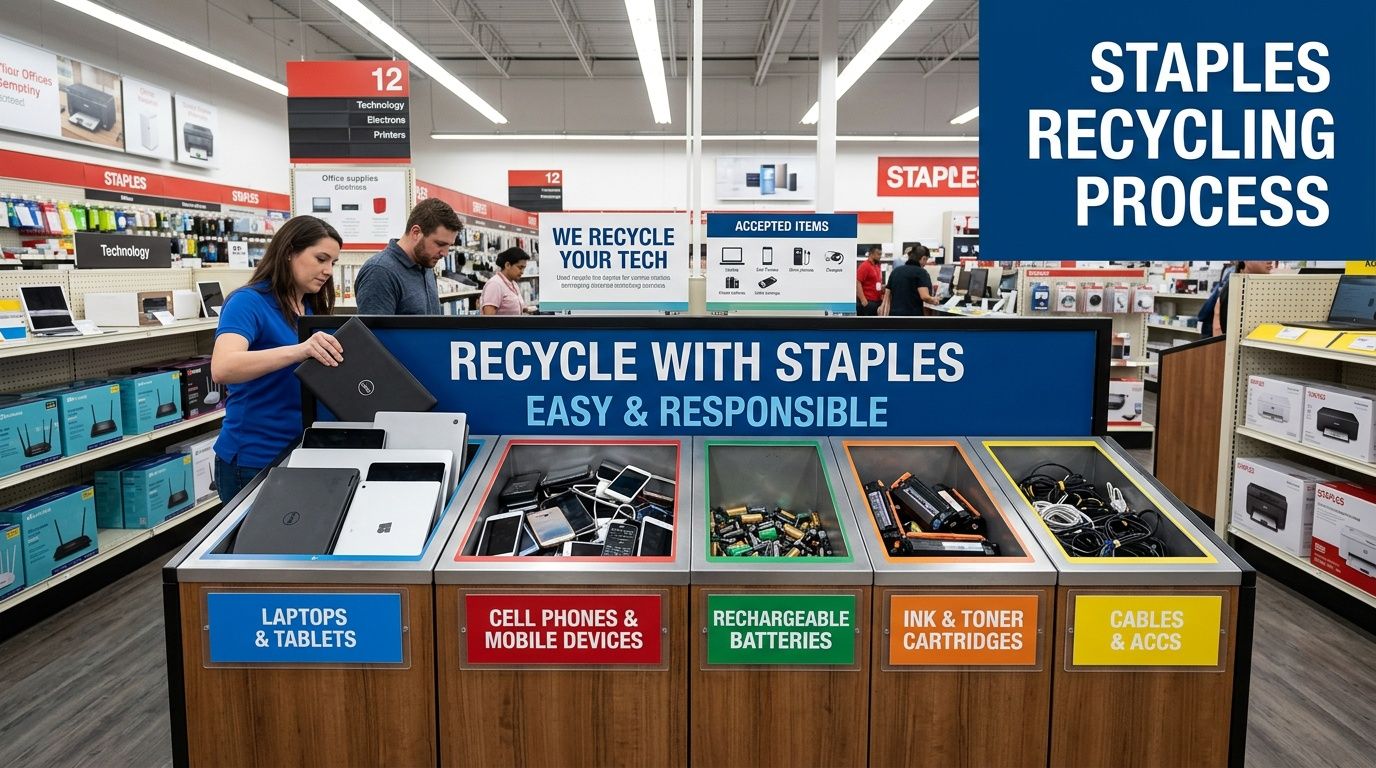
That’s the strong part of the program. The company built a broad retail collection system and tied it to recognized downstream standards. If your priority is keeping common electronics out of the trash, Staples is a credible option.
What the program feels like in practice
From the customer side, the process is straightforward.
You bring accepted electronics to the store. Staples takes the items into its recycling stream. From there, certified processing partners handle collection, sorting, and material recovery.
That simplicity is the whole point. It’s built like a public utility. You don’t need to negotiate a service agreement, schedule a truck, or manage pallet counts.
What happens after drop-off
The behind-the-scenes process is more complex than many people assume. Staples’ recycling chain uses disassembly-based material recovery, where technicians separate components into streams such as circuit boards, plastics, and metals so each material can be processed correctly (Pegasuss Online explains the component-level recycling approach).
That matters because proper recovery isn’t just smashing devices and hauling away scrap. Circuit boards, batteries, plastics, and metal housings need different handling if you want actual recovery instead of contaminated waste.
Where Staples works well
For the right situation, Staples is useful:
- Small consumer-like volumes: A few laptops, mice, keyboards, cables, or accessories.
- Office odds and ends: Devices left after a minor refresh, not a full decommission.
- Environment-first disposal: When your main concern is avoiding landfill disposal through a certified chain.
A retail drop-off program is best understood as a collection point, not a full business disposition workflow.
That distinction is important. A collection point answers, “Where do I take this?” It doesn’t automatically answer, “How do I document every asset, secure every data-bearing device, and prove what happened later?”
For businesses, that second set of questions is where retail convenience starts to thin out. If you want a plain-English look at downstream processing, this overview of what happens to recycled electronics is useful because it shows why handling methods matter after the drop-off moment.
The Hidden Data Security Risks for Businesses
The weak point in staples recycling electronics for business use isn’t whether the recycler is legitimate. The weak point is whether the drop-off experience gives your business the evidence and control it needs.
For the free in-store program, that answer is murky. Staples’ consumer-facing flyer tells users to delete their own data and doesn’t provide specific details about the wiping method or auditable certifications businesses often look for (Staples recycling flyer PDF).
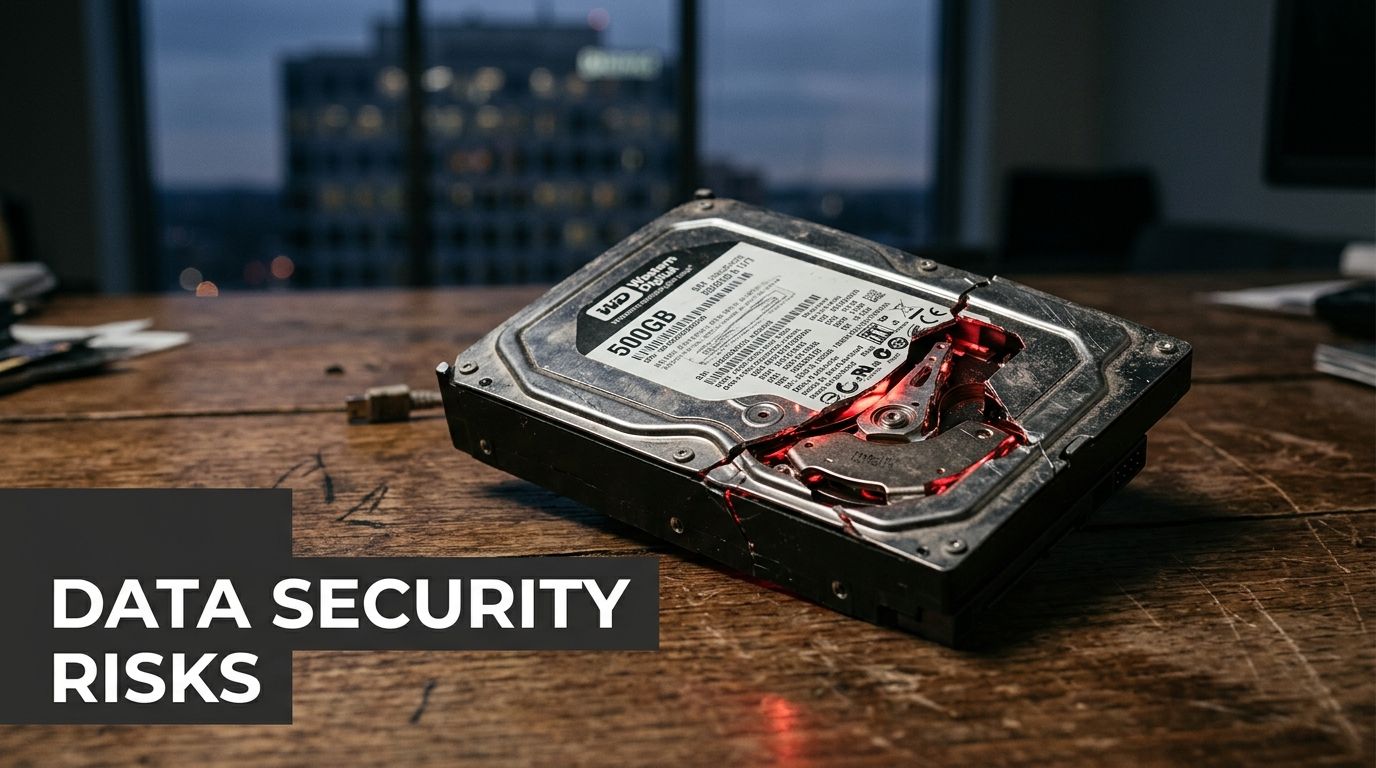
That’s the difference between “we recycle electronics” and “we can defend this process in an audit.”
Deleting files isn't disposal
A lot of businesses still rely on informal habits:
- An employee signs out of accounts
- Someone drags files to the trash
- The team assumes the recycler will handle the rest
- No one records serial numbers
That’s not a defensible process for business assets.
A retired laptop can still contain browser tokens, saved passwords, cached files, tax records, contracts, customer data, HR documents, and email archives. A phone can hold authenticator apps, contact lists, and messaging history. Printers and copiers may retain stored job data. Network appliances can contain configurations and credentials.
If you can’t tie a device to a documented destruction or sanitization event, you’re relying on trust where your business should rely on records.
The compliance problem
Regulated organizations need more than good intentions.
Healthcare groups think in HIPAA terms. Financial firms think about GLBA. Schools and colleges care about FERPA. Public-sector teams may have their own retention and destruction standards. Even if your company isn’t in a heavily regulated field, contracts often create similar obligations.
What those environments have in common is simple. If something goes wrong, you need to show:
| Question | What a business should be able to prove |
|---|---|
| Which asset was retired | Device identity by make, model, or serial |
| Who handled it | Clear custody from office to processor |
| What happened to data | Sanitization or destruction method |
| When it happened | Dateable records kept for review |
Free retail drop-off usually isn’t built to produce that level of evidence at the front end.
Businesses get into trouble when they confuse a convenient handoff with a documented chain of custody.
Internal risk is part of the story too
Most owners think about the recycler first. They should also think about what happens before the recycler ever touches the device.
Old hardware tends to sit in unsecured closets, cubicles, back rooms, and loading areas. That creates a window where former staff data, customer files, or credentials can be mishandled internally. If your team is tightening controls around who can access sensitive systems and data, these insider threat detection tools are worth reviewing because disposal risk often overlaps with access-risk blind spots.
If your business needs a secure workflow, the baseline should include inventory, controlled removal, and documented destruction. Services built around secure data destruction start to make money for large enterprises.montclaircrew.com/secure-data-destruction/) start to make more sense than a retail counter.
When Your Business Needs a Certified ITAD Partner
A certified ITAD partner handles retired technology the way a records-management company handles legal files. The job isn’t just hauling things away. The job is custody, documentation, data protection, environmental disposition, and sometimes value recovery.
That’s a different service category from store drop-off.
The clearest signal that retail won't fit
Staples does offer business-oriented recycling options, but its box-based model has a hard limit. Its B2B recycling option relies on mail-back boxes with a 70 lb maximum and doesn’t include on-site pickup, complete asset audits, or resale profit-sharing for higher-value equipment (Staples recycling solutions page).
That setup can work for a branch office mailing a few devices. It doesn’t fit a clinic clearing exam-room computers, a school retiring carts of laptops, or a company decommissioning server and telecom gear.
What an ITAD partner adds
A proper ITAD process usually includes several pieces that businesses underestimate until they need them.
Secure logistics from your site
The first risk point is removal.
If your team has to load assets into personal vehicles or leave them by a back door for later sorting, you’ve already weakened the process. An ITAD partner starts custody at your office, not after arrival somewhere else.
Asset-level reporting
Retail and professional services diverge rapidly.
An ITAD workflow can document what was collected and how each device was handled. That matters for internal controls, lease returns, accounting cleanup, and any later compliance question.
Certified destruction or verified sanitization
Business disposition should answer the data question clearly. Was the drive wiped to your standard, physically destroyed, or both? Can you produce documentation later?
That’s the difference between “it should be fine” and “here’s the record.”
Value recovery
Some retired hardware still has resale or parts value. Retail recycling rarely addresses that. Professional ITAD can.
Servers, network equipment, and telecom gear often deserve evaluation before they’re treated as scrap. Throwing them into a one-way recycling stream can erase recoverable value.
If the asset has data, compliance implications, or resale potential, treat it like inventory leaving your balance sheet, not like junk leaving your closet.
A simple threshold test
Move from retail recycling to certified ITAD when any of these apply:
- Sensitive data exists: Laptops, phones, drives, printers, servers, firewalls.
- Volume is awkward: Too much equipment for a few trunk loads.
- You need records: Serial reporting, certificates, audit support.
- Equipment may still have value: Especially servers and telecom gear.
- Removal needs coordination: Office moves, closures, refreshes, decommissions.
If that’s your situation, it helps to compare providers that focus on IT asset disposition companies rather than consumer recycling alone.
Comparing Staples Drop-Off vs a Professional ITAD Partner
The easiest way to evaluate staples recycling electronics is to stop asking whether it’s “good” and start asking whether it matches the job.
A coffee shop gift card and a corporate purchasing card both let you buy things. They are not interchangeable. Retail recycling and professional ITAD work the same way.
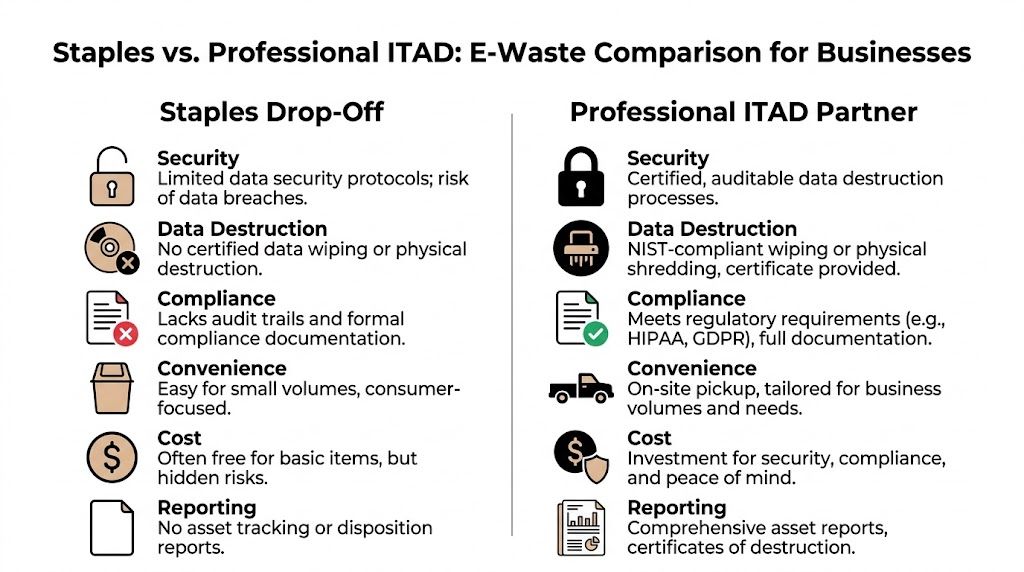
Side-by-side decision view
| Area | Staples drop-off | Professional ITAD partner |
|---|---|---|
| Best use case | Small, simple electronics disposal | Business asset retirement |
| Intake model | Bring items to store | Pickup or managed logistics |
| Data assurance | Limited at free retail level | Documented sanitization or destruction workflow |
| Reporting | Minimal consumer-style handoff | Asset lists, serial reporting, certificates |
| Scale | Fine for light volume | Built for office, school, clinic, and data center volume |
| Value recovery | Generally not the focus | Often evaluates reuse or remarketing |
| Audit readiness | Limited | Designed for review and recordkeeping |
The biggest dividing line is security level
Staples’ paid mail-back service is where the contrast becomes very clear. That service offers NAID AAA certified destruction and reduces solid-state data devices to particles nominally two millimeters edge length or smaller, with serialized tracking and certificates available through that process (Staples serialized certification product page).
That’s a real business-grade feature set.
But it also proves the core point. Enterprise-grade security is not the same thing as free retail convenience. Staples itself separates those two offerings.
What works well for Staples
Retail drop-off has real strengths:
- Fast cleanup for low-risk items: Think dead keyboards, cables, mice, accessories.
- Broad accessibility: You can solve a small disposal task during a normal office supply run.
- Responsible environmental handling: The downstream standards are stronger than many people expect.
For a tiny batch of non-sensitive electronics, that’s enough.
What works better with professional ITAD
A dedicated ITAD partner becomes the better choice when the business is retiring systems, not just discarding gadgets.
Consider the practical differences:
- A receptionist with three broken keyboards doesn’t need a pickup team.
- A dental office replacing workstations probably does.
- A company shutting down a satellite office almost certainly needs audit support, removal logistics, and documented destruction.
- A data center clearing racks needs a process, not a shopping errand.
The decision framework
Use Staples when the answer to most of these is no:
- Does the device contain or likely contain business data?
- Do you need serial-level accountability?
- Would your insurer, auditor, customer, or counsel want documentation?
- Is the volume large enough to make self-transport clumsy?
- Could any of the retired equipment still be resold?
If those answers start turning to yes, the cheap option can become the expensive one. Not because the drop-off fee changes, but because the hidden costs show up later as staff time, missing records, weaker controls, and lost asset value.
Retail recycling solves a disposal problem. ITAD solves a business risk problem.
Your Best E-Waste Recycling Options in Metro Atlanta
Metro Atlanta businesses have a wider choice set than many owners realize. That’s good news, because the right answer depends on what you’re disposing of.

For a few low-risk accessories, retail drop-off may still be the easiest path. For business assets, Atlanta companies usually need something more structured.
The practical local split
In this market, I’d separate options into two buckets.
Good fit for retail-style drop-off
Use a consumer-focused option when you have:
- Small quantities
- Little or no data exposure
- No need for pickup
- No need for formal reporting
This is the quick-cleanout category. It’s about convenience.
Better fit for a business recycler or ITAD provider
Use a specialized business service when you have:
- Office computers and laptops
- Hard drives, SSDs, or phones
- Servers, telecom gear, or networking equipment
- A move, closure, refresh, or decommission
- Any need for records, wiping, shredding, or value recovery
That’s the category where process matters more than storefront access.
What Atlanta businesses should prioritize
A local provider should be able to answer basic operational questions without vague language.
Ask these directly:
| Ask the provider | Why it matters |
|---|---|
| Do you offer on-site pickup? | Reduces internal handling and transport risk |
| Can you inventory assets by serial number? | Supports audit and internal controls |
| What data destruction options do you provide? | Clarifies wiping versus shredding |
| Do you handle servers and telecom equipment? | Many retail channels don't fit this gear well |
| Can you assess reuse or resale value? | Helps avoid scrapping useful equipment |
A good local vendor should answer those in plain language.
The Atlanta advantage
Businesses in Alpharetta, Marietta, Smyrna, Norcross, Sandy Springs, Roswell, and nearby cities can often get faster service and cleaner logistics from a local B2B recycler than from a national retail workflow. That matters when you’re clearing equipment from active offices and don’t want your staff turning disposal into a side project.
If you need a local starting point for business-focused electronics recycling near Atlanta, GA, prioritize providers that handle pickup, secure data disposition, and reporting together. Those three pieces usually tell you whether you’re hiring a real business partner or just finding a nearby drop-off point.
Making the Right Choice for Your Business's IT Assets
Staples plays a valuable role. It gives people and small offices a responsible, accessible way to move electronics into a certified recycling stream. For personal tech and low-risk office leftovers, that’s useful and practical.
But most businesses aren’t just disposing of electronics. They’re retiring assets that may hold data, trigger compliance obligations, require documented handling, or still carry residual value.
That’s why this decision shouldn’t be framed as retail versus professional service in a general sense. It should be framed as which process matches the risk of the asset.
If the item is a dead mouse, an old cable, or a basic accessory, retail drop-off may be fine.
If the item is a laptop, desktop, printer, phone, server, firewall, switch, storage device, or telecom unit that lived inside your business environment, treat it differently. That’s not clutter. That’s a controlled asset leaving your organization.
The safest rule for Atlanta businesses is simple:
- use retail recycling for consumer-style disposal
- use certified ITAD for business-grade disposition
That approach protects your data, shortens cleanup time, improves audit readiness, and gives you a better shot at recovering value where it still exists.
If your business in Metro Atlanta needs a safer path for retired laptops, desktops, servers, telecom gear, or storage devices, contact Montclair Crew Recycling. They help organizations with pickup, asset audits, certified data destruction, and responsible downstream recycling so your team can clear space without creating compliance or security problems.
