
A modern Georgia Business IT Asset Disposal Guide isn't just about chucking old computers anymore. It's a real strategy for protecting your data, staying on the right side of the law, and even getting some money back for your old gear. For any company in the Peach State, a formal ITAD (IT Asset Disposition) plan takes that pile of retired hardware from a major liability and turns it into a secure, strategic advantage.
Why Your Georgia Business Needs a Modern ITAD Strategy

We see it all the time. Georgia businesses look at old IT equipment—laptops stacked in a closet, servers collecting dust in a back room—and just see a junk removal problem. But that view misses two huge things: massive risk and hidden cash. Every single retired device with a hard drive is a data breach just waiting to happen if it's not handled correctly.
Getting this wrong can lead to six-figure fines, a ruined reputation, and customer lawsuits that can sink a company. Just running a consumer "wipe" program or, worse, drilling a hole through a hard drive doesn't even come close to meeting the strict, auditable proof required by data privacy laws.
The Impact of Georgia’s Tech Expansion
Georgia’s tech scene is exploding, especially with data centers popping up everywhere. This growth directly feeds the need for professional ITAD services. It's creating a serious e-waste problem, and the state is now second in the nation for data center investments. As these massive cloud providers and enterprises expand, they're refreshing their hardware faster than ever, creating an incredible amount of retired servers and equipment all over Metro Atlanta. Each one of those retired assets is both a security risk and an opportunity to recover value.
You can learn more about what this means for the state's tech infrastructure by reading about the state's data center boom.
This rapid turnover isn’t just for the big players. It hits every business in the ecosystem, from small startups in Alpharetta to established companies in downtown Atlanta. As tech moves faster, the lifecycle of your IT hardware gets shorter, making a real disposal plan more critical than ever.
Shifting from a Cost Center to a Strategic Advantage
The right way to look at IT asset disposal flips the whole script. It stops being a compliance headache or a disposal fee on an invoice. Instead, a well-run ITAD strategy becomes a part of your business that protects you and can even make you money.
Working with a professional ITAD partner gives you some serious advantages:
- Ironclad Data Security: We use certified, government-approved methods like DoD 5220.22-M data wiping and physical shredding to make sure your sensitive information is gone for good.
- Guaranteed Compliance: You get Certificates of Data Destruction. This is the auditable proof you need to satisfy regulations like HIPAA, FACTA, and GLBA.
- Environmental Responsibility: We make sure all non-reusable materials are ethically and responsibly recycled with a zero-landfill policy. This helps you hit your own green business goals.
- Financial Value Recovery: We spot the assets that still have resale value, find them a new home on the secondary market, and cut you a check through profit-sharing models.
By partnering with a certified ITAD expert, you transform a potential risk into a secure, compliant, and profitable part of your IT lifecycle. It’s the smartest way to manage the end-of-life for your technology assets in today’s demanding business environment.
Understanding Georgia’s ITAD Compliance Requirements
Getting rid of old IT gear in Georgia isn't as simple as tossing it in a dumpster behind the office. Honestly, that's one of the riskiest things a business can do. The legal landscape around data is no joke, and a mistake here can lead to crippling fines and a reputation that’s hard to rebuild.
For Georgia businesses, the key state law to watch is the Georgia Personal Identity Protection Act (GPIPA). This one is all about what happens after a data breach. If a single piece of unencrypted personal data gets out from one of your old hard drives, you're legally on the hook to notify every single person affected.
Think about that. The responsibility falls entirely on you to prove you did everything right to destroy that data.
Federal Laws With Big Teeth
On top of state rules, there are some heavyweight federal laws that apply to almost every business in Georgia. These aren't just suggestions; they have serious enforcement and the penalties can be massive.
- HIPAA: If you're in healthcare—a doctor's office in Kennesaw, a clinic in Savannah, or even a billing service—HIPAA is everything. Improperly disposing of a single workstation with patient records can easily trigger fines running into the millions.
- GLBA: This one is for the financial world. From the big banks in Atlanta to the local credit unions, the Gramm-Leach-Bliley Act demands you protect consumer financial data. Regulators are aggressive about pursuing companies that leak data from old hardware.
- FACTA: The Disposal Rule in FACTA hits almost everyone. Do you run background checks? Handle credit applications? If you touch any kind of consumer report, you are required by law to completely destroy it before getting rid of the device it was on.
To help you keep track, here's a quick look at the main regulations and what they demand.
Key Regulations For Georgia Businesses
| Regulation | Affected Sectors | Key ITAD Requirement |
|---|---|---|
| HIPAA | Healthcare, Insurance, Business Associates | Secure, documented destruction of all Protected Health Information (PHI). |
| GLBA | Financial Institutions, Banks, Credit Unions | Protection and secure disposal of Non-public Personal Information (NPI). |
| FACTA | Virtually All Businesses | Proper destruction of any consumer report information before disposal. |
| GPIPA | All Georgia Businesses | Notification of residents if unencrypted personal data is breached. |
| RCRA | All Businesses | Proper management and disposal of hazardous e-waste components. |
These rules all point to one critical thing: you have to be able to prove you were compliant.
The core takeaway is this: compliance is proven through documentation. Simply taking someone's word that a hard drive was wiped is not a defense. An auditable trail, including a formal Certificate of Data Destruction, is your most important shield against liability. You can explore our comprehensive guide to IT asset disposition services in Georgia for more details.
The Real Cost of Getting It Wrong
The numbers here are staggering. The IT Asset Disposition market in North America is set to explode, projected to hit USD 6.59 billion by 2030. What's really telling is that small and medium-sized businesses make up over 63% of that market. This isn't just a big corporation problem anymore.
Why the boom? Because businesses are waking up to the risks. We've seen FTC Disposal Rule fines climb past $100,000 per incident. That figure doesn’t even begin to cover the cost of notifying customers, paying for credit monitoring, and dealing with lawsuits that follow a public data breach. It's the kind of event that can sink a business.
Proper data destruction is the foundation of staying compliant. To get a better handle on the broader security measures involved, this workplace cyber security essential guide is a great resource.
Georgia’s E-Waste and Environmental Rules
Finally, there's the environmental side. While Georgia doesn't have a statewide law forcing you to recycle e-waste, you're not completely off the hook.
The Georgia Environmental Protection Division (EPD) enforces the federal Resource Conservation and Recovery Act (RCRA). This law classifies common parts of your old equipment as hazardous waste.
- Batteries: Especially lithium-ion batteries.
- Circuit Boards: Often contain lead and other heavy metals.
- Older CRT Monitors: These are loaded with lead.
You can't just toss these in a commercial dumpster. It's illegal and can get you fined.
A truly compliant IT asset disposal plan has to cover both data security and environmental responsibility. Working with a certified ITAD partner like Montclair Crew is the surest way to know every base is covered, giving you a fully documented and defensible process.
Building Your IT Asset Decommissioning Plan
Alright, let's get down to business. Having a high-level strategy is great, but turning it into an on-the-ground action plan is what makes our Georgia Business IT Asset Disposal Guide really work for you. A solid decommissioning plan isn't just a nice-to-have; it's the playbook that keeps the entire process from descending into chaos. It removes the guesswork and makes sure every step is secure, compliant, and efficient.
The whole operation starts with one simple truth: you can't manage what you don't know you have. Without a detailed inventory, you’re just guessing, and that's a quick way to create security holes or miss out on recovering value.
Start with a Comprehensive Asset Inventory
Before you even think about wiping data or hauling away equipment, you need a master list. A vague note like "50 old laptops and some servers" isn't going to cut it. That's a recipe for a data breach. A professional inventory is granular, detailed, and forms the bedrock of your entire ITAD project.
For every single piece of equipment you're getting rid of, you need to track:
- Asset Type: Is it a laptop, desktop, server, switch, or mobile phone?
- Brand and Model: Think a Dell Latitude 7420 or a Cisco Catalyst 2960 switch. Be specific.
- Serial Number: This is your golden ticket for tracking. It's essential for creating a paper trail and an auditable chain of custody.
- Physical Location: Is it sitting in a data center, locked in a storage closet, or still on a user's desk?
- Data-Bearing Status: This is a big one. Does it have a hard drive, SSD, or any other kind of storage?
This log becomes your single source of truth. We use it to build an accurate quote, plan the pickup logistics, and generate the final Certificate of Data Destruction.
On-Site vs. Off-Site Data Destruction
With your inventory in hand, the next big decision is where to destroy the data. Both on-site and off-site methods have their place, and the right choice usually comes down to your company's security policies and risk tolerance.
On-site data destruction is exactly what it sounds like. The ITAD vendor brings their gear to your Georgia office. This could be a mobile shredding truck pulverizing hard drives in your parking lot or a technician performing certified data wiping right at your desk. The main advantage here is total peace of mind—your sensitive data never leaves your sight intact.
Off-site data destruction involves securely moving the assets to a specialized, access-controlled facility for processing. This approach is often more budget-friendly and less disruptive to your day-to-day operations. Any reputable vendor will use locked, GPS-tracked trucks to guarantee a secure chain of custody from your door to theirs.
The compliance process boils down to a few key actions: figure out your risks, follow the rules that apply to you, and get proof that you did it right.
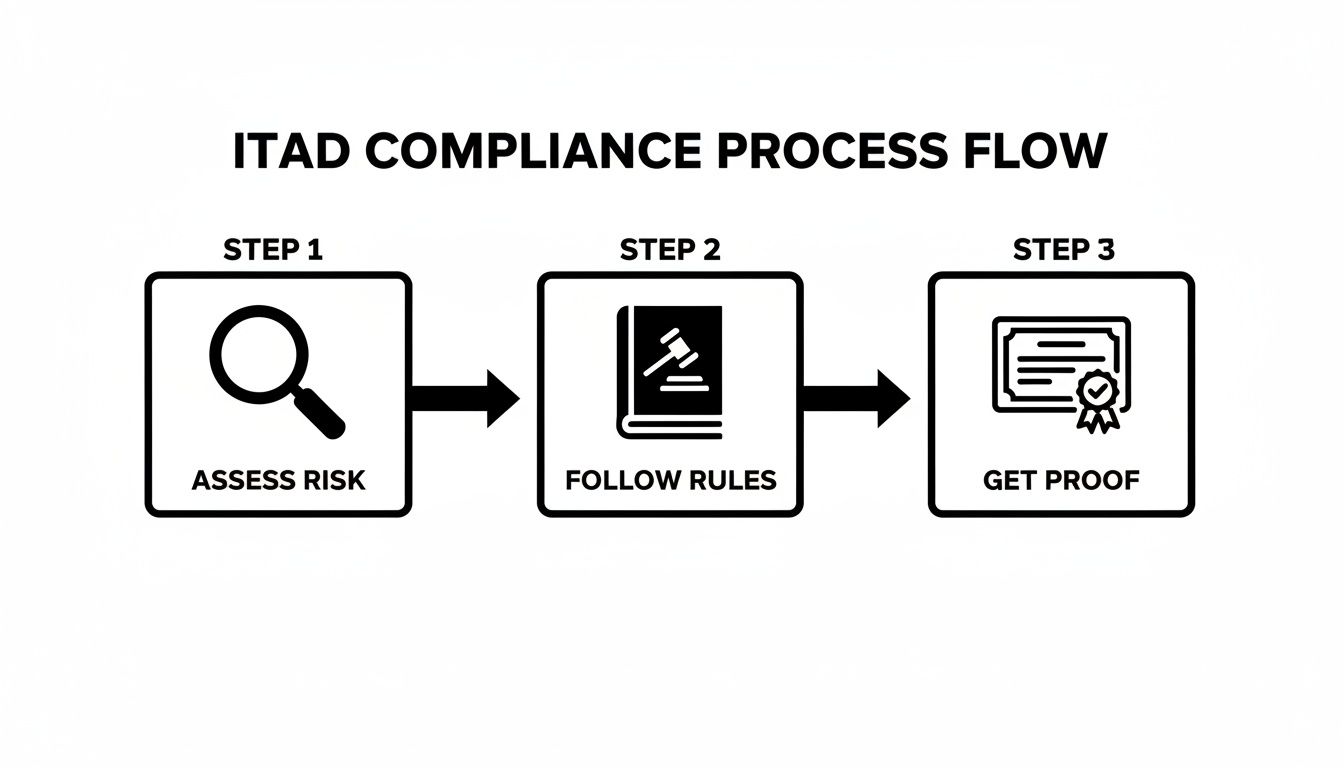
As you can see, compliance isn't a one-and-done checkbox. It’s an active process you have to manage at every stage. For businesses with a lot of hardware, especially in a data center, this gets complex fast. Laptops are one thing, but server racks are a whole different ballgame. For a closer look, our server decommissioning checklist provides a much deeper dive for those bigger projects.
Managing Logistics and Chain of Custody
Once your plan is set, it's time to execute. This is where a professional partner like Montclair Crew takes over. Our team shows up, verifies every piece of equipment against your inventory, and securely packs it all for transport.
The chain of custody is the unbroken, documented trail that follows your assets from pickup to final disposition. This paperwork is your legal proof that no device was lost, stolen, or mishandled, and it's absolutely essential for proving compliance.
We scan each asset's serial number at every single touchpoint. This creates a clear, auditable record confirming every data-bearing device was received and properly destroyed or sanitized exactly as you instructed. This is what separates a professional ITAD process from a simple junk hauler.
This careful handling is necessary for a huge range of hardware, from individual desktops to entire racks of servers and networking gear. A solid plan means you can confidently retire any IT asset, knowing you've covered all your bases for security and compliance from start to finish.
How To Choose The Right ITAD Partner In Metro Atlanta
Picking the right IT Asset Disposition (ITAD) vendor is probably the most important call you'll make in this entire process. A great partner shields your Metro Atlanta business from huge liability, squeezes value out of your old gear, and turns a headache of a project into a simple, checked-off box.
On the flip side, a bad one can lead directly to a data breach, leave you tangled in non-compliance, and actually cost you money. This isn't about finding a simple hauler; it's about vetting a security partner.
Look For The Right Certifications
First things first: certifications. These aren't just nice-to-haves; they're the absolute baseline for any professional ITAD company. They prove a third-party auditor has inspected their operation and verified they meet strict standards for security and environmental handling.
In the ITAD world, two names are the gold standard:
- R2 (Responsible Recycling): This is the top global standard for electronics recycling. An R2-certified company is proven to protect its workers, manage the entire downstream recycling process, and securely handle every device with data on it.
- e-Stewards: Another highly-respected certification, e-Stewards has a major focus on stopping the illegal export of hazardous e-waste. It also requires incredibly strict data security protocols.
Your first question to any potential vendor should be, "Are you R2 or e-Stewards certified?" If they say no, or try to talk their way around it, walk away. It’s a huge red flag that they haven't made the investment to protect you properly.
A vendor without R2 or e-Stewards certification is asking you to take their word for it on security and compliance. That’s a gamble you can’t afford to take with your company’s data and reputation.
Key Questions To Ask Any Potential Provider
Once you've confirmed they have the right certifications, it’s time to get into the details of their process. How they answer these questions will tell you everything. A true professional will have these answers down cold.
Here’s a checklist of questions every Georgia business needs to ask:
- What are your specific data destruction methods? They should immediately bring up NIST 800-88 compliant data wiping and physical shredding. You'll also want to ask if they can perform these services on-site at your facility for maximum security.
- Can I get a serialized Certificate of Data Destruction? "Serialized" is the magic word here. A generic certificate is worthless. You need a document that lists the unique serial number of every single drive that was wiped or shredded. This is your auditable proof.
- How do you ensure a secure chain of custody? They need to describe a rock-solid process. Listen for terms like locked GPS-tracked trucks, background-checked employees, and barcode scanning of every single asset from your office to its final destination.
- What is your insurance coverage for data breaches? Professional ITAD vendors carry specialized liability insurance. This covers them—and you—in the rare case a data breach happens on their watch. Don't be afraid to ask for a copy of their policy.
- How do you handle equipment with no resale value? A real partner deals with everything. They won't just cherry-pick the valuable gear and leave you with a pile of junk. Confirm they have a zero-landfill policy for anything that can't be reused.
A legitimate partner will be happy to answer these questions. If a company gets defensive or can't give you straight answers, that's all you need to know. For a deeper dive into vetting local providers, check out our guide on the top IT recycling companies serving the Atlanta area. Getting this step right is crucial for any Georgia business's IT asset disposal plan.
Unlocking The Hidden Value In Your Retired IT Assets

It’s time for a major mindset shift. That storage closet full of old electronics? It's not just a disposal problem waiting to cost you money. For savvy Georgia businesses, that pile of retired servers, laptops, and networking gear is actually a hidden revenue stream.
This is where a real IT asset disposal strategy goes beyond security and compliance to become a profit-generating part of your business. The secret is asset remarketing.
A good ITAD partner doesn’t just see junk; they see a portfolio of valuable components. The global market for used electronics is absolutely booming—it's projected to hit USD 147.9 billion by 2035. This means there’s real cash value in the processors, RAM, and enterprise-grade drives sitting in your old hardware right now.
How Asset Valuation And Remarketing Works
A professional ITAD process kicks off with a detailed audit. This isn't just counting boxes; it's a deep dive to figure out the Fair Market Value (FMV) of every single piece of equipment.
Several things factor into that valuation:
- Age and Generation: It’s no surprise that newer gear gets the best prices, especially enterprise-grade hardware that's less than five years old.
- Brand and Model: Business-class equipment from names like Dell, HP, Cisco, and Lenovo holds its value way better than consumer-grade stuff.
- Condition and Configuration: The cosmetic shape, whether it works, and the specific specs (CPU, RAM, storage) all make a big difference.
Once your data is wiped clean to NIST 800-88 standards, your partner taps into their network of buyers to get the best price. This could mean selling whole systems to other businesses or breaking them down to sell individual parts like CPUs and memory on the secondary market. You can learn more about how to recycle IT equipment in Georgia in our other guide.
Understanding Profit-Sharing Models
Here’s where it gets interesting for your bottom line: profit-sharing. It’s a transparent model where the money made from selling your assets is split between you and your ITAD partner after their processing costs are covered.
This model completely changes the dynamic. Your ITAD partner is now financially motivated to get the absolute highest value for your equipment, which aligns their goals directly with yours. It turns a cost center into a shared financial success.
This setup naturally pushes the focus toward refurbishment and reuse. Not only is this profitable, but it's also the most environmentally friendly option. Giving old hardware a second life contributes to the circular economy and reduces the need to manufacture new gear.
Setting Realistic Value Expectations
While the potential for a payout is real, it’s important to be realistic. Not every piece of equipment is a goldmine. Value really depends on what the market wants at that moment.
Here’s a rough idea of what tends to hold its value:
| Asset Category | High Value Potential | Low or No Value |
|---|---|---|
| Servers | Recent generations with high-core-count CPUs and large amounts of DDR4/DDDR5 RAM. | Older models (7+ years) or those with proprietary, outdated parts. |
| Networking Gear | Enterprise switches and routers from brands like Cisco and Juniper with high port counts and speeds. | Older 10/100 Mbps switches, consumer-grade routers, and damaged equipment. |
| Laptops/Desktops | Business-class models (Dell Latitude, Lenovo ThinkPad) less than 5 years old with Core i5/i7 processors. | Broken screens, missing components, or very old consumer models. |
| Storage | Enterprise-grade SSDs and large-capacity SAS drives. | Small-capacity consumer hard drives or drives that fail testing. |
And what about the equipment with no resale value? It isn't just tossed out. A responsible partner makes sure those items are properly de-manufactured and ethically recycled under a zero-landfill policy. This approach guarantees every asset is handled the right way—whether it's making you money or being sustainably recycled—making it a crucial part of any modern Georgia business IT asset disposal guide.
Common Questions About IT Disposal In Georgia
Even if you have a solid plan for your old IT gear, questions always come up. It's natural. We get calls every day from businesses across Metro Atlanta, from small law firms in Marietta to growing tech startups in Alpharetta, asking about the specifics.
Here are the straightforward answers to the questions we hear most often.
Is A DIY Approach To Hard Drive Destruction Compliant?
No, not if you want to be protected. While taking a drill to an old hard drive or using some free software you found online feels like an easy fix, it won’t stand up in an audit. Regulations like HIPAA, GLBA, and Georgia’s own GPIPA require you to prove that data is gone for good. A DIY job offers zero proof.
The problem is verifiability. How do you show a regulator that you drilled the right spot on the platter? You can't. That's why professional services are so important for any business handling sensitive information.
Professional ITAD vendors use certified data wiping methods that meet government standards like NIST 800-88. They then give you a serialized Certificate of Data Destruction. This paper is your legal, auditable proof that you did the job right and protects you if there’s ever a breach investigation.
What Is A Chain Of Custody And Why Does It Matter?
A chain of custody is the paper trail that tracks your equipment from the moment it leaves your office to its final destruction or recycling. It's a detailed log that shows who handled your assets, where they were transported, and every facility they passed through.
Think of it like an evidence log in a court case. It's there to prove that no laptop or server went missing, got stolen, or was accessed by someone who shouldn't have. For any company that takes data security seriously, a complete chain of custody isn't optional—it's essential.
This is your hard evidence that your customer lists, financial records, or employee files were secure the entire time. Without it, you're exposed and can't defend your process. You can dig deeper into why this paperwork matters by looking at what goes into a formal Certificate of Destruction.
We're A Small Business With Only A Few Computers. Is This For Us?
Absolutely. This is probably the biggest myth we hear. Data breach laws don't care if you have one employee or one thousand. A single lost laptop with customer PII (Personally Identifiable Information) can destroy a small business just as easily as a large one.
Fines, legal trouble, and a ruined reputation are real threats for businesses of any size.
Professional ITAD services are built to scale. The risk from five old desktops in a Roswell office is just as real as the risk from five hundred servers in a downtown Atlanta data center. A certified partner can give you a solution that fits your budget and ensures your small business gets the same protection as a Fortune 500 company.
What Happens To Equipment That Cannot Be Resold?
Anything that doesn't have resale value is sent for responsible recycling under a strict zero-landfill policy. This is a non-negotiable part of modern IT disposal and a key piece of corporate social responsibility.
The process is straightforward:
- De-manufacturing: Old equipment is taken apart by hand into its basic components.
- Material Separation: Raw materials are sorted—plastics, steel, aluminum, and precious metals from circuit boards.
- Commodity Processing: These materials are then shredded, melted down, or refined.
- Return to Supply Chain: Finally, the processed commodities are sold back to manufacturers to make new products.
This circular process stops hazardous e-waste from polluting Georgia’s landfills and water. It ensures every bit of your old hardware is handled the right way, backing up your company’s commitment to sustainability.
Handling IT asset disposal is a critical job for any Georgia business. When you get it right, you protect your data, stay compliant, and can even get some money back from your old equipment. Montclair Crew makes the whole thing simple, offering secure and certified ITAD solutions for businesses all over Metro Atlanta.
Ready to create an IT disposal plan you can trust? Contact the experts at https://www.montclaircrew.com to schedule your service today.
