
When it's time to retire old IT hardware, Georgia businesses need a secure, compliant way to handle the disposal. Professional server disposal services make sure your company’s sensitive data is completely wiped out and the electronic waste is recycled according to every state and federal environmental rule. This is how you protect your business from both crippling data breaches and steep legal fines.
Why Secure Server Disposal Is a Critical Business Function
Picture this: your Atlanta-based tech company just wrapped up a huge cloud migration. Now you've got a room full of old, decommissioned servers just sitting there. These machines aren't just taking up space; they're a massive, ticking liability. Each one holds a treasure trove of sensitive info—customer data, financial records, you name it. This is exactly why professional server disposal services for businesses in Georgia are so vital.
Thinking of server disposal as just another cleanup job is a huge mistake. It’s a core part of your business strategy, tied directly to your security, compliance, and even your brand's reputation. If those hard drives get into the wrong hands, you're looking at a potential disaster. To truly protect your data, secure server disposal should be part of a solid set of cybersecurity tips for businesses.
The Risks of Neglecting Proper Disposal
The hidden dangers of hanging onto old servers or tossing them improperly are real, and they hit on two fronts. First, the data security risk is immense. Don't be fooled—a simple factory reset or deleting files does not permanently erase data. Without certified data destruction, you’re basically leaving the back door wide open for identity thieves and corporate spies. Take a look at our complete guide to understand what goes into true secure data destruction and the methods that guarantee your information is gone for good.
Second, you're facing a serious environmental and legal headache. Servers are packed with hazardous materials like lead and mercury, which are heavily regulated.
As Georgia’s data center market continues to boom, so does the need for specialized hazardous waste management. Federal law is clear: your company has "cradle to grave" responsibility for any hazardous materials you create. That means you are still liable for improper disposal, even long after that equipment is out of your sight.
The Growing E-Waste Challenge
This isn't just a local problem; it's a global one. The e-waste management market is set to jump from $70 billion in 2024 to a massive $81.27 billion in 2025. On top of that, the IT asset disposition (ITAD) industry is projected to hit $36.4 billion by 2034.
Think about it: a staggering 62 million metric tons of e-waste was generated in 2022 alone. The worst part? Only 22.3% of it was properly collected and recycled. The rest is just sitting in landfills, polluting the environment.
By partnering with a local expert like Montclair Crew, Georgia businesses can get a handle on these issues. We help you turn a potential liability into a secure, compliant, and responsible business decision.
Understanding Your Data Destruction Options
When it's time to retire a server, simply hitting 'delete' or formatting the hard drive is a massive gamble. Think of it like tearing the table of contents out of a book—all the chapters (your sensitive data) are still there for anyone to flip through. Real data security means making sure those pages are gone for good. For any business in Georgia, this is the most critical part of server disposal.
To truly protect your company, you need to know the methods that make data vanish permanently. It really comes down to two paths: software-based wiping or physical destruction.
Software-Based Data Wiping
Software-based wiping uses special programs to scrub a hard drive clean by overwriting every single bit of data with random characters. It doesn’t just delete the pointers to your data; it actively scribbles over the data itself. It's like painting over a canvas multiple times with different colors until the original picture is completely gone.
One of the most trusted standards for this is DoD 5220.22-M. This protocol was originally created by the U.S. Department of Defense and lays out a specific three-pass process:
- Pass 1: Writes a single character (like a zero) across the entire drive.
- Pass 2: Writes a different character (like a one) over everything again.
- Pass 3: Writes a final, random character and then verifies the overwrite was a success.
This process is incredibly effective for most business data and has one huge advantage: the hard drive is left perfectly intact and can be reused. That means you have an asset that can be resold, which helps you recoup some of the cost of your IT refresh.
A lot of people think one wipe is enough, but that’s a common mistake. High-tech recovery tools can sometimes pull data fragments from a drive that's only been wiped once. The multi-pass method of DoD 5220.22-M gives you a much higher level of confidence that your data is truly gone.
This decision tree gives you a clear visual of the choices you face when getting rid of old servers, comparing the risks of doing it yourself against the security of using a professional service.
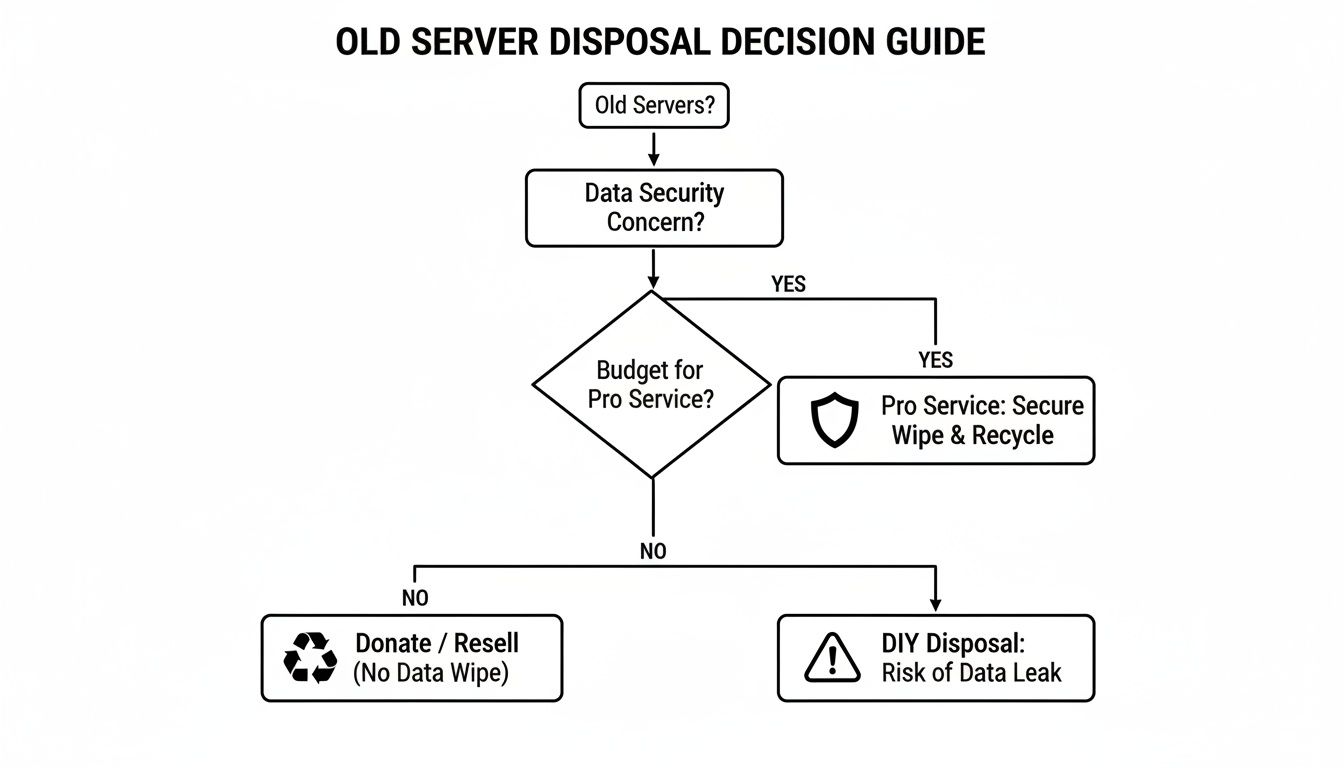
The flowchart shows that while a DIY approach looks cheaper on the surface, it opens you up to serious data security risks. Professional services, on the other hand, offer a secure and compliant path forward.
Physical Data Destruction
Sometimes, software wiping just isn't enough. For businesses handling extremely sensitive information or those legally bound by strict rules like HIPAA or GLBA, physical destruction is the only way to be 100% certain the data can never be recovered. This usually involves either degaussing or shredding.
To help you decide what's right for your business, here’s a quick breakdown of the common destruction methods.
Comparing Data Destruction Methods
| Method | How It Works | Security Level | Best For | Allows for Resale? |
|---|---|---|---|---|
| Software Wiping (e.g., DoD 5220.22-M) | Overwrites existing data with random characters in multiple passes. | High | Standard business data; companies wanting to recover asset value. | Yes |
| Degaussing | Uses a powerful magnetic field to destroy the magnetic storage on drive platters. | Very High | Businesses needing to render drives unusable without physical shredding. | No |
| Shredding | An industrial shredder physically pulverizes drives into tiny metal fragments. | Absolute | Healthcare, finance, government; any org with zero tolerance for risk. | No |
Each of these methods offers a different level of security and cost. The right one for you depends entirely on your data, your industry, and your budget.
1. Degaussing
Degaussing uses a machine that creates an incredibly powerful magnetic field to scramble the data on a hard drive's platters. Think about what happens when you put a strong magnet next to an old cassette tape—the sound is completely wiped out. Degaussing does the exact same thing to your digital files, making the drive totally unreadable and useless.
2. Hard Drive Shredding
Shredding is the final answer in data destruction. We use a specialized industrial shredder that chews hard drives, SSDs, and backup tapes into tiny, confetti-sized pieces. There is absolutely no chance of putting those pieces back together or getting any data off them.
This is the go-to method for industries where a data breach would be catastrophic:
- Healthcare Providers: Patient health information (PHI) has to be protected, no exceptions.
- Financial Institutions: Federal laws demand that customer financial data is secured.
- Government Agencies: Classified or sensitive public records require total destruction.
With on-site shredding, a mobile shredding truck comes right to your facility in Georgia. This gives you an unbroken chain of custody, and you can even watch the destruction happen yourself. For companies that need the highest possible standard of security, physical shredding is the only way to go.
You can get a closer look at how these techniques guarantee permanent data removal by exploring our complete overview of IT asset destruction services.
Navigating Georgia's Compliance and Environmental Rules
For any business in Georgia, getting rid of old servers isn't just about making room. It's a minefield of legal and environmental rules. One wrong step can lead to massive fines, a damaged reputation, and legal battles you never saw coming. This isn't just "disposal"—it's about protecting your business from the serious risks that come with data privacy and hazardous waste.
Think of it this way: your business is the captain of a ship, and those old servers are your cargo. Even after you hand that cargo off to a disposal company, you are still legally on the hook for where it ends up. This is the core of the "cradle to grave" responsibility under federal law. It’s why you absolutely must pick a partner who knows these rules inside and out.
Federal Data Protection Laws
Several major federal laws spell out exactly how you must handle the sensitive data on your servers. These aren't suggestions. They are strict legal requirements with painful penalties for getting it wrong. Knowing these is your first step toward secure server disposal services for businesses in Georgia.
HIPAA (Health Insurance Portability and Accountability Act): If you're a healthcare provider anywhere from Atlanta to Augusta, HIPAA demands that all patient health information (PHI) is protected. When a server is retired, this means the data has to be made completely unrecoverable. Certified destruction isn't just a good idea; it's a necessity.
GLBA (Gramm-Leach-Bliley Act): Financial institutions, from banks in Roswell to investment firms in Sandy Springs, fall under GLBA. The law requires you to protect consumer financial data, and regulators show no mercy for data breaches that happen because of carelessly discarded equipment.
FACTA (Fair and Accurate Credit Transactions Act): This law hits nearly every business. If you handle any kind of consumer information—credit reports, employee background checks, customer records—FACTA says you must destroy it before disposal to stop identity thieves in their tracks.
A Certificate of Destruction is your "get out of jail free" card when auditors come knocking. It’s the official, legal proof that you did your part under these laws. It shows exactly what was destroyed, when, and how, giving you a perfect paper trail.
Georgia's Environmental Regulations
Beyond the data, your old servers are considered electronic waste, or e-waste. This stuff is full of hazardous materials like lead, mercury, and cadmium. Georgia’s environmental laws are crystal clear: these materials must be kept out of our landfills, where they can poison the soil and groundwater. Tossing old IT gear in a dumpster isn’t just irresponsible—it's illegal.
The problem is huge. The world generated a staggering 62 kilotons of e-waste in 2022, but a mere 22.3% was properly collected and recycled. That leaves a massive amount of hazardous material being handled the wrong way. The good news is that recycling this e-waste makes a real difference, with current efforts saving over 700 million tonnes of CO2 emissions every year. You can get the full picture on the global e-waste challenge in this detailed report.
The Role of R2 and e-Stewards Certifications
So, how can you be sure your disposal partner is doing the right thing? Look for key industry certifications. These are a stamp of approval, a guarantee that the vendor meets the absolute highest standards for both data security and environmental safety.
- R2 (Responsible Recycling): This is a globally recognized standard. An R2-certified recycler has been audited and proven to have processes that protect the environment, their workers, and your data.
- e-Stewards: Often seen as the gold standard, e-Stewards has a strict zero-landfill policy and flat-out prohibits exporting hazardous e-waste to developing nations.
When you work with a certified recycler, you're not just calling a pickup service. You're bringing on a compliance expert. Montclair Crew is your compliance partner, making sure every single server is handled exactly as federal and state laws require. We provide all the paperwork you need, including a Certificate of Destruction, to prove your business met every last requirement. For more on this, check out our guide to Georgia electronics recycling.
A Step-by-Step Guide to Our Server Disposal Process
When you need to get rid of old servers, you need a partner you can trust. There's a lot on the line—data security, environmental compliance, and your company's reputation. We get it. That’s why we believe in total transparency.
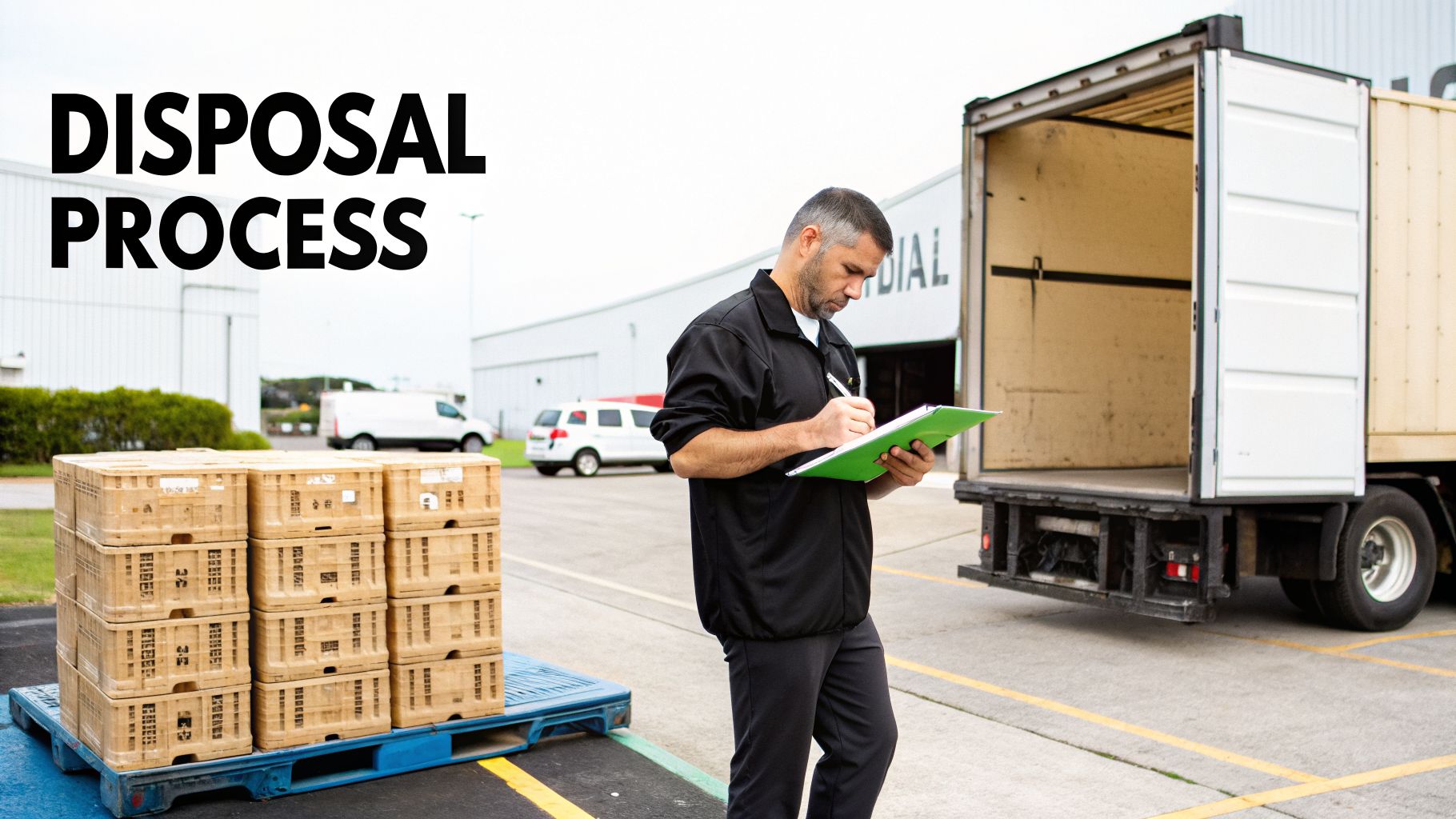
This guide pulls back the curtain on our entire process. We want you to know exactly what happens from the moment we hear from you to the final certificate in your hands. This is what to expect when you work with Montclair Crew for server disposal services for businesses in Georgia.
Step 1: Initial Consultation and Assessment
It all starts with a conversation. You reach out, and our team gets to work understanding exactly what you’re dealing with. We’ll talk about the amount and type of servers you have, your specific data security needs, and any logistical hurdles at your location.
This isn't a formality; it's the most important part of building the right plan. We’ll figure out everything from the pickup schedule to the best data destruction methods for your situation. There are no cookie-cutter solutions here—we build a strategy that fits your business like a glove.
Step 2: Secure On-Site Logistics and Removal
Once we have a plan, our crew comes to you, whether you’re in an Alpharetta office park or a downtown Atlanta data center. Our team knows how to handle sensitive IT gear securely and quickly. We take care of all the packing, palletizing, and loading, establishing a secure chain of custody the second we walk in your door.
This on-site service takes the risk and hassle completely off your plate. You don't have to worry about transportation logistics or heavy lifting. Your team can keep doing what they do best while we handle the rest.
Step 3: Detailed Asset Auditing and Inventory
As soon as your equipment gets to our secure facility, the auditing begins. This is way more than just a quick head count. We create a detailed inventory of every single asset we picked up.
Each server, hard drive, and component is logged by its serial number, model, and other key details. This gives you a complete record for your own asset management and creates the clear paper trail you need for compliance.
A detailed audit is the backbone of accountable IT asset disposition. It ensures every single piece of equipment is tracked from pickup to final disposition, leaving no room for error or misplaced assets.
Step 4: Certified Data Destruction
This is the make-or-break step for protecting your business from a data breach. Based on our initial conversation, we perform certified data destruction on every device that holds information. You’ve got two main choices, depending on your security requirements:
- Software Wiping: We use DoD 5220.22-M standard three-pass software to completely overwrite all data. This method securely erases everything but leaves the drive physically usable, making it perfect if you’re looking to get some cash back through resale.
- Physical Shredding: For the ultimate level of security, we physically destroy the drives. Our industrial shredders turn hard drives and other media into tiny, shredded fragments that can never be recovered. This is the method often required for healthcare, finance, and government.
No matter which route you choose, we guarantee your sensitive data is gone for good.
Step 5: Responsible Recycling or Resale
With all data completely destroyed, we then figure out the best path forward for the physical hardware. We operate on a zero-landfill policy, which means we focus on reuse and responsible recycling above everything else.
- Remarketing: If the equipment still has some life in it, we clean, test, and prep it for resale. Our profit-sharing model means you can actually make money from your old gear.
- Recycling: For anything that can’t be resold, we de-manufacture it. Components are separated and sent to our certified downstream partners who process the materials correctly, keeping hazardous e-waste out of Georgia's landfills.
This approach is good for your wallet and solidifies your company's commitment to being a good corporate citizen.
Step 6: Final Reporting and Certification
The job isn't done until the paperwork is in your hands. We wrap everything up by giving you a complete documentation package. This includes the final, itemized inventory report and, most importantly, a Certificate of Data Destruction and Recycling.
This certificate is your official proof that everything was handled correctly. It details every single serial number that was sanitized or destroyed and confirms that all your assets were processed in line with all federal and state regulations.
Maximizing Value from Your Decommissioned IT Assets
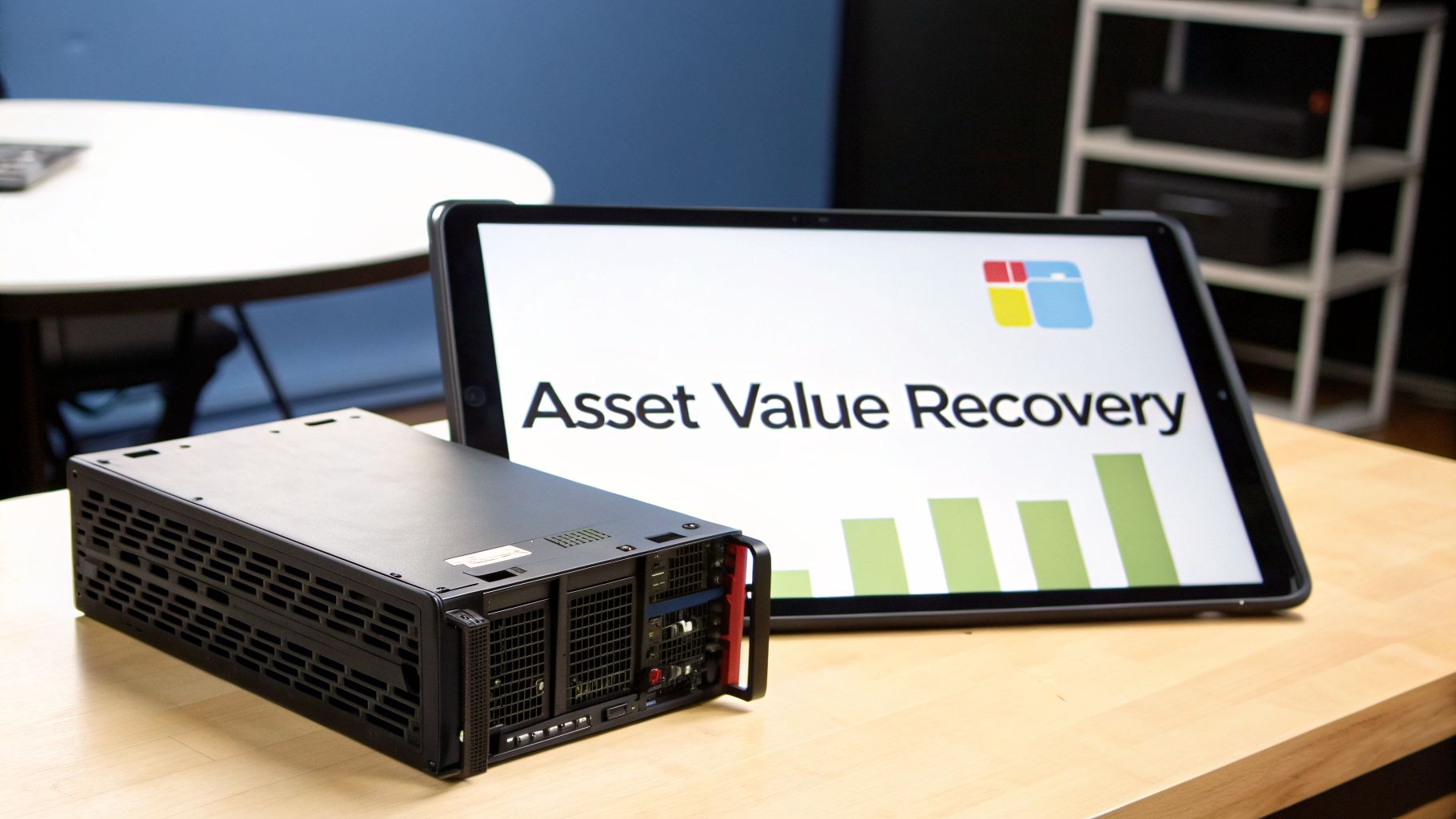
Your decommissioned servers might look like a pile of sunk costs just taking up space in your data center or office. But what if you could turn that equipment into a revenue stream? That’s the whole idea behind IT asset value recovery.
Instead of paying a company to haul away your old equipment, you can actually get paid for it. This turns what is usually an expensive disposal project into a profitable one.
It's a lot like trading in an old car. It might not have the latest tech, but it’s still full of valuable parts—an engine, a transmission, working components. Your retired servers are the same way, packed with processors, memory, and other parts that are in high demand on the secondary market. The trick is working with someone who knows how to unlock that value.
What Determines Your Server's Resale Value?
Not every old server is a goldmine. Just like with vehicles, the potential return you get really comes down to a few things that make it attractive for remarketing.
The main value drivers for used servers are:
- Processor (CPU) Generation: Newer, more powerful processors from brands like Intel and AMD are always hot commodities.
- Memory (RAM) Capacity: The total amount of RAM is a huge factor. Servers loaded with high-capacity RAM sticks will always fetch a better price.
- Brand and Model: Gear from trusted names like Dell, HP, and Cisco typically has a much stronger resale market.
- Overall Condition: A server that boots up and has been well-maintained is worth far more than one with physical damage or missing components.
For example, a fleet of Dell PowerEdge servers recently retired from a Roswell data center could bring in a serious return, especially if they have recent-gen Intel Xeon processors and a ton of RAM. This is where our experience in corporate electronic asset recycling really helps your bottom line.
How Our Profit-Sharing Model Works for You
Here at Montclair Crew, we keep things simple and transparent with our profit-sharing model. First, we perform certified data destruction to make sure your information is gone for good. Then, our techs get to work, assessing every single component to see what can be remarketed. From there, we tap into our huge network of buyers to get the absolute best price for your equipment.
Our profit-sharing model means our goals are the same as yours. We’re driven to get the highest possible resale value for your assets because when you make money, we make money. It’s a real partnership that turns your IT disposal into a financial win.
Once your equipment is sold, you get an easy-to-read, itemized report showing exactly what sold and for how much. Then, you get a check for your share of the profits. This whole approach is part of a bigger shift toward sustainability and a circular economy.
This model is catching on, especially with the U.S. waste management market projected to hit $44.64 million this year on a 5.5% growth rate. Businesses are pivoting to compliant disposal, and finding value in it is the next logical step.
If your business is planning its next IT refresh, looking at a guide to data center consolidation can spark some great ideas for improving efficiency while managing old assets. By choosing the right server disposal services for businesses in Georgia, you’re not just staying compliant—you’re making a smart financial move for your company.
How to Choose the Right Server Disposal Partner in Georgia
Picking the right partner for your server disposal is a big deal. You wouldn't hand over the keys to your office to just anyone, and you should treat the data on your old servers with the same level of caution. The right vendor shields you from costly data breaches and compliance nightmares. The wrong one could open you up to enormous risk.
Making a smart decision starts with asking the right questions. Any legitimate company providing server disposal services for businesses in Georgia should be able to answer these immediately. Use this as your checklist to tell the real professionals from the risky operators.
Questions to Qualify Your Disposal Vendor
Before you sign on the dotted line, walk through this list with any potential partner. How they answer will tell you everything you need to know about their process, security, and whether you can trust them with your assets.
Are You Certified for Data Destruction and Recycling?
A solid answer is a quick "yes," followed by the names of their certifications, like R2 (Responsible Recycling) or e-Stewards. These aren't just logos for their website; they prove the vendor has passed intense, third-party audits for both data security and environmental safety. If a vendor isn't certified, the "cradle to grave" liability for that equipment stays with you.Can You Provide On-Site Services Like Hard Drive Shredding?
The best partners are flexible. You want to hear, “Absolutely. We can bring our mobile shredding truck directly to your location.” This service gives you an unbreakable chain of custody. It lets you watch the destruction happen with your own eyes—a must-have for industries like healthcare or finance where there's zero room for error.What Is Your Process for Asset Tracking and Reporting?
A fuzzy answer here is a huge red flag. You should hear a detailed breakdown of their inventory process. They should be logging every single asset by make, model, and serial number from the moment they pick it up until its final disposal. A partner you can count on will talk about their careful tracking and provide a Certificate of Data Destruction—the final, critical document you need for your compliance records.
A partner’s transparency about their process is a direct reflection of their accountability. If they can’t clearly explain how they track your assets, they can’t guarantee your security.
- Can You Provide References from Local Georgia Businesses?
The only good answer is an enthusiastic “Of course.” A vendor who is confident in their work will be happy to connect you with other Atlanta-area businesses they've helped. Talking to a current client is the single best way to find out if they are professional, reliable, and actually do what they say they're going to do.
Making the right choice protects your company’s future. To learn more about how a full-service partner operates, you can explore the details of professional IT asset disposition services in Georgia and see how we align with these best practices.
Common Questions About Server Disposal in Georgia
When it's time to retire old IT equipment, a lot of questions come up. If you're a Georgia business trying to figure out how to handle old servers the right way—securely and responsibly—you need straight answers. Here are some of the most common questions we get about our server disposal services for businesses in Georgia.
How Much Does Server Disposal Cost for a Small Business in Atlanta?
Here's the good news: for many businesses, it can be free or even put money back in your pocket. At Montclair Crew, we often provide pickup and certified data wiping for qualifying servers and IT gear at no charge. We want to make sure secure disposal is within reach for everyone.
Of course, some specialized services, like on-site hard drive shredding for the absolute highest level of security, do have a cost. But if your old servers still have some life left in them, our profit-sharing program could mean a check for your company. You could turn an old expense into new revenue. The best way to know for sure is to contact us with your equipment list for a clear, no-obligation quote.
My Business Is in Smyrna. Do You Offer Pickup Services There?
Yes, absolutely. Montclair Crew is proud to serve the entire Metro Atlanta area and all the surrounding communities. That includes major business hubs like Smyrna, Alpharetta, Marietta, Kennesaw, and Roswell. We handle all the logistics and secure removal for businesses, schools, and data centers across Georgia.
We also have a convenient drop-off center right in Smyrna if that works better for your schedule. It’s a great option for clients who prefer to bring their equipment directly to us.
We believe that every business in the region deserves access to secure and compliant ITAD solutions. Our wide service area ensures that whether you're a startup in Midtown or an established enterprise in the suburbs, professional help is just a phone call away.
What Kind of Documentation Will I Receive?
After we process your equipment, you’ll get a Certificate of Data Destruction and Recycling. Think of this as your official proof of compliance. It’s the paper trail you need for audits and to show regulators you did everything by the book.
This certificate lists the serial numbers of every hard drive that was sanitized or destroyed. It also confirms that your assets were recycled in an environmentally sound way, following all state and federal laws. It’s your complete peace of mind, documented.
Do I Need to Wipe the Hard Drives Myself Before You Arrive?
No, and we actually recommend you don't. Wiping drives properly is a tricky business. Our standard service includes free, certified DoD 5220.22-M hard drive wiping at no cost to you. This is a government-approved method that uses multiple passes to make sure your data is 100% unrecoverable before any drive is considered for reuse.
If you need even more security, we can bring our shredder right to your office and physically destroy the drives on-site while you watch. Our secure chain-of-custody process protects your sensitive information from the second we arrive, saving you time and eliminating all the risk.
Ready to turn your old IT assets into a secure and profitable opportunity? Montclair Crew offers a trusted, compliant path to recycle your equipment, recover its value, and meet your organization's security and environmental goals. Get a free quote today by visiting us at https://www.montclaircrew.com.
