
Got a closet overflowing with old laptops, servers, and phones? Every business hits this point eventually. But that pile of retired tech isn’t just clutter—it's a ticking time bomb of security risks, environmental liabilities, and untapped cash that needs a real strategy.
Why IT Asset Disposition Is a Critical Business Function
Most companies see old equipment as a cleanup chore, something to deal with when you finally run out of storage space. That view misses the forest for the trees. In reality, every one of those old machines holds sensitive company data, hazardous materials, and potentially, a nice check with your company’s name on it. Just tossing it in a dumpster or calling a generic junk hauler is asking for trouble.
This is where IT Asset Disposition (ITAD) becomes a core part of your business plan. ITAD is the official process for securely and responsibly getting rid of unwanted IT equipment. Think of it like decommissioning a naval vessel. You wouldn't just sink the ship. A specialized crew comes in to salvage valuable parts, safely remove hazardous materials, and recycle the hull according to strict rules.
Professional IT asset disposition companies are that specialized crew for your old technology.
From Afterthought to Strategic Imperative
Putting off disposition can backfire, badly. A single hard drive that’s not properly wiped can lead to a massive data breach, costing you millions in fines, lawsuits, and trust you can never get back. On top of that, environmental laws are strict about how electronic waste (e-waste) gets handled.
A solid ITAD program turns that liability into a secure, predictable, and even profitable process. The main goals are pretty straightforward:
- Guarantee Data Security: Make sure every last byte of sensitive info on hard drives and other storage is gone for good, completely unrecoverable.
- Maintain Regulatory Compliance: Stay on the right side of environmental laws and data privacy regulations like HIPAA, SOX, and GDPR to avoid crippling penalties.
- Maximize Value Recovery: Find the gear that still works, get it refurbished, and sell it to turn old assets into a new revenue stream.
- Promote Environmental Sustainability: Responsibly recycle what can’t be resold, keeping toxic materials out of landfills and boosting your company’s green credentials.
The real job of ITAD isn't just getting rid of stuff; it's managing risk. By handling the end-of-life process correctly, a business protects its data, its reputation, and its bottom line from the hidden dangers of obsolete tech.
The True Cost of Neglecting ITAD
Ignoring a formal disposition strategy brings on hidden costs that are way higher than hiring a professional service. Without a certified partner, you’re wide open to data breach fines, which can easily hit seven figures for a single screw-up. You're also staring down environmental penalties and the loss of customer trust that always follows a public security failure.
And don't forget, you're literally throwing money away. Functional laptops, servers, and networking gear often hold significant value on the secondary market. IT asset disposition companies have the networks to refurbish and resell these items, often bringing in enough cash to cover—or even exceed—the cost of the service. In the end, a strategic approach to ITAD isn’t an expense; it’s an essential investment in security, compliance, and common-sense financial management.
What Do Top ITAD Companies Actually Do?
When you bring in a professional IT asset disposition (ITAD) partner, you're getting a lot more than just a truck to haul away old gear. Think of them as a specialized team that protects your business from all angles—security, financial, and legal. Each service they offer is a critical step in turning that pile of retired equipment from a major liability into a secure, managed asset.
This process is a big deal, and it's why the global ITAD market is exploding. As we all upgrade our tech faster than ever, the need for secure and responsible disposal is surging. The market was valued at around USD 29.23 billion in 2025 and is expected to hit a massive USD 90.06 billion by 2034. That growth tells you just how essential ITAD has become.
This simple diagram shows the basic flow: old tech goes in, and real value and safety come out.
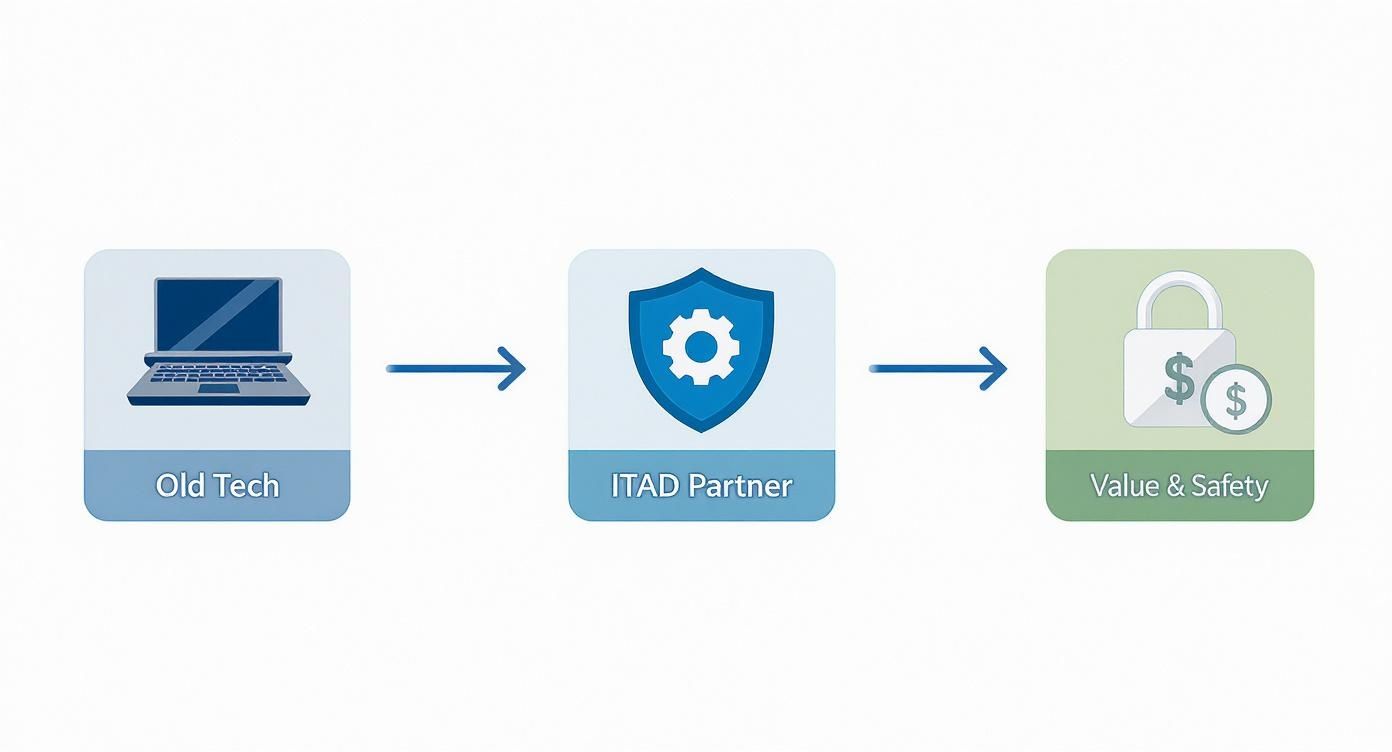
It’s all about transforming obsolete equipment into a secure, financially smart outcome. That’s the mission of any ITAD provider worth their salt.
Let's break down the essential services you should expect. The table below gives a quick overview of the key components and why they matter to your business.
Key ITAD Service Components at a Glance
| Service Component | Description | Primary Business Benefit |
|---|---|---|
| Secure Logistics | On-site packing and transport in GPS-tracked, secure vehicles, with a documented chain of custody. | Minimizes risk of asset loss or theft during transit. |
| Data Destruction | Certified wiping, degaussing, or physical shredding of all data-bearing devices. | Guarantees data privacy and prevents costly breaches. |
| Value Recovery | Testing, refurbishing, and reselling functional equipment to capture its remaining market value. | Generates a financial return that can offset disposition costs. |
| Compliant Recycling | Responsible recycling of non-functional assets according to R2 or e-Stewards standards. | Ensures environmental compliance and protects your brand reputation. |
Each of these pieces is crucial for a complete, risk-free ITAD solution. Let’s dive a little deeper into what each one involves.
Secure Logistics and Chain of Custody
The moment your assets leave your building, they are at their most vulnerable. A top-tier ITAD partner locks this down with a strict chain of custody. You can think of it as an unbroken, documented trail that follows every single device from your loading dock to its final destination.
This isn't just a vague promise; it's a precise, accountable system.
- Serialized Asset Tracking: Every piece of equipment—from a server down to an individual hard drive—gets scanned and assigned a unique serial number. This creates the master inventory that’s tracked at every step.
- Secure Transportation: Your assets are moved in locked, GPS-tracked vehicles driven by vetted personnel. This removes the opportunity for things to "fall off the truck."
- Auditable Reporting: You get detailed reports confirming that every asset that left your facility arrived safely, giving you the documentation you need for any compliance audit.
Without this airtight process, one lost laptop could quickly turn into a headline-making data breach.
Certified Data Destruction
This is the absolute heart of any ITAD service: making sure your sensitive data is gone for good. Simply hitting "delete" or reformatting a drive does almost nothing; the information is often easily recoverable. Professional ITAD firms use several certified methods to guarantee your data is permanently destroyed.
We cover these steps in more detail in our guide on the server decommissioning process, but here’s a quick rundown.
- Software-Based Wiping: This uses specialized software to overwrite the entire hard drive with random data, sometimes multiple times. Methods following standards like DoD 5220.22-M sanitize the drive, leaving it physically intact and ready for resale.
- Degaussing: For magnetic storage like hard drives and tapes, a powerful magnetic field is used to instantly scramble all the data. This completely wipes the drive but also renders it unusable.
- Physical Shredding: This is the most final solution. The hard drive is fed into an industrial shredder that grinds it into tiny metal fragments. Data recovery is physically impossible.
A Certificate of Data Destruction is a must-have. This document is your legal proof that the data on specific, serialized assets was destroyed compliantly, protecting you from any future liability.
Value Recovery and Compliant Recycling
Not all of your old IT equipment is worthless. Many devices, especially servers, networking gear, and newer laptops, still have significant resale value. A key service offered by leading ITAD providers is value recovery. They test, refurbish, and remarket this functional equipment for you.
This process can bring in a substantial financial return, often enough to offset—or even exceed—the cost of the disposition services. It turns your tech refresh into a revenue-positive event.
For equipment that truly has no market value left, the final step is environmentally compliant recycling. This is about more than just keeping electronics out of a landfill. Certified providers follow strict standards like R2 (Responsible Recycling) and e-Stewards to ensure all materials are processed safely. This prevents hazardous materials like lead and mercury from poisoning the environment and proves your company is meeting its corporate social responsibility goals.
Navigating Data Security and Regulatory Compliance
When you bring in an IT asset disposition company, you're not just making space—you're tackling some of your biggest business risks head-on. A single hard drive left in a decommissioned server can be just as damaging as a live data breach. That’s why data security is the absolute heart of any professional ITAD program. The whole point is to make sure your sensitive information never falls into the wrong hands, long after the equipment is gone.
This intense focus on security is exactly why the ITAD market has grown so much. In North America, and especially here in the U.S., businesses are acutely aware of the nightmare of data breach lawsuits. This has made certified data destruction and responsible e-waste recycling non-negotiable parts of doing business.
The Unbreakable Chain of Custody
Think about how a priceless diamond is transported. You wouldn't just toss it in a regular delivery truck. You’d use an armored vehicle, guards, GPS tracking, and a detailed log of every single person who touches it. An ITAD chain of custody provides that same level of security for your data-bearing assets. It’s a complete, auditable trail that follows every device from the moment it leaves your office to its final destruction or resale.
This detailed paperwork is your proof that everything was handled securely. It includes serial numbers for each piece of equipment, secure transit logs, and culminates in a final Certificate of Data Destruction. This certificate is your legal proof, confirming your data was wiped out for good according to industry standards.
Demystifying Key Industry Certifications
As you look at different IT asset disposition companies, you'll see a lot of certifications mentioned. These aren't just for show; they are proof from independent auditors that a vendor meets the highest standards for security and environmental care. Consider them essential trust signals you can’t ignore.
Two of the most important certifications you need to look for are:
- R2 (Responsible Recycling): The R2 Standard is all about protecting the environment and the health of workers. An R2-certified company has proven they have strict processes for tracking materials, sanitizing data properly, and safely managing hazardous e-waste.
- e-Stewards: This is another globally respected standard, often seen as even more rigorous than R2. e-Stewards certified recyclers promise not to export hazardous e-waste to developing nations and use the strictest methods available for data destruction.
Choosing a provider with R2 or e-Stewards certification is the simplest way to verify their competence and integrity. It confirms they have been audited by a third party and meet the industry's highest benchmarks for secure and ethical operations.
Connecting ITAD to Major Compliance Mandates
Getting rid of old hardware the wrong way can put you in direct violation of major data privacy regulations, leading to huge fines and a damaged reputation. A solid ITAD strategy isn't just about disposal; it's a critical piece of your company's overall compliance plan. For a closer look at the technical methods, check out our guide on what data sanitization is and how it works.
Here’s how ITAD helps you stay on the right side of the law:
- HIPAA (Health Insurance Portability and Accountability Act): Healthcare providers must make sure all patient health information (PHI) is completely unreadable and unusable before getting rid of old devices. Certified data destruction is a must for HIPAA compliance.
- GDPR (General Data Protection Regulation): This regulation protects the data of EU citizens and demands that personal info is securely erased when it's no longer needed. If you handle this data, you have to prove you destroyed it correctly.
- SOX (Sarbanes-Oxley Act): Publicly traded companies face strict rules from SOX regarding financial data. This means ensuring old computers and servers containing financial records are securely wiped to prevent fraud or leaks.
On top of that, when dealing with specialized IT equipment on an international scale, a good ITAD partner knows to check if items fall under export controls, like the Commerce Control List. A knowledgeable partner understands all these complicated rules. By making ITAD a part of your cybersecurity plan, you turn a simple chore into a powerful way to shield your organization from legal, financial, and reputational disasters.
How to Evaluate and Select the Right ITAD Partner
Picking the right partner from the many available IT asset disposition companies is a huge decision. It's not just about getting rid of old gear; it's about protecting your company's security, finances, and good name. A real partner is more than a disposal service—they become a vital part of your risk management team. You have to look beyond the price tag and do your homework.
Think of it like hiring a security firm to guard your most sensitive information. You wouldn't just go with the lowest bidder, right? You'd check their credentials, call their references, and make sure their methods are solid. That's the same level of care you need when choosing an ITAD vendor who will be handling devices packed with your confidential corporate data.
The good news is the market is full of strong providers. In 2025, you'll see big names like Securis, Iron Mountain, Dell, and Ingram Micro, all offering a wide range of services. You'll also find other top-tier IT asset disposition companies like HOBI International, ERI, and ER2. This means you have choices, but you need to understand how they differ, as many specialize in certain areas.
Create a Vendor Evaluation Checklist
To see past the sales talk and understand what a company truly offers, you need a plan. A checklist with a structured set of questions is your best tool. It forces you to cover all the critical bases and compare vendors apples-to-apples, helping you find the most qualified and trustworthy partner for your business.
Key Questions to Ask Potential ITAD Partners
When you're vetting potential vendors, you need specific, verifiable answers. Vague replies are a big red flag. A good partner will welcome these detailed questions because it shows you're serious about security and compliance.
Use the checklist below to guide your conversations and make sure nothing falls through the cracks.
A vendor's hesitation to provide detailed documentation or allow a facility tour should be a dealbreaker. True professionals are proud of their processes and have nothing to hide from a prospective client.
Vendor Evaluation Checklist
| Evaluation Area | Key Questions to Ask | Why It Matters |
|---|---|---|
| Security & Compliance | Can you provide a sample Certificate of Data Destruction? What certifications (like R2, e-Stewards) do you hold? | This is your legal proof. The certificate should list serial numbers and destruction methods. Certifications prove they meet strict industry standards. |
| Downstream Partners | How do you audit your downstream recycling partners? Can you prove they are also certified? | No single company does it all. You need assurance that their partners are just as secure and compliant as they are, preventing your e-waste from ending up overseas. |
| Chain of Custody | What does your standard chain-of-custody documentation include? Can you track my assets by serial number from pickup to final disposition? | A secure process is documented at every step. You should see serialized lists, secure transit logs, and facility receiving reports. This prevents assets from "disappearing." |
| Facility & Transparency | Can we perform an on-site audit of your processing facility? | A reputable provider will have an open-door policy for clients. Seeing their operation firsthand is a powerful trust signal. If they say no, walk away. |
| Value Recovery | What is your process for testing, grading, and remarketing assets? How do you determine the fair market value? | If you expect a return on your assets, you need to understand their resale process. Transparency here ensures you're getting a fair cut of the proceeds. |
This checklist isn't just a list of questions; it's a framework for building trust. The answers you receive will tell you everything you need to know about a potential partner's commitment to protecting your interests.
Comparing Pricing Models and Verifying Trust
Finally, you need to understand how you'll pay for these services. ITAD pricing usually comes in two main flavors. A fee-for-service model means you pay for specific tasks like pickup, data destruction, and recycling. On the other hand, a revenue-sharing model lets you earn a percentage back from the sale of valuable assets, which can often cover or even exceed your service costs.
Don't forget to verify their track record. Ask for case studies and references from companies in your industry, and actually call them. This is a critical final step, especially if you have specialized needs similar to those handled by dedicated e-waste disposal companies. Following this process will give you the confidence to select a partner you can truly rely on.
The Advantage of a Local ITAD Partner in Metro Atlanta
When it's time to retire your company's old tech, the big national ITAD companies can look tempting. But for businesses here in the bustling Metro Atlanta area, sticking with a local partner isn't just a preference—it's a game-changer.
Working with someone down the road means you're not just another account number in a massive database; you're a neighbor. That proximity translates into real, tangible benefits that a provider halfway across the country simply can't deliver.
A local firm means faster pickups and much lower transportation costs. Forget waiting days for a truck to be routed from another state. A local team can be at your Alpharetta office or Marietta data center in a flash. This kind of agility is priceless during a chaotic office move, a tight-deadline tech refresh, or an unexpected server decommissioning project.

Understanding the Unique Atlanta Business Landscape
A partner with deep roots in the Atlanta community gets the specific challenges and opportunities here. They know the logistics, from navigating I-285 rush hour to complying with local Fulton or Cobb County environmental regulations. This insider knowledge makes the entire process smoother and faster.
Think about the diverse industries that power our city:
- Healthcare Institutions: For major hospital networks like Emory or Northside, HIPAA compliance is everything. A local partner can bring a mobile shredder right to your facility, guaranteeing that sensitive patient data is destroyed on-site before it ever hits the road.
- Fintech and Tech Corridor Firms: Companies lining the corridors of Sandy Springs and Roswell require absolute, ironclad data security. A local ITAD provider lets you walk into their facility for an audit, so you can see their security protocols with your own eyes.
- Educational and Government Bodies: Schools and public agencies all over the metro area are held to strict standards of accountability. A local firm gives you a direct line of communication and transparent reporting you can count on.
The biggest benefit of a local partner is the trust you build through proximity and accessibility. Being able to visit their facility, meet their team, and see their process in person provides a level of confidence that a faceless national company can never replicate.
This kind of direct oversight is how you ensure the it asset disposition companies you hire are truly aligned with your security and compliance needs.
The Power of a Hands-On Partnership
A local provider is more than just another vendor; they're a strategic partner who's invested in our local business ecosystem. They get the nuances of the Atlanta market because they're part of it, too. This shared understanding leads to better, more responsive service, whether you're a small business in Kennesaw or a Fortune 500 company downtown.
This local-first approach is at the heart of what makes ITAD work. It combines the high standards of certified data destruction and responsible recycling with the convenience and accountability you only get from a neighborhood relationship. For any business looking for a dependable solution, the logical first step is exploring options for electronic recycling in Atlanta, GA.
Ultimately, going local gives you faster logistics, lower costs, and the priceless peace of mind that comes from a transparent, hands-on relationship. You can rest easy knowing your assets are being managed by a team that truly understands the unique demands of the Metro Atlanta business world—right in your own backyard.
Building Your Sustainable IT Asset Management Strategy
Let’s be honest. Treating IT asset disposition as a last-minute cleanup job is a huge mistake. A smart, forward-thinking approach weaves ITAD directly into your equipment’s entire lifecycle, from the day you buy it to the day it’s retired. This shifts disposition from a reactive headache into a core part of your operational, security, and even financial planning.
A world-class ITAD program really boils down to four key things: ironclad data security, unwavering environmental compliance, getting the maximum value back, and working with a certified expert you can trust. When you get these pieces working together, you build a sustainable system that protects your business from all sides. It stops being about "getting rid of old gear" and starts being about managing risk and creating value.
From Acquisition to Disposition
The best strategies plan for the end at the very beginning. As you think about your next tech refresh, it's critical to consider the financial and operational angles of different acquisition models, like whether to prioritize leasing vs. buying equipment. Planning for disposition when you purchase the gear ensures you have a clear, compliant path forward later on. This avoids the last-minute scrambles that always seem to open up security gaps and leave money on the table.
This proactive mindset is what building a sustainable operation is all about. If you want to dive deeper into how this affects your green initiatives, our guide explains practical steps on how to reduce electronic waste through smarter lifecycle management.
Your ITAD program should be as meticulously planned as your cybersecurity defenses. A forgotten hard drive poses the same threat as an unpatched server, and a certified disposition partner is your final line of defense against that risk.
Take the Next Step Towards a Secure Strategy
Stop letting your retired IT assets become a source of hidden risk and untapped value. By partnering with professional IT asset disposition companies, you can build a disposition strategy that tightens your security, supports your sustainability goals, and protects your bottom line.
Now is the perfect time to take a hard look at your current ITAD process. A professional consultation can quickly identify vulnerabilities, uncover potential cash in your old equipment, and map out a clear, actionable plan. It's time to take that next step and make sure your organization is fully protected.
Frequently Asked Questions About IT Asset Disposition
Even when you have a solid plan for your retired IT gear, questions always pop up. Here are some of the most common things businesses ask when they start looking into IT asset disposition.
What Is the Difference Between ITAD and E-waste Recycling?
Think about what happens to an old car. You could just send it straight to the scrap yard to be crushed. That's essentially e-waste recycling—it’s the final step focused purely on breaking down materials.
IT Asset Disposition (ITAD) is the whole journey. It's like taking that car to a professional shop first. They would responsibly drain the fluids, pull out valuable parts like the engine or catalytic converter to sell, and then send the leftover metal shell to the recycler. ITAD is a complete strategy that puts data security and getting money back for your assets first, with recycling as the final, responsible step for equipment that has no life left in it.
The main takeaway is that recycling is just one piece of the puzzle. A real ITAD plan covers security, logistics, and financial returns long before anything gets recycled.
How Much Money Can We Get Back from Our Old IT Equipment?
The cash you can get back really boils down to three things: how old your equipment is, what condition it's in, and if anyone still wants it. Newer gear, especially things like enterprise-grade servers, networking hardware, and recent laptops, holds the most value. A good ITAD partner will test and grade everything to figure out its fair market value.
A trustworthy IT asset disposition company uses its network of buyers to sell these items for you. They should give you a clear report showing what each item sold for, what their fees were, and the final amount you get back. While old desktop PCs and monitors might not be worth much, a solid program can often bring in enough cash to seriously reduce—or even cover—the entire cost of the service.
Do ITAD Companies Work with Small Businesses or Small Batches of Equipment?
Absolutely. Many ITAD providers work with businesses of all sizes, though how they handle the pickup might change. A huge corporation might fill up an entire truck, but a small business has different needs.
To help smaller companies, many ITAD partners have flexible options:
- Scheduled Pickups: They might group pickups from a few small businesses in your area on the same day to make it efficient.
- Drop-Off Centers: Some have secure locations where you can bring a smaller load of equipment yourself during business hours.
- Mail-In Programs: For just a handful of devices, they can send you secure, prepaid boxes so you can ship your assets to them.
The best thing to do is just call a provider and tell them what you have. A partner that cares about its customers will find a way to help you handle your equipment securely and correctly, no matter how much you have.
Ready to build a secure and profitable ITAD strategy? Montclair Crew Recycling offers certified, transparent, and locally-focused IT asset disposition services for businesses across Metro Atlanta. Contact us today for a consultation at https://www.montclaircrew.com.
