
Is that mountain of old servers, laptops, and networking gear starting to feel like a technological graveyard? For any business in Kennesaw, dealing with obsolete IT equipment isn't just a spring-cleaning project—it's a critical task that loops in data security, environmental rules, and even your bottom line. Thankfully, professional electronics recycling in Kennesaw gives you a secure and responsible way to manage it all.
Your Go-To Guide for Business Electronics Recycling in Kennesaw
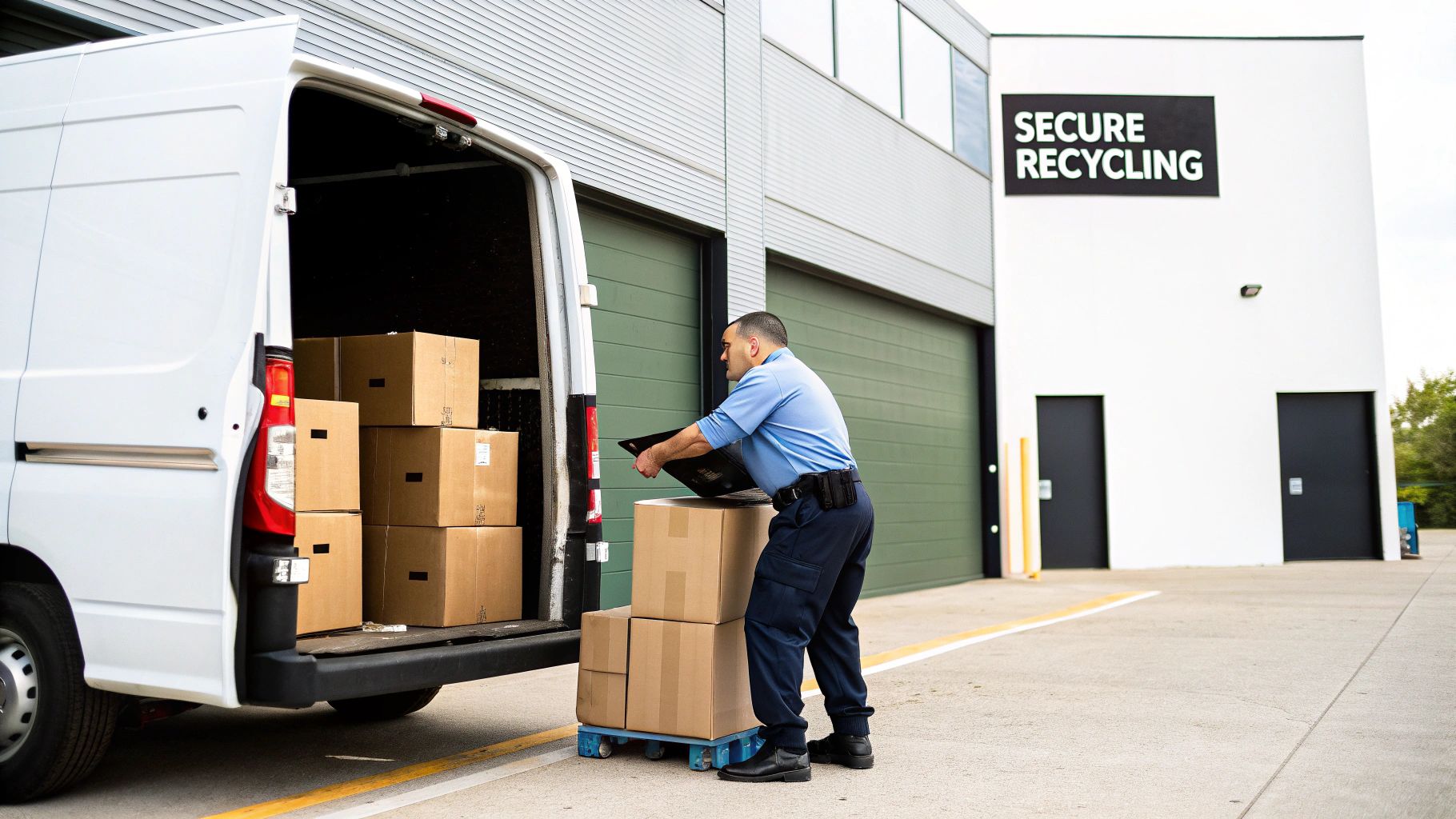
Whether you're wrapping up an office lease or overhauling a data center, you're often left with a pile of outdated tech. For a company, just dropping this gear off at a local e-waste event isn't going to cut it. Those residential services simply aren't built to handle the sheer volume or the massive security risks tied to commercial IT assets.
Think about it: every server, PC, and network switch holds sensitive information. We're talking client data, financial records, and employee files. Disposing of it improperly is like leaving your company's filing cabinets wide open on the sidewalk—a huge gamble you can't afford to take. On top of that, businesses have to follow strict environmental regulations for handling electronic waste.
From "Disposal" to Smart Asset Management
The modern way to handle this isn't just "disposal." It's a strategic process called IT Asset Disposition (ITAD). This approach completely changes the game, turning what looks like a costly headache into a managed, secure operation. A professional ITAD partner in Kennesaw can transform this challenge into a smooth and compliant process.
ITAD isn't about just getting rid of old junk. It’s about managing the final stage of an asset's life. The goal is to recover any remaining value, guarantee data is destroyed for good, and ensure you're being environmentally responsible—all wrapped up in a single, documented process.
This guide will walk you through everything you need to know about professional electronics recycling right here in Kennesaw. We want you to feel confident you're protecting your business while doing the right thing. You can also dig deeper into this structured approach in our guide to IT asset disposition in Kennesaw, GA.
Business vs Residential Electronics Recycling What Kennesaw Businesses Need to Know
For businesses, the stakes are just higher. A residential drop-off event is fine for an old toaster, but it doesn't offer the security and documentation a company needs. The table below breaks down the key differences.
| Feature | Typical Residential Recycling | Professional B2B ITAD Service |
|---|---|---|
| Data Security | None. You're responsible for wiping your own data. | Certified data destruction (DoD wiping, shredding) with certificates provided. |
| Logistics | You have to drop off items yourself, often with limits. | On-site pickup for bulk equipment, handled by a professional crew. |
| Chain of Custody | No documentation or tracking provided. | A documented, secure chain of custody from pickup to final processing. |
| Value Recovery | No opportunity to recover value from equipment. | Asset evaluation, resale, and profit-sharing options for valuable gear. |
| Compliance | Basic environmental compliance, but no business-specific reporting. | Detailed reporting for environmental and data security compliance audits. |
| Accepted Items | Usually limited to common consumer electronics. | Handles everything from data center servers and racks to specialized lab equipment. |
As you can see, a professional B2B service is built around security, compliance, and efficiency—essentials that residential programs simply don't cover.
Why B2B Recycling Services Are Different
Unlike the programs for homeowners, a business-focused service is an end-to-end solution designed for commercial needs. This is about more than keeping tech out of landfills; it’s about creating a secure chain of custody for your most critical assets. Here’s what that looks like in practice:
- On-Site Pickup and Logistics: We coordinate the removal of all your bulk equipment right from your facility, so you don't have to worry about transportation.
- Certified Data Destruction: We offer services from DoD-standard data wiping to on-site physical hard drive shredding, complete with certificates you can keep for your compliance records.
- Responsible Recycling: Our commitment is to de-manufacture equipment into reusable commodities, and we operate with a zero-landfill policy for all hazardous materials.
- Asset Value Recovery: If you have newer or high-value enterprise equipment, we can explore resale or profit-sharing opportunities that turn decommissioned assets back into revenue for you.
Why Proper E-Waste Disposal Is a Critical Business Function
Thinking of old IT gear as just "junk to get rid of" is a massive oversimplification, and honestly, a dangerous one for any modern business. It’s time to start treating IT asset disposal like you treat payroll or cybersecurity—it’s that important. Mishandling this process can create serious ripples, hitting your finances, your reputation, and your legal standing hard.
Imagine every discarded hard drive, server, and company phone ending up in a "digital dumpster." Without a secure, documented process, that dumpster becomes a goldmine for data thieves. Just one improperly wiped hard drive can hold a treasure trove of sensitive information: customer lists, financial records, employee PII, and your own trade secrets. A data breach traced back to a carelessly tossed device isn't just a headache; it can be catastrophic.
And this isn't just some hypothetical scare tactic. Fines for data privacy violations and environmental non-compliance can be absolutely devastating. But even worse than the financial hit is the permanent damage to your brand. Customers and partners trust you to protect their data. A breach from sloppy disposal shatters that trust in an instant.
The Growing E-Waste Crisis
The sheer scale of the e-waste problem is staggering, and it directly affects how your business has to operate. Electronic waste is the fastest-growing waste stream on the planet, projected to blow past 60 million metric tons in 2025 alone. What's truly shocking is that documented recycling rates are expected to plummet to just 20% by 2030, leaving billions in valuable, recoverable resources buried in the ground.
This mountain of digital trash makes professional electronics recycling in Kennesaw not just a good idea, but a flat-out necessity for any company that's paying attention.
A documented, professional recycling program isn't just a defensive move—it's a strategic advantage. It demonstrates a tangible commitment to corporate social responsibility (CSR), bolstering your brand's reputation and building deeper trust with your customers and community.
Partnering with a certified recycler is the only real way to guarantee your old assets don't end up fueling this global crisis or, worse, becoming a direct liability for your company. To get a better handle on the bigger picture, you can explore the environmental impact of electronic waste in our detailed article.
From Liability to Strategic Advantage
A formal IT asset disposition (ITAD) plan flips the script, turning a potential liability into a clear strategic advantage. It gets your company out of the reactive "what do we do with this stuff?" mindset and into a proactive, documented system that protects you on every front.
Here’s how a professional program delivers real value:
- Eliminates Data Breach Risks: Certified data destruction is non-negotiable. Methods like DoD 5220.22-M wiping and physical shredding completely remove the risk of sensitive information getting out.
- Ensures Environmental Compliance: Working with a partner who has a zero-landfill and zero-export policy for hazardous materials keeps you clear of steep fines and legal trouble.
- Strengthens Your Brand: Actively participating in the circular economy by responsibly recycling your electronics sends a powerful message about your company’s values.
- Provides an Audit Trail: Getting official paperwork, like Certificates of Data Destruction, gives you a clear, auditable trail for compliance checks and your own internal records.
By embracing a structured approach, you're doing more than just getting rid of old equipment; you're actively managing risk, protecting your brand's integrity, and making a positive environmental impact. For more context, it's worth looking into sustainable electronics recycling and proper disposal practices in tech repair shops. This proactive stance is what separates the leaders from the laggards in a market that's only getting more security-focused and eco-conscious.
What IT Assets Can Be Recycled
When it comes time to clear out an office or decommission a data center, the first question is always the same: "So, what can you actually take?" Getting a clear picture of what qualifies for professional electronics recycling is the first step to creating an accurate inventory and making sure pickup day goes off without a hitch.
The good news is, the range of accepted IT gear is pretty broad. It covers everything from the heavy-duty servers that form your company's digital backbone to the everyday monitors sitting on each desk. Both categories are equally important to handle correctly—not just for environmental compliance, but because of the sensitive data they hold. A single server might contain years of financial records, while a humble office printer often stores copies of every document it's ever scanned right on its internal memory.
Properly managing this process is a huge part of responsible electronics recycling in Kennesaw. It’s about protecting your information and making sure valuable materials are recovered instead of wasted.
Data Center and Network Hardware
This is the high-performance equipment that keeps your business running. These assets are usually packed with valuable metals like copper and aluminum, but more importantly, they are ground zero for your company's most sensitive data.
- Servers (Rackmount and Tower): The heart of your operations. These machines absolutely require certified data destruction to wipe them clean before any recycling happens.
- Network Switches and Routers: These devices direct your data traffic and can hold network configurations and access logs that need to be securely erased.
- Storage Arrays (SAN/NAS): With dozens or even hundreds of hard drives, these units are a top priority for secure data sanitization.
- Firewalls and Security Appliances: While protecting your network, these devices store logs and rule sets that should be professionally cleared.
- UPS Battery Backups: These contain lead-acid batteries that are hazardous waste. They can't go to a landfill and require handling by a certified facility.
General Office and Business Equipment
This bucket covers all the electronics you'd find in a typical office. They might seem less critical than a server rack, but every single one can hold personal, client, or company data, making secure disposal just as important.
A lot of businesses overlook this, but printers and copiers have internal hard drives or memory. They can store a ghost image of every document ever scanned, copied, or printed. Not wiping these is a common and potentially expensive data security mistake.
Here’s a look at the common office gear we handle:
- Computers and Laptops: Desktops, notebooks, you name it. They all contain hard drives or SSDs that must be professionally wiped or physically destroyed.
- Monitors (LCD, LED): Modern flat-screen monitors are straightforward to recycle. Just know that old-school CRT monitors have leaded glass and need special handling, which comes with a fee.
- Printers, Scanners, and Copiers: All-in-one machines and standalone units often have that internal storage we mentioned that needs clearing.
- Telecom Equipment: This includes things like VoIP phones, PBX systems, and other communication hardware.
To give you a clearer idea, here’s a table outlining the common assets we regularly process for businesses in the Kennesaw area.
Common IT Assets Accepted for Recycling in Kennesaw
| Asset Category | Examples of Accepted Items | Key Recycling Consideration |
|---|---|---|
| Data Center Infrastructure | Servers, Storage Arrays (SAN/NAS), Network Switches, Routers, Firewalls | Data security is paramount. Certified data destruction is required before recycling. |
| Office & End-User Devices | Desktops, Laptops, Computers, Tablets, Smartphones | All devices contain storage media that must be securely wiped or shredded. |
| Displays & Peripherals | LCD/LED Monitors, Keyboards, Mice, Docking Stations | Modern displays are highly recyclable. Older CRT monitors contain hazardous materials. |
| Printing & Imaging | Printers, Scanners, Copiers, Fax Machines, Plotters | Many of these have internal hard drives that store sensitive document images. |
| Telecom & A/V Gear | VoIP Phones, PBX Systems, Projectors, Conference Equipment | Can contain network configuration data or user logs needing removal. |
| Power Management | UPS Battery Backups, Power Distribution Units (PDUs) | UPS units contain lead-acid batteries that must be handled as hazardous materials. |
| Cables & Components | Power Cords, Ethernet Cables, RAM, CPUs, Hard Drives | Rich in copper and other recoverable metals. |
This table covers the basics, but it's not exhaustive. We handle a massive range of specialized and miscellaneous equipment.
For a complete and detailed breakdown of everything we can take off your hands, please view our full list of accepted items for recycling. This comprehensive resource will help you confidently audit your inventory and get everything ready for a seamless disposal process.
How to Prepare Your IT Assets for Secure Recycling
Getting your old IT gear ready for recycling involves more than just unplugging it and shoving it in a corner. Think of it as the final, crucial step in that equipment's life—a step that shields your company from data breaches and makes the whole handoff process seamless. A little prep work now goes a long way.
The absolute most important task is dealing with the data left on your devices. Just hitting "delete" on your files is useless; it’s like tearing a page out of a book but leaving the pieces right there in the trash for anyone to find. Real data destruction means overwriting the information so completely that it’s impossible to recover. It's digital shredding.
Your Guide to Data Destruction
For any business involved in electronics recycling in Kennesaw, certified data destruction isn't optional—it's essential. That’s why we provide a complimentary DoD 5220.22-M three-pass wipe for all qualifying assets. This is a government-grade method that writes over every single sector of a hard drive multiple times, effectively wiping out any trace of the original data.
If your business needs the highest level of security possible or has to meet tough compliance rules, on-site physical shredding is the ultimate answer. We’ll bring a mobile shredder right to your Kennesaw office, letting you watch us physically obliterate your hard drives, SSDs, and other storage media. You get undeniable proof that your data is gone forever.
This diagram shows the journey your IT assets take, from your office or data center straight through to the final recycling phase.
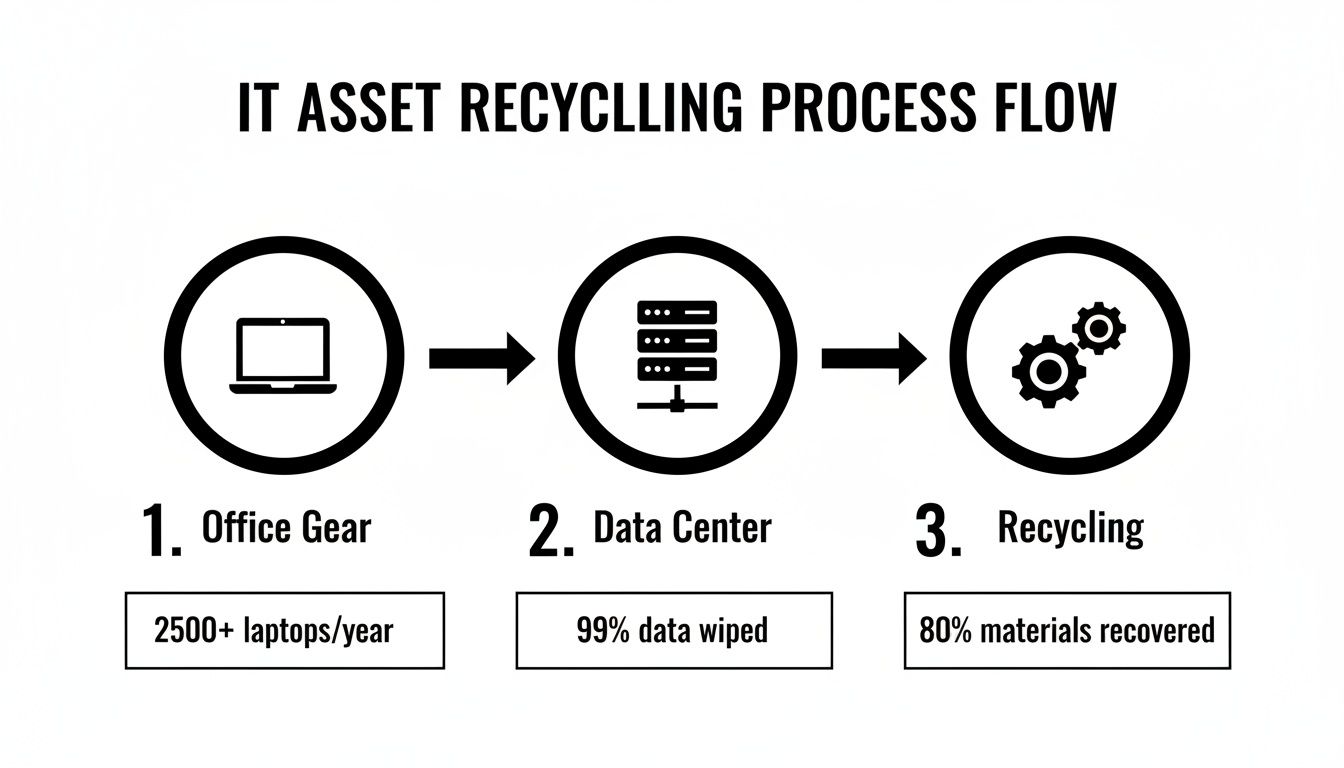
Whether the gear comes from a standard office setup or a complex data center, it all feeds into the same secure, structured pipeline for data destruction and recycling. For a deeper dive into the first steps of this process, you can learn more about how to wipe a computer before recycling in our detailed guide.
Best Practices for Inventory and Consolidation
Once you have a plan for your data, it's time to get organized. A clear inventory list is basically your roadmap for the whole disposal project. It doesn't just help you keep track of every piece of equipment; it also makes the pickup and auditing process way faster and more accurate for our team.
Here are a few practical tips to get your equipment ready:
- Make a Simple Asset List: A basic spreadsheet is perfect. Just list the device type (e.g., Dell Latitude Laptop, HP Server), its serial number, and any internal asset tag you use. This creates a solid chain of custody.
- Consolidate in One Spot: If you can, gather all the equipment in a single, easy-to-access area like a spare conference room or an empty office. This lets us handle the on-site removal quickly without disrupting your daily workflow.
- Bundle Cables and Peripherals: Try to keep power cords, keyboards, and mice with their matching computers. This helps us figure out what can be refurbished and reused much more easily.
- Label Items Clearly: If some items need special handling (like on-site shredding versus wiping), just stick a simple label on them. Good communication is the key to a flawless pickup.
A well-organized inventory and staging area can seriously cut the on-site removal time in half. It ensures every last asset is accounted for and lets our logistics crew work efficiently, causing minimal disruption to your business.
The market for used IT gear is huge. PCs and laptops make up a massive 45.0% share of recycled electronics, while the actual dismantling process accounts for 52.0% of all recycling activities. For businesses here in Metro Atlanta, this just highlights how critical it is to partner with someone who masters both certified data destruction and responsible de-manufacturing. By following these simple prep steps, you're setting your team up to manage the decommissioning process like seasoned pros, ensuring a secure and efficient retirement for your old IT assets.
Navigating Environmental Compliance and Certifications

In an industry with a massive spectrum of standards, how can you be sure you’re picking a truly responsible partner for your IT assets? Vetting your recycling vendor isn’t just good practice; it's a critical step in protecting your company from the serious risks of improper disposal.
True environmental compliance goes far beyond a simple promise to keep electronics out of the trash. It’s about partnering with a recycler who operates with a documented, transparent process that sticks to the strictest environmental and data security protocols.
This ensures your old equipment is handled ethically and legally from the moment it leaves your Kennesaw facility until its components are ready to re-enter the manufacturing stream. Choosing the right partner is choosing peace of mind.
This commitment is more crucial than ever. Globally, a staggering 62 million tonnes of e-waste were generated in 2022. That figure has shot up 82% since 2010 and is on track to hit 82 million by 2030. With the IT asset disposition (ITAD) market racing toward USD 36.4 billion by 2034—fueled by data center decommissioning and stricter ESG mandates—the pressure on businesses to get this right has never been higher.
What Do Zero Landfill and Zero Export Actually Mean?
When you hear terms like "zero landfill" and "zero export," they represent a core ethical promise in the electronics recycling world. These aren't just buzzwords; they are firm policies that define a recycler's dedication to doing things the right way.
- Zero-Landfill Policy: This is an absolute guarantee that no hazardous materials from your electronics will ever see the inside of a landfill. Instead, every single component is de-manufactured and sorted for reuse, refurbishment, or commodity-grade recycling.
- Zero-Export Policy: This policy ensures that hazardous e-waste isn't just shipped off to developing nations, where it could be processed under unsafe conditions that harm people and pollute local environments.
These two principles are the bedrock of ethical electronics recycling. They make sure your retired assets are transformed back into valuable commodities—metals, plastics, and glass—without creating a negative environmental or social footprint.
Your Proof of Compliance
A professional recycling process is built on documentation. This paper trail is your official record, proving your company has met all its legal and ethical obligations. When our team completes your project, you receive the critical documents that close the loop on your asset disposition.
The Certificate of Data Destruction is one of the most important documents you will receive. It serves as your official, auditable proof that all sensitive information was permanently destroyed according to industry and government standards, protecting you from future liability.
This documentation demonstrates your company's commitment to both data security and environmental responsibility. For any business handling e-waste, understanding the rules is non-negotiable. You can learn more about the importance of Mastering Safety Data Sheet Compliance, a critical part of managing the materials found in old electronics.
By prioritizing certified partners, you not only ensure compliance but also strengthen your company's reputation as a responsible corporate citizen right here in the Kennesaw community.
Your Kennesaw Electronics Recycling Questions Answered
When it's time for an IT asset cleanout, a lot of questions pop up. It's natural. You're dealing with logistics, potential costs, and crucial company data, so figuring out the right way to handle it all can feel like a puzzle. Getting clear, straightforward answers is the first step toward a secure and responsible disposal process.
We've put together the most common questions we hear about electronics recycling in Kennesaw to give you the information you need, right from the start.
Is There a Cost for Business Electronics Recycling in Kennesaw?
For most businesses we work with, the answer is no. If you have a decent amount of IT equipment—things like servers, PCs, laptops, and networking gear—our services are typically completely free. We even include complimentary DoD 5220.22-M data wiping to make sure your information is handled securely.
There are a few exceptions. Costs might come into play for items that need special processing, like old CRT monitors packed with leaded glass, or for premium services like bringing our hard drive shredder to your location. On the flip side, if you have high-value enterprise equipment, we even offer profit-sharing. The best way to know for sure is to just ask for a custom quote based on what you have.
How Can I Be Sure Our Sensitive Company Data Is Destroyed?
We don’t mess around with data security—it’s our absolute top priority. Every single drive that comes through our doors goes through a free three-pass DoD 5220.22-M data wipe. This is a government-approved method specifically designed to make data permanently unrecoverable. Think of it as digitally cross-shredding a document until it's just dust.
For that extra layer of certainty, we can bring our shredder right to your facility for on-site physical destruction. You can watch your hard drives turn into tiny metal fragments with your own eyes. Afterwards, we’ll hand you an official Certificate of Data Destruction for your compliance records, giving you auditable proof that everything was handled correctly.
Do You Offer Pickups Outside of Kennesaw?
Yes, absolutely. Our service area covers the entire Metro Atlanta region. We’re constantly coordinating IT asset pickups for businesses, data centers, and schools in Marietta, Alpharetta, Roswell, Norcross, Sandy Springs, and all the surrounding communities. Our logistics team knows the area and is ready to handle removals wherever you are.
No matter your location in the metro region, we can put together a plan that works. You can learn more about our process and schedule a free electronics recycling pickup right on our services page.
What Happens to Our Equipment After You Collect It?
Our entire operation is built on a strict reuse-first, zero-landfill foundation. The first thing we do is audit all the assets to see what can be refurbished and given a second life. This is a huge part of supporting a circular economy and getting the most value out of every component.
For gear that’s too old or no longer functional, we responsibly de-manufacture it down to its core materials—metals, plastics, and circuit boards. These clean, sorted commodities are then sent to our certified downstream partners to be used in new manufacturing. Nothing gets wasted, and nothing ends up where it shouldn't.
Ready to clear out your outdated IT assets the right way? Montclair Crew Recycling provides professional, end-to-end solutions for businesses all over Metro Atlanta. We make electronics recycling simple, secure, and compliant.
Contact us today to schedule your pickup at https://www.montclaircrew.com.
