
For businesses here in Kennesaw, data destruction isn't just IT cleanup—it's a critical line of defense. Getting rid of a single old hard drive the wrong way can open the door to devastating data breaches, massive regulatory fines, and permanent damage to your customers' trust. Professional disposal has moved from a "nice-to-have" to a core business necessity.
Why Secure Data Disposal Is Mission-Critical in Kennesaw
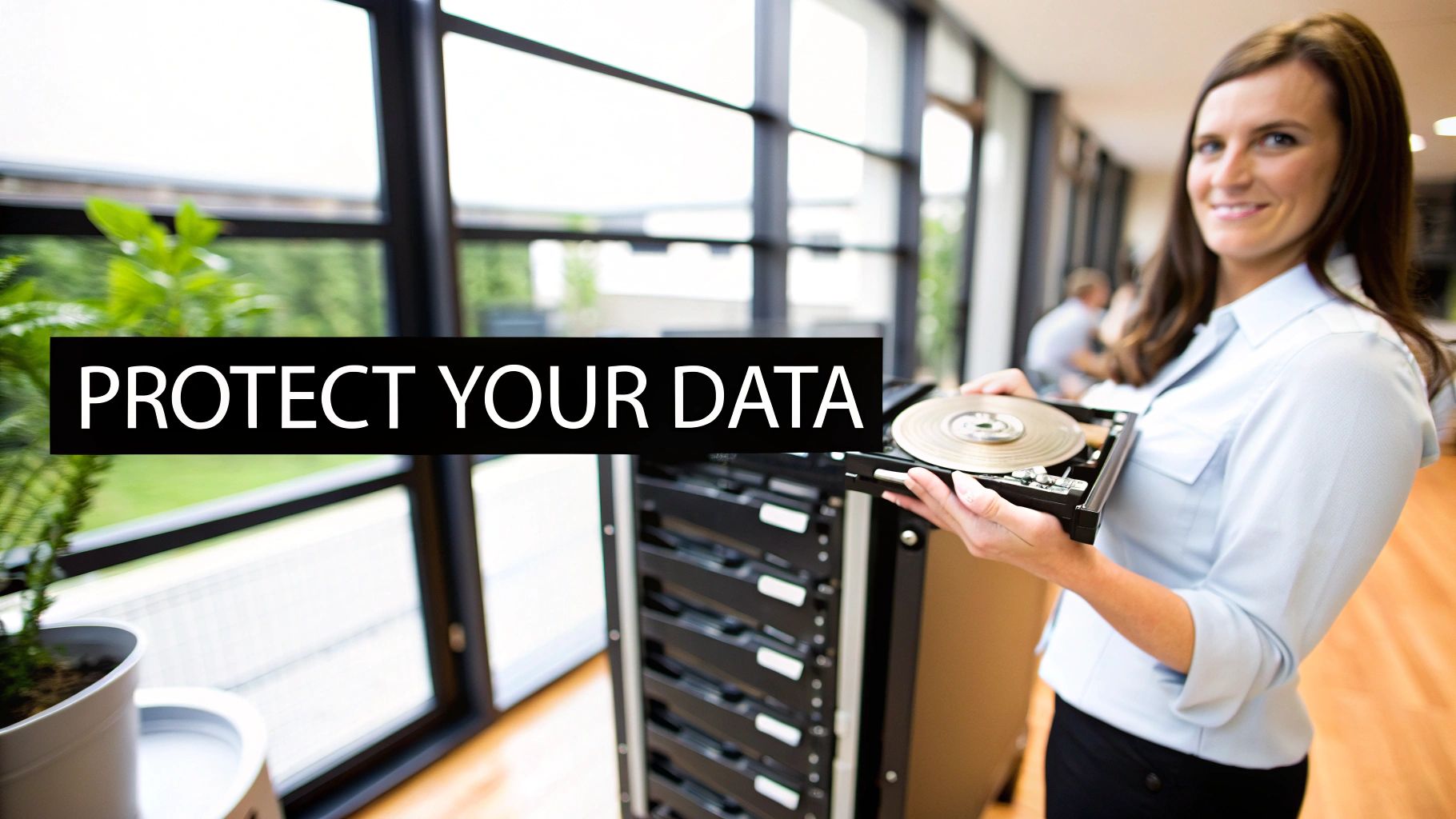
In a busy economic hub like Kennesaw, data is the engine that runs your company. Every client file, patient record, and transaction adds to the mountain of digital information you rely on. But once that data hits its end-of-life, it flips from being a valuable asset to a major liability.
Just hitting 'delete' or reformatting a drive gives a false sense of security. The truth is, sophisticated data recovery software can easily bring back information you thought was long gone. This leftover data, often called "data remanence," is exactly what cybercriminals are looking for.
The Real-World Risks of Getting It Wrong
The fallout from a data breach goes way beyond a bad press release. For businesses across the Metro Atlanta area, the consequences can be crippling.
- Financial Penalties: Rules like HIPAA for healthcare and FACTA for financial firms come with severe fines. A single slip-up can lead to penalties costing tens of thousands of dollars per violation.
- Reputational Damage: Trust is incredibly hard to build and frighteningly easy to lose. Once news of a breach gets out, you can bet clients will start looking at your competitors. That stain on your reputation can linger for years.
- Legal Liability: On top of the regulatory fines, your business could be hit with civil lawsuits from customers whose personal information was exposed. Those legal fights are almost always long and expensive.
This isn't some far-off threat; it's a local reality. Think about a Kennesaw medical practice tossing old computers and accidentally exposing patient health records—that’s a direct path to a HIPAA investigation and huge fines. Or a local accounting firm that gets rid of old servers without professional data destruction Kennesaw services, leaking sensitive financial data and facing client lawsuits.
"Treating data destruction as an afterthought is one of the biggest unforced errors a modern business can make. A proactive, certified disposal strategy is your strongest shield against financial and reputational ruin."
The Unseen Data Explosion in Metro Atlanta
The challenge keeps getting bigger because of the sheer volume of data we're all creating. Across the Metro Atlanta area, the demand for secure data destruction is skyrocketing. Globally, total data storage is on track to blow past 200 zettabytes by 2025. Companies right here in Kennesaw, Marietta, and Alpharetta are generating terabytes of sensitive information on aging servers and laptops that have to be handled correctly.
This constant cycle of tech upgrades means more and more devices are being retired every single quarter, and each one is a potential data time bomb.
Of course, a solid data protection plan goes beyond just physical hardware. It also requires comprehensive digital security and resilience planning to build a culture where security is a priority from start to finish.
Ultimately, secure disposal is a fundamental business strategy. It shows you're serious about protecting your clients, employees, and partners. When you work with a certified vendor, you ensure your old IT assets are handled responsibly, giving you a clear chain of custody and a Certificate of Destruction. Our guide to professional IT asset destruction breaks down how this process provides the legal proof you need to show compliance, protecting your company's future.
Preparing Your IT Assets for Secure Disposal
Proper data destruction in Kennesaw starts long before a shredding truck ever pulls up to your building. Getting this prep work right is the secret to a smooth, defensible, and secure process. Too often, we see businesses rush this initial phase, which almost always leads to costly mistakes, overlooked devices, and chaos for daily operations.
A little planning goes a very long way.
First things first: you can't protect what you don't know you have. You need to create a detailed inventory of every single IT asset slated for disposal. This isn't just about counting old desktops. It includes everything that stores data—servers, laptops, company smartphones, tablets, external hard drives, and even network gear like routers and firewalls.
For each device, you'll want to log a few key details to keep your records straight.
- Asset Type: (e.g., Dell PowerEdge R740 Server, iPhone 12 Pro)
- Serial Number: This is absolutely critical for tracking and your final audit trail.
- Physical Location: (e.g., Storage Closet B, Desk #14)
- Data Sensitivity Level: (High, Medium, Low)
This inventory list becomes the master document for the entire project. It's your guarantee that nothing gets missed.
Before you begin, it’s a smart move to create a simple checklist to guide your team. This ensures every critical step is handled consistently across all departments.
Data Destruction Readiness Checklist
Here is a straightforward checklist Kennesaw businesses can use to prepare their IT assets for secure disposal.
| Preparation Step | Key Action | Why It Matters |
|---|---|---|
| Asset Inventory | Create a detailed spreadsheet listing every device for disposal with its type, serial number, and location. | Provides a master list for tracking and ensures no data-bearing device is overlooked. |
| Data Classification | Assign a sensitivity level (e.g., High, Medium, Low) to each asset based on the data it contains. | Prioritizes devices with PII, PHI, or intellectual property for the highest level of security. |
| Secure Staging | Designate a locked, access-controlled room to physically gather and consolidate all assets. | Prevents unauthorized access, theft, or accidental reuse of retired equipment before destruction. |
| Internal Point Person | Assign a single project manager to oversee the entire process and liaise with the vendor. | Creates clear accountability and a single channel for communication, avoiding confusion. |
| Vendor Vetting | Confirm your chosen data destruction partner is certified (e.g., NAID AAA) and provides a Certificate of Destruction. | Guarantees compliance and provides the legal documentation you need for audits. |
Following these steps methodically turns a potentially chaotic process into a manageable and auditable project.
Creating a Secure Staging Area
Once you know what you have, the next job is to physically round it all up. Designate a secure, controlled space—like a locked storage room or a caged-off section in your warehouse—as your official staging zone. This simple step prevents employees from accidentally grabbing a retired machine for personal use or having a sensitive device mysteriously "walk away."
Inside this staging area, get organized. Group the assets based on how sensitive their data is. All the devices containing personally identifiable information (PII), patient health records, or critical intellectual property should be kept separate from lower-risk items. A simple labeling system like colored tags (red for high-risk, yellow for medium) makes it incredibly easy for your team and the disposal vendor to see what's what.
A well-organized staging area doesn't just protect your data—it helps your vendor work faster. When they arrive, they can immediately spot the high-priority assets that require witnessed, on-site destruction, which ultimately saves you time and money.
Managing the Process Internally
Pick one person in your company to be the single point of contact for the entire disposal project. This project lead will be the one coordinating with department heads, managing the inventory sheet, and acting as the main liaison with your data destruction partner.
Make sure to communicate the plan clearly to your entire team. Let them know the timeline, where the secure staging area is, and who the project lead is. This avoids a lot of confusion and ensures the logistics of asset removal don't interrupt daily business.
Finally, remember that some assets might not need to be physically destroyed but still require responsible handling. For non-data-bearing items or components that can be reused, it's important to partner with a certified recycler. You can learn more about compliant e-waste recycling in Kennesaw to ensure your entire IT retirement process is environmentally sound. By taking these preparatory steps, you create a seamless and defensible handover for your final data destruction Kennesaw service.
Choosing Your Data Destruction Method
Once you've got your IT assets inventoried and lined up, the next big call to make is how to actually destroy the data. This isn't just a small detail; the method you pick directly affects your security, your budget, and whether you can get any value back from that old equipment. For businesses here in Kennesaw, it usually boils down to two solid strategies: software-based data wiping or physically destroying the hardware.
Each way has its own perks, and the right one for your company really depends on what you're trying to achieve and the kind of data you're dealing with.
When Software-Based Wiping Is the Smart Choice
Software-based wiping, or data sanitization, uses specialized programs to overwrite every bit of information on a hard drive with random data. Instead of just deleting file markers, which leaves the data recoverable, this method essentially paints over the entire drive, making the original information practically impossible to get back.
Think of it this way: deleting a file is like taking a painting off the wall. The art still exists, it's just not on display. Wiping a drive is like covering that entire canvas with a few thick coats of black paint—the original image is gone for good.
This approach is perfect for Kennesaw businesses planning to reuse, donate, or sell their old IT gear. If your company's laptops or servers still have some life left in them, wiping lets you securely scrub all sensitive info while keeping the hardware intact.
You’ll probably hear the term DoD 5220.22-M, a Department of Defense wiping standard that uses a three-pass overwrite. While it’s a well-known benchmark, it's worth knowing that the National Institute of Standards and Technology (NIST) now offers more current and comprehensive guidelines in its Special Publication 800-88.
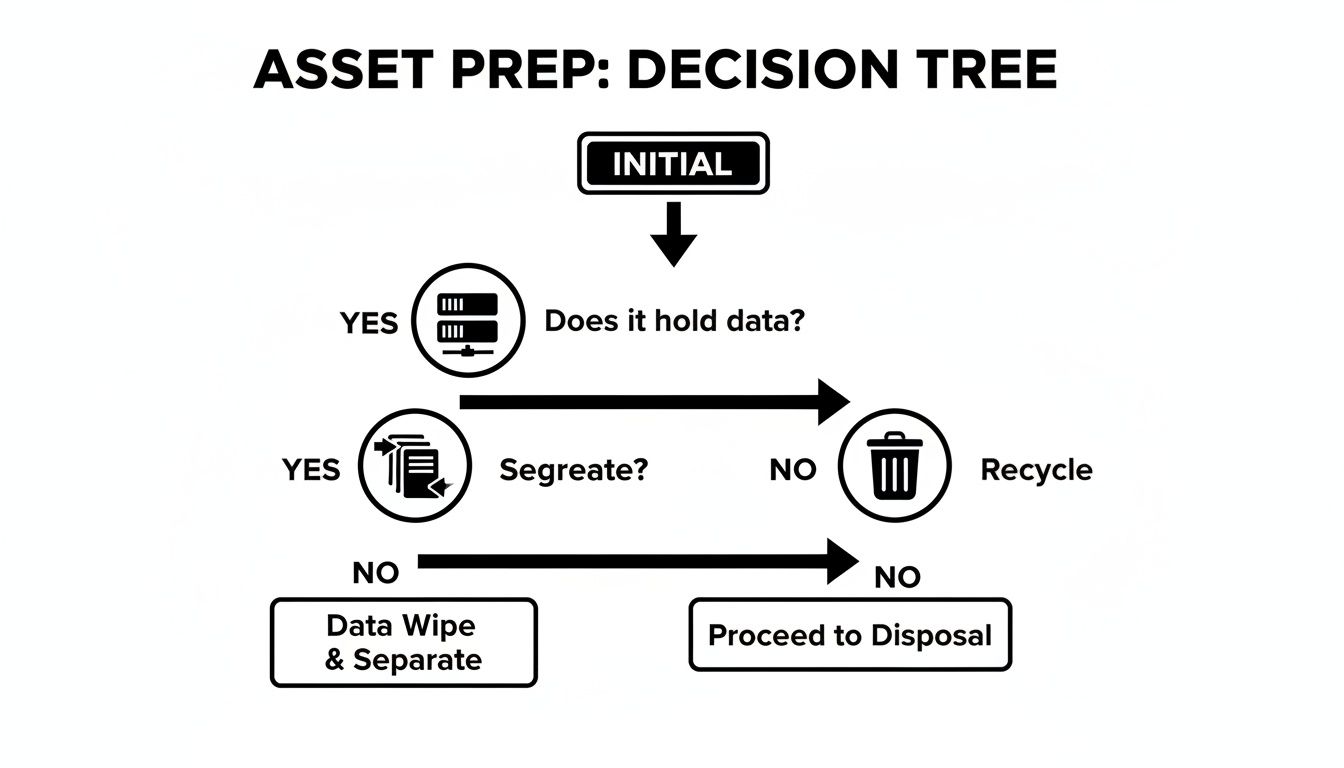
The main takeaway from modern standards like NIST's is the focus on verification. It's not just about running the software; it's about proving the data is truly, irreversibly gone.
The Ultimate Security of Physical Destruction
Sometimes, wiping just isn't enough. For hard drives holding your most critical intellectual property, confidential financial records, or protected health information (PHI), the risk is simply too high. In these cases, physical destruction is the only way to get absolute peace of mind.
This is where on-site hard drive shredding is a game-changer. A specialized mobile shredding truck comes right to your Kennesaw office, armed with an industrial-grade shredder. You can physically watch as each hard drive is fed into the machine and torn into tiny, useless bits of metal.
The biggest advantage of on-site shredding is undeniable proof. There's zero question about whether the data is gone because the device it was stored on has been completely obliterated. This is the highest level of data security you can get.
This method gives you a complete, unbroken chain of custody right up to the moment of destruction, which is critical for compliance and internal audits.
Comparing Your Options
So, which path do you take? Choosing the right data destruction method in Kennesaw means weighing your security needs against asset value and compliance rules. There’s no single "best" answer—often, a hybrid approach is the smartest strategy. For a deeper look at the technical side, our guide on the best ways to destroy a hard drive has some great additional info.
Here’s a quick breakdown to help you decide:
-
Go with Software Wiping if:
- You want to resell, redeploy, or donate your IT assets.
- The hardware is fairly new and still has significant resale value.
- You have a large number of working devices and need a cost-effective solution.
- Your company's green policy favors reuse over recycling.
-
Go with Physical Shredding if:
- The devices hold your most sensitive data (like trade secrets or PHI).
- The hard drives are old, broken, or have no resale value anyway.
- Your compliance standards demand witnessed destruction for high-risk data.
- You absolutely must have 100% certainty that the data can never be recovered.
For many local businesses, the answer is a bit of both. You might wipe newer laptops to sell them and recover some cash, while shredding the drives from old servers that held the company's crown jewels. A professional partner can help you build out this kind of blended strategy, ensuring every single asset is handled the right way.
For any business in Kennesaw, handling data the right way isn't just a suggestion—it's the law. Getting this wrong can lead to some seriously painful penalties that are far more than a simple slap on the wrist. Getting a handle on these rules is your first move toward creating a data disposal process that can stand up to an audit.
The legal side of things is a tangled web of federal and state regulations. Each one has its own strict rules for protecting sensitive information all the way through its lifecycle, including the very end when it's destroyed. You can't just guess your way through compliance; the stakes are way too high for that.
Key Regulations Kennesaw Businesses Must Know
Several major laws directly affect how you manage and destroy data. This isn't a complete list, but these are the big ones that local companies run into all the time.
- HIPAA (Health Insurance Portability and Accountability Act): If you're in healthcare—a provider, insurer, or one of their partners—this is non-negotiable. HIPAA requires that all protected health information (PHI) is rendered completely unreadable and impossible to piece back together before you get rid of it.
- FACTA (Fair and Accurate Credit Transactions Act): Any company that handles consumer reports is on the hook for FACTA. That includes banks, car dealerships, landlords, and even employers. The law demands secure destruction of consumer info to prevent identity theft.
- FERPA (Family Educational Rights and Privacy Act): Kennesaw's educational institutions, from local K-12 schools to universities, have to protect student records. That means securely destroying any documents or digital files when they're no longer needed.
These aren't just friendly guidelines. A single HIPAA violation can trigger fines from $100 to $50,000 per record, all depending on how negligent the violation was. If you're handling patient data, understanding HIPAA compliance for small businesses is absolutely critical and directly shapes your secure disposal methods.
The Power of Industry Certifications
So, how can you be sure your data destruction vendor in Kennesaw actually meets these tough legal standards? This is where industry certifications become your best defense. The most trusted credential out there is the NAID AAA Certification.
This is more than just a logo for a website. The NAID AAA program involves intense, unannounced audits that check a vendor's compliance in over 20 different areas. They look at everything from employee screening and facility security to the destruction process itself. When you partner with a NAID AAA certified provider, you're showing due diligence, which shifts the liability and gives you a rock-solid defense if an auditor ever comes knocking.
"A Certificate of Destruction from a NAID AAA certified vendor is more than just a receipt. It's your legal proof that you took every reasonable step to protect sensitive data, turning a potential compliance nightmare into a manageable risk."
The push for data privacy is a global trend. The data destruction market is expected to explode from $7.70 billion to $16.82 billion by 2030. That growth is fueled by the massive financial risks involved—GDPR fines alone have already topped €1.2 billion. For Kennesaw businesses, this just underscores how vital it is to work with certified partners who know how to navigate the rules.
Your Proof of Compliance The Certificate of Destruction
Once your devices are destroyed, your certified partner will give you a document that's worth its weight in gold: the Certificate of Destruction (CoD). This legal document is your official, final record of compliant IT asset disposal.
A legitimate CoD will always contain:
- A unique serial number for easy tracking.
- The exact date and location of the destruction.
- An itemized list of the media destroyed, complete with serial numbers.
- The specific destruction method used (e.g., shredding, wiping).
- The signature of an authorized witness confirming the process.
This certificate is your audit-proof evidence. It officially closes the loop on your asset's life, proving you met your legal duties. It's also important to remember that even after shredding, all the electronic components need to be managed by a responsible recycler. To learn more about compliant disposal practices, take a look at our guide on Georgia electronics recycling. This final step ensures your entire end-of-life process is both secure and environmentally sound.
How to Vet and Select a Local Data Destruction Partner

Picking a partner for your data destruction in Kennesaw is one of the weightiest security decisions your company will ever make. This isn't like hiring a cleaning crew; you're handing over the keys to your entire digital kingdom. Get it right, and your vendor becomes a seamless part of your security team. Get it wrong, and you're opening the door to catastrophic risk.
Your real mission is to find someone who doesn’t just have the right machinery, but who lives and breathes strict, auditable procedures from the moment they arrive until the last drive is dust. This takes more than a quick Google search—it requires digging in and separating the true professionals from the folks who just own a truck.
Start with Certifications and Security Protocols
Your very first filter should be certifications. In our world, the undisputed gold standard is the NAID AAA Certification. This isn't just a fancy logo for their website; it means the company is subject to frequent, unannounced audits covering their entire operation.
These audits are intense, focusing on the areas that matter most:
- Employee Screening: Are all employees with access to your sensitive materials background-checked and drug-tested?
- Chain of Custody: Can they prove a secure, unbroken chain of custody from your door to final destruction?
- Facility Security: Is their facility locked down and monitored 24/7 to prevent anyone from walking in off the street?
- Process Integrity: Are their destruction methods verified and fully compliant with state and federal laws?
Choosing a NAID AAA certified partner gives you a defensible position. It's concrete proof that you did your homework, which is a lifesaver if a compliance auditor ever comes knocking.
The Importance of a Secure Chain of Custody
A vendor's chain-of-custody process is the absolute backbone of their service. You need to ask them to walk you through it, step-by-step. How are your assets tracked from your Kennesaw office to their vehicle? What safeguards are in place the second they leave your property?
A pro will use barcoded asset tags, scanning each device at every single touchpoint. This generates a detailed digital trail, proving every drive you handed over was accounted for and destroyed. This documented journey isn't optional for any business that takes security seriously.
If a potential vendor gets vague or hesitant when you ask about their chain-of-custody process, that's a massive red flag. They should be able to explain it clearly and confidently.
Evaluate Local Presence and On-Site Options
While huge national companies exist, there are real advantages to partnering with a local Kennesaw-area provider. A local team offers more scheduling flexibility and can respond faster, especially for an urgent, last-minute need.
Even better, a local presence makes on-site shredding a realistic and powerful option. There's nothing quite like having a mobile shredding truck pull up to your facility so you can watch your data being destroyed with your own eyes. It completely eliminates any doubt and provides the ultimate peace of mind. Always ask if they offer witnessed, on-site services.
The IT asset disposition (ITAD) industry is booming for a reason. The global data destruction market is expected to rocket from $2.5 billion to $6.9 billion by 2032. This isn't just random growth; it's driven by businesses needing certified pros who follow strict standards like NIST 800-88. Top-tier ITAD firms are built to serve regulated industries, and their models often include on-site service and even profit-sharing on resold assets to help offset your costs.
Key Questions to Ask Every Potential Vendor
Once you have a shortlist, it's time to get direct. The confidence and detail in their answers will tell you everything you need to know.
- Are you NAID AAA Certified? If they say no, press them on why and ask how they can prove their security measures are just as good.
- Can you describe your chain-of-custody process in detail? You want to hear them talk about locked containers, asset scanning, and secure transport.
- Do you perform background checks on all employees? Anyone touching your data needs to be fully vetted. No exceptions.
- Will I receive a formal Certificate of Destruction? This is your legal proof. It should be detailed, listing every single asset by serial number.
- What happens to the shredded material? A responsible partner will work with a certified electronics recycler for proper downstream disposal.
- Do you carry downstream liability insurance? This is critical. It protects you from financial fallout if a data breach happens because of their mistake.
The right ITAD partner does more than just destroy things. They can help you build a complete strategy that includes valuing assets for potential resale. To learn more about that approach, check out our guide on IT asset disposition in Kennesaw GA, which breaks down how to get maximum value from old equipment while ensuring total data security.
Your Data Destruction Questions Answered
Once a business in Kennesaw decides on a data destruction method, a few questions almost always pop up. It's perfectly normal. When you're dealing with sensitive information, the details are everything, and getting straight answers is key for your compliance and peace of mind.
Let's walk through some of the most common questions we hear from companies right here in the area. Our aim is to clear up any confusion and help you feel confident about the final steps of securing your data.
What Actually Happens to My Shredded Hard Drives?
This is a great question, and an important one. After our on-site shredding truck turns your hard drives into a pile of mangled metal, the job isn't done. Those fragments aren't just hauled off to a landfill. Instead, every last piece is securely transported to a certified downstream recycling partner.
At the recycling facility, the materials are meticulously sorted and processed under strict environmental guidelines.
- Metals like the aluminum and steel from the drive casings are separated and sent to smelters to be melted down and used in new products.
- Circuit boards are full of valuable materials—gold, silver, palladium—which are carefully extracted and refined for use in the next generation of electronics.
- Plastics are ground down and recycled into a variety of other goods.
This final step ensures your data destruction Kennesaw process is not only secure from start to finish but also environmentally responsible.
Is My Data Truly Gone After Wiping?
Absolutely. When data wiping (also called sanitization) is done correctly using professional standards like NIST 800-88, the information is gone for good. It's completely irrecoverable by any software or hardware recovery tool known today. The process works by overwriting every single sector of the drive multiple times with random data, essentially burying the original information under layers of digital noise.
But here's the crucial part: verification. A professional service doesn’t just hit "run" on the software. We verify that the overwrite was successful across the entire drive. This validation is what gives you the green light to confidently resell or redeploy the hardware without a shred of risk.
There's a night-and-day difference between a simple "format" and professional data wiping. Formatting just removes the file pointers, like taking the table of contents out of a book. The chapters are still there. Certified wiping shreds every page.
Can I Just Destroy the Drives Myself?
Taking a hammer or drill to an old hard drive might seem like a simple, money-saving solution, but for a business, it's a huge gamble. DIY destruction methods are inconsistent and, critically, they leave you with zero proof of compliance.
Imagine you're facing an audit or a legal issue related to a potential data breach. How do you prove you did your due diligence? You can't. You won't have a Certificate of Destruction, a chain-of-custody record, or any third-party validation. That lack of documentation leaves your business wide open to fines and liability.
What If I Only Have a Few Devices to Destroy?
Many Kennesaw small businesses think professional data destruction is only for big corporations with rooms full of servers. That's a common misconception. Certified vendors are set up to handle jobs of any scale, whether it's a couple of laptops from a small office or a full data center cleanout.
Most providers have flexible options, like drop-off services for small batches or scheduled pickups that combine jobs from several local businesses to keep costs down. Don't let a small number of devices prevent you from choosing a secure, compliant path. The risk tied to just one mishandled hard drive is far greater than the cost of getting it done right.
Protecting your business data is too critical to leave to chance. At Montclair Crew Recycling, we provide Kennesaw businesses with certified, auditable data destruction services that guarantee compliance and deliver real peace of mind. Whether you need on-site shredding for maximum security or certified wiping to maximize asset value, our team will tailor a solution for your needs.
Secure your data and protect your reputation. Find out more about our IT asset disposal and data destruction services by visiting us at https://www.montclaircrew.com.
