

Recycling data center equipment in Georgia is no longer just about getting rid of old gear; it's a vital part of doing business. As Georgia solidifies its place as a top data center hub, companies have to get smart about how they handle retired servers, networking equipment, and storage hardware. It's about protecting your data, staying compliant with environmental laws, and even recovering some money from your old assets through secure data destruction and certified recycling.
The E-Waste Problem from Georgia's Data Center Boom
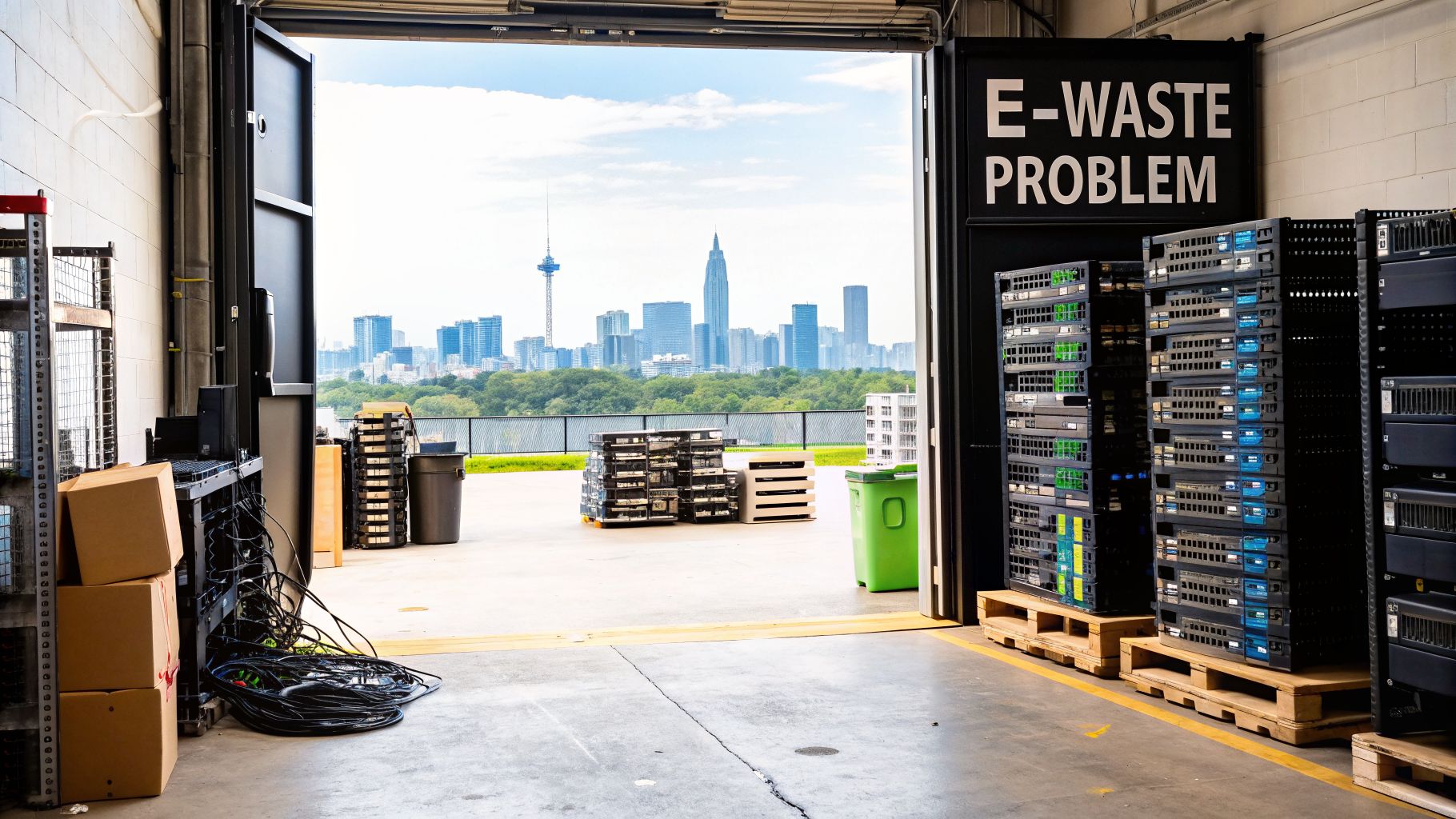
Georgia's explosion as a data center powerhouse has a downside: a massive wave of electronic waste. The Metro Atlanta area is now a top-five market for data center construction, thanks to huge investments in AI and cloud services. It’s like a digital gold rush—and while data is the new treasure, the old, outdated hardware is piling up fast.
This boom means hardware gets replaced more frequently, making equipment obsolete quicker than ever. Every server, switch, or storage array you retire adds to an e-waste stream that’s a major headache and a big risk. This isn't just scrap metal; these devices contain a tricky mix of valuable materials and hazardous substances.
When IT hardware reaches its end of life, it represents a regulated waste stream. Circuit boards and power supplies often contain heavy metals such as lead, cadmium, and mercury, which require specialized handling to prevent environmental contamination and ensure regulatory compliance.
Just tossing this equipment is out of the question. Doing so can lead to everything from hefty environmental fines to devastating data breaches. That's why having a real strategy for IT Asset Disposition (ITAD) is absolutely essential.
Moving Beyond Disposal to Strategy
Thinking of ITAD as just a disposal chore is a huge missed opportunity. A smart approach treats it as a core business function that manages risk, protects your company's reputation, and can even bring in revenue. A good ITAD program looks at the entire lifecycle of your retired assets, turning a problem into a well-managed process.
An effective plan has a few key parts:
- Secure Logistics: Carefully planning the safe, audited removal of equipment from your data center.
- Data Sanitization: Making sure every bit of sensitive information is permanently destroyed before any hardware leaves your sight.
- Value Recovery: Finding components that can be cleaned up and resold, turning those old assets into cash.
- Compliant Recycling: Responsibly breaking down materials that can't be resold and making sure hazardous parts are handled correctly. You can learn more about the complexities of recycling heavy metals from IT equipment in our detailed guide.
The Modern Business Imperative in Georgia
For any company in Georgia’s competitive tech scene—from Roswell to Alpharetta—having a professional ITAD program is a sign of a well-run operation. It shows you're serious about data security, environmental responsibility, and being smart with your money. As our digital world grows, so does our duty to manage the physical hardware that powers it.
By working with a local expert in data center equipment recycling in Georgia, you can navigate this complex process without the worry. A skilled partner helps turn potential liabilities into assets, ensuring you stay compliant and have peace of mind. This isn't just a "best practice" anymore; it's a basic requirement for success.
Navigating Your Legal and Environmental Duties
When it's time to decommission a data center in Georgia, it's about much more than just unplugging servers and sweeping the floors. You’re stepping into a minefield of legal and environmental duties. Getting it wrong can open your business up to staggering fines, data breach lawsuits, and a public relations nightmare.
While Georgia doesn't have one single, overarching e-waste law for businesses, you're still governed by a tight web of powerful federal regulations.
Think of it as a digital chain of custody. From the second a server is taken offline, you are responsible for the sensitive data it holds and the physical hardware itself. That chain has to stay secure and documented all the way until the equipment is verifiably destroyed or properly recycled. A single broken link can have serious consequences.
Understanding Your Federal Compliance Obligations
Several major federal laws dictate exactly how you must handle the data on your old IT assets. These aren't just suggestions—they have the full force of law and apply to almost every company here in Georgia.
- HIPAA (Health Insurance Portability and Accountability Act): If your business touches any patient health information, the law demands you protect it and ensure it's securely destroyed. No exceptions.
- GLBA (Gramm-Leach-Bliley Act): This one’s for financial institutions. It lays down strict rules for protecting and disposing of consumer financial data.
- FACTA (Fair and Accurate Credit Transactions Act): This act requires the proper destruction of any consumer information to head off identity theft before it can start.
Ignoring these laws can lead to crippling fines and legal battles. And here's the kicker: that responsibility doesn't just vanish when you hire a vendor. You are still on the hook until you have solid proof of compliant destruction.
The Environmental Stakes and Financial Risks
Beyond the data, there's the massive environmental cost of doing this wrong. The environmental toll of Georgia's data center growth highlights the critical role of certified recycling partners. E-waste in our state is projected to hit 52,000 tonnes by 2027—a 147% jump from 2014—with a shockingly low 1.48% circularity rate. This isn’t just an ecological problem; it's a direct business risk that can lead to fines and tarnish your company's name. You can dig deeper into Georgia's data center impact and policy recommendations in this detailed brief.
Old servers, switches, and racks are packed with hazardous materials like lead, mercury, and cadmium. If that gear gets dumped in a landfill, those toxins will eventually seep into our soil and groundwater.
Under the Resource Conservation and Recovery Act (RCRA), this is what's known as "cradle-to-grave" liability. As the one who generated the waste, your company is legally responsible for it from start to finish—even after it's left your property.
What does that mean for you? If the vendor you hired dumps your equipment illegally, your company can still be held legally and financially responsible. This is exactly why picking the cheapest disposal option often turns into the most expensive mistake you can make.
Why a Certified Partner Is Your Best Defense
Working with a certified expert in data center equipment recycling in Georgia is the smartest way to protect your business from all these risks. A qualified ITAD provider is your shield, making sure every single step is compliant, secure, and fully documented. For a closer look at what that involves, check out our complete guide on IT asset disposition services in Georgia.
A certified partner gives you the peace of mind you need by delivering:
- A Secure Chain of Custody: From the moment we pick up your equipment, it's tracked and audited until final disposition.
- Certified Data Destruction: You get verifiable proof that every bit of data has been permanently destroyed according to strict federal standards.
- Environmental Compliance: We provide complete assurance that all materials are recycled or disposed of following all EPA and state rules.
When you hand over your retired assets to a professional recycler, you’re not just getting rid of old equipment. You're transferring risk and guaranteeing that your legal and environmental responsibilities are handled with expert precision.
Your Step-By-Step Guide to the ITAD Process
Getting rid of old data center hardware feels like a massive job, but a proper IT Asset Disposition (ITAD) process breaks it down into simple, manageable steps. You wouldn't just start demolishing a house without a plan, right? You'd first figure out what's valuable, what's hazardous, and what can be sold or junked.
The same idea applies to data center equipment recycling in Georgia. A clear, step-by-step approach makes sure every server is tracked, every bit of data is destroyed, and your company stays compliant. Let's walk through the five phases that turn a potential headache into a smooth, auditable project.
Phase 1: Initial Asset Audit and Inventory
First things first: you have to know what you’re working with. This starts with a detailed inventory of every single piece of gear you plan to decommission. We’re not just talking about counting servers. This means logging serial numbers, asset tags, models, and specs for every server, switch, storage array, and PDU.
This detailed list does two things. It’s the starting point for a secure chain of custody, and it lets your ITAD partner spot any equipment with resale value, giving you a rough idea of your potential return.
Phase 2: Secure On-Site Logistics and Removal
With the inventory locked down, the hands-on work begins. This is where trained technicians come in to de-rack, palletize, and securely remove all the equipment. This is much more than just heavy lifting; it's a security-focused operation from start to finish.
Our crew works methodically, making sure no equipment gets damaged or goes missing. Everything is logged against the initial audit before it's loaded onto secure, GPS-tracked trucks for transit. This careful process protects the value of your assets and keeps that all-important chain of custody intact.
A rock-solid logistics phase is the foundation of any good ITAD project. It guarantees that every asset is accounted for from your server room to the processing facility, giving you a perfect audit trail.
For a full rundown on taking out servers, our server decommissioning checklist is an incredible step-by-step guide.
Phase 3: Certified Data Destruction
This is where we eliminate risk. Before any hardware is resold or recycled, all your sensitive data must be wiped clean—permanently and verifiably. There are two main ways to get this done, and the right choice depends on your security needs.
Choosing Your Data Destruction Method
Do you need to reuse the drives, or is total destruction the only option? This table breaks it down.
| Feature | DoD 5220.22-M Wiping | On-Site Shredding |
|---|---|---|
| Process | Software overwrites all data multiple times. | Drives are physically pulverized into small fragments. |
| Asset Outcome | Drive is completely clean and can be reused or resold. | Drive is destroyed and totally unusable. |
| Best For | Getting the most resale value out of working equipment. | Failed drives or meeting the strictest security policies. |
| Verification | Certificate of Data Destruction listing every drive's serial number. | Certificate of Destruction, often with on-site visual proof. |
Whether we wipe or shred, the outcome for you is the same: a Certificate of Data Destruction. This document is your official proof that you've met your legal duty to protect sensitive company and customer data.
Phase 4: Sorting for Resale vs. Recycling
Once the data is gone, we sort the hardware. Technicians test everything—servers, memory, CPUs, networking gear—to see what works and what it’s worth on the secondary market.
Newer, functional equipment that’s still in demand gets refurbished and sold. This is the asset recovery part of the process, and the money generated can help offset—or even pay for—the entire project.
Anything that’s too old, broken, or has no market value is slated for responsible recycling. These items are broken down, and materials like steel, aluminum, and precious metals are separated for certified downstream partners to refine and reuse.
Phase 5: Final Compliance Reporting
The last step is getting all your paperwork in order. This final documentation package is your proof that the job was done right and will satisfy any internal or external audit. When you're bringing in any outside vendor, having solid agreements in place is key; using general contract templates can be a great starting point to ensure all responsibilities are clearly defined.
Your final ITAD report will always include:
- Certificate of Data Destruction: A serialized list of every hard drive that was wiped or shredded.
- Certificate of Recycling: Proof that all non-sellable assets were recycled in an environmentally compliant way.
- Detailed Asset Report: A final breakdown of what happened to every piece of equipment, including what was resold and for how much.
This final report provides total transparency from beginning to end, closing the loop on your assets and giving you complete peace of mind.
Why Secure Data Destruction Is Not Optional
When a server in your data center is ready for retirement, just hitting 'delete' or reformatting the drives is a massive gamble. That’s like leaving confidential blueprints and financial records in an unlocked filing cabinet on the curb for anyone to take.
In the world of data center equipment recycling in Georgia, secure data destruction isn’t some premium add-on. It’s a non-negotiable step to shield your business from a catastrophic data breach.
Just think about the sheer volume of sensitive information that has lived on your hardware: customer PII, employee records, proprietary trade secrets, and financial data. If a single one of those drives ends up in the wrong hands, the consequences can be devastating—crippling regulatory fines, ugly legal battles, and permanent damage to your company’s reputation.
This simple workflow breaks down the core steps of any secure ITAD process, moving from the initial audit to the final report.
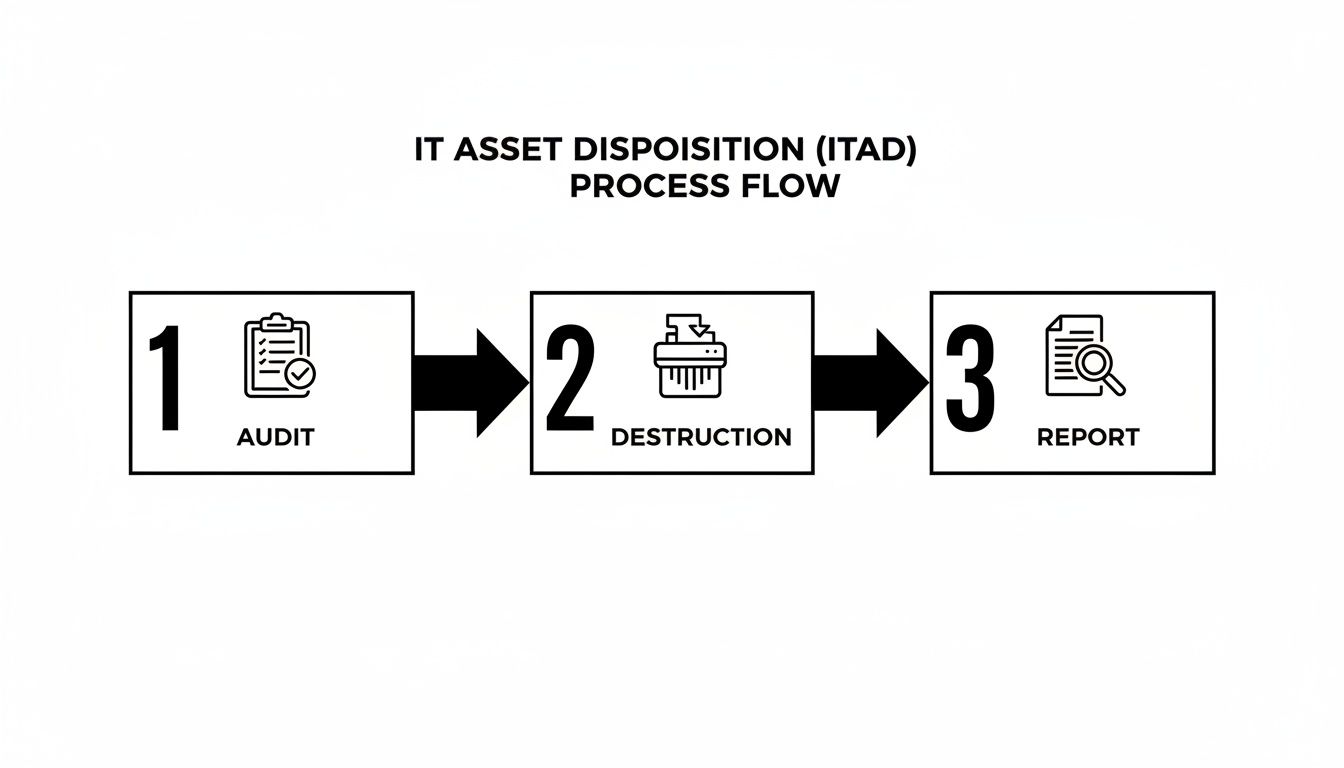
As you can see, secure destruction is the central, critical action sandwiched right between auditing your assets and getting the compliance paperwork you need to prove it was done right.
Data Wiping: The Digital Shredder
The gold standard for software-based data cleaning is the DoD 5220.22-M method. This process doesn't just delete files; it's a systematic attack that overwrites every single sector of a hard drive with new data, not once, but three separate times.
Imagine you have a document with top-secret information. The DoD method is like this:
- First, you shred the document into tiny, unreadable strips.
- Next, you burn all those strips into a fine ash.
- Finally, you scatter those ashes into the wind to make sure it can never, ever be put back together.
This overwriting process renders the original data forensically unrecoverable. The big win with data wiping is that the physical hard drive stays intact and functional, which means it can be resold. This is a crucial part of asset recovery, where the value from refurbished equipment can directly offset your recycling costs. For a deeper dive into our methods, you can learn more about our secure IT asset destruction services.
Physical Shredding: The Point of No Return
Sometimes, wiping isn't enough—or even possible. For drives that are damaged, non-functional, or fall under extremely strict company security mandates, physical shredding is the final, definitive answer. The process is exactly what it sounds like: we feed hard drives into an industrial-grade shredder that pulverizes them into small, unrecognizable bits of metal.
Physical destruction gives you the ultimate peace of mind. There's zero chance of data recovery because the media that stored the data physically no longer exists. It’s the final, irreversible step for maximum security.
On-site shredding is a popular choice for organizations in healthcare, finance, and government, as it allows them to witness the destruction firsthand before the materials are even moved. While it completely eliminates any resale value for the drives, the security guarantee it provides is priceless when dealing with high-risk data.
The Certificate of Data Destruction: Your Legal Shield
Whether you go with software wiping or physical shredding, the entire process wraps up with one of the most critical documents you'll receive: the Certificate of Data Destruction. This is far more than just a receipt; it's your legal proof of compliance.
This certificate delivers a serialized audit trail, listing every single hard drive that was sanitized or destroyed by its serial number. It acts as your official record, proving to auditors, regulators, and stakeholders that you performed your due diligence. Without this certificate, you're left with no verifiable defense if a data breach is ever traced back to your old equipment.
Turning Old Hardware Into New Revenue
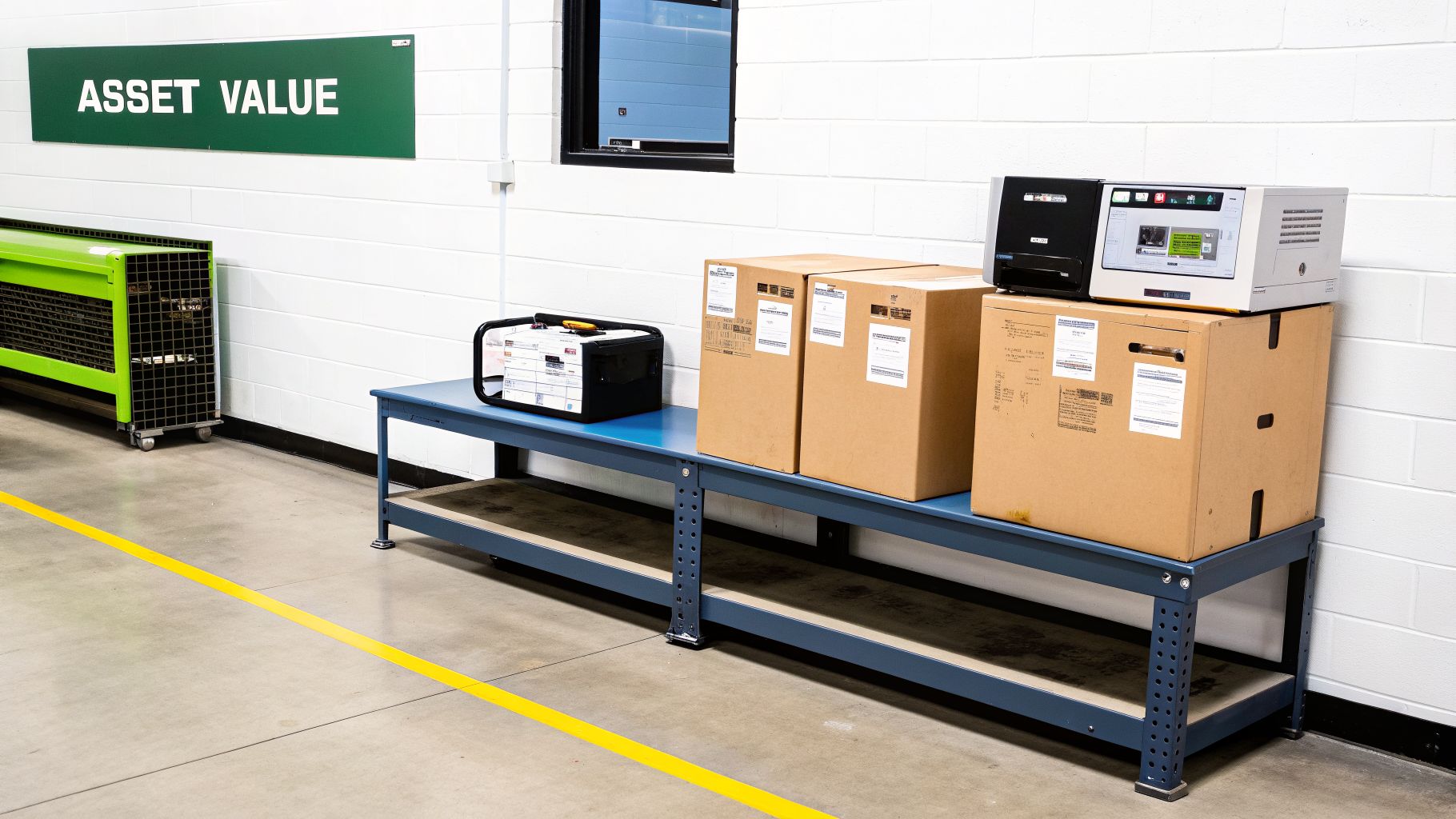
What if your old IT equipment wasn’t just another expense? It’s time to stop thinking of decommissioned hardware as a disposal headache and start seeing it as cash sitting in your server room. This simple change in mindset reframes data center equipment recycling in Georgia from a cost into a strategic way to generate revenue.
This is what IT asset recovery is all about. It’s a smart, circular approach where a professional IT Asset Disposition (ITAD) partner doesn't just haul away old gear. Instead, we meticulously evaluate every single component to see what can be refurbished and resold on the secondary market.
The goal is to squeeze every last drop of value out of your server racks. By testing, repairing, and remarketing usable equipment, a good ITAD provider can create a return that significantly cuts your recycling costs. In many cases, it can even help fund your next hardware refresh.
Identifying Your Most Valuable Assets
Let’s be honest, not every piece of old equipment is a goldmine. Some older, truly obsolete gear is simply destined for responsible recycling. But you'd be surprised how much of it holds significant value. A proper ITAD audit will quickly identify these high-value assets.
Some of the most common items we see with strong resale potential include:
- Servers: Enterprise-grade servers, even those a few years old, are always in demand. Components like CPUs, RAM, and even the bare chassis can be resold.
- Networking Gear: High-speed switches, routers, and firewalls from major brands hold their value long after you've moved on.
- Storage Arrays: SAN and NAS systems, along with their enterprise hard drives and SSDs, are prime candidates for refurbishment and resale.
The trick is to work with a partner who actually knows the market and has the right channels to sell this gear. When you do, you can get a cut of the profits through a transparent profit-sharing model that puts money directly back into your IT budget. Our guide on how you can sell used computer parts for cash breaks this process down even further.
Asset Recovery in Action
Picture a mid-sized business in Roswell, Georgia, that needs to decommission a full rack of servers. A few years ago, that meant paying someone a hefty fee to haul it away. Today, the story is completely different.
An ITAD partner inventories the rack and finds that while the servers are retired, they’re recent enough to have value. The drives are securely wiped to DoD 5220.22-M standards, keeping them functional. After a quick test and some minor cleanup, the servers are sold.
The money made from selling those servers is then shared with the Roswell company. That profit doesn't just cover the cost of the project—it also pays for the secure recycling of all their other old office electronics. It turns a potential expense into a net-zero or even profitable project.
This is a huge deal in Georgia’s tech scene. With over $40 billion invested in the state’s data center industry in early 2026, hardware is constantly being refreshed. But with a local circularity rate of just 1.48%, most of that old equipment is going to waste. Professional ITAD services flip that script, helping Georgia companies recover real value from the constant churn. You can read more about Georgia's explosive data center growth on Inteleca.
Got Questions About Georgia Data Center Recycling?
When it comes to a data center decommission or even a simple office refresh, you're bound to have questions. It’s smart to want clear, straight answers before you start. We get it.
This is your quick guide to the most common things Georgia businesses ask about IT asset disposal (ITAD). We'll clear up any confusion about costs, data security, and what happens to your old gear, so you can move forward with confidence.
What Types of Equipment Do You Recycle?
We are a business-to-business (B2B) recycler. Our focus is on the core IT hardware you'll find in data centers, offices, schools, and hospitals across Georgia. If it's professional-grade equipment, chances are we handle it.
Our expertise covers:
- Servers: All brands of rackmount, tower, and blade servers.
- Storage Systems: SANs, NAS devices, storage arrays, and tape libraries.
- Networking Gear: Enterprise switches, routers, firewalls, and load balancers from brands like Cisco, Juniper, and Arista.
- Computers and Laptops: Bulk quantities of desktops, workstations, and laptops from a business environment.
- Telecom Equipment: VoIP phones, PBX systems, and other communication hardware.
While we take the majority of business IT assets, some things are outside our lane, like specialized lab equipment or electronics from a residence. If you have items we don't handle, we won't leave you hanging. We’ll connect you with trusted local partners like Beyond Surplus who can take care of those specific needs.
What Are the Costs for Data Center Recycling in Georgia?
The cost for data center equipment recycling in Georgia isn't one-size-fits-all. It really depends on the size of your project, the logistics involved, and how you want your data handled. But here's a common myth we need to bust: professional ITAD doesn't have to be expensive. In fact, many of our key services are free.
For instance, our standard DoD 5220.22-M data wiping service is provided free for our business clients. This takes care of your data security needs right away without hitting your budget.
Often, the final cost of a project is drastically reduced—or wiped out completely—by our asset recovery program. If your old equipment still has market value, we sell it and share the revenue with you. This can easily cover all service fees and sometimes even put money back in your pocket.
A few things that can affect the final quote include:
- How much equipment you have and what kind it is.
- On-site work like de-racking servers and packing gear.
- Special requests like on-site hard drive shredding.
- The current resale value of your reusable assets.
We give you a clear, no-obligation quote upfront. You'll know exactly what to expect before we start.
Is My Business Too Small for Professional ITAD Services?
Not at all. Data security and proper recycling are just as important for a small business as they are for a Fortune 500 company. No business is "too small" to do the right thing. We've built our services to be flexible for companies of any size across the Metro Atlanta area.
We work with everyone, from a small law firm in Smyrna with one server rack to a massive data center in Alpharetta clearing out an entire floor. We know a small office might not have a full truckload of gear.
That's why we offer flexible options, including local drop-offs at our Smyrna facility. This makes certified data center equipment recycling in Georgia easy and affordable for any business. Every company deserves the peace of mind that comes from handling old IT assets the right way.
What Proof of Compliance Will I Receive?
The paperwork is one of the most important parts of the whole process. This is your official proof that you met all your legal and environmental duties. Once the job is done, we provide a full set of compliance documents for your records.
This isn't just a receipt; it's a full documentation package that includes:
- Certificate of Data Destruction: Your legal proof that all data was destroyed. This certificate lists every single hard drive and SSD by its serial number, confirming whether it was wiped to the DoD 5220.22-M standard or physically shredded to bits.
- Certificate of Recycling: This certifies that every piece of non-working equipment was recycled responsibly, following all federal, state, and local rules. It gives you a clear audit trail for every asset.
- Detailed Asset Recovery Reports: If we sold any of your equipment, you'll get a full report. It breaks down what was sold, where it was sold, and exactly how much value was recovered for your company.
This documentation package provides total transparency. It ensures you’re ready for any audit and closes the loop on your retired hardware, giving you undeniable proof that everything was handled securely and professionally from start to finish.
Ready to handle your retired IT hardware the right way? Montclair Crew Recycling offers secure, compliant, and often profitable solutions for businesses all over the Metro Atlanta area. From free data wiping to transparent asset recovery, we make data center recycling simple. Contact us today for a free quote and see how we can turn your old equipment into a secure asset. Find out more at https://www.montclaircrew.com.
