
A Certificate of Destruction (CoD) is so much more than a simple receipt. Think of it as your official, auditable proof that sensitive data has been completely and permanently wiped out. This document is a critical shield for your business, creating a defensible record that protects you from compliance nightmares and the fallout from a data breach. A proper certificate of destruction template is the key to making sure every vital detail is captured.
Why a Certificate of Destruction Is Non-Negotiable

In the world of IT asset disposal, a Certificate of Destruction is your frontline defense against legal trouble, massive fines, and brand damage that can take years to repair. It’s the final, crucial checkpoint in your IT asset disposition (ITAD) process. Without this verifiable proof, you're left exposed and unable to confirm that sensitive information was handled correctly after that old hardware left your facility.
The risks here are very real. A single improperly discarded hard drive can hold a treasure trove of confidential information, from employee PII to customer financial data. The fallout from a breach can be crippling.
- Regulatory Fines: Getting caught being non-compliant with regulations like GDPR or HIPAA can lead to fines stretching into the millions.
- Reputational Damage: A data breach shatters customer trust. Rebuilding that trust can take years and almost always results in losing clients.
- Legal Liability: You could easily face lawsuits from individuals or other businesses if their data gets compromised because of your disposal practices.
A properly executed CoD turns a routine disposal task into a powerful risk management tool. It offers the concrete evidence you need to prove you did everything right.
The Growing Demand for Formal Documentation
Let's be clear: this document isn't just a "nice-to-have." It's a globally recognized best practice. As e-waste volumes continue to explode, the need for airtight documentation has become a top priority for businesses trying to stay compliant and secure.
A 2023 report was staggering, revealing that over 78% of organizations in North America and Western Europe now mandate formal destruction certificates for all asset disposal. That’s a huge jump from just 42% back in 2015. This surge is mainly driven by stricter data protection laws, with 76% of companies now using standardized templates that have slashed documentation errors by 45%.
A robust Certificate of Destruction process turns a potential liability into a documented asset. It’s the definitive proof that you’ve met your legal and ethical obligations to protect sensitive data, closing the loop on your security protocols.
Creating an Indisputable Audit Trail
A well-structured certificate of destruction template ensures every critical piece of information is captured consistently—from asset serial numbers to the exact method of destruction. This consistency builds an unbreakable chain of custody, which is simply the chronological paper trail that documents every single touchpoint for your sensitive assets.
This concept isn't unique to data destruction. The shipping industry, for example, relies heavily on verifiable records. Understanding what a proof of delivery is and why it matters highlights the universal importance of this kind of documentation. Each document serves as the final, authoritative link in a chain, confirming a process was completed securely and accountably.
For Metro Atlanta organizations, from small businesses in Roswell to large corporations downtown, this documentation provides essential peace of mind. Partnering with a certified local expert like Montclair Crew ensures the entire process is handled correctly from start to finish. You can read more about our approach to secure data destruction services to see how professional handling validates every detail on your certificate.
Ultimately, the CoD isn’t just an administrative chore—it's a core piece of your risk management strategy that protects your organization long after the assets are gone.
Taking Apart Your Free Certificate Template
This is where the rubber meets the road—your free, ready-to-use Certificate of Destruction template. A good template isn't just a form; it's a structured, legally sound record designed to stand up in an audit. We’re not just going to give you a download link and call it a day. Let's really dig into each field so you know exactly what to put there and why it matters.
Downloading a blank document is one thing. Understanding the why behind each section is what turns that piece of paper into a compliance shield. We designed this template to be clear, comprehensive, and most importantly, defensible.
[Download Your Free Certificate of Destruction Template – Word Doc]
[Download Your Free Certificate of Destruction Template – PDF]
Anatomy of an Effective CoD Template
Once you open up the template, you'll see it’s organized into specific sections. Think of each one as a chapter in the story of your asset's final journey. Every part plays a crucial role. For a broader look at how legal records are structured, checking out guides on various legal document templates can be helpful, as they share the same need for precision and clarity.
Let’s break down the key fields you'll be working with.
Pro Tip: Before you do anything else, save a "master" copy of the template. Add your company's logo and contact information right away. This little bit of prep saves a ton of time down the road and keeps all your documents looking professional and consistent.
The Critical Fields and What They Mean
Getting the details right is everything. A vague or incomplete certificate is almost as bad as having no certificate at all. If you can’t prove what you destroyed and how you did it, you’re exposed.
Here’s a closer look at the essential information needed to create a CoD that will actually protect you.
Key Fields in Your Certificate of Destruction Template
This table breaks down each field in the template, explaining its purpose and offering some hard-won advice on getting it right every time.
| Field Name | Purpose and Required Information | Pro Tip for Accuracy |
|---|---|---|
| Unique Certificate ID | This is a unique tracking number for this specific destruction job. It prevents any mix-ups and makes it simple to pull up records during an audit. | Use a clear, sequential system like "COD-2024-001". This keeps your records organized and easily searchable. |
| Client Information | This identifies the organization whose assets are being destroyed. You'll need the full company name, address, and a primary contact person. | Always use the official, legal name of the business—not a DBA or trade name. This ensures the document is legally precise. |
| Destruction Vendor | This identifies the certified ITAD partner doing the work, like Montclair Crew. It includes the vendor’s name, address, and contact info. | Double-check that this info matches the vendor's official business registration. For our clients, we pre-fill this section. |
| Asset Identification | This is a detailed list of every single item destroyed, described with unmistakable clarity. It’s the most critical part for building an airtight audit trail. | Don’t use generic descriptions. Attach an addendum listing each asset's Type, Model, and Serial Number. Vague is not your friend here. |
| Method of Destruction | This explains exactly how the data and the physical assets were destroyed. Vague terms are a massive red flag for auditors. | Be specific. Instead of "Wiped," write "DoD 5220.22-M 3-Pass Wipe." Instead of "Shredded," state "Shredded to 2mm particle size." |
| Date & Location | This documents the exact date, time, and physical address where the destruction happened. | Specify if destruction was "On-site at Client Location" or at the vendor’s facility. This clarifies the chain of custody. |
| Chain of Custody | This section logs the official handover of assets from you to the vendor. It must include names, signatures, and dates from both parties. | This is the moment responsibility officially transfers. Treat it like signing for a high-value package—because that's what it is. |
| Authorized Signatures | The final sign-off. This requires signatures from your company’s representative and the destruction vendor’s authorized staff. | Make sure signatories also print their names and titles. This adds a crucial layer of personal accountability to the entire process. |
Getting these fields right isn't just about filling in blanks; it’s about creating a bulletproof record of responsible data stewardship.
Why Asset Identification Demands Such Precision
Let's drill down on the 'Asset Identification' section, because this is where we see the most mistakes. A CoD that just says "15 Laptops" is practically useless and a major compliance risk. In an audit, you have to prove that a specific device that once held sensitive data is now gone forever.
For instance, a properly detailed entry should look like this:
- Asset Type: Laptop
- Manufacturer/Model: Dell Latitude 7490
- Serial Number: J8G5XQ2
- Internal Asset Tag: IT-0881
This level of detail creates a direct, unbroken line from your internal inventory records to the final certificate of destruction. There's no room for doubt. You can see exactly how this works by looking at a sample certificate of destruction we've prepared. This precision is your single best defense against any claims of improper data handling.
How to Complete the Certificate: A Real-World Example
Templates are great, but nothing makes the process click like seeing it in action. Let's walk through a common, real-world scenario to show you exactly how to fill out a certificate of destruction with the kind of precision that will satisfy any auditor.
Imagine a growing accounting firm right here in Roswell, Georgia—we'll call them "Roswell Financial Partners." They’ve just upgraded their hardware and now have 15 old laptops and two servers at their end-of-life. These devices are packed with years of sensitive client financial data, so just tossing them isn't an option. Secure, documented destruction is an absolute must.
Setting the Scene: The Asset Decommissioning Project
Roswell Financial Partners keeps a detailed internal asset list, and they’ve brought in Montclair Crew to handle the on-site data destruction and IT asset removal. The firm’s IT manager, David Chen, is tasked with overseeing the entire process and making sure the final Certificate of Destruction is airtight.
The main goal here is to create a document that shows a complete, unbroken audit trail from their office to final destruction. This means every single field on the CoD needs to be filled out with specific, verifiable information. Any vague entry is an immediate red flag for auditors and a huge compliance risk.
The whole process of filling out the certificate flows logically, from identifying the assets to the final sign-off.
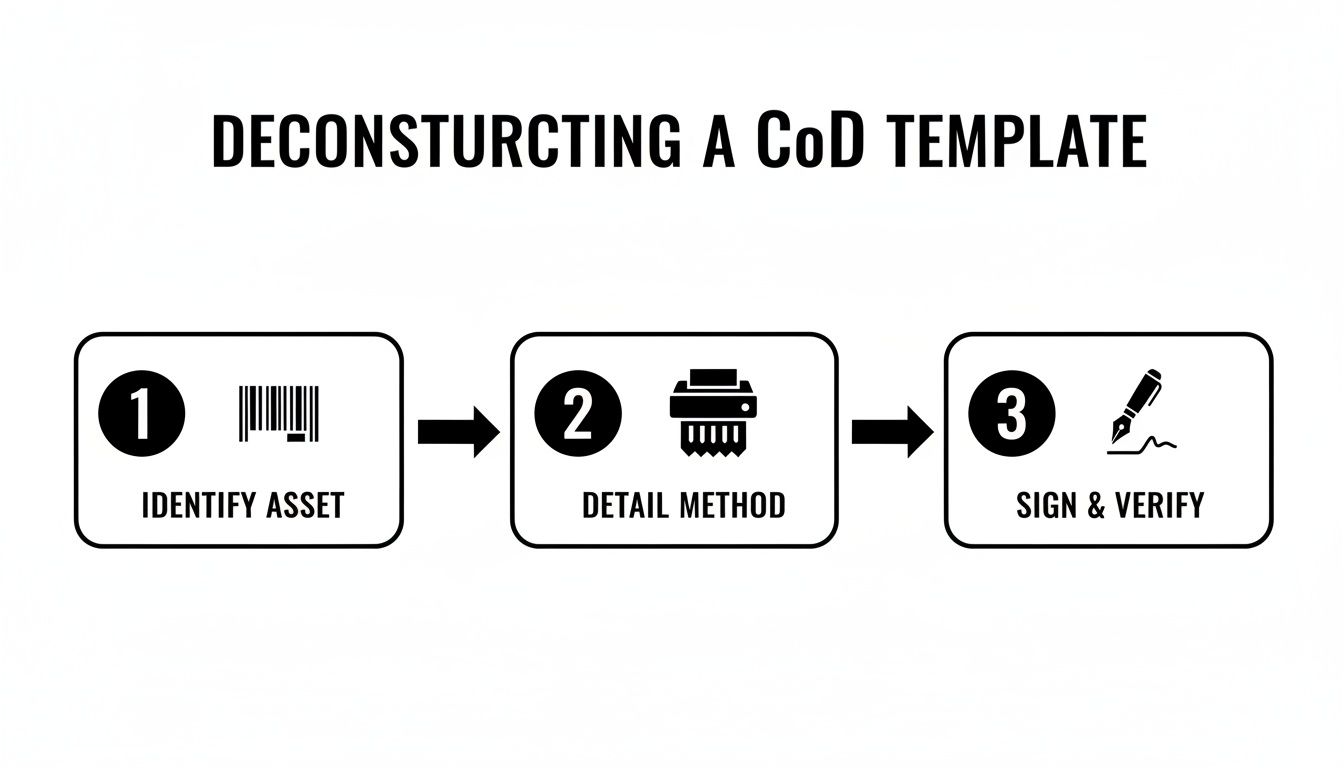
This diagram breaks it down into the three core parts: nailing down exactly what's being destroyed, detailing how it's being destroyed, and getting the right signatures to make it official.
Populating the Certificate, Field by Field
Let's watch as David fills out the key sections of the CoD for this job. His first move is to generate a unique ID so this project can be easily tracked inside their own system.
Unique Certificate ID: He uses their internal naming convention to create the ID: RFP-COD-2024-003. It's simple, sequential, and easy to look up months or even years from now.
Client & Vendor Information: This part is straightforward but demands accuracy. David enters his firm's full legal name and address, and Montclair Crew's details are added as the certified vendor doing the work.
Next up is the most critical section for any audit: the asset list. Just writing "15 laptops, 2 servers" is a rookie mistake that will get you in trouble. Instead, David attaches a detailed log that lists every single device.
Example Asset Log
| Asset Type | Manufacturer/Model | Serial Number | Internal Tag |
|---|---|---|---|
| Laptop | Dell Latitude 5400 | 8XJ3YF2 | IT-LAP-101 |
| Laptop | Dell Latitude 5400 | H2K9ZG2 | IT-LAP-102 |
| … (13 more laptops) | … | … | … |
| Server | Dell PowerEdge R740 | 7Y88LM2 | IT-SRV-04 |
| Server | Dell PowerEdge R740 | 9Z11PN2 | IT-SRV-05 |
This level of detail creates an undeniable link between the company's inventory records and the exact items being destroyed. To see what this looks like on a finished document, check out our complete sample certificate of destruction to get a feel for the final layout.
Specifying the Destruction Method and Finalizing the Record
Now David needs to document exactly how the data was destroyed. For maximum security, Montclair Crew performed on-site hard drive shredding before taking the inert materials away for recycling.
Key Insight: Be explicit when describing the destruction method. Vague terms can completely invalidate your certificate. There's a world of difference between saying something was "wiped" versus "data sanitized using a DoD 5220.22-M 3-pass wipe."
He fills out the "Method of Destruction" field with precise language:
"All hard drives physically removed from assets on-site and shredded to a 2mm particle size in accordance with NAID AAA certification standards. Remaining chassis and components transported for secure e-waste recycling."
Finally, he completes the chain of custody and authorization sections. This is the official handover.
- Date & Location: He enters the exact date and specifies the location as "On-site at Roswell Financial Partners, 123 Main Street, Roswell, GA."
- Chain of Custody: He and the Montclair Crew technician both sign and date the "Released By" and "Received By" lines, which officially transfers responsibility for the assets.
- Authorized Signatures: As the last step, both David (Client Representative) and the Montclair Crew manager (Vendor Representative) sign off with their printed names and titles.
What you're left with is a complete, compliant, and legally defensible Certificate of Destruction. It tells the full story of each asset's end-of-life journey, leaving absolutely no gaps for a potential auditor to question. This approach turns a simple form into a powerful risk management tool.
Partnering with Professionals for Certified Destruction
A solid Certificate of Destruction template gives you the framework for compliance, but the real authority comes from the certified process behind it. Let's be honest, the document is only as strong as the actions it records. This is exactly why partnering with a professional IT Asset Disposition (ITAD) vendor isn't just a convenience—it's a strategic move that validates the entire process.

When you work with a certified expert like Montclair Crew, the dynamic shifts completely. Instead of you meticulously filling out a blank form and hoping you’ve covered all your bases, we deliver a completed, verified, and audit-ready Certificate of Destruction as the final step. It’s an approach that eliminates guesswork and transfers the burden of proof to a trusted third party.
From Manual Entry to Automated Assurance
Think about the difference. A DIY approach means you’re stuck manually cataloging every single serial number, researching the right terminology for destruction methods, and managing the chain of custody yourself. One simple typo or a missed asset can create a huge compliance gap.
Our end-to-end service, on the other hand, automatically populates the CoD with accurate, verifiable data gathered at every stage.
- Secure On-Site Removal: We start right at your Metro Atlanta facility. Our technicians securely pack and transport your assets, kicking off a documented chain of custody from the very first touchpoint.
- Detailed Asset Auditing: Once at our facility, every item is scanned and logged. We capture the make, model, and—most importantly—the unique serial number of each device. This creates a detailed inventory that links directly to the final certificate.
- Certified Data Destruction: Whether you need DoD-standard wiping or on-site physical shredding, we record the specific method, date, and technician responsible. This level of detail leaves no room for ambiguity about how your data was sanitized.
This integrated workflow means the certificate you receive isn't just a piece of paper. It's a direct output of a secure, documented, and verifiable process.
The Value of Verified Compliance
Bringing in a professional partner takes the pressure of self-certification completely off your shoulders. It's no secret that the stakes are getting higher. The global data destruction market is expected to jump from $3.2 billion in 2023 to $5.8 billion by 2030, a surge driven by increasing cyber threats and tougher regulations. This trend makes specialized, trustworthy services more critical than ever.
Standardized templates are a big part of this global shift. A 2022 study showed that 65% of organizations now rely on destruction certificates, and those using templates cut their issuance time by an impressive 40%. For businesses across Alpharetta and Marietta, Montclair Crew leverages this efficiency to provide NAID AAA certified destruction that aligns with NIST 800-88 guidelines. We give you a document that will stand up to any audit. You can dig into these global trends and find more insights on data destruction certification.
When a certified ITAD partner signs your Certificate of Destruction, they are putting their reputation and their certification on the line. That signature is a guarantee that every step was performed to the highest industry standards, providing you with a level of assurance that a self-signed document simply cannot match.
Making the Right Choice for Your Organization
Choosing the right partner is what turns your IT disposal process from a potential liability into a documented strength. The benefits of working with a professional are crystal clear.
- Eliminates Human Error: Automated logging and reporting slash the risk of typos and incomplete records.
- Ensures Full Compliance: We live and breathe regulations like NIST 800-88, so the methods we use—and document—are always compliant.
- Provides a Defensible Audit Trail: Your CoD is backed by our own meticulous internal records, giving you multiple layers of proof if you ever need it.
- Saves Time and Resources: Your team is freed up from the complex and time-consuming task of managing and documenting the entire destruction process.
At the end of the day, a Certificate of Destruction template is a crucial tool. But it only reaches its full protective power when it's paired with a certified service. It’s the difference between claiming compliance and proving it with third-party verification. To see how we stack up against other vendors, check out our guide on choosing between different IT asset disposition companies in the Atlanta area.
Avoiding Common Pitfalls in CoD Management
Getting the signed Certificate of Destruction is a great feeling, but the work isn't over. Proper management of these documents is what really protects you long-term, turning a one-time event into a permanent, defensible record. This is where a lot of companies drop the ball, leaving themselves wide open to risk later on.
Think of a CoD as a critical business document, right up there with a legal contract or financial statement. It needs to be stored, managed, and retained with that level of care. If an auditor comes knocking years from now, a lost or poorly filed certificate is almost as bad as never having one at all.
Incomplete or Vague Information
One of the worst mistakes we see is accepting a CoD with fuzzy details. An auditor won't be impressed with a certificate that just says "50 computers destroyed." That kind of ambiguity shatters the chain of custody, making it impossible to prove a specific device was properly handled.
Your certificate has to create an unbreakable link between your internal asset list and the final destruction event. To make sure you’re covered, insist that every CoD includes:
- Unique Serial Numbers: Every single asset, from a server to a hard drive, needs to be listed with its manufacturer serial number.
- Internal Asset Tags: If you use your own asset tags for inventory, make sure those are on the certificate, too. It makes cross-referencing a breeze.
- Specific Destruction Methods: The document has to state exactly how the data was destroyed. Vague terms won't cut it. It should say something precise, like "Physically shredded to 2mm particle size" or "Sanitized using a 3-pass DoD 5220.22-M wipe."
This level of detail is non-negotiable. It’s what turns a simple piece of paper into a powerful piece of evidence.
Misunderstanding Record Retention Requirements
Another common tripwire is not having a clear record retention policy. How long should you hang on to these certificates? There’s no single right answer—it all comes down to the regulations governing your industry.
A healthcare provider under HIPAA has totally different rules than a financial firm governed by the Sarbanes-Oxley Act (SOX). You might hear a general rule of thumb like three to five years, but that's often not enough and can be dangerous advice for many businesses.
Key Takeaway: Never guess or assume a standard retention period works for you. Talk to your legal or compliance team to set a policy based on your specific obligations. It might be seven years, or in some cases, even longer.
To give you a clearer picture, it's helpful to see how retention periods vary across different compliance frameworks.
Sample CoD Retention Periods by Regulation
This table gives you a starting point for understanding the minimum timeframes required by some of the most common regulations.
| Regulation | Governed Industry | Recommended Retention Period | Key Consideration |
|---|---|---|---|
| HIPAA | Healthcare | Minimum 6 years from date of creation | Protects patient health information (PHI) and documents due diligence. |
| SOX | Public Companies / Finance | 7 years for audit-related records | Applies to records that support financial audits, including IT asset disposal. |
| FACTA | Credit / Financial Services | No specific timeline, but must show "reasonable measures" were taken. 5-7 years is a safe harbor. | Focuses on preventing identity theft from consumer information. |
| GDPR | Organizations handling EU data | As long as necessary to prove compliance; often tied to data processing agreements. | The burden of proof is on the data controller to demonstrate compliance. |
This isn't an exhaustive list, but it highlights just how different the requirements can be.
Developing a sound strategy is critical for your long-term protection. For a deeper dive, you can explore our in-depth guide covering record retention guidelines for businesses.
Poor Storage and Retrieval Systems
So, you've got a perfect CoD, and you know exactly how long to keep it. The final mistake is losing it in a messy filing system. It doesn't matter if your records are physical or digital; you need a system that lets you find what you need, fast. During an audit, fumbling to produce a certificate sends up a huge red flag.
If you’re storing them digitally, use a logical naming convention like CoD_VendorName_YYYY-MM-DD. Keep the files in a secure, backed-up location with tight access controls. For paper copies, a centralized, fire-proof cabinet organized by date or vendor works best. A simple slip-up here can completely undermine all the careful work you put into the destruction process.
Got Questions About Data Destruction Certificates?
Even when you have a solid process, questions always pop up. When you're dealing with something as critical as a certificate of destruction, getting the right answers is the only way to truly protect your organization. Here are some of the most common questions we hear from businesses all over Metro Atlanta.
Think of this as your go-to guide. We’ve pulled together the essentials to help you handle your documentation with confidence, making sure every move you make is secure and by the book.
Is a Certificate of Destruction Actually a Legal Document?
Yes, absolutely. A correctly filled-out Certificate of Destruction is a legal document. It serves as your official, auditable proof that specific data-bearing devices were properly destroyed using stated methods and standards.
If you ever face a regulatory audit or a legal challenge, that certificate is your evidence of due diligence. It shows you took your responsibility to protect sensitive information seriously and complied with data privacy laws like HIPAA or GDPR.
What’s the Real Difference Between Data Wiping and Physical Shredding?
This is a huge one, and it directly affects what you document on the certificate. Each method has a different purpose, and picking the right one boils down to what you plan to do with the hardware afterward.
- Data Wiping: This is all done with software. A program overwrites the data on a hard drive, usually multiple times, to make the original information impossible to get back. The big advantage here is that the drive is still physically usable and can be resold or redeployed.
- Physical Shredding: This is the brute-force approach. A machine literally grinds the hard drive into small metal fragments. It completely destroys both the data and the drive, offering the absolute highest level of security.
Your company's own security policies and any compliance rules you're subject to will dictate which path you need to take for any given piece of equipment.
Can I Just Make My Own Certificate Without a Template?
You technically could, but it's a risky move we really advise against. A professional template is built to make sure you include all the legally necessary details—details that are incredibly easy to forget if you're starting from scratch.
Leaving out crucial information like unique serial numbers, chain of custody signatures, or the specific destruction method can make your certificate totally invalid in an audit. That opens your organization up to some serious compliance risk. A vetted template closes those dangerous gaps.
How Long Should We Hang On to These Certificates?
There’s no single answer here; retention periods are tied directly to your industry and the specific regulations you have to follow. For example, HIPAA requires you to keep health-related records for a minimum of six years.
For most businesses, a good rule of thumb is to keep CoDs for at least seven years. But we always recommend talking to your legal or compliance team. They can help you create a formal retention policy that's perfectly matched to what your organization is legally required to do.
Making sure every certificate is filled out and filed correctly is the final, crucial step in a secure IT asset disposition plan. For Metro Atlanta organizations that need certified, audit-proof data destruction, Montclair Crew Recycling offers a complete solution. We deliver a finalized Certificate of Destruction that guarantees your compliance. Find out more about our services at https://www.montclaircrew.com.
