

For any business in Dunwoody, dealing with old IT gear isn't just about clearing out space. It's about security. You absolutely cannot afford to overlook secure data destruction.
Simply deleting files or formatting a drive just doesn't cut it. That sensitive information is surprisingly easy to recover, creating huge risks for organizations all over our area, from Perimeter Center to the historic downtown district. Bringing in a professional service isn't just a good idea; it's your best defense for staying compliant and protecting the reputation you've worked so hard to build.
Why Data Destruction Is a Must for Dunwoody Businesses
Every server you retire, every laptop you replace, and every old company phone holds a detailed history of sensitive information. For any Dunwoody business—whether you're a healthcare provider protecting patient records or a tech startup guarding your latest innovation—improperly disposing of these assets is a direct threat.
It's easy to get a false sense of security by formatting a hard drive or dragging files to the trash. But the reality is, with basic recovery software widely available online, someone could restore that "deleted" data in a matter of minutes.
Think about a local law firm right here in Dunwoody that decommissions an old server without getting it professionally wiped. If that server falls into the wrong hands, confidential client files, financial records, and private emails could be completely exposed. The aftermath is brutal: steep fines from regulators, legal battles, and a catastrophic loss of client trust that can take years, if ever, to rebuild.
The Financial and Reputational Stakes
The cost of a data breach is staggering. This fact alone should reframe secure data destruction as a critical investment, not just another expense line.
With cybercrime costs projected to explode to $10.5 trillion annually by 2025, unsecured, end-of-life IT assets are practically an open invitation for criminals. And as global data storage is expected to hit 200 zettabytes that same year, the sheer volume of information at risk makes professional data destruction an essential security measure for any Dunwoody business. You can read more about the rising costs of cybercrime and how it's impacting companies.
For organizations in the Dunwoody area, the question isn't whether you can afford professional data destruction. It's whether you can afford the consequences of not doing it. A single compromised device can undo years of building a trusted brand.
A Proactive Defense Strategy
It's time to start thinking about data destruction as the final, crucial step in your cybersecurity plan. It's a proactive move that closes a major security loophole that too many companies leave wide open.
This process ensures your organization meets its obligations under strict regulations like HIPAA or FACTA. More than that, it sends a clear message to your clients and partners that you are serious about protecting their information.
A solid IT asset disposition (ITAD) plan always includes:
- Inventory Management: You have to know what devices you have and, more importantly, what kind of data they hold.
- Certified Destruction: Using proven, verifiable methods like DoD 5220.22-M wiping or physical shredding is non-negotiable.
- Documented Proof: Always get a Certificate of Destruction. This is your official record that proves you did your due diligence and are compliant.
Following a structured approach like this transforms a potential liability into a controlled, secure, and fully compliant business process.
Choosing Between On-Site Shredding and Software Wiping
So, your old IT assets are piling up. Now comes the big question for your Dunwoody business: how do you handle the data on them? It really comes down to two main paths: on-site physical shredding or certified software wiping.
Deciding between them is a balancing act of absolute security, asset value, and compliance. There's no single right answer—the best choice depends entirely on your organization's game plan.
The Case for On-Site Shredding
Physical shredding is exactly what it sounds like, and it's the most definitive way to destroy data. A specialized truck rolls up to your Dunwoody office, and you can literally watch as your old hard drives, SSDs, and backup tapes are ground into tiny, useless bits of metal and plastic.
There's a real peace of mind that comes with witnessing that process. For businesses handling highly sensitive information—think financial institutions, law firms, or healthcare providers bound by HIPAA—this isn't just an option; it's often a requirement. It completely eliminates any doubt.
What About Software Wiping?
Software wiping is a more subtle approach. Instead of brute force, it uses sophisticated programs to overwrite every single sector of a drive with random data. This is often done in multiple passes, following strict standards like the DoD 5220.22-M, to ensure the original information is gone for good.
The key difference? The drive itself is left physically intact and perfectly usable.
This quick visual breaks down the core choice between a DIY approach and bringing in the pros.
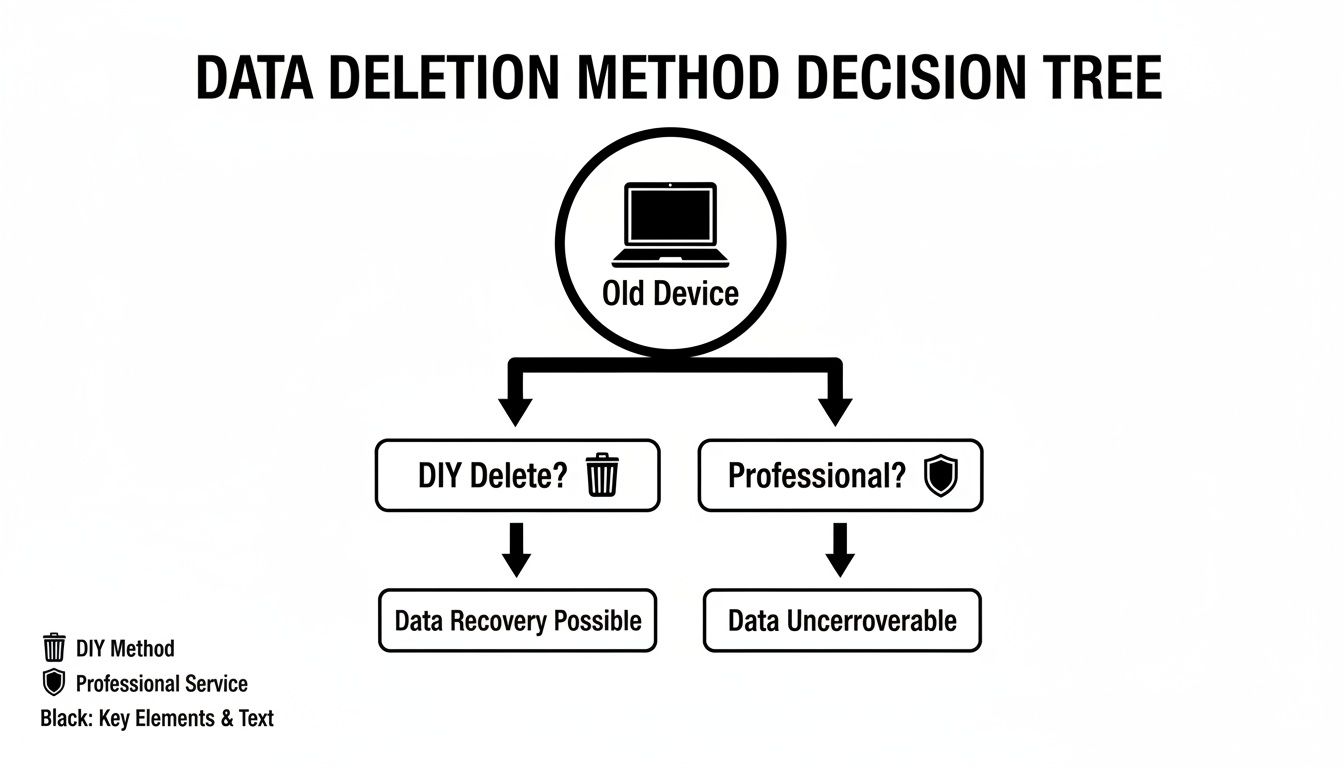
As you can see, professional services deliver a certified, unrecoverable result, which is crucial for staying compliant and secure.
Comparing Data Wiping and On-Site Shredding
To make the decision easier, it helps to see the two methods side-by-side. Each has clear advantages depending on what you're trying to achieve with your old equipment.
| Feature | Software Wiping (e.g., DoD 5220.22-M) | On-Site Physical Shredding |
|---|---|---|
| Security Level | High; data is forensically unrecoverable. | Absolute; the physical drive is completely destroyed. |
| Asset Condition | Hardware remains intact and fully functional. | Hardware is pulverized into scrap material. |
| Value Recovery | Excellent. Allows for resale, donation, or redeployment. | None. The asset's value is in its raw materials only. |
| Best For | Newer, high-value assets (laptops, servers, networking gear). | End-of-life drives, damaged media, or devices with top-secret data. |
| Compliance | Meets NIST 800-88, HIPAA, and other standards. | The ultimate proof of destruction for the strictest compliance needs. |
| Process | Overwrites data with random characters in multiple passes. | Mechanical shredders tear drives into small fragments. |
| Verification | A Certificate of Data Erasure is provided for each drive. | A Certificate of Destruction is provided for the entire lot. |
Ultimately, both methods get the job done right when handled by a certified professional. Your choice hinges on whether you need to squeeze more value out of your old gear or if you need the absolute, undeniable finality of physical destruction.
When to Go with Software Wiping
Software wiping is your best friend when you want to get some value back from your old equipment. Because the hardware is still perfectly good, you can refurbish and resell newer laptops, servers, or networking gear. It’s a smart way to turn a disposal line item into a revenue source.
This approach is ideal for:
- Lease Returns: Wiping devices clean before sending them back to the leasing company.
- Employee Buy-Back Programs: Giving staff a chance to buy their old company laptops after a professional wipe.
- Donations: Prepping computers for local Dunwoody schools or non-profits without worrying about a data breach.
When On-Site Shredding Is the Only Answer
For maximum security, nothing beats physical destruction. If your devices are holding proprietary trade secrets, years of client financial data, or protected health information (PHI), shredding is the safest move. It cuts out any chain-of-custody risks and gives you undeniable proof that the data is gone forever.
It’s no surprise that the demand for this is skyrocketing. The Hard Drive Destruction Service Market is expected to jump from $1.65 billion in 2024 to $5.05 billion by 2035. When you consider that the average data breach costs a company $4.45 million, you can see why executives are more than willing to invest in certified destruction.
Expert Tip: Dealing with a mix of assets? Take a hybrid approach. Shred the older, low-value drives that contain your most sensitive data. At the same time, use software wiping on the newer, high-value equipment you plan to resell. You get the best of both worlds—top-tier security and a financial return.
At the end of the day, both software wiping and shredding are legitimate forms of data sanitization when done by a certified pro. Understanding your options is the first step in building a data destruction strategy that perfectly fits your Dunwoody organization's security, financial, and operational goals.
A Practical Plan for IT Asset Disposition in Dunwoody
Let's be honest, managing your company's old IT assets can feel like a massive, complicated headache. But for any Dunwoody organization, breaking the process down into clear, manageable phases turns a daunting task into a streamlined security procedure. A solid plan is your best defense, ensuring nothing gets missed and all your sensitive data is handled correctly from start to finish.
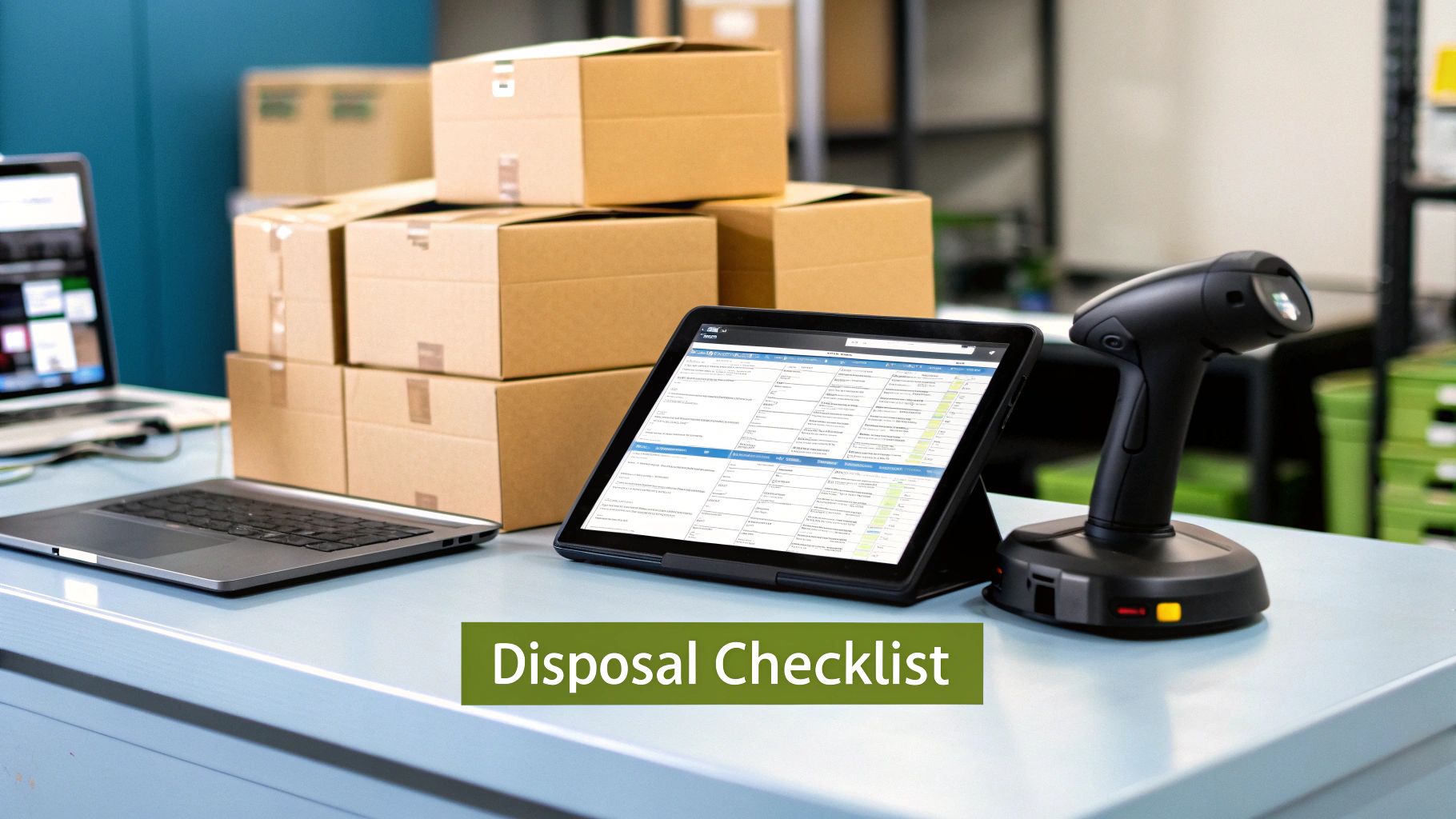
The whole journey kicks off with a detailed inventory. You really have to know exactly what you're dealing with—from the servers humming away in the back room and the laptops your team uses every day, to old mobile phones and miscellaneous networking gear stuffed in a closet. Documenting every single device is the foundational step for secure and compliant data destruction in Dunwoody.
Asset Categorization and Risk Assessment
Once you have that inventory list, the next critical task is to categorize everything. This isn't just about noting the make and model; it's about understanding the sensitivity of the data that lived on each device. A marketing director's laptop holding client strategy documents requires a much different level of scrutiny than a conference room display monitor.
I recommend creating simple risk tiers to guide your decisions:
- High-Risk Assets: These are the big ones. Devices that store confidential client data, financial records, employee PII, or your company's intellectual property. Think servers, executive laptops, and accounting workstations. These are prime candidates for on-site physical destruction to guarantee there is zero chance of data recovery.
- Medium-Risk Assets: This category usually includes general employee laptops and company smartphones that hold business communications and operational data. Certified software wiping is typically a secure and sufficient solution here, which also allows for potential hardware reuse or resale.
- Low-Risk Assets: Peripherals like monitors, keyboards, mice, and printers fall into this group. While they don't store data, they still need to be recycled responsibly according to environmental regulations.
This simple act of categorization directly tells you which destruction method to choose, making sure your time and money are focused where the risk is highest.
We recently worked with a Dunwoody marketing agency that was decommissioning its old server room. By categorizing their assets first, they pinpointed three servers with archived client financial data (high-risk) and slated them for on-site shredding. The rest of the networking equipment and workstations (medium-risk) were scheduled for DoD-compliant wiping. This smart approach allowed them to recover significant value by reselling the newer gear.
Coordinating Logistics and Execution
With your plan in place, the final piece of the puzzle is logistics. This is all about coordinating with your data destruction partner to execute the plan without a hitch. Will you need an on-site pickup from your Dunwoody office, or is it more practical for your team to arrange a drop-off?
Here are the key logistical questions you'll need to answer:
- Scheduling: When is the best time for the service to happen with minimal disruption to your daily operations?
- Chain of Custody: Who on your team will be responsible for overseeing the assets from the moment they are collected until destruction is confirmed?
- Documentation: Make sure you receive a serialized inventory list and, most importantly, a formal Certificate of Destruction when the job is done.
A clear plan doesn't just tighten up your security—it makes the entire process smoother and more predictable. Proper planning is truly the cornerstone of a successful ITAD strategy. You can explore more about building your own effective IT asset disposition Dunwoody, GA plan with a professional partner like us. By thinking through these steps, any Dunwoody organization can confidently and securely retire its old technology.
Understanding Compliance and Certification
For any Dunwoody business in a regulated field—think healthcare, finance, or legal—secure data destruction isn't just a smart security habit. It’s a non-negotiable legal duty.
Navigating the world of compliance can feel a bit overwhelming, but it boils down to two simple things: protecting the data and having the paperwork to prove you did it right.
Key Regulations and Standards to Know
Regulations like the Health Insurance Portability and Accountability Act (HIPAA) for healthcare and the Fair and Accurate Credit Transactions Act (FACTA) for financial institutions are crystal clear. They mandate that sensitive personal information must be completely unreadable and unusable when it's no longer needed.
The gold standard for getting this done is outlined in the NIST 800-88 Guidelines for Media Sanitization. This is the framework published by the National Institute of Standards and Technology that government agencies and private businesses turn to. It lays out the proper methods—Clear, Purge, and Destroy—to make sure data is gone for good.
This is not an area where you can afford to cut corners.
Just think about it: over 60% of data breaches come from lost or stolen devices, and a whopping 93% of organizations that get hit with a breach also face a regulatory investigation. With the average cost of a breach now hitting $9.44 million for larger firms, sticking to certified processes is your best line of defense against crippling fines.
To keep things straight, it’s essential to develop solid data retention policies. These policies outline exactly when specific data should be archived or destroyed, making sure you aren’t holding onto sensitive information longer than you have to, which only increases your risk.
The Certificate of Destruction: Your Proof of Compliance
The single most important document you’ll receive in this entire process is the Certificate of Destruction. This isn't just a receipt. It is your official, legally defensible record proving you took every necessary step to protect sensitive information. It’s your shield if an auditor or lawyer ever comes knocking.
A Certificate of Destruction is more than just paperwork. It's your proof of due diligence, demonstrating a clear, auditable trail from the moment an asset left your facility to its final, secure disposition.
A legitimate certificate has to include specific, critical details to be valid. It should serve as an official log of the entire process, leaving absolutely no room for questions.
Here’s what a proper certificate must include:
- Unique Serial Numbers: A complete list of every single hard drive or media device that was destroyed.
- Method of Destruction: A clear statement on how the data was destroyed—whether through software wiping (like DoD 5220.22-M) or physical shredding.
- Chain of Custody: Details on who handled the assets, with dates and signatures at each transfer point.
- Date and Location of Destruction: Pinpointing exactly when and where the job was done.
- Statement of Compliance: An official affirmation that the destruction process met all relevant industry and legal standards.
Without this document, you have no verifiable proof that you fulfilled your obligations for data destruction in Dunwoody. It's the final, critical step that closes the loop on your IT asset disposition process and gives you complete peace of mind.
To get a better handle on this crucial document, you can learn more about the importance of a Certificate of Destruction in our article.
Partnering With a Local Data Destruction Expert
Choosing the right partner for data destruction is probably the most critical decision in your entire IT asset disposition (ITAD) plan. For businesses in Dunwoody, this goes way beyond just finding a company to haul away old gear. You need a local expert who delivers a secure, seamless, and totally transparent process from the moment they arrive until you have the final certificates in hand.
The best partner feels like an extension of your own team, taking a complex and high-stakes security task and making it feel routine. It all starts with convenience. Look for providers that offer flexible options, like on-site services that come directly to your Dunwoody office. This minimizes disruption to your workflow and, more importantly, kills the security risks that come with transporting data-filled devices yourself.

What to Look For in a Dunwoody Data Destruction Provider
When you're vetting an expert for data destruction in Dunwoody, there are a few non-negotiables. A truly professional provider should offer a complete, end-to-end service that covers every single step, ensuring nothing ever falls through the cracks.
Here's what your checklist should include:
- Certified and Compliant Processes: They must offer DoD 5220.22-M compliant wiping as a baseline. This multi-pass data overwrite standard is the gold standard for secure data sanitization.
- On-Site Service Capability: The choice to have hard drives shredded or wiped right at your location is a huge security advantage. You can witness the destruction yourself, leaving no room for doubt.
- Transparent Chain of Custody: From the second they take possession of your assets, you should receive clear, detailed documentation that tracks every single device.
- Responsible Recycling: Data security is only half the battle. Your partner must be certified for environmentally sound e-waste disposal (look for certifications like R2) to help you meet corporate sustainability goals.
This level of service turns ITAD from a logistical headache into a smooth, secure process. You can dive deeper by checking out our guide on what to consider when comparing IT asset disposition companies for your specific needs.
A true partner doesn't just destroy data; they protect your business. They should provide detailed asset audits, secure logistics, and ironclad documentation, giving you complete confidence in the process.
Turning Expense Into Opportunity With Profit-Sharing
Here's something many businesses overlook: the potential for value recovery. A lot of your decommissioned IT assets, once all the data is securely wiped, still have significant resale value. The right partner can help you tap into that.
Through profit-sharing or asset resale programs, equipment that's still viable—like newer servers, laptops, and networking gear—can be refurbished and sold on the secondary market. A good ITAD provider handles everything: the testing, sanitization, marketing, and sales, and then shares the revenue directly with your company.
For many Dunwoody businesses, this is a total game-changer. It can flip a necessary security expense into an unexpected revenue stream, dramatically improving the ROI on your original technology purchases. All of a sudden, the cost of secure data destruction is partially or fully offset by the cash you get back from the hardware. It's the smartest way to manage your end-of-life IT assets, maximizing both your security and your bottom line.
Common Questions About Data Destruction Services
When you're looking at professional data destruction, a few questions always come up. Business owners and IT managers across Dunwoody want to know what they're getting into, and getting straight answers makes all the difference. It takes the mystery out of the process and shows why it’s such a critical part of your security plan.
How Is the Cost for Data Destruction Determined?
No two projects are the same, so the price isn't a simple flat rate. The final cost really boils down to a few key factors, making sure you’re only paying for what you actually need.
Think of it this way. The main things that shape the quote are:
- How much gear you have: The total number of hard drives, servers, or other pieces of IT equipment.
- The service you choose: Do you need us to come to your Dunwoody office for an on-site pickup, or would you rather drop it off?
- The destruction method: What level of security are you looking for?
For many qualifying IT assets, we actually offer free DoD-compliant software wiping as a standard service. If you've got devices with extremely sensitive data, you might opt for our premium on-site shredding service for an added fee.
Do I Need to Wipe Drives Myself Before Pickup?
Absolutely not. In fact, we strongly advise against it. Trying to wipe drives on your own without the right certified software can be a huge time sink and, worse, might not even get the job done completely.
That's the whole point of a professional service—it’s a secure, hands-off solution from start to finish. The second our team picks up your equipment, a strict chain of custody kicks in. Our certified sanitization processes guarantee that every last bit of data is gone, freeing up your team and removing the risk of a botched wipe.
What Happens to My Old Equipment After Data is Destroyed?
Once we've verified that your data is 100% gone, your old gear has a whole new life ahead of it. It doesn't just go to a landfill; it enters a responsible, sustainable lifecycle through our certified e-waste recycling partners.
First, the equipment is carefully taken apart. We sort out all the valuable materials—metals, plastics, circuit boards—and process them for reuse in new products. If any of the assets are still in good working order, they get professionally refurbished and find a new home, which is great for the environment and your budget.
The goal here is simple: maximize the value of your old assets while guaranteeing total data security. After a certified wipe, a newer server isn't a liability; it's an asset you can resell. That turns a disposal cost into real revenue. It’s just a smarter way to handle IT asset management.
How Long Does the Process Take From Start to Finish?
We get it—your business can’t just stop. That’s why we’ve designed the entire process to be fast and cause as little disruption as possible.
From the moment you schedule a pickup in the Dunwoody area to the second you have the official Certificate of Destruction in your hands, the timeline is faster than most people expect. We can typically get the whole job done within just a few business days. This quick turnaround means your security gaps are closed fast, and you get the compliance paperwork you need without any long waits.
You can get a better sense of what to expect by checking out our guide on shredding hard drives near me.
Ready to secure your retired IT assets with a trusted, local partner? Montclair Crew Recycling offers certified, compliant data destruction services for businesses across Dunwoody and Metro Atlanta. Contact us today for a free quote and ensure your sensitive information is protected.
