
For any business in the Atlanta area, that stack of old company cell phones in the storage closet isn't just clutter—it's a collection of ticking time bombs loaded with sensitive data. If you don't handle the disposal of old cell phones properly, you're exposing your organization to staggering risks. We're talking about everything from devastating data breaches to severe penalties for not following data privacy laws.
This guide will show you how to turn this critical challenge into a secure, streamlined process.
Why Secure Cell Phone Disposal Is Non-Negotiable
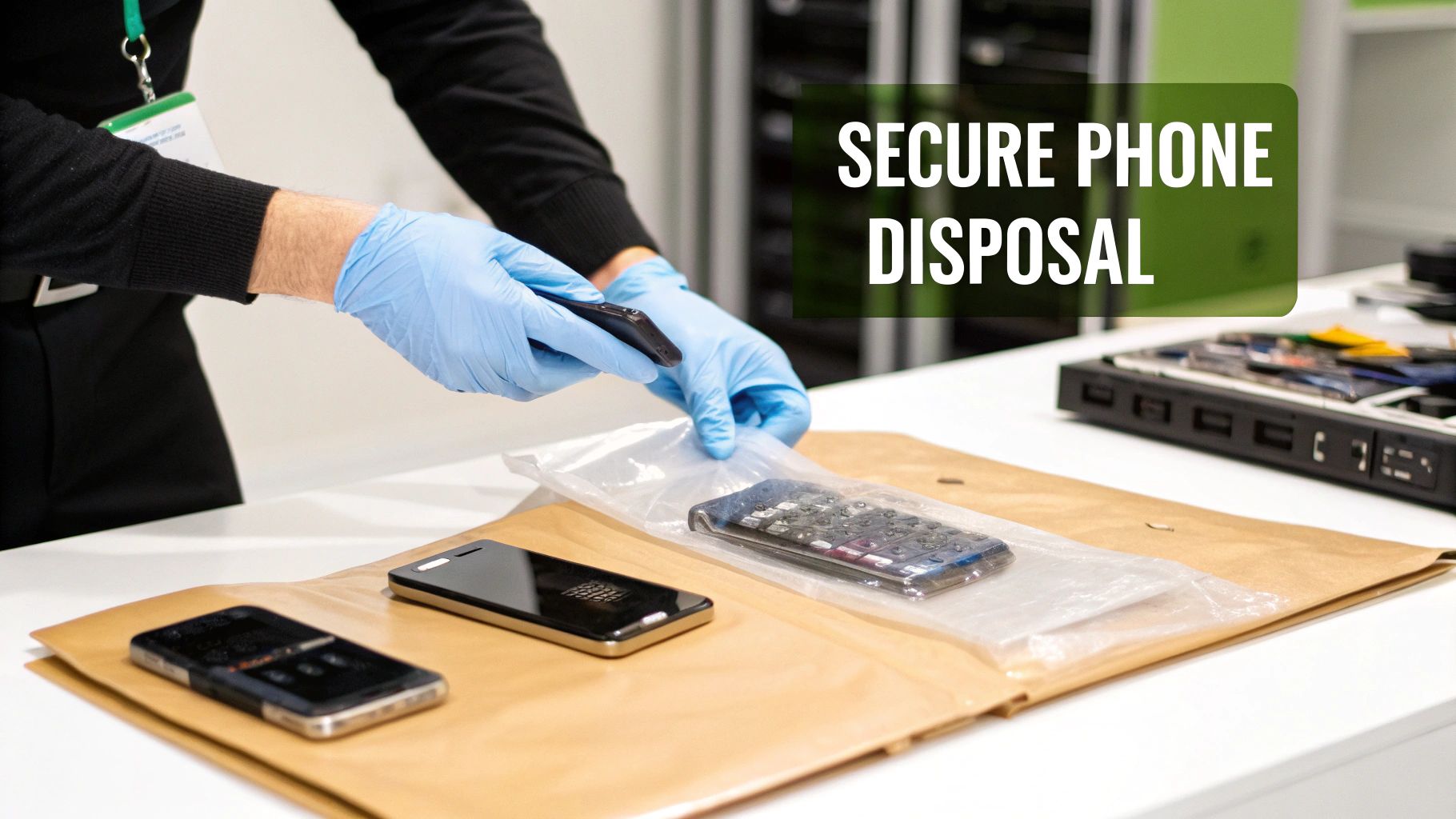
Think of each retired company smartphone as a digital filing cabinet left unlocked in a public park. It’s not just holding old contact lists. These devices are treasure troves, potentially containing client emails, financial records, employee PII, and even network login credentials.
Just tossing them in a drawer or, far worse, a dumpster is practically rolling out the welcome mat for disaster. A single compromised device can cause immense financial and reputational harm. These consequences aren't just hypothetical; they're a daily reality for businesses that aren't prepared.
The Real Risks of Just Tossing Them
The danger goes way beyond a simple data leak. If your organization is in a regulated industry like healthcare or finance, the stakes are dramatically higher. One mishandled device could put you in direct violation of strict compliance standards, leading to huge fines and draining legal battles.
The risks of poor disposal of old cell phones are serious and multi-faceted:
- Data Breaches: Someone getting their hands on sensitive corporate or customer data stored on the phone.
- Regulatory Penalties: Getting hit with fines for non-compliance with laws like HIPAA (Health Insurance Portability and Accountability Act) or FACTA (Fair and Accurate Credit Transactions Act).
- Reputational Damage: The loss of customer trust and brand credibility after a data security incident goes public.
- Environmental Liability: Getting penalized for improperly discarding electronics, which contain hazardous materials and are subject to environmental regulations.
For a business, a stack of old phones isn’t just e-waste; it’s a concentrated archive of potential liabilities. Each device represents an entry point for data thieves and a test of your company's commitment to security and compliance.
From Liability to a Managed Asset
This guide is built for Atlanta-area organizations ready to move past risky, informal disposal methods. We’ll walk you through the essential steps for creating a professional IT Asset Disposition (ITAD) strategy. A solid ITAD program does more than just sidestep risks—it builds a secure, documented, and auditable process for managing electronic assets from deployment to destruction.
With the right game plan and a reliable local partner, you can transform a major security threat into a well-managed part of your operations. This ensures every single device is handled securely, all data is verifiably destroyed, and your organization stays compliant with every regulation that applies.
The Hidden Data Security Risks in Every Device
Here’s a dangerous assumption many organizations make: hitting "factory reset" on an old phone is all it takes to make it safe for disposal. That couldn’t be further from the truth. A factory reset feels like wiping a whiteboard clean, but it's often more like using a dry cloth on a permanent marker. The surface might look clear, but with basic data recovery tools, someone can easily bring back what you thought was gone for good.
Every single retired corporate phone is a treasure chest of sensitive information. We're not just talking about old photos or contacts. These devices are packed with confidential corporate data that could be absolutely devastating if it fell into the wrong hands.
More Than Just Old Emails
The amount of data still lingering on a "wiped" phone is staggering. Even after a reset, traces of critical information remain accessible to anyone with the right software and a bit of know-how.
Just think about what’s stored on a typical company phone:
- Cached Login Credentials: Saved passwords for your corporate network, cloud platforms, and client portals.
- Sensitive Client Documents: Contracts, proposals, and confidential emails downloaded or saved as attachments.
- Employee PII (Personally Identifiable Information): Names, addresses, social security numbers, and other personal details.
- Financial Data: Invoices, expense reports, and even access to company financial apps.
Picture this: an old phone from your sales team ends up for sale online. A bad actor could potentially recover your entire client list, recent sales quotes, and internal strategy documents. This could give a competitor a massive advantage or expose your clients to sophisticated phishing attacks.
Inadequate Methods Versus Professional Data Destruction
The difference between a consumer-grade reset and professional data destruction is night and day. To truly shield your organization, you need a process that guarantees data is gone forever—completely and permanently unrecoverable. This is where professional data sanitization standards are non-negotiable.
A professional data wipe is like shredding a highly sensitive document, burning the shreds, and then scattering the ashes in the wind. The goal is not just to delete the data, but to obliterate it beyond any possibility of reconstruction.
One of the most trusted methods is the DoD 5220.22-M wipe. This process overwrites the device's storage with specific data patterns multiple times, ensuring the original information is thoroughly destroyed. It’s a crucial step for any business that's serious about protecting its information during the disposal of old cell phones.
The Ultimate Fail-Safe: Physical Destruction
For organizations that need absolute, ironclad proof that data has been destroyed, nothing beats physical destruction. This method completely eliminates any risk of data recovery because the storage media—the chip inside the phone—is literally pulverized. It’s the ultimate security measure for devices that held your most sensitive information.
- On-Site Shredding: A mobile shredding truck can come directly to your Atlanta-area facility, allowing you to physically watch your old cell phones get turned into fragments of plastic and metal.
- Chain-of-Custody Documentation: This is a critical part of the process. You get a detailed paper trail that tracks every device from the moment it leaves your office to its final, documented destruction.
This documented chain-of-custody provides irrefutable proof of secure disposal, which is invaluable during compliance audits for regulations like HIPAA or FACTA. It shows you took every necessary step to protect sensitive data.
The e-waste problem only amplifies these risks. Globally, old electronics contribute to 70% of the planet's toxic waste stream, yet only 15% of users actively recycle them. For Metro Atlanta businesses, this casual approach to disposal is a recipe for data breaches and steep regulatory fines, making certified destruction services a true necessity.
Navigating Environmental and Data Privacy Laws
Getting rid of old electronics isn't just about clearing out a storage closet; it's a legal minefield. For any business, the process is tangled up in a dense web of environmental and data privacy laws. Simply tossing old devices in a dumpster can land you in some serious hot water, complete with hefty fines and legal trouble.
Think of it like trying to do your corporate taxes on your own. Sure, you could give it a shot, but the risk of a costly mistake is incredibly high. It’s far smarter to partner with an expert who lives and breathes this stuff, ensuring your organization avoids penalties and stays on the right side of the law.
Understanding the Regulatory Maze
Several major regulations directly impact how your business has to handle old cell phones. These laws are built to protect both consumer data and the environment, and ignoring them can bring down severe consequences—especially if you're in healthcare, finance, or education.
Here are the heavy hitters:
- HIPAA (Health Insurance Portability and Accountability Act): If you're in healthcare, this one's for you. HIPAA demands strict protection of patient health information, and a device that hasn't been properly wiped is a direct violation.
- FACTA (Fair and Accurate Credit Transactions Act): This applies to financial institutions and creditors, requiring them to securely destroy consumer information to head off identity theft.
- GDPR (General Data Protection Regulation): If you have data on any EU citizens, GDPR's reach extends to you. It requires verifiable data destruction and comes with massive fines for getting it wrong.
These aren't gentle suggestions; they're legal mandates with real teeth. One mishandled phone could be all it takes to trigger a full-blown audit, resulting in penalties that dwarf the cost of bringing in a professional. A crucial first step is understanding the benefits of meeting security compliance in your business to see why this matters so much.
The Role of Certified Recycling
This is where "certified recycling" becomes more than just a buzzword—it becomes your company's shield against liability. Top-tier certifications like R2 and e-Stewards are your guarantee that a recycler follows strict, independently audited standards for both data security and environmental responsibility.
Two of the most important certifications in our industry are:
- R2 (Responsible Recycling): This standard is all about protecting the environment, ensuring worker health and safety, and maintaining data security through the entire process.
- e-Stewards: Often seen as the gold standard, e-Stewards strictly prohibits shipping hazardous e-waste to developing nations and requires the absolute highest levels of data security.
When you work with a certified recycler, you aren't just getting rid of old equipment. You are transferring liability to a partner who is contractually and legally bound to handle your assets according to globally recognized best practices.
For businesses in the Atlanta area, especially those in regulated fields, this partnership is essential. A certified ITAD provider doesn't just recycle your phones; they give you a documented, auditable trail that proves you did everything by the book.
Documentation as Your Legal Shield
At the end of the day, compliance isn't just about what you do—it's about what you can prove you did. The right partner will provide the essential paperwork that serves as your legal defense if an auditor ever comes knocking. It turns a potential legal nightmare into a straightforward demonstration of your company's due diligence.
The most critical piece of paper is the Certificate of Destruction. This is a legally binding document that confirms your devices were handled correctly and that all data was destroyed according to specific standards. It lists serial numbers, dates, and the methods used, giving you undeniable proof that you took every necessary step. For local companies looking for a clear path forward, understanding the specifics of Georgia electronics recycling is the best place to start.
Choosing Your Disposal Strategy: On-Site vs Off-Site
When it's time to retire a batch of old company cell phones, you've got a critical decision to make that goes way beyond just finding someone to take them. You need a strategy that fits your company’s security posture, daily operations, and tolerance for risk. The two main paths are on-site services, where everything happens at your location, and off-site processing, where the phones are securely transported to a specialized facility.
Think of it this way: for a major financial institution in Downtown Atlanta decommissioning a thousand phones, an on-site shredding truck offers undeniable proof of destruction. It's direct, verifiable, and completely controlled. But for a smaller marketing firm in Decatur with a box of ten old iPhones, a certified pickup service is far more practical and just as secure when done right.
Evaluating On-Site Disposal Services
For organizations where data security isn't just a priority but a legal mandate, on-site disposal is the undisputed champion. A specialized truck, basically an industrial shredder on wheels, rolls up to your Atlanta-area office. Your team can literally watch as every single device is turned into tiny fragments, completely destroying the data on the spot.
This is the go-to method for businesses in healthcare, finance, government, or legal fields. When a data breach could mean crippling fines or a complete loss of public trust, there's no substitute for seeing the destruction with your own eyes.
Here’s why it’s so popular for high-stakes disposal:
- Ironclad Security: The phones never leave your control until the exact moment they’re destroyed.
- Instant Verification: You get immediate confirmation and peace of mind, which makes compliance audits a breeze.
- Zero Transport Risk: By eliminating the transit phase for intact devices, you remove any chance of them getting lost or stolen along the way.
Understanding Off-Site Processing
Off-site processing is a much more flexible and often more budget-friendly approach. A certified vendor schedules a pickup, secures your old phones in locked containers, and transports them in GPS-tracked vehicles to their secure facility for data destruction and recycling.
This is a fantastic option for businesses with smaller quantities of devices or those who simply don't have the physical space for a massive shredding truck. While the phones do leave your sight, a trustworthy partner provides a meticulous chain of custody from your door to their facility, documenting every step. The whole process relies on trusting your vendor, which is why their certifications are non-negotiable.
Don’t think of off-site processing as a less secure option. It's about entrusting the job to a certified expert. The trick is doing your homework—verify their R2 or e-Stewards certifications and walk through their security protocols before you sign anything.
A professional electronic waste company will treat your assets with the same level of care you would, ensuring they are secure from the moment they leave your office.
On-Site vs. Off-Site Cell Phone Disposal: Which Is Right for Your Business?
So, how do you choose? There's no single "best" answer, only what's right for your organization's specific needs. Consider the volume of devices you have, your industry's compliance rules, and your budget. Answering these questions will point you in the right direction.
This table breaks down the key decision factors to help your Atlanta organization choose the right service model.
| Feature | On-Site Services (Pickup & Processing at Your Location) | Off-Site Services (Drop-off or Scheduled Bulk Pickup) |
|---|---|---|
| Security Requirements | Your company policy or industry regulations demand witnessed destruction. | A documented chain of custody and a formal Certificate of Destruction are sufficient. |
| Device Volume | Best for large batches (50+ devices) processed all at once. | Ideal for smaller, more manageable quantities or recurring pickups. |
| Logistics & Convenience | You have the physical space for a shredding truck and want immediate, on-the-spot processing. | You prefer the simplicity of a scheduled pickup or can drop assets at a secure facility. |
| Budget | You’re willing to pay a premium for maximum security and immediate verification. | You need a certified, secure solution that is also highly cost-effective. |
Ultimately, whether you have a shredding truck come to you or you send your devices to a secure facility, the goal is the same: complete data destruction and compliant recycling. The key is to partner with a vendor who understands your needs and can deliver a transparent, secure, and fully documented process.
Finding the Hidden Value in Your Old Company Phones
For most businesses, that closet full of old cell phones is just a headache. It's a security risk, a storage problem, and something you'll eventually have to pay to get rid of. But what if you could flip that script? What if those old devices were actually a hidden asset, waiting to be cashed in?
This is the whole idea behind modern IT Asset Disposition, or ITAD. It’s a complete shift in thinking, moving the disposal of old phones from the "cost" column over to the "revenue" column.
It all starts with a change in perspective. Instead of seeing a box of junk, you start seeing a collection of valuable resources. You’d be surprised how much resale value even phones that are a few years old can still have. When you work with a certified ITAD partner, you can tap into that value through a secure, structured process that does all the heavy lifting for you.
Turning Old Tech into New Revenue
The most direct way to get value back is through refurbishment and resale. This is the circular economy in action—giving perfectly good electronics a second life instead of sending them to a shredder way too early.
Here’s a look at how it generally works:
- The Assessment: First, every single device is inspected and graded. We look at the model, its age, and its physical condition to figure out what it's worth.
- The Data Wipe: This is the most critical step. All data is professionally and permanently destroyed using certified methods like the DoD 5220.22-M wipe. Your security is non-negotiable.
- The Sale: Your ITAD partner then uses their established sales channels to find buyers for the refurbished phones, getting you the best possible price on the secondary market.
The best part? The profit-sharing model. Instead of you paying for a disposal service, you get a check in the mail. Your organization receives a cut of the profits from the sale, turning what was once a liability into a genuine financial return.
Mining for Gold (and Silver, and Copper)
So, what about the phones that are genuinely at the end of the road? The ones that are too old, broken, or busted up to be resold? Even these devices still have value locked inside them.
A modern smartphone is a little treasure chest of precious metals and reusable materials. We're talking about small amounts of gold, silver, copper, and palladium. One phone doesn't have much, but when you're processing hundreds or thousands of them, those tiny amounts add up fast.
This is where certified, responsible recycling comes in. A professional recycler has the industrial-grade equipment needed to safely break down the phones and extract these valuable materials. Not only does this keep hazardous e-waste out of landfills, but it also recovers resources that can go right back into manufacturing new products. Properly handling the recycling of electronics in Atlanta isn't just good for the planet; it keeps your business compliant.
This isn't a niche market, either. The global cell phone recycling industry was valued at around $15 billion in 2025 and is projected to grow at a blistering 12% through 2033. This boom gives businesses like yours a fantastic opportunity to offload old equipment responsibly. You can read more about these trends and find market insights on Data Insights Market.
By adopting a smart value recovery strategy, getting rid of old cell phones stops being an annoying expense. It becomes a chance to offset IT costs, bring in some unexpected cash, and show everyone that your company is serious about its environmental and corporate responsibilities.
Your Guide to Secure Cell Phone Disposal
Turning a pile of old company phones from a ticking liability into a secure, compliant, and maybe even profitable asset doesn't just happen. It takes a solid, repeatable process. Think of this guide as your playbook for getting it right every time, taking the guesswork out of disposing of old cell phones for good.
The whole journey really begins with creating a formal device retirement policy for your organization. This isn't just busywork; it's the foundation. This document lays out who's in charge, what data destruction methods are approved, and which partners you’ll trust. It ensures everyone is on the same page and that every phone is handled consistently and accountably.
Step 1: Start with a Thorough Internal Audit
Before you can get rid of anything, you have to know exactly what you've got. The first real action is to conduct a full internal audit and create a detailed inventory of every single device you plan to retire. This is more than just a headcount; it's about logging the critical details you'll need later.
Your inventory sheet for each device should capture:
- Asset Tag or Serial Number: For tracking each phone precisely.
- Device Model and Condition: This helps figure out any potential resale value.
- Assigned Employee or Department: For keeping internal records straight.
- Data Sensitivity Level: Crucial for deciding if a phone needs to be physically shredded.
This log is the starting point for your chain-of-custody documentation, which is absolutely essential for proving you’ve done things by the book.
Step 2: Select a Certified ITAD Partner
With your inventory list in hand, your next move—and it’s the most important one—is to choose a certified IT Asset Disposition (ITAD) partner. Don't just Google "recycler." You need a partner with either R2 or e-Stewards certifications. These aren't just fancy logos; they are your guarantee that the company meets the highest industry standards for both data security and environmental responsibility.
When you're talking to potential partners, ask tough questions. How do they track devices from start to finish? What data destruction methods do they use? Can they show you a sample Certificate of Destruction? A partner worth their salt will have clear, confident answers and be totally transparent about their process.
Step 3: Execute the Disposal and Document Everything
Once you've picked your partner, it's time to set the plan in motion. This means coordinating the logistics, whether that's having them come to you for an on-site service or arranging a secure pickup. While all this is happening, keep meticulous records. Your goal is to get those final certificates of data destruction and recycling—your official proof that the job was done right.
This diagram shows you the typical journey a retired device takes, from the moment it's evaluated to its final destination.
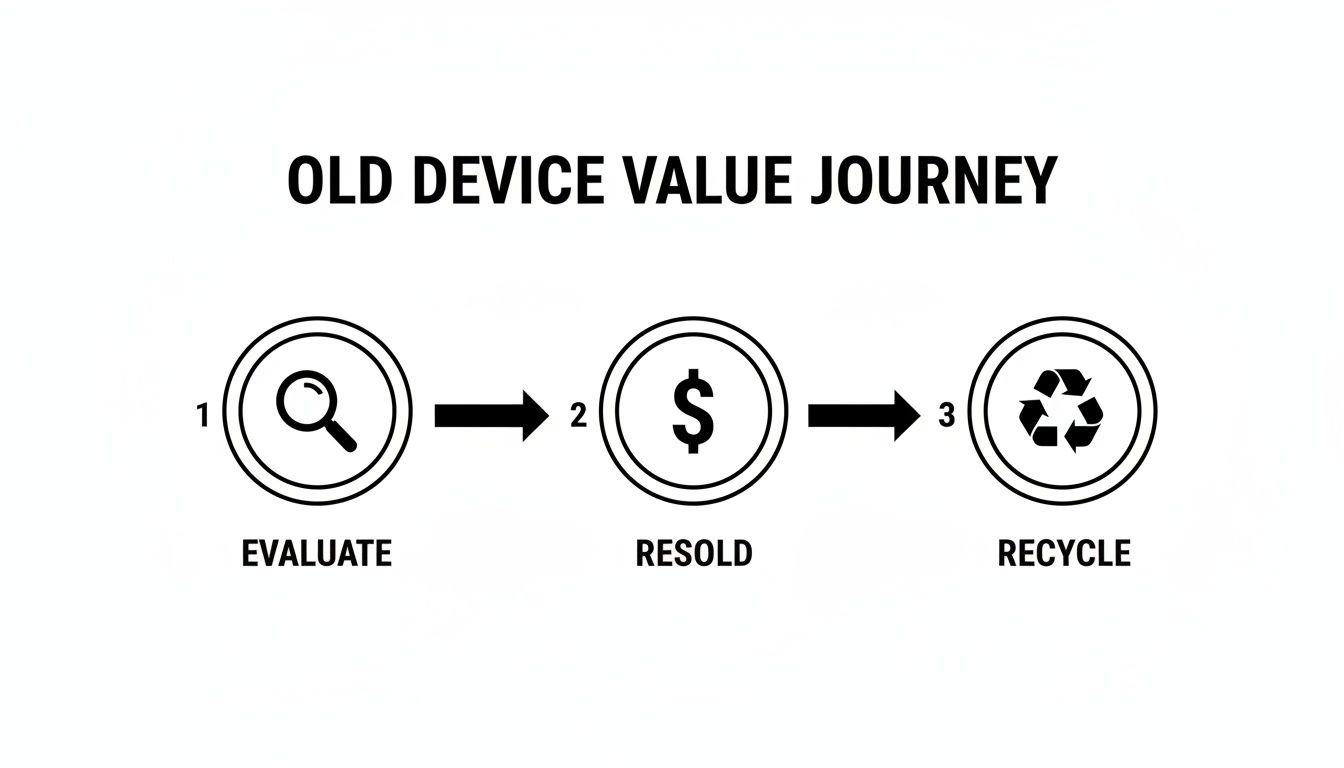
As you can see, every device has a path to value, whether that's through a second life in resale or by recovering the raw materials inside. As you build out your disposal strategy, it's also worth looking into resources like funding opportunities for waste prevention that can support more sustainable initiatives.
By following a structured, documented process, you transform a complex liability into a managed, auditable, and secure business function. This protects your organization from every angle—data, legal, and environmental.
This systematic approach makes sure every single retired device is handled securely, compliantly, and responsibly from the moment it leaves your hands.
Common Questions About Corporate Phone Disposal
Even with a solid plan, you're bound to have questions when it’s time to retire a fleet of old company cell phones. For business owners and IT managers here in Atlanta, getting straight answers is the only way to move forward with confidence and keep the process compliant.
Let’s tackle some of the most common questions we hear.
Is a Factory Reset Enough to Protect Our Data?
Absolutely not. For corporate devices loaded with sensitive information, a factory reset is not a secure data destruction method. Think of it like ripping the table of contents out of a book—the pages are all still there. Someone with basic, widely available data recovery tools can easily piece that information back together.
For business-level security, you need professional data destruction. Methods like a DoD 5220.22-M wipe or, even better, physical shredding are the only ways to guarantee your company’s information is gone for good and completely unrecoverable.
What Is a Certificate of Destruction and Why Do We Need It?
A Certificate of Destruction is a formal document that acts as your official, legal proof of secure data disposal. It’s a critical piece of your compliance paper trail.
This document lists the serial numbers of the devices we processed, the exact date of destruction, and the methods used. For any kind of compliance audit under regulations like HIPAA or FACTA, this certificate is your shield, proving you did your due diligence. You can learn more about why this documented paper trail is so important by understanding what a formal certificate of destruction provides.
What if Our Old Phones Are Broken or Obsolete?
It doesn’t matter if a phone is shattered or won’t turn on—the internal storage chip still holds your sensitive data. These devices must be handled just as securely as working ones. On top of that, they're considered e-waste and legally cannot be tossed in the regular trash.
Broken phones need to go to a certified recycler who will first physically destroy the data-holding components before responsibly recovering any valuable materials.
The scale of this issue is massive. In 2022, the world generated an incredible 62 million tonnes of e-waste, and old phones were a huge part of that pile. What’s worse is that only about 22% of it was properly collected and recycled. When you consider that recycling just one million cell phones can recover thousands of pounds of valuable materials like gold and silver, you see why proper disposal is so critical, even for broken devices. You can read more about the global e-waste challenge on Waste Direct.
Ready to build a secure and compliant disposal plan for your company's old devices? Montclair Crew delivers certified, on-site services for businesses all over Metro Atlanta. We make sure your data is destroyed, your company is protected, and your e-waste is handled the right way. Contact us today to schedule a pickup or learn more at https://www.montclaircrew.com.
