
When you're searching for "hard drive destruction near me," you might be tempted to handle it yourself. After all, how hard can it be? A few clicks to format the drive, and you're done, right?
Not so fast. This is a classic mistake, and it offers a dangerously false sense of security, leaving your most sensitive data ripe for the picking.
Why You Can't Just Delete Your Data
Hitting the 'delete' key or even reformatting a drive feels so final. But in reality, it does almost nothing to actually remove your information. All it does is tell the computer's operating system, "Hey, this space is now available for new data." The original file—your financial records, client lists, trade secrets—is still sitting there, fully intact, just waiting to be overwritten. Eventually.
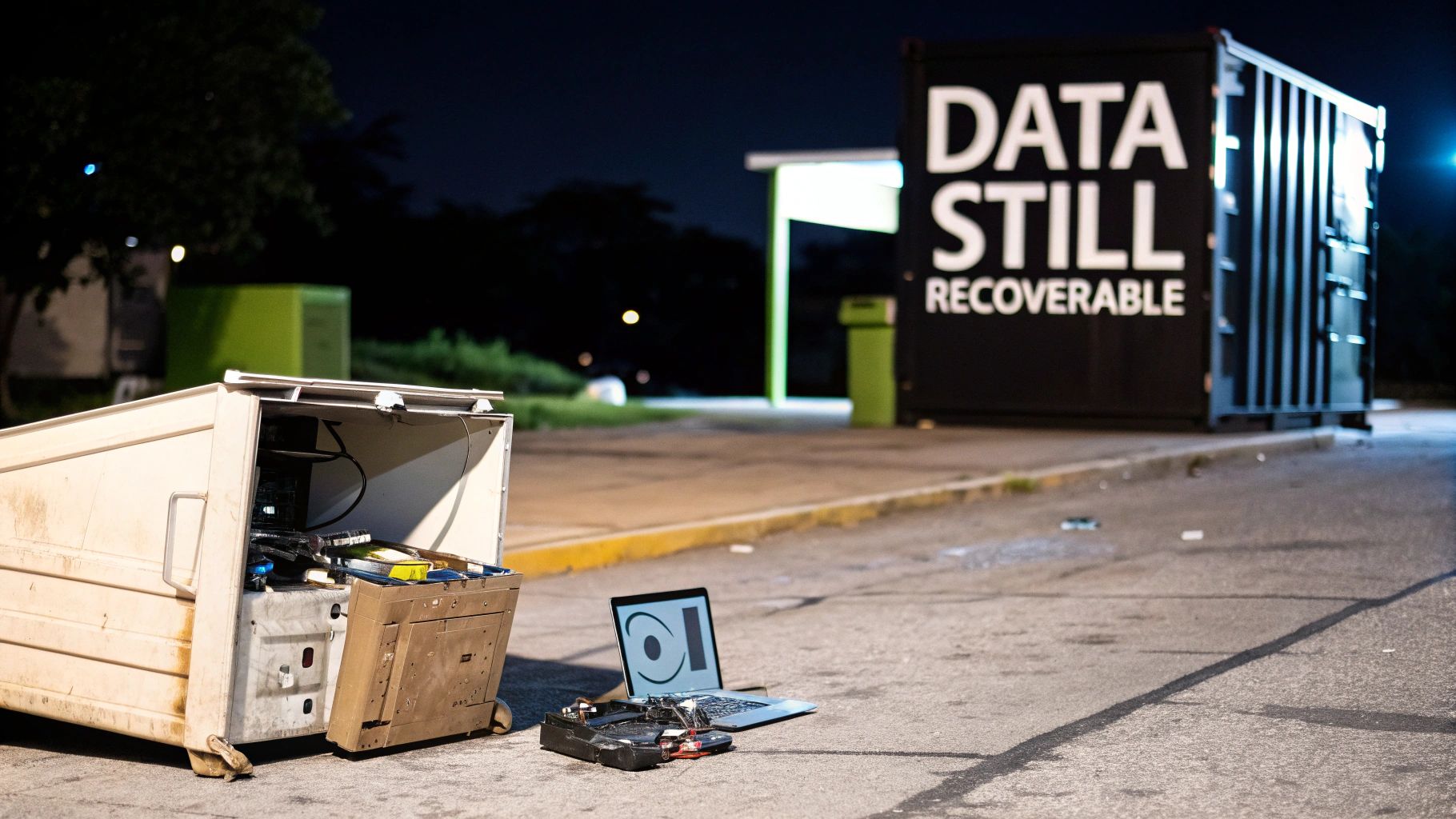
This creates a massive risk. Picture this real-world scenario: a small Atlanta marketing firm upgrades its office computers. They format the old hard drives and drop them off with a local recycler, feeling good about their eco-friendly choice. A week later, their entire client database, campaign strategies, and private emails are for sale on the dark web. Someone recovered it all using simple, widely available software.
It happens more than you think.
Software Wiping vs. Physical Destruction
Okay, so what about professional software wiping? This method, technically called data sanitization, is a step up. It involves overwriting the drive's data with random characters, often multiple times, to make the original information harder to recover. But even this advanced technique has its weak spots:
- It’s a Time Sink: Properly wiping a single high-capacity drive can take hours. Now multiply that by dozens of computers in an office refresh. It’s just not practical for most businesses.
- Verification is Tricky: How do you know for sure the wipe was 100% successful? Drives with bad sectors or hidden partitions can fool the software, leaving pockets of data behind.
- Useless on Damaged Drives: If a drive is physically damaged or has already failed, software wiping methods are completely off the table. You can't run software on a device that won't even power on.
This is exactly why physical destruction is the only guaranteed, failsafe solution. Methods like industrial shredding or pulverizing don't just erase data—they completely obliterate the drive platters where the data lives. Recovery isn't just difficult; it's physically impossible.
You can dive deeper into the technical side of this by checking out our guide on what is data sanitization.
Understanding your options is the first step. Not all data removal methods are created equal, and choosing the right one depends entirely on your security needs.
Data Deletion Methods Compared
| Method | How It Works | Data Recoverability | Best For |
|---|---|---|---|
| Standard Deletion/Format | Marks data as "available to be overwritten" but doesn't remove it. | Very High. Easily recovered with basic software. | Clearing space for your own reuse; never for disposal. |
| Software Wiping | Overwrites the entire drive with random data in multiple passes. | Low, but not zero. Can fail on damaged drives or miss sectors. | Reselling or donating non-critical devices. |
| Degaussing | Uses a powerful magnet to destroy the magnetic field on platters. | Extremely Low. Renders the drive unusable. | Quick, secure disposal of magnetic media like tapes and some HDDs. |
| Physical Destruction | Shreds, pulverizes, or melts the drive into tiny pieces. | Impossible. The physical storage medium is destroyed. | Ultimate security for sensitive, regulated, or proprietary data. |
As you can see, when the stakes are high, nothing beats turning that hard drive into a pile of metal fragments.
Ensuring Compliance and Avoiding Hefty Penalties
Beyond shielding your business from cybercriminals, proper data disposal is a serious legal matter.
Regulations like HIPAA in healthcare and FACTA for financial institutions don't just suggest—they mandate the secure and permanent destruction of sensitive information. Getting this wrong isn't just an "oops." It can lead to crippling financial penalties, lawsuits, and a public relations nightmare that can tank your reputation for good.
Using a robust GDPR compliance checklist is a smart move, even for U.S.-based companies that might handle international data. It reinforces the critical importance of documented, certified destruction—a core service offered by any reputable vendor.
When you have a Certificate of Destruction in hand, you have undeniable proof that you took every necessary step. Physical destruction is the clearest, most defensible method for proving that sensitive data is gone for good. Period.
How to Find and Vet Local Destruction Services
Finding the right partner to trust with your most sensitive data goes way beyond a quick search for "hard drive destruction near me." Think about it: the company you choose is the final link in your security chain. Dropping the ball here isn't an option, so doing your homework isn't just a good idea—it's absolutely essential.
A great way to start is to look past the search results and just ask people you already trust. Reach out to your IT managed service provider or even your commercial property manager. These folks are often in the loop and have established relationships with reputable local vendors. Getting a firsthand recommendation based on solid experience can give you a huge head start.
The Vetting Checklist: Key Questions to Ask
Once you've got a short list of potential companies, it's time to dig in. Your mission is to separate the true, certified professionals from the simple scrap haulers who happen to own a truck. The conversation should revolve around their processes, their security protocols, and most importantly, their certifications.
Here are the non-negotiable questions you need to ask every single one of them:
- Are you NAID AAA Certified? This is the undisputed gold standard in our industry. It means the company follows the most rigorous security protocols and is subject to regular, unannounced audits. It's a big deal.
- Will I receive a formal Certificate of Destruction? This isn't just a receipt. It's your legal proof of compliance that details what was destroyed, when, and by whom. It absolutely must be serialized and is non-negotiable.
- Can I witness the destruction process? Transparency is key. Whether you opt for on-site shredding at your location or off-site at theirs, a trustworthy company will always allow you to witness the process if you ask.
- What is your chain of custody procedure? They need to be able to walk you through, step-by-step, how they secure your drives from the second they leave your hands until they're turned into tiny fragments.
This is the official logo for the National Association for Information Destruction (NAID). It's the mark of a serious, professional operation.
Seeing this on a vendor's website or their paperwork is a strong signal that they're committed to doing things the right way. As you research, you'll come across providers like Techwaste Recycling LLC for electronics and data destruction that prominently display their certifications and capabilities.
Expert Tip: Never assume a recycling company is also a certified destruction vendor. Many e-waste recyclers offer both, but proper data destruction requires specialized, expensive equipment, audited security procedures, and specific certifications that general handlers often lack.
Real-World Vetting: A Healthcare Clinic Scenario
Let's make this real. Imagine a healthcare clinic in Roswell that needs to retire a batch of old patient computers. The data on those drives falls under strict HIPAA regulations, where a single slip-up can be disastrously expensive.
The practice manager puts together a list of three local Atlanta vendors and starts making calls, checklist in hand.
Vendor A is suspiciously cheap and, when pressed, admits they can't provide a real Certificate of Destruction. Red flag. Vendor B is NAID certified, which is great, but they have a three-week waiting list. Vendor C not only confirms their NAID AAA Certification but immediately emails over a sample Certificate of Destruction. Better yet, they offer to perform on-site shredding the following week so a staff member can watch the whole thing happen.
For the clinic, the choice is obvious. Vendor C provides the verifiable, compliant, and transparent service they need to satisfy HIPAA and sleep well at night. This methodical approach is exactly how you should vet your options to confidently pick the right partner.
For a broader look at the types of vendors you'll run into, exploring different e-waste disposal companies can give you some valuable context.
What to Expect During the Destruction Process
Knowing what really happens to your hard drives after they leave your office is a huge deal. It's the difference between sleeping soundly and worrying about a data breach. A professional, secure destruction process isn’t some black box mystery—it's a transparent, documented procedure designed to turn your sensitive data into recycled, harmless scrap metal. The whole thing is built on security, accountability, and giving you absolute proof it was done right.
It all kicks off with a secure chain of custody. When the technicians show up, they won't just toss your drives into a cardboard box. They'll place everything into locked, tamper-evident containers right in front of you. Each drive gets scanned, and its serial number is logged, creating a detailed inventory that ties every single device back to your company.
This infographic breaks down the simple but essential steps for finding a service you can actually trust.
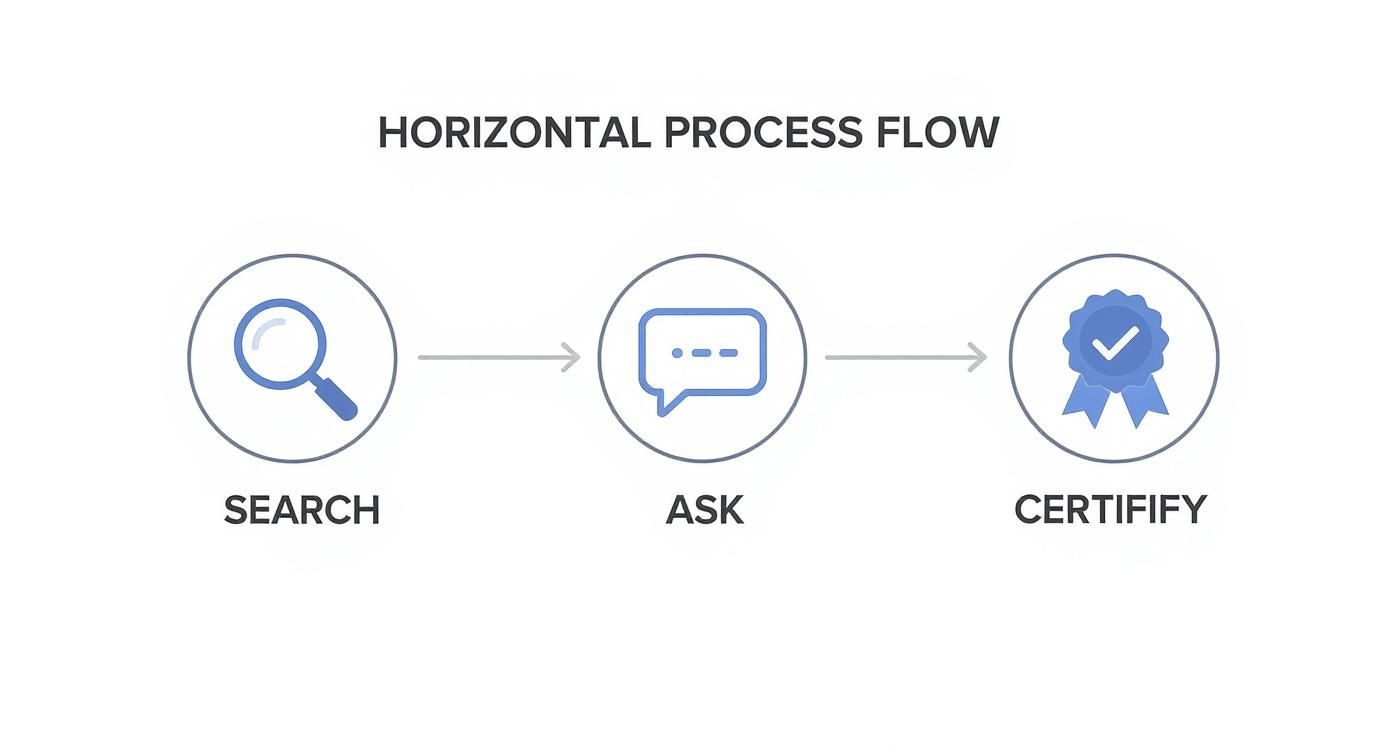
As you can see, finding a reliable partner means doing your homework, asking pointed questions about certifications, and, most importantly, demanding proof when the job is done.
Witnessing the Shredding Firsthand
Whether you opt for on-site or off-site destruction, you should expect total transparency. If you choose on-site service, a specialized truck armed with an industrial-grade shredder will pull up to your Atlanta-area facility. You have every right to watch as your drives are fed into the machine and pulverized into tiny metal fragments.
Many of these mobile shredding trucks are even equipped with a camera system inside the shredding bay that feeds to an external monitor. This lets you watch the entire process safely from a distance, giving you immediate confirmation that your data is gone for good. If seeing is believing for you, make sure you confirm this feature is available when you book the service.
Here's a pro tip: a legitimate service will have no problem with you watching. Any hesitation or flat-out refusal to let you witness the destruction—either in person or via camera—is a massive red flag. Walk away.
Your Legal Proof of Compliance
Once every drive has been destroyed, you'll receive the most important piece of paper in this whole process: a Certificate of Destruction. This isn't just a receipt. It’s a legally binding document that serves as your official record of compliance with data privacy laws.
This certificate is your get-out-of-jail-free card during an audit. It proves you took the necessary steps to protect sensitive information under regulations like HIPAA, FACTA, or GLBA. A legitimate certificate will always include:
- A unique serial number for easy tracking and verification.
- The date and location where the destruction took place.
- A detailed list of the serialized assets that were destroyed.
- The name of the company that performed the service.
- An official signature from an authorized person at the vendor.
This document is what formally transfers liability for the data from your organization to the destruction partner. It closes the loop on your IT asset disposal and gives you a clean, documented end to the asset's lifecycle. To see how this all fits together, you can learn more about the complete hard drive destruction service and everything it covers. Without that certificate, you have zero verifiable proof your data was handled correctly, leaving your organization wide open to risk.
When you start looking for "hard drive destruction near me," one of the first big questions you'll hit is whether to go with on-site or off-site service. There’s no single “best” answer here—it really comes down to your business’s specific needs, how much risk you're comfortable with, and of course, your budget.
On-site destruction, or mobile shredding as it's often called, brings the whole operation right to your Atlanta office. A specialized truck with an industrial-grade shredder parks on-site, and your hard drives are turned into tiny metal fragments right before your eyes.
For many, this method offers the ultimate peace of mind.
The Case For On-Site Mobile Shredding
The biggest win for on-site destruction is the unbroken chain of custody. From the moment your drives leave the server rack to the second they're obliterated, they never leave your sight. This is a non-negotiable for organizations dealing with strict compliance rules like HIPAA or protecting extremely sensitive intellectual property.
- Maximum Security: You get to physically witness every single drive being destroyed. There's zero doubt or worry about what happens once they're out of your hands.
- Immediate Verification: The vendor hands you a Certificate of Destruction right then and there, giving you instant proof that you've met your legal obligations.
- Total Transparency: Watching the process happen offers a level of transparency that an off-site service just can't replicate.
Think about a law firm in Sandy Springs that's retiring old servers packed with confidential client records. For them, the slightly higher cost of on-site service is a small price to pay for undeniable, verifiable security.
When Off-Site Destruction Makes Sense
Off-site, or plant-based, destruction works a bit differently. A secure, GPS-tracked truck comes to your location to pick up your drives, which are sealed in locked containers. They are then transported to a highly secure, specialized facility for shredding. You don't see it happen in real-time, but the entire process is rigorously documented with video surveillance and tight access controls.
The main reasons to choose this route? Cost-effectiveness and efficiency, especially when you're dealing with a huge number of drives.
Imagine a large enterprise in Norcross decommissioning an entire data center with thousands of drives. Trying to shred all of that on-site would be a logistical nightmare. Off-site service offers a much more streamlined and budget-friendly way to get the job done without cutting corners on security.
To help you weigh the options, here’s a straightforward comparison:
On-Site vs. Off-Site Hard Drive Destruction
| Feature | On-Site (Mobile) Destruction | Off-Site (Plant-Based) Destruction |
|---|---|---|
| Security | Highest level; you witness destruction | High level; secure transport and facility |
| Chain of Custody | Unbroken; assets never leave your sight | Documented; secure transport and tracking |
| Verification | Immediate Certificate of Destruction | Certificate issued after destruction |
| Cost | Generally higher due to logistics | More cost-effective, especially for bulk |
| Convenience | Very convenient; comes to you | Requires scheduled pickup |
| Best For | Highly sensitive data, strict compliance | Large volumes, budget-conscious projects |
Ultimately, both paths lead to the same secure outcome when you work with a reputable, NAID AAA Certified vendor. The choice is about what fits your operational and security priorities best.
Speaking of trends, businesses are increasingly focused on certification and audit trails when picking a vendor. Full chain-of-custody tracking and eco-friendly recycling are becoming just as important as the destruction method itself. You can explore more on these secure data destruction market trends to see what's driving decisions in the industry.
Remember, hard drive destruction is just one piece of a much larger puzzle. To see how this fits into the complete lifecycle of your IT equipment, it's worth reading our overview on what is IT asset disposition.
Destroying More Than Just Hard Drives
Your data security plan can't stop at the old spinning hard drives (HDDs) piled up in the server room. In any modern office, sensitive information is scattered across a whole host of devices, and each one stores data a little differently. Thinking one destruction method fits all is a rookie mistake—and a surefire way to leave massive security holes.
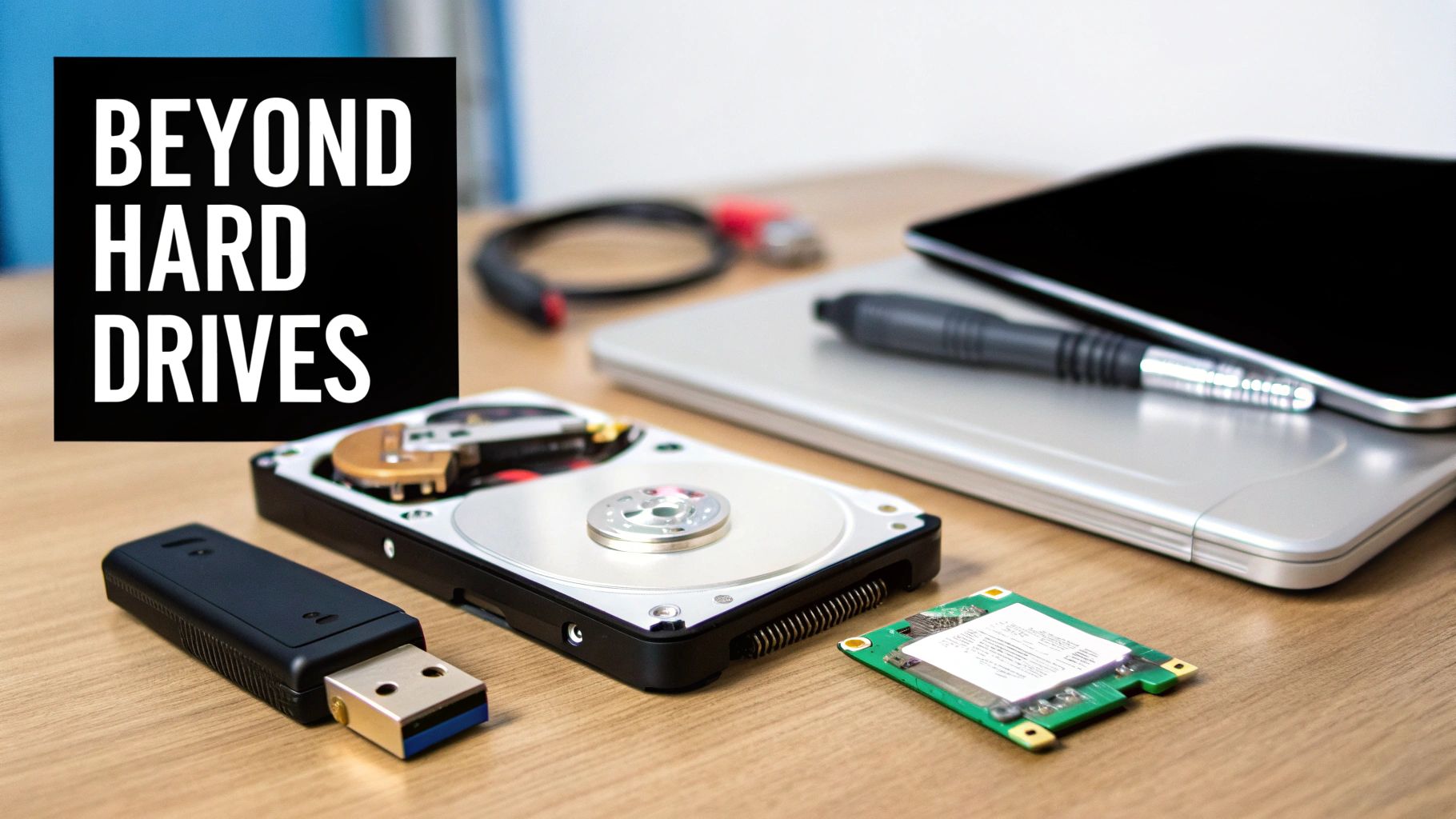
Take Solid-State Drives (SSDs), for example. They're built completely differently than their magnetic cousins. There are no platters to shatter. Instead, they rely on tiny flash memory chips. To truly kill the data, you need specialized shredders that can pulverize these components into nothing more than dust.
This isn't just a minor technical detail; it's critical. If you run an SSD through a standard hard drive shredder, you might crack the casing, but you won't necessarily destroy every single memory chip. That leaves fragments of potentially recoverable data just waiting for someone to find.
Your Data Hides in More Places Than You Think
Once you start looking, you'll realize just how many places your business data lives. Every one of these devices needs a specific game plan for disposal, or you risk that information ending up somewhere it shouldn't. A solid IT asset disposal plan has to account for all of it.
Think about these common but often-forgotten data carriers:
- Backup Tapes: Those old LTO or DLT tapes sitting in storage could hold years of financial records or customer lists. The gold standard here is degaussing (blasting them with a powerful magnet) and then shredding them for good measure.
- USB Flash Drives: These things are tiny, easy to lose, and can hold a ton of sensitive files. Simply formatting them is useless—the data is still easily recoverable. They have to be physically destroyed.
- Old Smartphones and Tablets: Every company phone or tablet holds emails, contacts, and direct access to cloud services. The only way to securely decommission them is to shred the device and its internal memory chips.
- Decommissioned Servers: When you retire a server, you pull the hard drives, right? But what about the memory modules (RAM)? They can sometimes hold residual data long after the power is cut.
Specialized Equipment for Total Security
Properly destroying this mix of media isn't a job for a single machine. It requires an arsenal of specialized equipment, each designed for a specific task. As businesses everywhere get serious about decommissioning old storage devices, the technology for destroying them has had to keep pace. You can get more details on the evolution of destruction equipment to see just how advanced these machines have become.
A professional destruction service worth its salt will look at your inventory and match the right tool to the right asset. They'll use a high-torque shredder for SSDs and other flash media, a different industrial shredder for magnetic tapes, and so on. This tailored approach is the only way to guarantee your data is gone for good.
Common Questions About Hard Drive Destruction
So, you're on board with professional hard drive destruction. That's a huge step. But it's completely normal to have a few practical questions pop up before you hand over your company's sensitive assets. Getting clear on the details is the last piece of the puzzle.
Let's walk through some of the most common questions we hear from businesses right here in Metro Atlanta when they're getting ready to pull the trigger.
How Much Does Hard Drive Destruction Cost?
This is usually the first question on everyone's mind, and the honest answer is: it depends. There isn't a flat rate because the final price is shaped by a few key variables.
The biggest factor, hands down, is quantity. A small marketing firm getting rid of five old desktop PCs will see a very different invoice than a data center decommissioning a few hundred server drives.
The type of service you pick matters, too. On-site mobile shredding, where a massive shred truck comes directly to your office, is the premium option and costs more. It's paying for convenience and the ability to witness the destruction. On the other hand, off-site plant-based destruction is typically the more budget-friendly route. The vendor can process drives from many clients at once in their secure facility, creating efficiencies that lower the cost. Your location within the Atlanta area can also nudge the price a bit.
Here's a good rule of thumb: expect a per-drive cost that gets lower as your volume goes up. Always, always get a detailed quote upfront that breaks down every single charge. No one likes surprises on an invoice.
What Should I Do Before the Service Arrives?
A little prep work on your end goes a long way and makes the entire process incredibly smooth. The most critical task is to get a handle on your inventory.
You'll want to create a simple list of all the hard drives, SSDs, backup tapes, and any other media slated for destruction. If you can grab the serial numbers, even better. This list is gold—it helps the technicians verify every single asset when they arrive and ensures your final Certificate of Destruction is 100% accurate.
Here are a few other pro tips:
- Remove Drives from Machines: If you have an IT person who's comfortable doing it, popping the drives out of desktops and servers beforehand is a huge time-saver. If not, don't worry—most destruction companies can handle this for you.
- Consolidate in One Place: Round up all the devices and drives and put them in one spot that's easy to get to. This keeps things organized and makes the pickup quick and painless for the technicians.
- Designate a Point of Contact: Choose one person on your team to be the go-to. They'll meet the crew, sign the chain of custody forms, and watch the shredding happen if you chose the on-site service.
Can I Just Destroy the Drives Myself?
I get it. The idea of taking a drill or a hammer to an old hard drive sounds simple, maybe even a little satisfying. But taking the DIY route is a classic case of false security that can open up a world of compliance and environmental headaches.
Sure, smashing a drive with a hammer might stop a casual user, but what about a determined data thief? With the right forensic tools, they could still potentially recover data from the platter fragments left behind.
Even more important is the lack of proof. DIY destruction leaves you with zero legal documentation. You won't get a serialized Certificate of Destruction, which is your only verifiable proof that you securely disposed of that data. If your business has to comply with regulations like HIPAA or FACTA, doing it yourself is simply not an option. To really grasp why this document is so vital, you should learn all about what a Certificate of Destruction entails and the protection it offers.
Finally, after you've taken a hammer to it, what do you do with the mess? You're now holding hazardous electronic waste that can't legally be tossed in the dumpster. Professional services close the loop by ensuring all the shredded materials are responsibly recycled, keeping you compliant with environmental laws.
Ready to secure your data the right way? Montclair Crew Recycling provides certified, reliable, and transparent hard drive destruction services for businesses across Metro Atlanta. We ensure your sensitive information is permanently destroyed and provide the documentation you need for total peace of mind. Contact us today for a free quote.
