
An electronic waste company is your partner for getting old IT gear—like computers, servers, and phones—out of your office securely and responsibly. But picking the right one is a huge deal. It’s a decision that directly protects your sensitive data, keeps you on the right side of the law, and safeguards the reputation you’ve worked so hard to build.
Why Your E-Waste Partner Is a Critical Business Decision
Let's be clear: choosing a company to handle your retired electronics isn't just about clearing out a storage room. It's a strategic move that impacts your company's security, compliance, and even your bottom line. Every single server, laptop, and smartphone you get rid of holds a piece of your business's history—confidential client lists, employee records, financial data, and proprietary secrets. If any of that information gets into the wrong hands, the fallout can be catastrophic.
Think about a healthcare provider right here in Marietta getting rid of old patient computers. One tiny slip-up could trigger a massive HIPAA violation, leading to crippling fines and a complete loss of patient trust. Or imagine a local Atlanta law firm accidentally exposing sensitive case files from a hard drive that wasn't properly wiped. These aren't just hypotheticals; they are the real-world risks every single business faces when equipment reaches its end-of-life.
The Growing E-Waste Challenge
The sheer scale of this problem is hard to wrap your head around. In 2022 alone, the world generated an incredible 62 million metric tonnes of electronic waste. That number is projected to jump to 82 million tonnes by 2030. What's even more shocking? Only about 22.3% of that e-waste was actually documented as being properly collected and recycled. If you want to dig deeper, check out the UN's findings on rising electronic waste to see the global scope of the issue.
This explosion of e-waste creates a perfect storm of risk and opportunity. The risk is obvious—data breaches and non-compliance penalties. But the opportunity lies in finding a professional electronic waste partner who can eliminate those dangers for you.
A professional IT asset disposition (ITAD) partner doesn't just show up with a truck to haul away your old gear. They deliver a documented, secure, and compliant process that acts as a critical line of defense for your business.
A top-notch Atlanta-area partner turns this headache into a simple, streamlined process. For businesses, schools, and healthcare organizations all across the metro area—from Alpharetta down to Sandy Springs—making the right choice means you get:
- Complete Data Security: Using certified, verifiable data destruction methods.
- Regulatory Compliance: Following all local, state, and federal disposal regulations.
- Environmental Responsibility: Guaranteeing hazardous materials don't end up poisoning local landfills.
- Potential Value Recovery: Finding ways to turn that old equipment into a revenue stream.
This guide will walk you through exactly what to look for when selecting an electronic waste company—one that protects your interests and transforms a potential liability into a secure, efficient, and maybe even profitable process.
Verifying Your Data Is Actually Destroyed
Let's be blunt: your single biggest liability when getting rid of old IT assets is the data left on them. A single server or a stack of old company laptops can be a goldmine for criminals if that information isn't permanently and verifiably destroyed.
Simply deleting files or formatting a hard drive just doesn't cut it anymore. Anyone with a bit of know-how and the right software can recover that "deleted" data. This is exactly why professional, irreversible data destruction is non-negotiable.
It's the same principle whether you're sending a device out for a simple fix or for its final disposal. You have to ensure data security and privacy during phone repair just as rigorously as you do during its end-of-life destruction. The responsibility to protect that data is yours until it's verifiably gone.
Understanding Your Destruction Options
Any e-waste partner worth their salt will offer a few different ways to handle data destruction. Knowing the difference helps you pick the right level of security without overpaying.
- Software Wiping: This is where specialized software overwrites the entire hard drive with random data, sometimes multiple times over. It follows strict protocols like the DoD 5220.22-M standard, making the original data practically impossible to get back. This is a solid choice if you want the hard drive to be reused or resold.
- Degaussing: Think of this as a powerful magnetic blast. The hard drive is hit with an intense magnetic field that scrambles the magnetic domains where data is stored. It’s an instant and permanent erasure, but it also kills the drive. No coming back from that.
- Physical Shredding: This is the most secure method, and frankly, the most satisfying to see. Hard drives are fed into an industrial shredder that chews them up into tiny metal fragments. There is absolutely zero chance of recovering anything. Game over for the data.
This flowchart gives you a good visual for the decision-making process. As you can see, everything starts with data security.
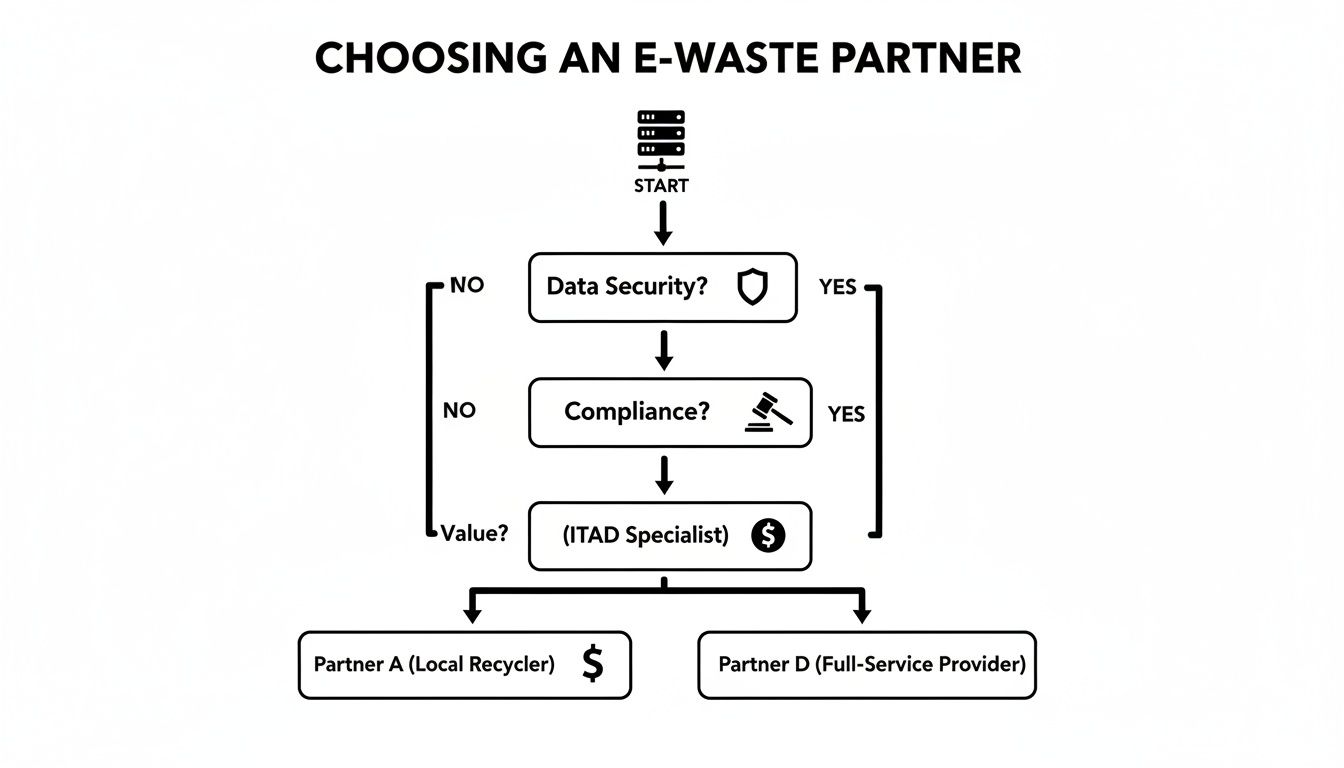
Once you've nailed down a partner with ironclad security, then you can start looking at their certifications and whether you can get any money back for your old gear.
Comparing Data Destruction Methods
Choosing the right method depends on your specific security needs and whether the hardware has any resale value. This table breaks down the key differences to help you decide.
| Method | Description | Security Level | Best For |
|---|---|---|---|
| Software Wiping | Overwrites drive with random data using certified software. | High | Devices with resale value; meeting most compliance needs. |
| Degaussing | Uses a powerful magnet to erase the drive's magnetic field. | Very High | Erasing data quickly on-site; when drives don't need to be reused. |
| Physical Shredding | Grinds the hard drive into small metal pieces. | Absolute | Top-secret data; end-of-life drives; maximum security requirements. |
Each method has its place. Software wiping preserves the asset's value, while degaussing and shredding offer absolute certainty that the data is gone forever.
The Non-Negotiable Certificate of Destruction
No matter which destruction method you go with, the process must end with one critical piece of paper: a Certificate of Destruction (CoD). This is your official, auditable proof that your data was destroyed properly and securely.
A Certificate of Destruction isn’t just a receipt; it’s your legal proof of due diligence. It effectively transfers the liability for that data from your company to the disposal vendor, protecting you from major headaches down the road.
Think about a healthcare provider in Marietta getting rid of old patient computers. A CoD is their definitive proof of HIPAA compliance. For a local financial firm, it's the document that shows they protected sensitive client information. If you want to dive deeper, you can explore the specifics of a certificate of destruction and see why it's so critical.
A proper CoD isn't vague. It should always include these key details:
- A unique serial number for tracking the job.
- The date and location of the destruction.
- A detailed list of the serial numbers of every single asset destroyed.
- The exact destruction method used (e.g., shredding, wiping).
- A statement confirming compliance with relevant regulations.
If an electronic waste company can't provide this level of detailed, serialized reporting, walk away. It’s the only way to truly confirm your data has been handled responsibly.
Decoding Certifications and Environmental Responsibility
Here’s the thing: not all recyclers are created equal. When you hand over your old electronics, you’re not just clearing out storage space—you're trusting that company with your environmental and legal obligations. This is where certifications become your best friend, cutting through the vague promises of "green" recycling you see everywhere.
Think of these certifications as a thorough background check on your vendor. They prove a company follows strict, third-party audited rules for handling hazardous materials, keeping their workers safe, and, crucially, keeping your data secure. For any business in Alpharetta, choosing a certified partner is the difference between doing the right thing and accidentally contributing to a global waste crisis.
Key Certifications to Look For
Two big names dominate the industry, and you should really only consider partners who hold at least one of them.
- R2 (Responsible Recycling): The R2 standard covers the entire journey of an electronic device, from the moment it’s picked up to its final destination. It forces recyclers to track all materials downstream, making sure toxic bits aren't illegally shipped overseas or just dumped in a landfill. An R2-certified recycler is committed to a transparent process you can actually verify.
- e-Stewards: This one is often seen as the gold standard. e-Stewards has a strict zero-tolerance policy for exporting hazardous e-waste to developing nations, period. It also piles on rigorous requirements for data security and worker protection, giving you the highest level of confidence that your assets are being managed ethically.
These certifications are so important because e-waste laws around the world are a patchwork at best. Enforcement can be spotty. By picking a certified partner, you ensure your business is meeting the highest global standards, no matter what the local loopholes might be. If you're looking for partners who meet these standards, our overview of certified Georgia electronics recycling options is a great place to start.
Verifying a Vendor’s Claims
Don't just take a company’s word for it—check for yourself. It’s simple and literally takes a minute. Both R2 and e-Stewards keep updated online directories of every certified recycler. If a potential vendor in the Atlanta area says they're certified, just hop on the official SERI (for R2) or e-Stewards websites to confirm their status.
A transparent chain of custody is your ultimate safeguard. This paper trail tracks your assets from the moment they leave your office to their final destination. It’s your proof that you did your due diligence and it protects you from potential fines down the road.
Proper disposal is just one piece of the puzzle. Beyond finding certified recyclers, businesses can also look into practical strategies to reduce e-waste and extend device life, making an even bigger impact.
The scale of the e-waste problem really drives home why these standards matter. Projections show that if we can boost global collection and recycling rates to 60% by 2030, the benefits to society—from recovered materials to less pollution—could outweigh the costs by more than US$38 billion. When you choose a certified electronic waste company, you're actively helping make that happen.
When it's time for your old electronics to finally walk out the door, that’s the real moment of truth. This is where a professional e-waste company stops talking about certifications and starts showing you what they’re made of—with the hands-on, heavy-lifting work of getting your assets out safely and efficiently.
A smooth, well-planned pickup means minimal disruption to your business. It’s the difference between chaos and a seamless handoff.
Think about a school in Sandy Springs trying to clear out an entire computer lab over a weekend. They absolutely can't have a messy, disorganized process with students showing up Monday morning. A real ITAD pro handles this by sending a team of insured technicians who arrive with a game plan. They’ll get to work inventorying, tagging, and palletizing every single machine on-site, making sure the count is perfect before anything even gets loaded onto the truck.
From Your Quote to Their Truck
For you, the whole logistics process should feel almost effortless. It usually kicks off with a detailed quote based on what you have and how much there is. Once you give the green light, they’ll schedule a pickup time that works for you—even if that means after 5 PM or on a Saturday.
On pickup day, their crew should show up with everything they need to do the job right.
- The Right Gear: Dollies, pallet jacks, and shrink wrap are non-negotiable for moving heavy or awkward items without damaging them or your property.
- Secure Transport: Look for locked, enclosed box trucks. This protects your equipment from the weather and keeps it secure during transit.
- Professional Movers: The team should be uniformed, insured, and properly trained to handle sensitive IT gear. This isn't a job for generic movers.
This level of professionalism is what separates the experts from the amateurs. You want an organized removal, not a chaotic mess with a couple of guys struggling to wrestle a server rack out the door.
A top-tier electronic waste company doesn't just send a driver. They send a specialized logistics team with a clear plan to respect your time, secure your assets, and leave your space just as they found it.
Key Questions to Ask About Logistics
Before you sign anything, get the details on their pickup service. For example, many companies want a partner that offers to recycle electronics with free pick up, which can be a huge budget-saver, especially when you’re dealing with a large volume of equipment.
Here are a few questions you need to ask to make sure there are no last-minute surprises:
- Can you work around our schedule? Ask if they can handle pickups after hours or on weekends to avoid disrupting our operations.
- What kind of trucks do you use? You need to know if they have the capacity to take everything in one go. Multiple trips can get complicated and costly.
- Do you inventory assets on-site? Will your team tag and serialize our equipment before it gets loaded? This is critical for a clear chain of custody.
- Are you insured? Can you provide a Certificate of Insurance (COI) that covers your team while they're working on our property?
Getting straight answers to these questions is how you vet a company's real-world capabilities. It ensures the final, physical part of the process is just as secure and professional as the data destruction that comes next.
Finding the Hidden Value in Your Retired IT Assets
That storage closet full of old electronics? Most companies see it as a headache—a disposal project that’s going to cost time and money. But what if that retired equipment could actually generate revenue for your business? That's the entire idea behind IT asset value recovery.
With the right partner, your disposal project can turn into a financial win. Instead of just shredding everything for scrap metal, a skilled e-waste company will test, refurbish, and find new homes for any assets that still have life in them. You’d be genuinely surprised at what can be resold. Enterprise-grade servers, networking switches, bulk lots of laptops, and even specialized medical equipment often have a surprisingly strong secondary market.
How Value Recovery Agreements Work
Turning old tech into cash isn't just a vague promise; it's a structured process. The best IT asset disposition companies offer transparent financial models, so you know exactly what to expect. You'll typically run into two main types of arrangements.
An outright purchase is the most straightforward route. The vendor looks at your inventory, assesses its value, and makes a direct offer to buy it all. This gets you cash in hand quickly and transfers all the risk of remarketing over to them. It's fast, simple, and perfect if you need budget certainty.
The other common option is a profit-sharing agreement, which can often lead to a higher return. Here, the e-waste company acts as your partner. They handle all the heavy lifting—testing, data wiping, refurbishing, and selling the assets. Once everything is sold, they deduct their service fees and you get a pre-agreed percentage of the final revenue. It's a true partnership where everyone is motivated to get the best possible price.
The global e-waste stream in 2022 contained metals with a potential value in the tens of billions of dollars, but only a fraction of that was successfully recovered. This massive gap highlights the opportunity for professional ITAD services to capture that lost value for their clients.
Maximizing Your Return on Investment
Let's be realistic—not every piece of old equipment is a hidden gem. But a surprising amount is. The trick is to work with a partner who has deep market knowledge and the right connections to sell your assets effectively.
The potential for recovery is massive. The global e-waste stream in 2022 contained an estimated 31 billion kilograms of metals. While the material value was enormous, only about US$28 billion was actually recouped. That leaves a staggering amount of value on the table. You can explore more insights on the value of metals contained in global electronic waste to see just how big this opportunity is.
To get the best possible return from your retired assets, keep these tips in mind:
- Act Quickly: Tech depreciates fast. That functional equipment sitting in a storage closet for two years is losing value every single day.
- Keep Items Intact: It's tempting to pull RAM or a hard drive from an old server, but complete systems are almost always worth more than a pile of parts.
- Provide Details: The more information you can give your vendor upfront—like make, model, specs, and general condition—the more accurate their initial quote will be.
When you choose a partner that excels at value recovery, you’re no longer just managing a liability. You’re unlocking a hidden asset.
Key Questions for Your Potential E-Waste Partner
When you start vetting an electronic waste company, you’re going to have questions. A lot of them. Getting straight answers is the only way you’ll feel confident you’ve picked the right partner. This isn't just about getting a price—it's about digging into their process, their security protocols, and how they’ll handle your assets from the moment they leave your office.
Think of it like an interview for a critical role on your security and compliance team. You need someone who can give you detailed, transparent answers without missing a beat.
What Types of Electronics Do You Accept?
This sounds like a simple question, but the answer speaks volumes about a company’s capabilities. A true, full-service IT Asset Disposition (ITAD) provider should be able to take pretty much everything your business uses off your hands.
A solid partner should have no problem handling a comprehensive list:
- Standard Office Equipment: Laptops, desktops, monitors, printers, and keyboards.
- Data Center Hardware: Servers, storage arrays, networking switches, and UPS systems.
- Telecommunications Gear: Office phones, PBX systems, and video conferencing units.
- Miscellaneous Items: Cables, docking stations, and all those other peripherals.
Some companies, however, draw the line at things like large appliances or highly specialized medical equipment. You need to confirm they can take your entire inventory. The last thing you want is to hire one vendor for your computers and another for everything else. If they can’t handle it all, a good follow-up question is whether they have trusted local partners they can refer you to.
Your goal should be a single, streamlined solution. Finding a partner who manages your whole asset list simplifies the logistics, cuts down on your administrative headache, and guarantees a consistent chain of custody for every single item.
How Is the Value of My IT Assets Determined?
Understanding the money side of things is a big deal, especially if you have a feeling your old gear still has some life left in it. Any electronic waste company worth its salt will have a clear, transparent process for figuring out what your assets are worth.
The valuation process really boils down to a few key factors:
- Age and Condition: How old is the equipment? Does it still work?
- Specifications: What's the processor speed, how much RAM does it have, and what’s the storage capacity?
- Brand and Model: Some brands and specific models just hold their value better than others.
- Current Market Demand: What’s the going rate for this stuff on the secondary market right now?
A reputable partner will give you a detailed audit report that lists out every asset and its assessed value. This level of transparency isn't optional. It gives you the hard data you need to decide between taking an outright purchase offer or going with a profit-sharing deal. For a deeper look at this, it helps to know what to look for in a computer disposal company to make sure you're getting a fair shake.
Choosing the right partner ultimately comes down to trust, transparency, and capability. Asking these direct questions helps you cut through the marketing noise and find a company that can genuinely protect your interests and actually deliver on what they promise.
Ready to clear out your retired IT assets with a partner you can trust? The team at Montclair Crew Recycling provides secure, compliant, and responsible electronics recycling services for businesses across Metro Atlanta. Contact us today for a straightforward quote. Learn more at https://www.montclaircrew.com.
